
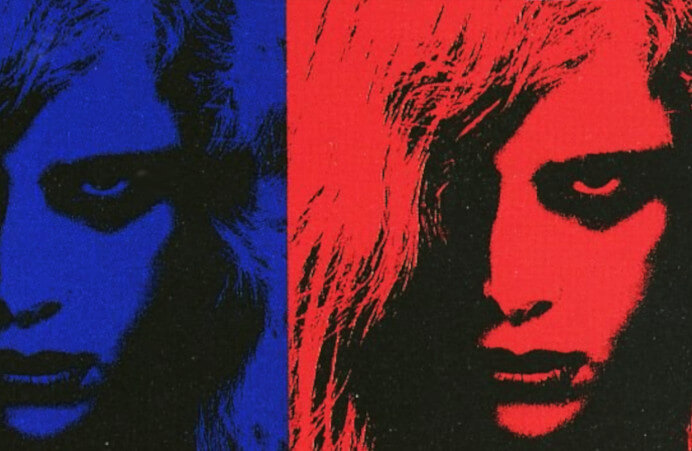
Continuing a series that celebrates the fifty-fifth anniversary of Night of the Living Dead with a look at the classic zombie film and its many follow-ups.
There is a recurring joke online that, according to statistics, the relative popularity of horror monsters corresponds with whichever political party is in the White House: under a Republican administration, zombies are in vogue; but when Democrats take power, zombies retreat and vampires take centre stage.
This amusing phenomenon does not entirely apply to the Living Dead series. After all, both Night of the Living Dead and Dawn of the Dead were released during Democratic presidencies. Yet it is hard to miss that the Reagan/Bush years saw a spurt of Living Dead projects: Day of the Dead, The Return of the Living Dead, Return of the Living Dead Part II, Flesheater, the Night of the Living Dead remake and, if we stretch far enough to include non-US films, Italy’s Zombi 3. The Bill Clinton era, meanwhile, brought with it just two cinematic revisits to Romero’s world. The first was 1993’s forgettable Return of the Living Dead 3. The second was Night of the Living Dead: 30th Anniversary Edition.

Like the 1990 remake, the 30th Anniversary Edition was a transparent effort by people involved with the original film to regain creative control after a copyright oversight had sent their work into the public domain. This time, it was co-writer John Russo who took the lead, writing and directing new scenes that could be slotted into the footage of the 1968 film. The idea must have seemed obvious at the time — after all, the Star Wars films had received their contentious special editions the year before. But Star Wars had access to deleted scenes and an effects budget capable of updating the series’ alien worlds. What could be added to Night of the Living Dead…?
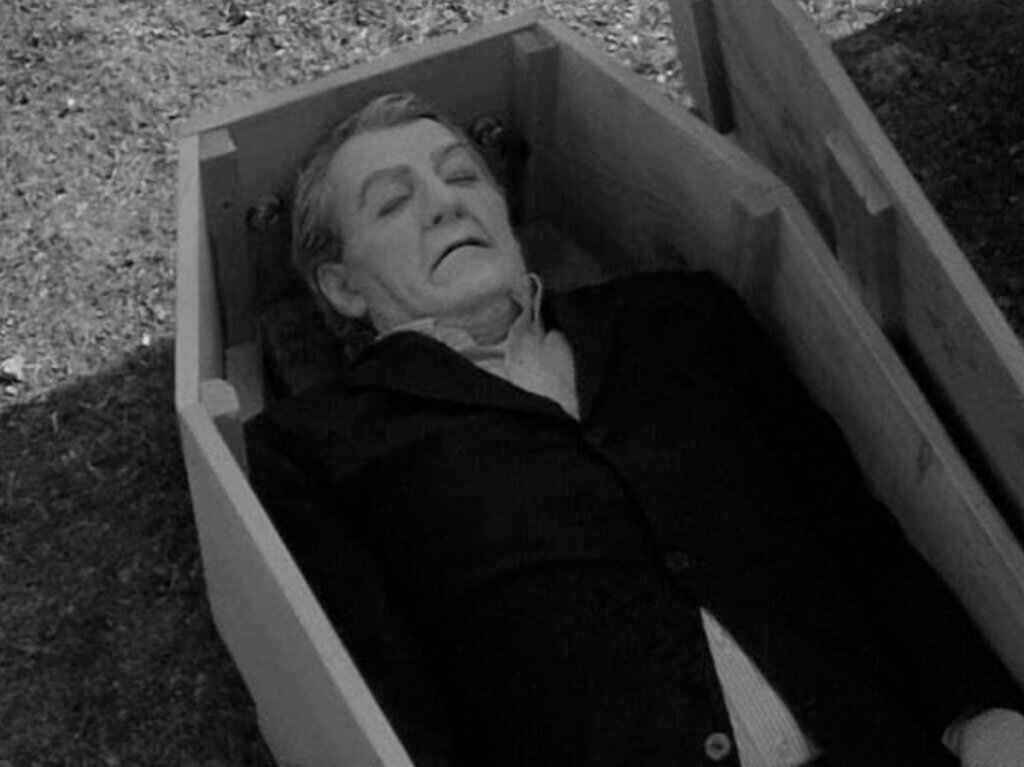
The 30th Anniversary Edition begins with an all-new opening scene. This provides a backstory to the first zombie to appear in the film: that is, Bill Hinzman’s Graveyard Ghoul, a character who had already been given an entire spin-off ten years earlier in the dire Flesheater. As two workmen transport the corpse to the graveyard, we learn that Hinzman’s character was, in life, a convict sent to the electric chair for raping and murdering a little girl. This detail was perhaps influenced by the success that A Nightmare on Elm Street had in making a beloved family icon out of undead child-killer Freddy Krueger.
The makeshift funeral is overseen by Reverend Hicks, a hellfire-and-brimstone preacher bearing a bizarre resemblance to Church of Satan founder Anton LaVey. The proceedings are inevitably disrupted when the corpse gets up and starts biting people. We then cut to Barbara and Johnny arriving at the cemetery, and the film proceeds along familiar lines.
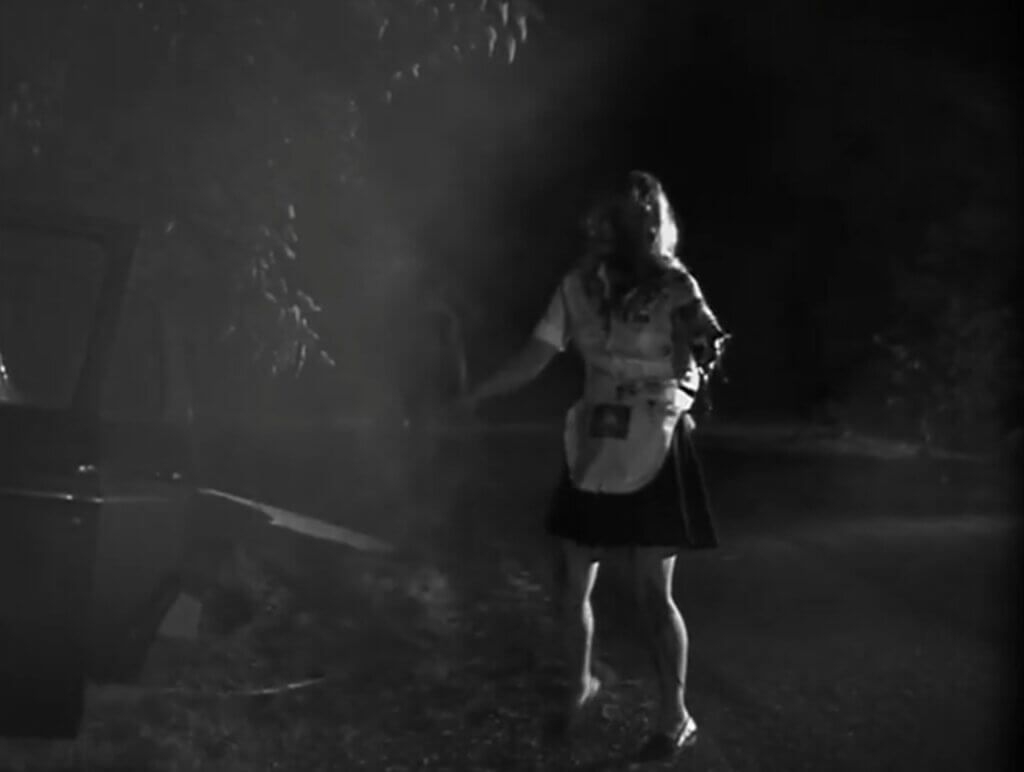
After this, most of the new footage consists of additional exterior shots showing zombies gathering outside the farmhouse. These extra ghouls are gruesome enough for viewers weaned on eighties splatter, the most prominent being a rotting, one-armed waitress. But aside from a single sequence in which the zombies drag a corpse out of a crashed car and eat it, they do nothing beyond slowly shamble around, and it seems doubtful that anyone watched the original Night of the Living Dead and went away with the impression it was in need of more footage of shambling zombies.
As well as adding new scenes, the re-release shortens certain existing sequences. Much of the lost material is dialogue-based, apparently removed on the assumption that audiences of 1998 had less patience with watching Mr. and Mrs. Cooper squabble in the basement, but one change is significant. This concerns the characterisation of Barbara.
Multiple instances showing Barbara’s trauma are either cut down or removed. Her panic when describing her brother’s death to John is shortened. Her startled reaction to Mrs. Cooper lighting a cigarette is gone altogether, as is the shot where she makes her way sleepwalker-fashion to the basement on Ben’s advice.
The impression is that these changes, like the wholesale reinvention of Barbara as a gun-toting Ripley-alike in the 1990 remake, exist to make the film’s female lead less passive. If so, they backfire entirely. The Barbara of 1968 had good reason to be inactive, and Judith O’Dea’s portrayal successfully conveyed her trauma. By diluting her chief character trait, the extended version merely lets her fade into the background.
The film also has a new musical score, courtesy of composer Scott Vladimir Licina (who cameos as Reverend Hicks). This addition is easier to justify than the others: after all, the original film’s low budget meant that Romero had to make do with pre-existing stock music. At the same time, comparing the two makes it clear the library music did a perfectly good job. Russo and Licina appear to have agreed, as the extended version reverts to the old score around its climax.
Finally, the film arrives at a new ending, which has the tragic fate of Ben sandwiched in its middle. We see a showdown between the Graveyard Ghoul and Reverend Hicks, the latter surviving despite having a bite taken out of his cheek. In the coda, Hicks cuddles up to a cute dog named Mushu (presumably after the dragon from Disney’s Mulan, which came out the same year) and announces a new era when the dead will need to be staked so as not to rise again – an idea that also turned up in John Russo’s Return of the Living Dead novel.

This sequence appears to have been the set-up for a sequel, and there were indeed plans for a follow-up to the extended Night of the Living Dead; plans which would quickly rot away into the 2001 film Children of the Living Dead.
So concludes this attempt to improve upon a classic It would be hard to argue that Night of the Living Dead benefitted from the embellishments, but at the same time, there seems little point in objecting to the existence of the 30th Anniversary Edition. After all, unlike the Star Wars Special Editions, it did not replace the original on home media, and has since plummetted into obscurity. Moreover, when re-watched it comes across as pitiful rather than contemptible: who could fault Russo and company for trying to eke a little more cash out of a film that should have been a decades-long moneyspinner for them?
But alas, flops that a viewer might feel sorry for tend to be forgotten faster than flops that inspire contempt, and Night of the Living Dead: 30th Anniversary Edition serves merely as further evidence that, as the nineties rolled on, Living Dead movies were indeed dead.
Blame Clinton.
Next: Dead on the Web…

