
Continuing a series that celebrates the fifty-fifth anniversary of Night of the Living Dead with a look at the classic zombie film and its many follow-ups.
While George Romero was building his trilogy, his former collaborator John Russo was following a tangled route towards the production of his alternative sequel, the details of which are covered in the book The Complete History of The Return of the Living Dead by Christian Sellers and Gary Smart.
Russo’s 1978 novel Return of the Living Dead, based on the script that he had written with Rudy Ricci and Russell Steiner, caught the eye of film producer Tom Fox, who bought the rights to Russo’s project. However, while distributor Orion Pictures saw potential in a Night of the Living Dead sequel of its own, it rejected the script. The film went ahead under the same title (albeit with the addition of the definite article) and a completely new plot. It was also to have a new tone, as the powers that be had seen the humorous element in Dawn of the Dead and decided that comedy-horror was the way forward.
A lingering question was the matter of who should direct the film. Russo himself was initially lined up for this role, but he decided to pick a more marketable name in the form of Texas Chain Saw Massacre director Tobe Hooper. After briefly considering the option of shooting The Return of the Living Dead in 3D, Hooper left the project and Alien co-writer Dan O’Bannon stepped in to write and direct. Russo would still get a story credit in the finished film, along with Ricci and Steiner; he would also write the tie-in novelisation, putting him in the unusual position of having penned two different novels with the same title.
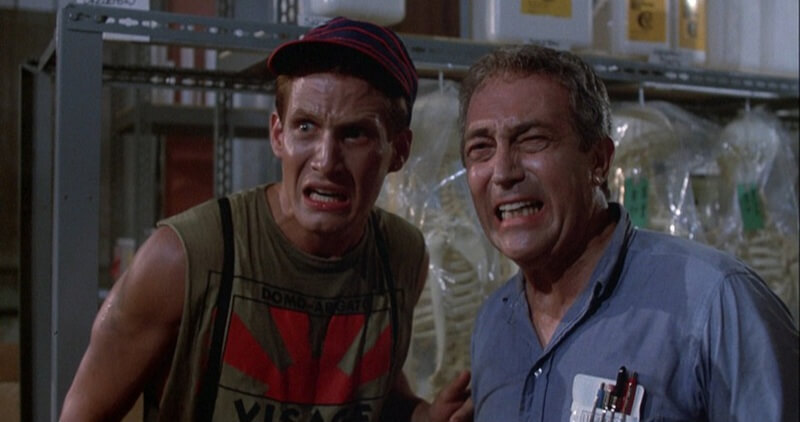
The Return of the Living Dead opens with gormless youngster Freddy starting his job at the Uneeda Medical Supply warehouse and being shown the ropes by foreman Frank. During the conversation, Frank brings up Night of the Living Dead and reveals that the film was based on a true story: a chemical spill in Pittsburgh back in the sixties really did result in corpses rising from the dead, but it was all contained and hushed up by the establishment. Furthermore, due to a military screw-up, the remaining supply of the chemical is housed at Uneeda.
It is not securely housed, however, and the chemical soon gets loose in the form of a toxic, corpse-animating gas. Given that the medical supplies in the warehouse include cadavers, things go from bad to worse.
Like its contemporary Day of the Dead, The Return of the Living Dead understands that, by 1985, zombies had become a bit silly. And again like Romero’s film, it responds to the situation by experimenting with them. This time, however, these experiments embrace the comedic aspect of zombies. The first revenant encountered by Franks and Freddy is a proto-Damien Hirst preserved dog-half that barks and whimpers; elsewhere, mounted butterflies can be seen lethargically flapping their limbs. Eventually, a human cadaver goes on a slapstick rampage.
This is where the Uneeda staff learn the hard way that Night of the Living Dead was not especially accurate. Remembering that the film’s ghouls were killed when their brains were destroyed, they drive a pick-axe into the zombie’s head – only for it to remain alive. Next, they decapitate it, but its headless body gets back up and resumes stumbling around the warehouse.
They eventually resort to dismembering the zombie and taking its body parts to the local crematorium, telling the mortician that the squirming plastic bags contain rabid weasels. This merely makes the situation worse: the crematorium chimney blows the chemical into the atmosphere (acid rain was a hot talking point at the time the film was made, as environmentalist groups clashed with the Reagan administration over the matter). A contaminated shower then hits a nearby cemetery, which happens to be occupied by Freddy’s punk friends, and the town’s dead begin rising from their graves.

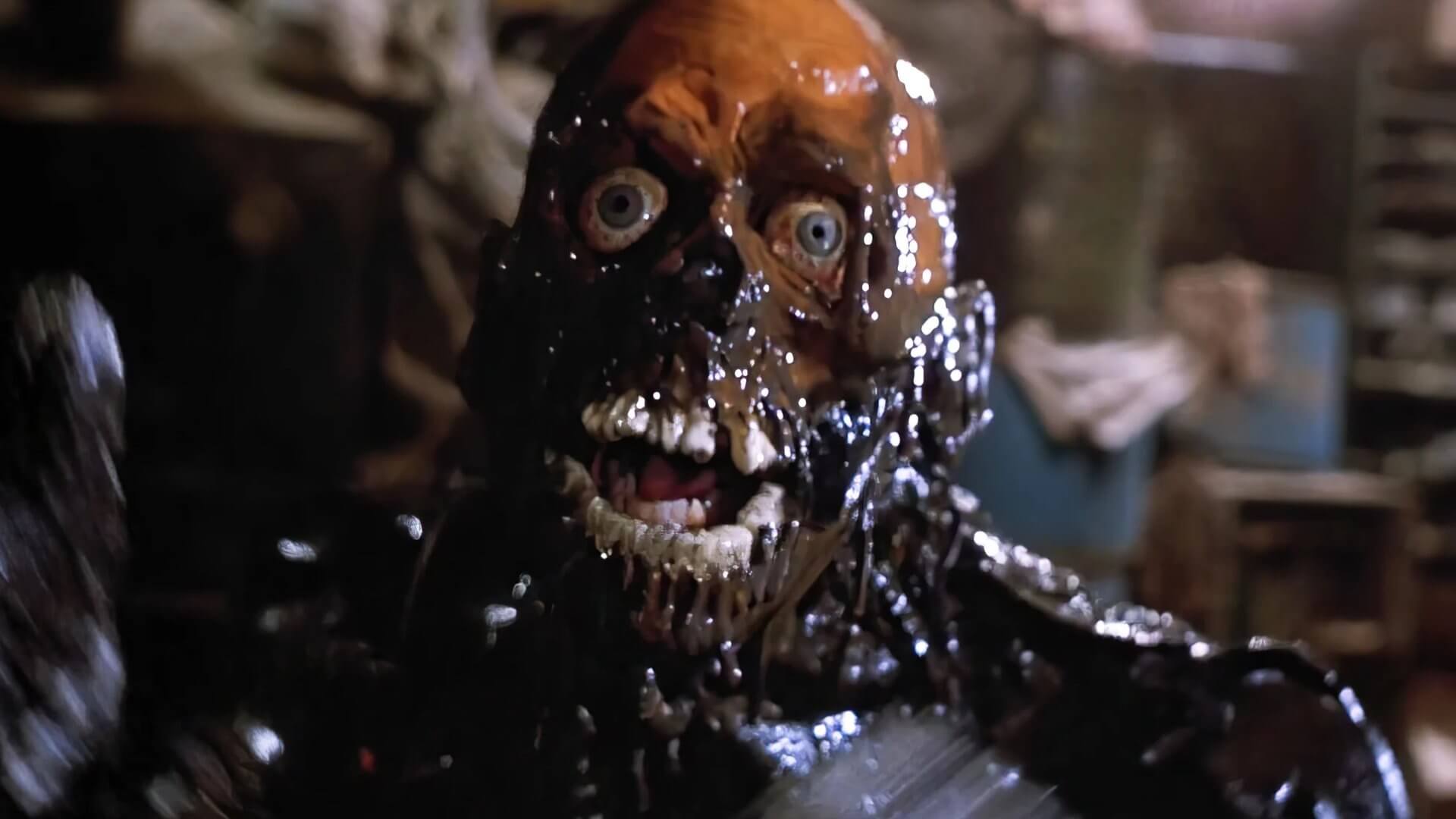
The zombies in The Return of the Living Dead belong to an eighties vogue for cartoonish horror monsters, a trend that also begat Chucky, the Gremlins and the Killer Klowns from Outer Space. Many are created with puppetry rather than make-up and costumes, allowing the film to explore more advanced stages of decomposition than earlier efforts. The influence of EC Comics had hovered around zombie films for decades, but the ghouls in Return are the first to look as though they sprang directly from Graham Ingels’ sketchbook. Indeed, they could even be termed the definitive cartoon zombies, their habit of moaning “brains, brains” (Return’s own addition to zombie lore) being imitated by various animated spoofs.
As befits a comedy, the zombies’ antics are often silly. One scene has a zombified traffic warden sneakily lure back-up cops into a trap, where other ghouls can jump out and kill them (contrary to popular belief, the idea of zombies holding on to base-level cunning and a degree of agility did not start with 28 Days Later). At the same time, the film has a genuine streak of queasy horror. This is evident when the characters tie up and interrogate a rotting female torso that remains capable of articulation: it reveals that the zombies eat brains as a way of easing the pain of their decomposition. Rather than Romero’s mindless killing machines, these are sapient beings in the throes of addiction – a novel twist that adds humour and horror.
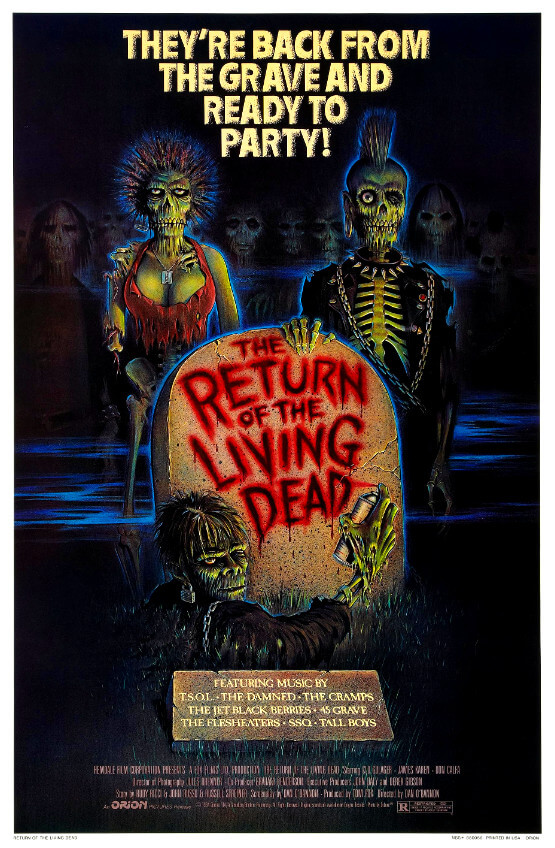
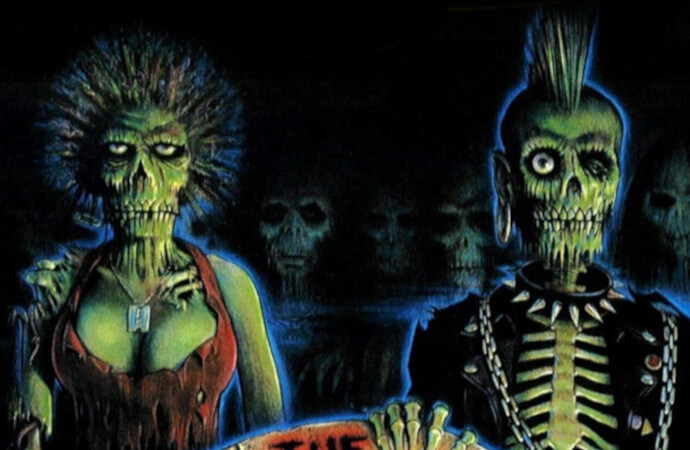
Of course, The Return of the Living Dead was not sold on the basis of talking zombies, puppet zombies or traffic warden zombies. It was sold as a film about punk zombies. Its most iconic poster shows two zombies in an advanced state of decomposition yet remarkably on-point in terms of fashion, the male sporting a mohawk and spiked dog collar while the female wears a safety-pin earring and razorblade necklace.
In the film itself, the hedonistic existence of Freddy’s punk friends is portrayed partly with satire (“He got a job? What a dick!”) and partly with a certain subcultural reverence (“You think this is a fuckin’ costume? This is a way of life!”). The early scene in which Linnea Quigley’s gang matriarch Trash strips naked and poses on a tomb, while her friends circle her with lights like some sort of MTV-era witches’ sabbat, became lodged in the psyche of many a Generation X-er. The soundtrack, meanwhile, boasts the likes of The Flesh Eaters, T.S.O.L., The Cramps, The Damned and SSQ.
Youth culture had been explored and exploited by horror films at least as far back as I Was a Teenage Werewolf in the fifties, but the seventies and eighties saw a deeper blending of the two. The booming slasher genre focused on teenagers by default, while the writing of Anne Rice and Clive Barker was eagerly embraced by the nascent Goth scene. Romero’s films showed no obvious urge to court fashionably rebellious youth audiences in quite the same way: even young lovers Tom and Judy in Night of the Living Dead were remarkably square by the standards of 1968. And so it fell upon Russo and O’Bannon to rectify matters. If Dawn of the Dead introduced splatter, then The Return of the Living Dead added punk.
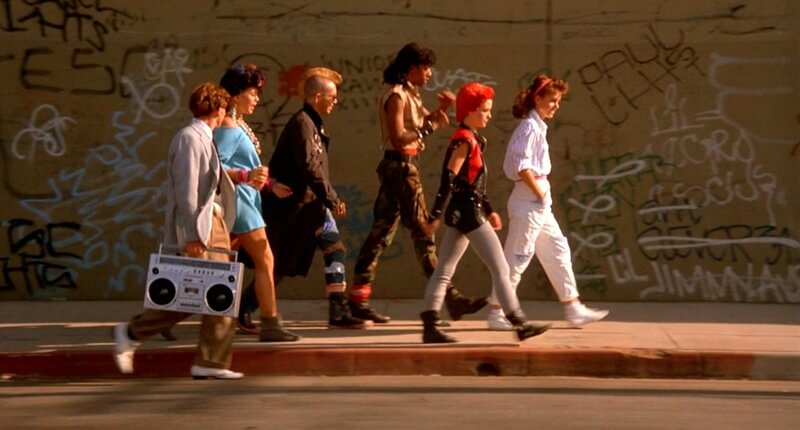
The film’s spiky-haired stylings were sufficient to make it a cult classic, although, looking back, it seems oddly noncommittal.
The songs play only in short snippets, and the spectacle of a nude, blue-skinned, zombified Trash rising from the dead as a seductive she-ghoul – which should really have been an iconic highlight – is similarly truncated. The script follows one of the more tiresome monster-movie conventions by foregrounding its dullest characters, particularly Freddy’s girlfriend Tina (a caricature of stereotyped good-girls, who wears a nice blouse to the cemetery jaunt and says “oh fudge”) and middle-aged warehouse proprietor Burt Wilson. And really, when a punk-oriented film has characters named Scuz, Spider, Trash and Suicide in its cast, then how can it possibly justify focusing on Burt Wilson?
As for the comedy aspect, this is regrettably summed up by the character arcs of Freddy and Frank. They start out as amusing leads, but once they get infected by the zombie chemical, they are reduced to flailing their limbs around and moaning while rigor mortis gradually sets in. Only a short way through the film, the actual gags start to get lost in a mass of physical humour that amounts to people stumbling around yelling. O’Bannon made a misjudgment in shooting the film as a sub-Three Stooges slapstick when it would have been better off shot as a music video.
Trash and company would vomit at being compared to Michael Jackson, but the truth must be stated: Thriller did it better.
Next: A child’s-eye view…
