
Continuing a series that celebrates the fifty-fifth anniversary of Night of the Living Dead with a look at the classic zombie film and its many follow-ups.
The 1978 film Dawn of the Dead is, in certain quarters, regarded as belonging to that hallowed category of sequels better than their originals. There is little point in debating such a subjective assertion, but it can surely be agreed upon that Dawn of the Dead is a masterclass in making a sequel that expands upon the original while becoming unmistakably its own animal.
With minimal set-up, the film begins in a chaotic television studio where a pair of talking-heads and a crowd of staff discuss the apocalyptic situation. Hectic back-and-forth clips establish the scenario: the attempts to contain the zombie epidemic at the first film’s close have evidently failed. The ghouls have spread beyond the easternmost US to threaten the entire country and perhaps even the world, save for small islands that provide viable escape points.
The four protagonists who emerge from this mayhem are SWAT officers Peter Washington and Roger DeMarco; Roger’s friend, TV traffic reporter Stephen “Flyboy” Andrews; and Flyboy’s pregnant girlfriend Fran Parker. Between them, the four are able to steal the TV studio’s traffic helicopter and begin an escape in the vague hope of arriving at a safe island. Along the way, the band comes across a shopping mall, ripe to be plundered – so long as they can get by the zombies that have infested it.

From the start, the four leads are a more competent team than the luckless protagonists in Night of the Living Dead. They are familiar with zombie behaviour, not to mention the workings of firearms, and have picked up enough quasi-military tactics to give themselves a fighting chance. The presence of long-haul helicopter travel and the primary setting of the sprawling shopping centre mean the sequel is a world apart from the trapped-in-a-farmhouse premise of the first film. Even at this early stage, the zombie apocalypse demonstrates that, like the old American West, it is a setting capable of sustaining both close, intimate narratives and grand, sweeping sagas.
While debates can rage into the early hours as to whether Night or Dawn is the better film, a strong case could be made for Night of the Living Dead – with its pervasive tone of claustrophobia – is the better horror film. Dawn of the Dead often feels less like horror and more like a weird mutation of a war film, taking place on a dream-memory of various cinematic battlefields where interchangeable enemy targets fade together into blue-faced zombies.
Another detail that separates Dawn from Night is the sequel’s element of humour. The first film had a strain of sardonic wit – see Ben’s bleakly ironic fate, for one – but nothing quite like the absurdity running through Dawn. When the protagonists make it to the shopping mall and restart the building’s power, we are treated to a montage of gormless zombies staggering around in front of shopfronts to the strains of goofy in-store muzak.

Much has been written about the film’s satirical digs at consumerism: one line of dialogue establishes that the zombies instinctively cluster to places that were important to them during life, hence how the shopping centre became infected. But really, to dwell on this point is to give the humour a little too much credit in terms of subtlety. Dawn of the Dead is, after all, a movie with a sequence in which a gang of bikers shove pies into zombies’ faces.
That said, despite its strain of absurdity, the film lacks the actual jokes (in the set-up-and-punchline sense) expected from an outright parody: nobody can mistake Dawn of the Dead for Shaun of the Dead. Instead, it creates periods of outright silliness that it is able to turn on and off like a tap. The humour is either in a state of full-blast clownishness or completely absent – and the changeovers are timed to match the mental states of the main characters.
Unlike their counterparts in Night of the Living Dead, the protagonists of Dawn have a strong sense of hope, even if this is merely hope they can hold together for a few more days. Where the farmhouse in the first film was a desperate, last-ditch refuge, the mall in the sequel is an opportunity for the heroes both to restock and to enjoy some semblance of their old lives. The characters behave like children in the proverbial sweet shop: Flyboy plays arcade games, Fran does an entire make-up regimen on herself, and one scene has Fran and Flyboy sit down for a dinner-date in a classy restaurant, with Peter serving as waiter. With so many creature comforts at hand, who can worry about a few easily-outmaneuvered zombies?
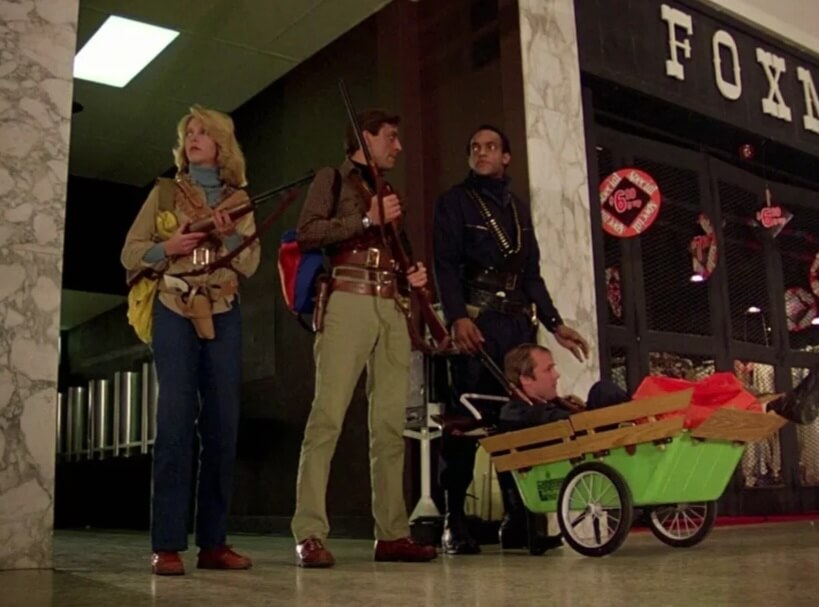
But this childlike, materialistic glee can hardly last. The characters view television broadcasts which, unlike the news clips in the first film, offer not glimmers of hope but increasing despair. According to one man in a TV interview, the zombie problem has become so far out of control that it can be tackled only by nuking major cities; eventually, the broadcasts end altogether.
The protagonists’ streak of good luck in coping with the living dead also starts to thin. They learn the hard way that they cannot always expect to come back from a zombie encounter unscathed – a grave matter when even a single bite can lead to death. During such moments, the tone of apocalyptic silliness vanishes, the zombies becoming a true threat rather than a joke. The lighthearted atmosphere may return, but always with the undercurrent of distraction from the inevitable end: a cold war danse macabre.
And then the biker gang turns up. The survivors have a new threat on their hands, one more formidable than the living dead, as illustrated by the aforementioned pie-in-zombie-face sequence.

The bikers serve a broadly similar role to the trigger-happy posse at the end of the previous film, both groups reminding us that none of our imaginary monsters are quite as scary as humanity itself. This is an inevitable theme for zombie apocalypse stories to run into, for the simple reason that human antagonists are more interesting and flexible than a horde of shambling corpses, but it is notable that the two films work polar opposite finales out of a very similar plot twist.
In contrast to the grim, punch-to-the-gut ending in Night of the Living Dead, the arrival of the bikers allows the protagonists of Dawn of the Dead the chance to become heroes in a clear-cut, good-versus-evil pairing. As noted earlier, Dawn of the Dead is a mutated war film; its climax is a heroic last stand.
This time around, Romero allows at least some of his protagonists to survive, while the bikers are left to their fate at the hands (and teeth) of the zombies. It was not always going to be this way: the original ending was to have the central cast die. Famously, the crew even prepared a prosthetic for an abandoned scene in which Fran committed suicide by shoving her head into the helicopter’s blades, a prosthetic that was instead used for a different character in the opening shoot-out.
Even with the more optimistic ending inserted, however, Dawn of the Dead’s climax is graphic indeed. The scene in which one particularly unfortunate biker is torn apart by zombies, screaming in agony as his insides are yanked outside, was one of the most graphic scenes of bodily violation that horror cinema had depicted thus far.
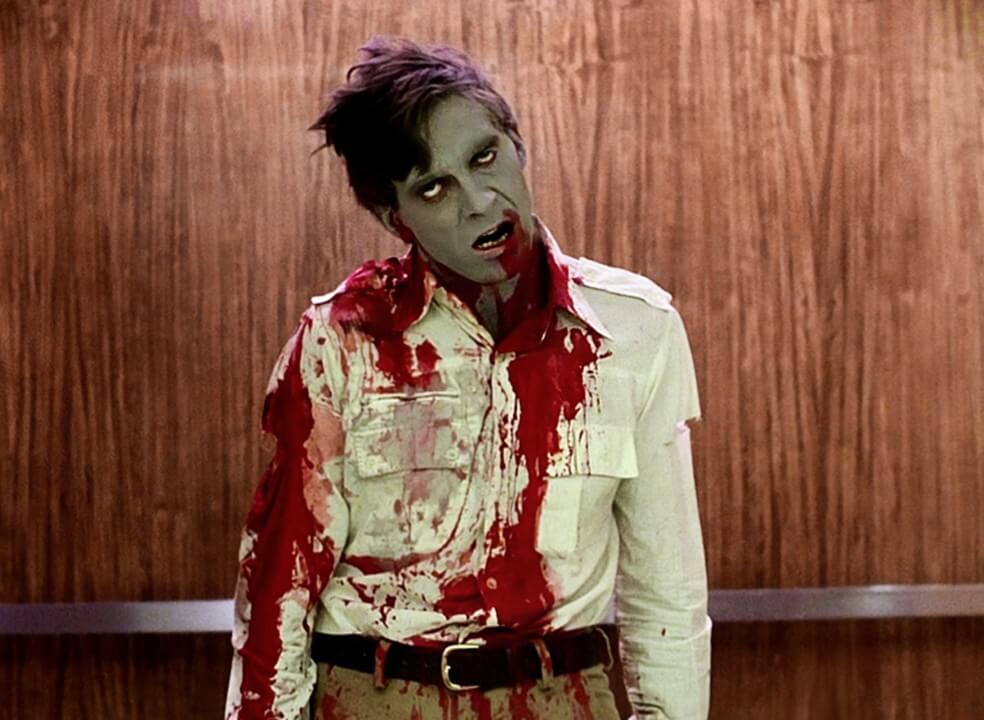
Night of the Living Dead, largely content with stabbings and shootings, had only two scenes approaching this level of gore: the discovery of the half-eaten corpse in the farmhouse, and the shots of ghouls chomping on human remains left from the vehicle explosion. The sequel, meanwhile, boasts the talents of Tom Savini, a make-up artist who also worked on Romero’s previous film, the comparatively sedate modern-day vampire story Martin. This partnership allowed Romero to reach a whole new level of onscreen gore.
Dawn of the Dead arrived on a wave of extreme seventies horror cinema, other examples being The Last House on the Left, The Exorcist and The Texas Chain Saw Massacre. By and large, these films lacked the blood-and-guts content that might be expected (Texas Chain Saw Massacre included only one character being killed with a chainsaw) and instead succeeded with claustrophobic suspense and taboo-breaking subject matter. The sixties films of Hershell Gordon Lewis demonstrated how easy it was for graphic gore to look silly rather than horrific.
But Dawn of the Dead gets the balance right. Its bouts of convincing gore, its descents into grimness and its leaps into giddy absurdity all combine into a single carnivalesque nightmare.
In 1968, George A. Romero and John Russo birthed the zombie apocalypse genre; and In 1978. Romero and Savini codified splatter cinema. Plenty more would come in the following years, and zombies would be leading the charge.
Next: An Italian vacation…
