
Continuing a series that celebrates the fifty-fifth anniversary of Night of the Living Dead with a look at the classic zombie film and its many follow-ups.
Back in the seventies and eighties, if a genre of action or horror film left its mark, then there was one sure testament to its success: a slew of Italian imitations. Night of the Living Dead begat an early example in the 1974 Spanish-Italian co-production Non si deve profanare il sonno dei morti (known in English variously as The Living Dead at Manchester Morgue, Let Sleeping Corpses Lie and Don’t Open the Window). But the spaghetti zombie cycle began in earnest after Dawn of the Dead came out in Italy under the title Zombi.
Of all the Italian cash-ins, surely none showed more outright brazenness than a certain 1979 film that was released under the title Zombi 2. This gave the impression to Italian audiences that it was a sequel to Dawn of the Dead when, in reality, it had no official connection whatsoever to Romero’s series. The film has carried a number of different titles in the English-speaking world, the most succinct being Zombie.
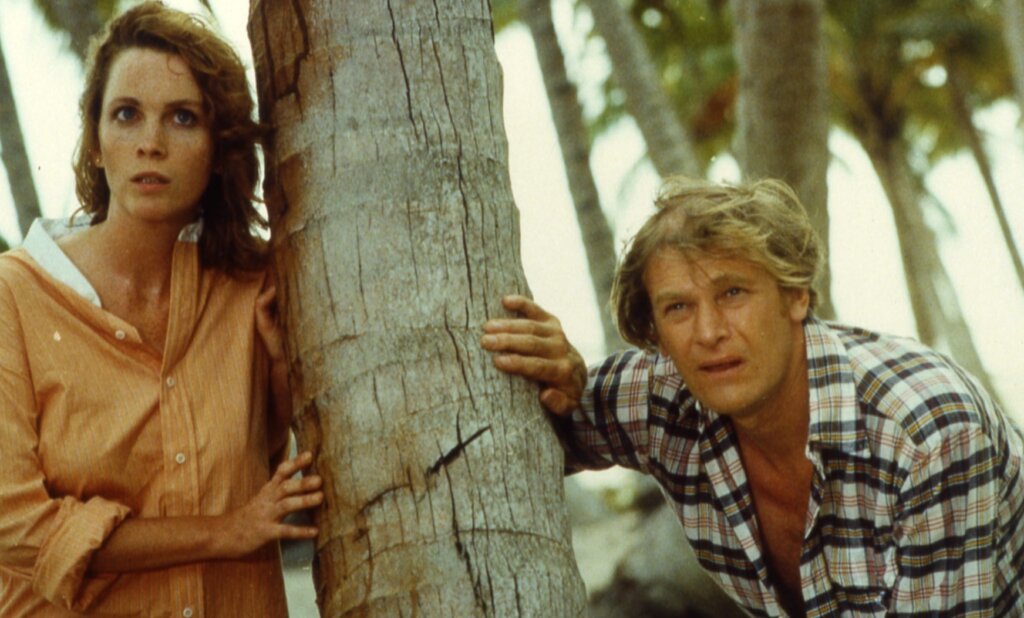
Helmed by Lucio Fulci, a director known at the time for his giallo thrillers and violent westerns, Zombi 2 actually serves as an unofficial prequel rather than a sequel as it begins before the zombie apocalypse seen in Dawn. The film begins with a mystery as a boat drifts into New York Harbor, the only occupant being a zombie (shades of Dracula’s arrival in England). The police go looking for the boat’s owner but find only his daughter Anna, who turns out to be equally in the dark about what happened to her father. She teams up with journalist Peter West (played by British TV star Ian McCulloch, who had tackled an apocalyptic plague of a very different sort in the BBC’s Survivors) and the two head to a Caribbean island in search of answers.
The film’s structure ensures that the zombie action never goes full-throttle until the plot has reached the island. Rather than throwing its characters straight into the zombie-pit, as Romero did in both Night and Dawn, Zombi 2 takes its time introducing us to everyone before placing them in danger. First we meet protagonists Anna and Peter, who then pick up guides Brian and Susan en route to the island; and upon arriving, the four meet up with Dr. Menard and his wife Paola, the last of the key players in the narrative.
The sense of urgency that Romero brought to his films is sorely lacking through this pedestrian stretch of scene-setting. But it has to be said that, when the zombies finally arrive, they do so in style.
Zombi 2 avoids imitating the humorous aspect of Dawn of the Dead – a wise move, as the genre was too young to fall into self-parody just yet. Instead of outright silliness, the film shows the oddball eye for horror characterising much of Fulci’s later work. It treats its genre elements with a gleeful but unselfconscious inventiveness, like a child telling a story around a box of hand-me-down toys.
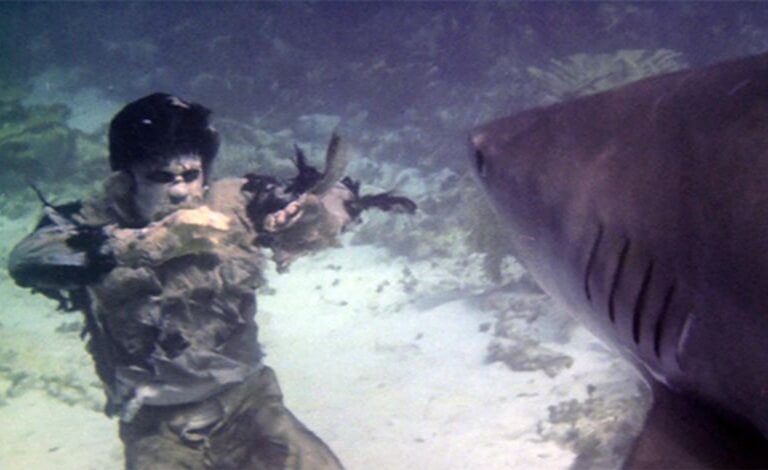
One of the film’s most celebrated sequences has Susan strip to a skimpy thong (the camera leaves no close-up spared) and go for a spot of topless snorkelling. During her dip she finds herself accosted by a shark, reminding us that Jaws was only a few years old and still prominent in the public imagination. She hides behind a rock, only to run afoul of an altogether different predator: a zombie that happens to be lurking underwater. Susan manages to get to safety after slapping the zombie with a clump of seaweed, leaving the two man-eaters to battle among themselves. Few filmmakers would have decided that the nascent zombie apocalypse genre was in need of a zombie/shark fight scene – and yet here we are.
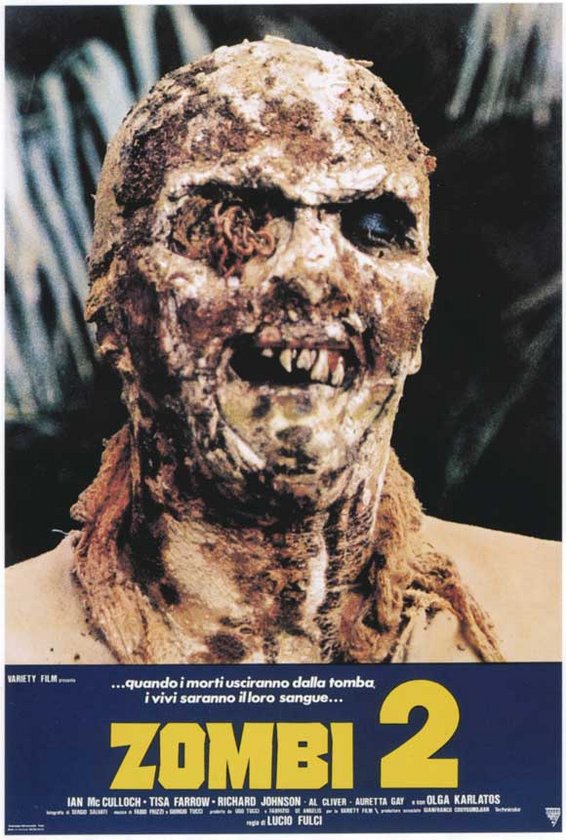
The gore effects, while not quite as polished as Tom Savini’s work in Dawn of the Dead, are executed with a sheer gusto that is hard to fault: few can forget the unflinching sequence in which a character is pulled eye-first into a large wooden splinter. Easier to miss nowadays, when we take such things for granted, is just how much the zombie make-up improves upon the blue-faced corpses in Dawn of the Dead. One particular zombie, who emerges from a 400-year-old conquistador graveyard with a near-skeletal visage and an eye socket full of maggots, received a prominent place in the film’s publicity material, and even today may well be cinema’s single most iconic zombie.
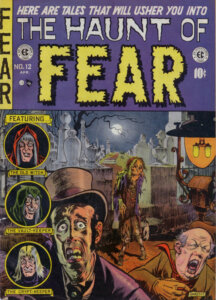
In depicting zombies as masses of half-decomposed flesh rising from their graves, rather than the clean-faced shamblers seen in Night of the Living Dead, Zombi 2 evokes the notorious horror comics published by EC and its rivals in the 1950s. Cover after cover of these publications showed hideous rotting corpses emerging from graveyard soil, illustrating the stories of macabre vengeance that lay within.
A typical example is “Poetic Justice”, a 1952 tale that appeared in EC’s Haunt of Fear #12 and was faithfully adapted for the 1972 film Tales from the Crypt. Here, a man is driven to suicide by a harassment campaign. A year later he returns from the grave as a decaying revenant – motivated by the same vaguely-defined supernatural force that drives the restless spirits in countless ghost stories – and slays the man responsible. Such stories of personal revenge lack the apocalyptic element pioneered by Romero; yet both the comic and film versions of “Poetic Justice” feature a zombie far more hideous than those in either Night or Dawn of the Dead.
As well as harking back to 1950s horror comics, Zombi 2 draws upon an earlier era of zombie cinema with its Caribbean setting and its explicit, if rather loose, references to Voodoo. Dawn of the Dead had touched upon this subject in an often-quoted line of dialogue from its African-American protagonist, Peter:
“Something my granddaddy used to tell us. You know Macumba? Voodoo. Granddad was a priest in Trinidad. Used to tell us, ‘When there’s no more room in hell, the dead will walk the Earth.’”
Zombi 2 gives a very similar line to its one significant Black character, Lucas:
“The father of my father always say, when the earth spit out the dead, they will come back to suck the blood from the living.”
But while Peter’s line in Dawn of the Dead is ultimately an exotic gloss in a film that favours a pseudo-scientific origin for its zombies, Zombi 2 ends up leaning towards the supernatural explanation. Dr. Mernard admits to having tried to diagnose the zombie plague using virology, bacteriology and even radiology, but without success. The only theory left is the “Voodoo superstition” of the islanders, who hold that the land is cursed and an (unseen) witch doctor is raising the dead for some unspecified purpose.
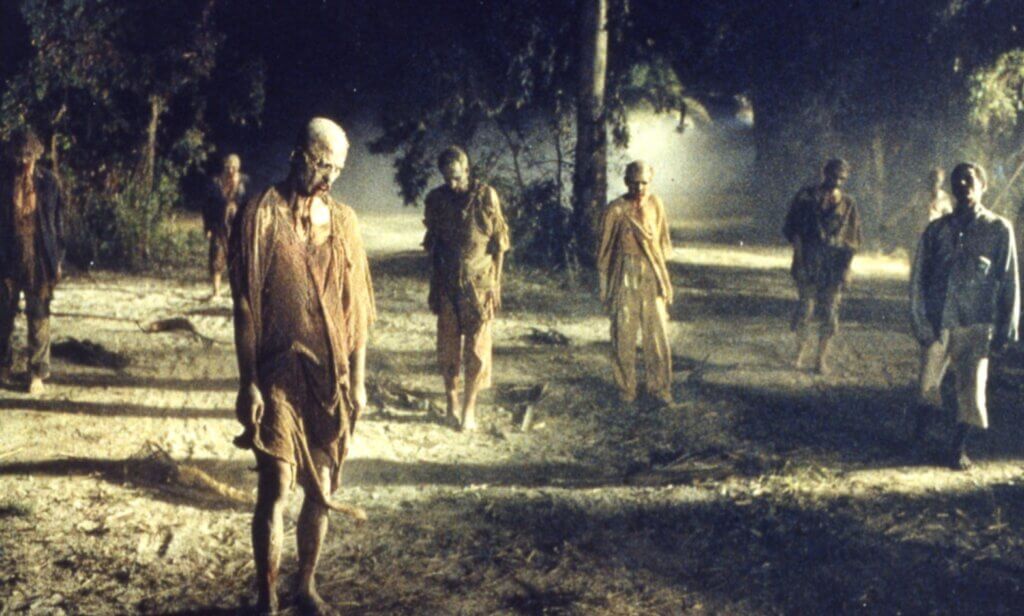
This aspect brings novelty value to Zombi 2, but the execution is unconvincing, largely because of a failure to depict the community that actually holds these beliefs. The film appears to have had trouble obtaining Black actors: aside from Lucas and one or two cadavers, the islanders are represented purely by the sound of drumbeats and wailing that plays when the protagonists are in the local woods. A viewer could be forgiven for failing to realise this is meant as a diegetic part of the Fabio Frizzi score, until the risible moment where the characters shrink away upon hearing “drumbeats… getting closer!”
Fulci and his Zombi 2 screenwriter Dardano Sacchetti would explore the supernatural end of the zombie genre to better effect in the eighties with the Lovecraft-influenced Paura nella città dei morti viventi (City of the Living Dead) and its spiritual successor …E tu vivrai nel terrore! L’aldilà (The Beyond), two films that achieved their own flavour without riding on Romero’s series. Zombi 2, despite some trashy virtues, ends up feeling like an awkward halfway point.
Yet these shortcomings add to the film’s grindhouse mystique. Zombi 2 embodies a vogue for horror films that saw Romero and Savini’s splatter aesthetic in Dawn of the Dead as a challenge – a model not merely to be imitated but to be one-upped. The rotting, shambling zombie served as the ideal representative for this new wave, which continued as the 1970s bled into the 1980s,
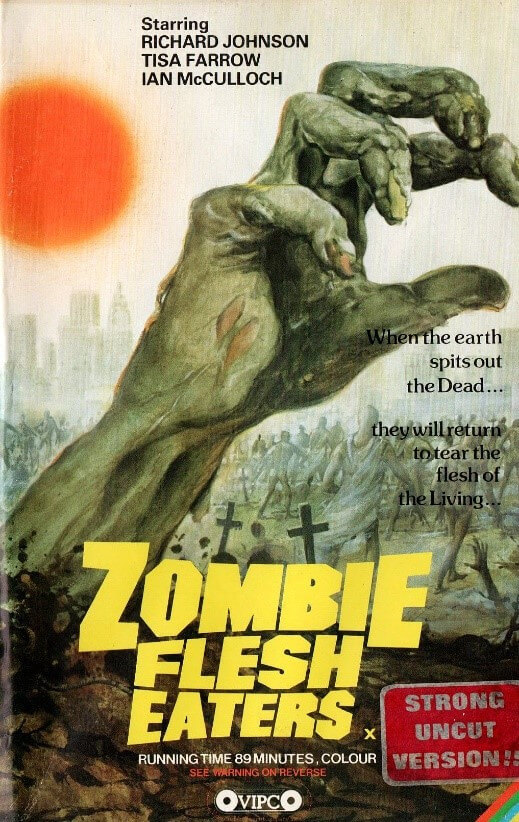
In Britain, where Zombi 2 was released under the title Zombie Flesh-Eaters, the film became one of several dozen VHS releases caught up in the “video nasties” moral panic of the early eighties. Looking over the films that were targeted by the Department of Public Prosecutions during this period, it is remarkable how many involve zombies.
Fulci’s own The Beyond and Quella villa accanto al comitero (The House by the Cemetery) also made the list, as did The Living Dead at Manchester Morgue, Toxic Zombies (known in the UK as Forest of Fear) and Virus (aka Zombie Creeping Flesh), plus the zombie-adjacent Dead & Buried and The Evil Dead. The less severe “Section 3” list, meanwhile, included a few more zombie films, among them both Night of the Living Dead and Dawn of the Dead.
The other traditional monsters who turn up in the video nasty canon (werewolves, yetis and demons) are vastly outnumbered. Indeed, the only monsters that can be said to rival zombies in this ranking of once-controversial films are the altogether human varieties like serial killers, cannibals and Nazis.
The zombie had become the face of splatter cinema – and Zombi 2 gave that face an extra eyeful of maggots
Next: Romero returns…
