
Continuing a series that celebrates the fifty-fifth anniversary of Night of the Living Dead with a look at the classic zombie film and its many follow-ups.
What was the first sequel to Night of the Living Dead?
Most horror fans would reply Dawn of the Dead. Yet there is another contender for this honour: Return of the Living Dead. No, not the film The Return of the Living Dead that came out in 1985; rather, a little-known novel with an almost identical title.
In 1978, the same year that Dawn of the Dead saw its premier in Italy (it would not reach American cinemas until 1979), publisher Dale Books put out a novel entitled Return of the Living Dead. This was penned by Night of the Living Dead co-writer John Russo, who adapted it from an ultimately-unfilmed sequel screenplay that he had written in collaboration with Rudy Ricci and Russell Steiner (both of whom had roles in Night, playing Johnny and a zombie respectively)
“I think I wrote the novel in a couple of months and it was based on the screenplay, which came first,” Russo would explain years later in an interview for the 2017 book The Complete History of The Return of the Living Dead. “I don’t think that Dawn of the Dead existed at the time the novel was published, so it could not have had any negative impact.” In the same book, Russo outlines how his collaboration with George A. Romero came to an end with both men writing different sequel scripts:
George Romero and I have never fought over much of anything and rumours or gossip to this effect are false. When I left the Latent Image [production company], it was an amicable arrangement; George wanted me to stay, but I decided I had better strike out on my own. Not too long after that, we mutually decided that since we had shared the screenwriting credit for Night of the Living Dead, we should come up with an agreement that enabled each of us to pursue our separate projects. We read each other’s scripts and I gave him the right to pursue financing for Dawn of the Dead and to call it a sequel and he gave me the right to pursue Return of the Living Dead without calling it a sequel.
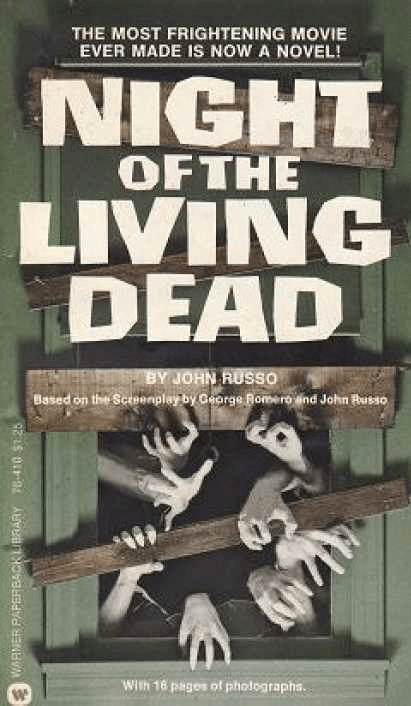
Russo began developing his own corner of the Living Dead saga with his tie-in novelisation of Night of the Living Dead, published in 1974. The original edition of this volume listed Romero as co-writer, presumably because of his hand in the source screenplay. But Russo became the sole credited author in subsequent reissues – including Undead, a 2011 omnibus of both Night of the Living Dead and Return of the Living Dead.
The novelisation follows the film’s plot faithfully, adding only a few new details. Ben is revealed to be a widower hoping to get back to his children. The dead woman found in the farmhouse has a name, Mrs. Miller, and a (similarly deceased) grandson called Jimmy. In a reminder of the film’s origins as an alien invasion story, the novel’s media commentators theorise that the zombie outbreak may have been caused not by radiation from a crashed Venus probe but by an extra-terrestrial organism.
Most of all, the book pushes the gore to a level that Romero’s limited make-up and effects budget could not allow. The zombies are described as having faces with rotting, oozing flesh; one particularly gruesome specimen has an eye dangling from its socket and arm-bones visible through its skin, “like a jacket with the elbows worn through.” The violence the characters inflict on the zombies is likewise amped up: one zombie is left walking despite having had half its torso blown away.
Romero and Russo appear to have originally visualised the film’s zombies as something along these lines, as evidenced by the awkward moments where characters speak of being attacked by “creatures” or “things” despite their assailants looking like no more than unusually aggressive sleepwalkers. Yet it took Russo’s novel to make the zombies convincingly inhuman. When a newsreader expresses surprise “that the alien beings are human in many physical and behavioral aspects”, the reader can readily accept his state of mind.
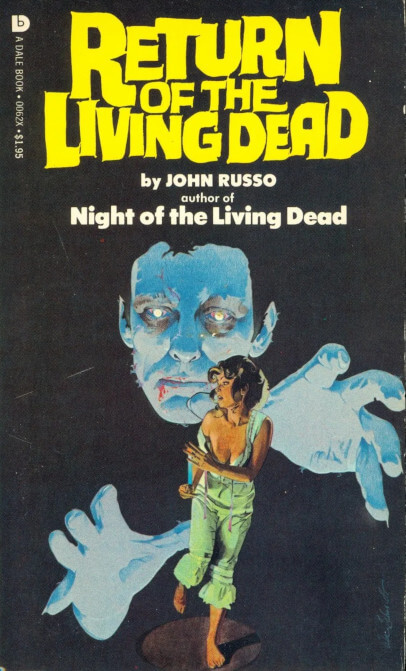
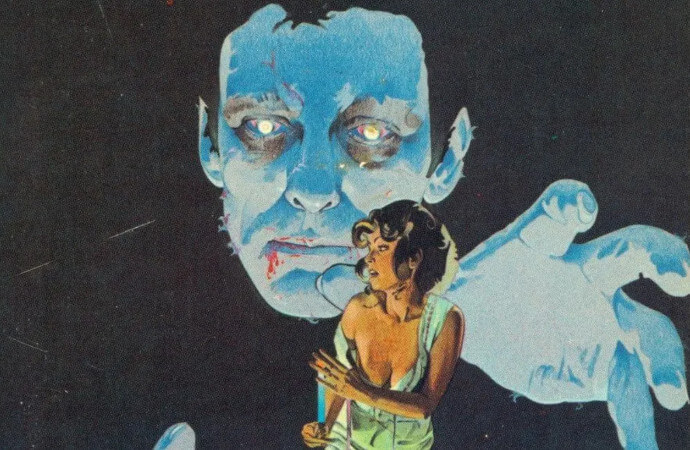
Russo gave his rotting prose zombies another runaround come Return of the Living Dead. This sequel begins ten years after the end of the original, establishing that even though the zombie plague has subsided, the fear of the living dead remains. The opening chapter depicts a child’s funeral where the congregation recites a somewhat unorthodox prayer (“May the body turn to dust as the lord has spoken. May the body never rise again.”) before the father of the deceased hammers a spike into his late daughter’s head.
Writing gruesome descriptions of zombies and zombie-hunting is the easy part of the job, of course. Any attempt to follow up Night of the Living Dead faces the more intimidating prospect of recapturing that film’s cultural claustrophobia: the seemingly effortless way in which it used its holed-up characters to create a microcosm of a society in turmoil. Romero, in his sequels, would do so by removing ambiguity and tackling themes such as prejudice and militarism head-on. Russo, as we shall see, had different priorities.
The central characters in the narrative are the Miller family (whether they are related to Jimmy Miller and his partially-eaten grandmother is never divulged). Bert Miller is the resident patriarch, with his three daughters Ann, Sue Ellen, and Karen in tow. Karen’s illegitimate pregnancy is a source of shame in the local community, so much so that her swollen belly prompts more disconcertion at the opening funeral than the corpse-spiking. But when the dead inevitably start rising once again, the Millers find they have rather bigger problems to deal with than disapproving neighbours.
With this sequel, Russo is not afraid to go over some of the same ground as his first novel. Indeed, certain portions of Return of the Living Dead are directly copied from the Night of the Living Dead novelisation, namely the philosophically-waxing prologue (“Think of all the people who have lived and died and will never again see the trees or the grass or the sun”) and the chapter in which lawmen go about disposing of corpses. In fairness, however, Russo cannot be accused of telling the same story twice: Return elaborates upon the widespread chaos that was only hinted at by Night.
The only character carried over from Night of the Living Dead is Sheriff McClellan, whose posse was responsible for killing Ben (Russo’s novelisation had him specifically chide the gunman for his brashness, making him a more sympathetic figure than in the film). Through McClellan, Return of the Living Dead examines the breakdown in law and order accompaning the zombie plague.
The first novel informed us that communities were threatened “not only by marauding ghouls but also looters and rapists taking advantage of the chaos,” and this is a detail that recurs throughout the sequel. A TV announcer warns that “looters and rapists are wandering the countryside;” McClellan argues that, even if the ghouls are under control, “we have the looters and rapists to contend with;” another character expresses concern that a survivor visiting his property might be “one of the looters or rapists that have been loose around here.”
As the Miller family and the sheriff follow their respective plot threads, the reader is introduced to a number of characters representing the surrounding societal collapse. One memorable antagonist is Flack, a rapist with the Joker-like tic of breaking into uncontrollable laughter at inappropriate moments. Elsewhere we encounter a band of bow-and-arrow-wielding teenage survivors, hinting at a Lord of the Flies-esque situation going on in the background. Where most of Night was confined to a single farmhouse, Return includes more varied settings, including a vast mansion where the wealthy occupants are tied up as hostages by a band of looters.
In mapping the world we had only a partial glimpse of in the film, Return of the Living Dead plays with the question of exactly where the zombies came from – and yes, unlike the film, Russo’s books actually have no qualms about using the word “zombie,” although “ghoul” and “humanoid” are more common. A talk show host argues that “the spores or radiation or whatever had caused the terror” cannot have come from Venus, as “scientists believed now that there was no life on Venus.”
Instead, as a radio announcer explains, the zombies are likely animated by “an unknown cancer, perhaps a virus, [that] brings dead cells back to life… Most scientists do claim it is something in the air, a virus born of pollution, an odd mixture of carcinogenic chemicals which attack cells that have recently died.” However, the priest who oversees the opening funeral argues that the zombie outbreak is the Devil’s work, brought about by society’s worship of “witchcraft and astrology and other forms of Satanism.”
As with the film, the origin of the zombies is unimportant. Even so, it is notable that Russo rejects the arbitrary space-probe-radiation plot device and instead chooses two hypothetical possibilities in which humanity’s own folly – whether that folly be pollution or sin – is to blame for the outbreak. This is a rare example of social commentary found in Return of the Living Dead, as the sequel lacks the satirical bite of the original.
Compared to Romero’s Dawn of the Dead, where one of the first characters we encounter is a racist cop, the novel misses almost every opportunity to explore the topic of corrupt authority, with even the intriguing concept of corpse-staking cultists being squandered. When those with power behave badly, they do so as a result of the zombie plague. In one scene, an innocent survivor is shot dead by a trigger-happy gunman, as Ben was; but the novel defangs the moment by revealing the gunman to be mentally handicapped. Another plot thread has the Miller family fall in with people purporting to be a team of state troopers; these turn out to be sexual predators – but they also turn out to be imposters in stolen uniforms, while the actual state troopers they disrobed are portrayed as decent sorts.
For all of its death and violence, Return of the Living Dead has a sense of timidity. Unlike Dawn of the Dead and many zombie films that followed, it never truly embraces the apocalyptic implications of its premise. The novel instead gives the impression that, as nasty as the zombie outbreak may be, and as often as we read the phrase “looters and rapists,” all that we witness is merely a small-scale disaster that will be wrapped up by the doughty Sheriff McClellan and company.
It is no great loss for horror cinema that the story was never filmed. It is best left as a paperback potboiler, where Russo’s rough-and-ready prose at least retains some pulpish vitality:
He heard the rustling sound of their movement and the painful wheezing of their dead lungs. Then they touched the wires and burst into flames, their skin much drier and deader than the ghoul who had burned on the wires earlier, because with a crackle of electricity and a mad dance of sparks these two were consumed in flames. The woman made a frightening fiery image, running with a burning mass of hair until falling and rolling down the grassy hill. Her companion had fallen among the trees and continued to burn there, the flames rising from dead flesh, making a low orange glow, casting flickering shadows among the trees.
And whatever its shortcomings, the novel manages to go out on a high point. Simply rehashing the senseless death of the protagonist in Night of the Living Dead would have been the easy way out. The final scene in Return of the Living Dead – a twist ending involving the future of the Miller family – succeeds in being completely different yet equally bleak.
Next: A new dawn begins…

