
Continuing a series that celebrates the fifty-fifth anniversary of Night of the Living Dead with a look at the classic zombie film and its many follow-ups.
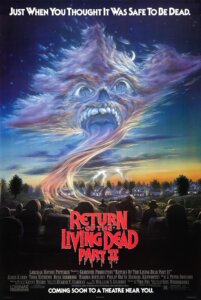
How appropriate that The Return of the Living Dead, itself an alternative to Dawn of the Dead, would beget an alternate Zombi 2 – namely, the awkward quasi-sequel that is Return of the Living Dead Part II, released in 1988.
In an interview with The Flashback Files, writer-directer Ken Wiederhorn explains how he wrote the script as a self-contained story with no connection to any other film. This personal project was an effort on his part to push his industry association away from straight horror (he had previously written and directed a 1977 zombie film called Shock Waves) and towards comedy horror. The producer who picked up the script was none other than Tom Fox, who had previously shepherded Return of the Living Dead from a broad idea by John Russo to the completed Dan O’Bannon gore-spoof, and felt that Wiederhorn’s story could work as the next instalment in the saga.
This was not the first time that Wiederhorn inadvertently wrote a sequel to another film: his comedy script about an alien at a summer camp had managed to end up on screen as Meatballs Part II. Here is his own account of how his zombie-comedy evolved into Return of the Living Dead Part II:
By this time I knew I was never going to be on a Hollywood A-list for anything. This is where it’s at. This is how it’s going to be. I was a horror director. But then I thought if I could do a horror comedy, that would enable me to step sideways. So I had written a horror comedy about a kid who has a run-in with a bunch of zombies.
This was another situation where the producer bought the sequel rights to a title. The producer of RETURN OF THE LIVING DEAD offered me to finance my film if they could call it RETURN OF THE LIVING DEAD II. I thought: Wait a minute, I’m not going to walk into this quicksand again. So, through a friend we had in common, I got in touch with Dan O’Bannon who was the writer-director of the original. I wanted to discuss with him if it was even worth doing. Also, I wanted his approval, because I had an idea of what I wanted to do with it. And Dan said: Go for it! The tone of my sequel is a lot goofier, I think.
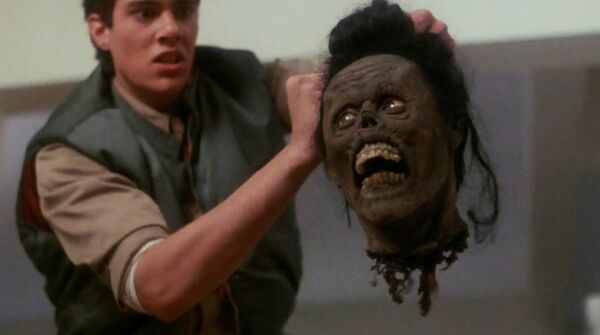
Despite its origins, the film shares much of its predecessor’s gore-cartoon aesthetics. Once again we have EC-style zombies shambling around saying “brains” and getting involved in slapstick antics (the zombies-rising-from-their-graves scene has living dead falling into open pits or being trodden on by other revenants). It also brings back James Karen and Thom Mathews, who played warehouse staff Frank and Freddy in the earlier film. This time they play two grave-robbers named Ed and Joey who are, for all intents and purposes, the same characters; they even undergo the same arc as they become infected and slowly turn into zombies.
But there’s one key aspect of The Return of the Living Dead that is completely absent, belying the sequel’s origins as an unrelated project: the punk element. Teen counterculture is a long way away as the film introduces us to preteen protagonist Jesse, who stumbles across a hidden cache of zombifying chemicals while exploring suburbia’s outskirts with two other boys. Although the cast expands to include characters from a number of age brackets, the cute and clean-cut Jesse remains central, placing the film in that distinct mode of boyish, nostalgic fantasy that was pioneered by Ray Bradbury, expanded upon by Steven Spielberg, and eventually congealed into Stranger Things.
This playing-in-the-graveyard transgression-nostalgia holds the film together through its early stretches, but things start slipping apart after the zombie outbreak gets underway. The tension never manages to build up, and the solid gags are spread thin. As with the original Return, the film has a misguided faith in the inherent comedy of people flailing their arms around wailing, but it lacks the spark of absurdity that made the first film’s rather shrill tone bearable.
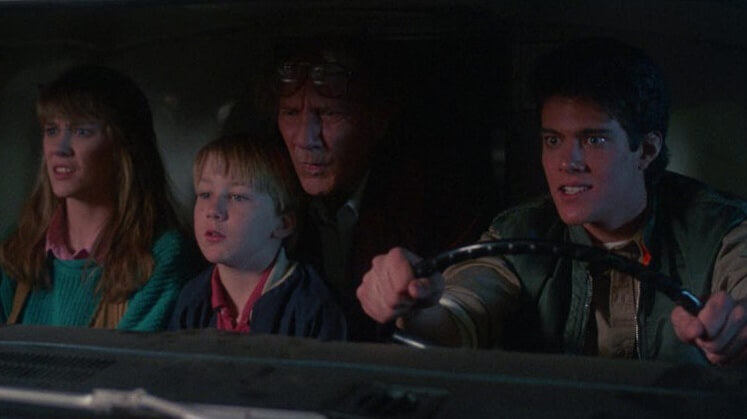
Return of the Living Dead Part II was a commercial failure. In the above-mentioned interview, Ken Wiederhorn blames this on poor marketing:
[The studio] wanted to promote it as a horror film. I thought the film should have been marketed as a comedy, which it was in the first place. But unfortunately they came up with a campaign that split it down the middle. It wasn’t one thing or another. The audience can smell that. It opened in about 1200 theaters and played for a couple of weeks and then sailed off into the sunset, without making much money. And once you make a studio film which doesn’t make money, it is very very tough to get your next film gig.
Yet where Return of the Living Dead Part II is concerned, the question of tone seems less significant than the question of target age demographic. This is patently a children’s film, and its shortcomings become a lot easier to forgive if we picture an audience of kids cheering on Jesse as he gets his own back on his zombified bullies.
The topic of the Living Dead series and its relationship with child audiences is something that was famously brought up by none other than Roger Ebert. In his 1969 review of Night of the Living Dead, Ebert noticed just how young the turnout was: “There were maybe two dozen people in the audience who were over 16 years old. The rest were kids, the kind you expect at a Saturday afternoon kiddy matinee.”
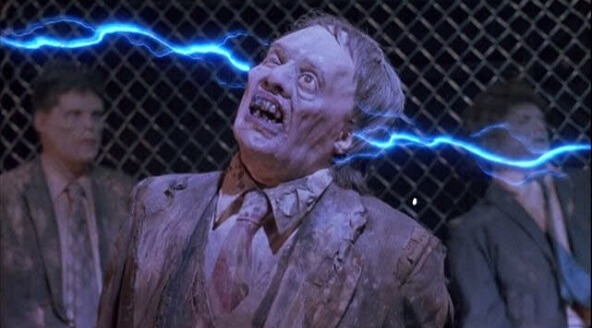
Ebert’s description of the audience ranges from kids climbing over chairs to little brothers being whacked by big sisters for talking. After all, this was a time when horror films were generally tame enough to be packaged as children’s entertainment. “Monster kid” culture flourished in the sixties, with Famous Monsters of Filmland serving as its lifestyle magazine.
At the same time, Ebert’s trip to the pictures made clear just what a sea change was occurring in the horror genre: Romero and company did much to end the earlier, more innocent era of monster movies. The review is less a commentary on the film and more a blow-by-blow description of the young audience’s reaction. Ebert relates how the kids rolled along with the early scares, but grew restless with the characters’ debates over whether to hide upstairs or in the cellar. Then the deaths started piling up and the children grew genuinely disturbed. Finally, everyone died:
There was a little girl across the aisle from me, maybe nine years old, who was sitting very still in her seat and crying.
I don’t think the younger kids really knew what hit them. They were used to going to movies, sure, and they’d seen some horror movies before, sure, but this was something else. This was ghouls eating people up — and you could actually see what they were eating. This was little girls killing their mothers. This was being set on fire. Worst of all, even the hero got killed.
“I felt real terror in that neighborhood theater last Saturday afternoon”, writes Ebert. “I saw kids who had no resources they could draw upon to protect themselves from the dread and fear they felt.” His review concludes with hope that the newly-introduced MPAA rating system would prevent such occurrences in the future.
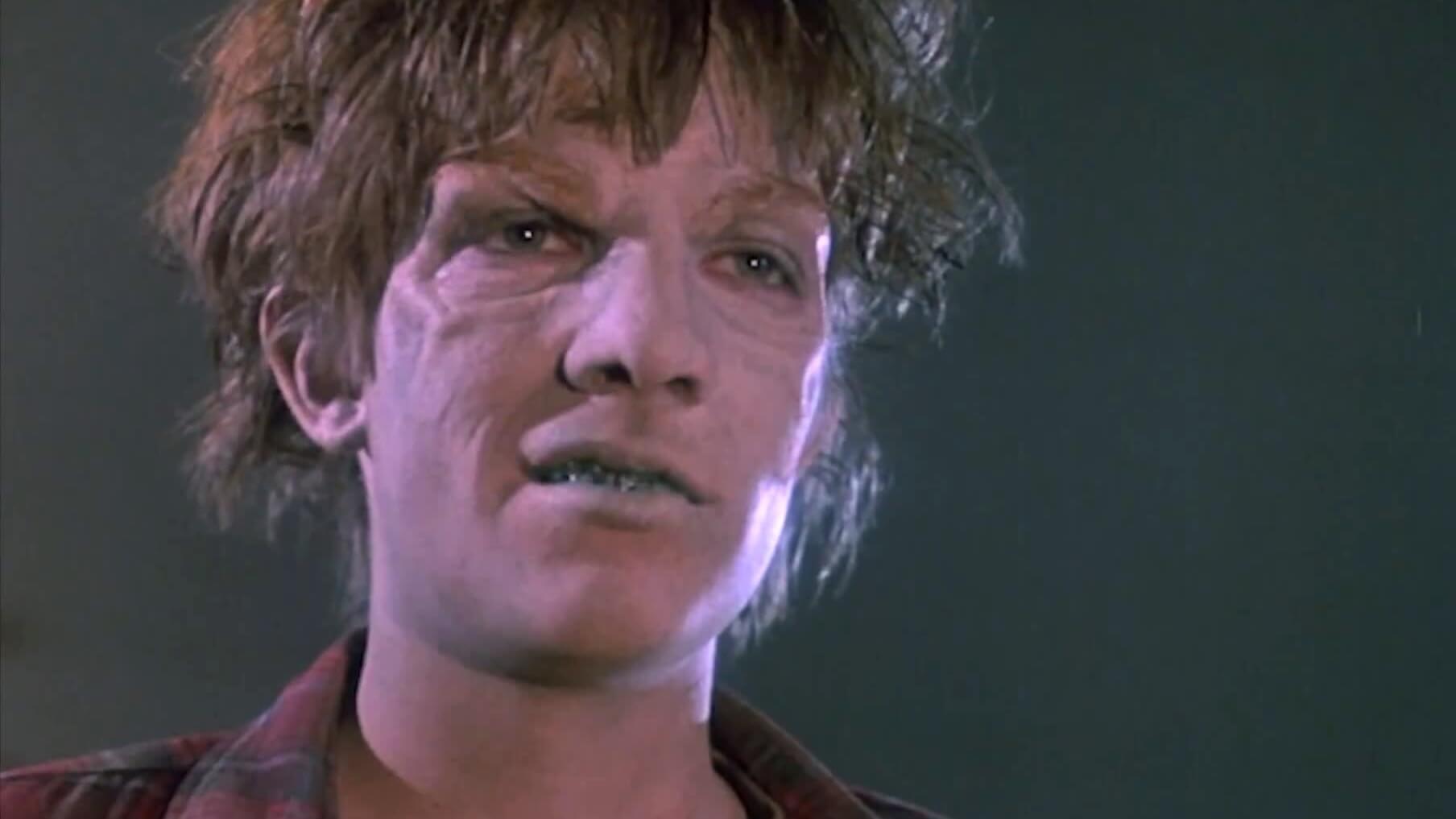
Although this is unlikely to have been intentional on the part of Ken Wiederhorn, Return of the Living Dead Part II looks for all the world like a response to Ebert’s objections. It retains Romero’s gruesome theatrics but places them into a story tailored for children, with bleakness and despair abandoned in favour of a feel-good, kid-beats-the-bullies ending.
Granted, the film’s graphic death scenes and usage of the word “fuck” are not the most obvious traits of a children’s movie. But the era of home video had begun, and horror films were once again embracing an unofficial but enthusiastic audience of children: witness the increasingly juvenile Nightmare on Elm Street sequels.
Not that any of this was enough to save Return of the Living Dead Part II on its theatrical release, of course. Nor does the film appear to have accumulated much in the way of nostalgic appeal. Instead, it stands as a curious incident in which Return of the Living Dead forgot to be punk.
Next: Things get worse…
