
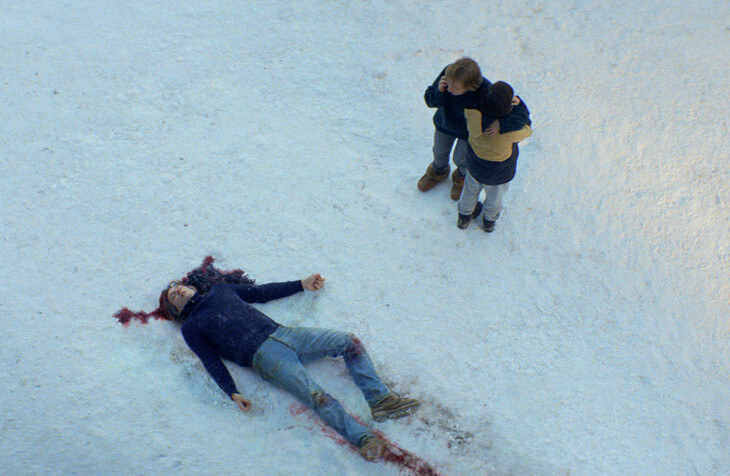
A writer is accused of murdering her husband when his body is found under suspicious circumstances. The trial that unfolds will reveal the messiness of this family. But are they really so much more unusual than any other family?
Anatomy of a Fall
Justine Triet (director and writer), Arthur Harari (writer), Simon Beaufils (cinematography), Laurent Sénéchal (editor)
Sandra Hüller, Samuel Theis, Swann Arlaud, Milo Machado Graner (cast)
September 7, 2023 (TIFF)
I didn’t think I’d be able to catch the 2023 Palme d’Or winner Anatomy of a Fall at TIFF 2023. But the team at Cinetic kindly secured me a ticket.
Before the film began, director Justine Triet spoke to the audience. Without giving anything away, she said Anatomy of a Fall was about, “family, couples, and creation,” and that it was a lot of heavy subject matter for her to tackle in one film. I wasn’t entirely sure why Triet mentioned those three traits of the film until I started watching it. But Anatomy of a Fall slowly unveils how the family dynamic, the couple’s relationship and the urge to create caused the death of a seemingly-loving husband and father.
First, we learn about the family unit at the centre of Anatomy of a Fall—writer Sandra (Sandra Hüller), her husband, the music-loving failed writer Samuel (Samuel Theis) and their son, Daniel (Milo Machado Graner). Daniel was blinded in an accident when he was four and there’s clearly been some resentment between his parents since then. Could that have been the reason for Samuel’s murder/suicide?
Second, how were Sandra and Samuel as a couple? There’s plenty to unpack there. When both people in a relationship have similar talents but only one is successful, there’s likely to be, you guessed it, resentment. And there’s the question of belonging and language—there are so many silent regrets and judgments tied into living away from one’s home and being forced to speak a third language. Sandra is German. Samuel is French. They met in England and speak English because they don’t know each other’s languages. The impact language has on this film was thrilling to watch.
And finally, creation. Those books that Sandra is writing and publishing, what’s the inspiration there? What’s making it possible for her to write? The question of uneven division of household labour has been top of mind during the pandemic—it plays a big part in Anatomy of a Fall.
I was, in a word, floored by Anatomy of a Fall. It’s a slow burn, taking time to lay out all the details of the case, sometimes in excruciating detail. You see Sandra’s lawyer and friend, Vincent (Swann Arlaud), examine the crime scene methodically. No jumps or unnecessary cuts—the audience sees what Vincent sees as and when he encounters it.
Scenes from the trial feel similarly like being there in person and watching the cross-questioning progress in real time. Anatomy of a Fall is unsurprisingly a long film—two hours and forty minutes, and during every second of those, we learn important details about the people on-screen, their relationships with each other and hints to the nature of the crime, or whether it was a crime, in the first place.
Triet directed Anatomy of a Fall, and co-wrote it with her real-life partner, Arthur Harriar, though she was quick to tell the audience the film is not about them. But this joint partnership did allow them to explore the sporting match that Sandra and Samuel’s relationship is revealed to be.
The couple’s relationship was fascinating for me. There are so many layers to them, yet the trial wants to focus on a few narrow aspects—the juicier, easier-to-understand aspects of their personalities. Violence. Infidelity. Resentment. These are so easy to use to pillory a person. I couldn’t help but think of the Heard v Depp case and how quickly society is willing to judge a woman who doesn’t fit the ideals of mother, wife, caretaker. Give her a role outside the domicile and a voice in an unfamiliar language, and she becomes the monster.
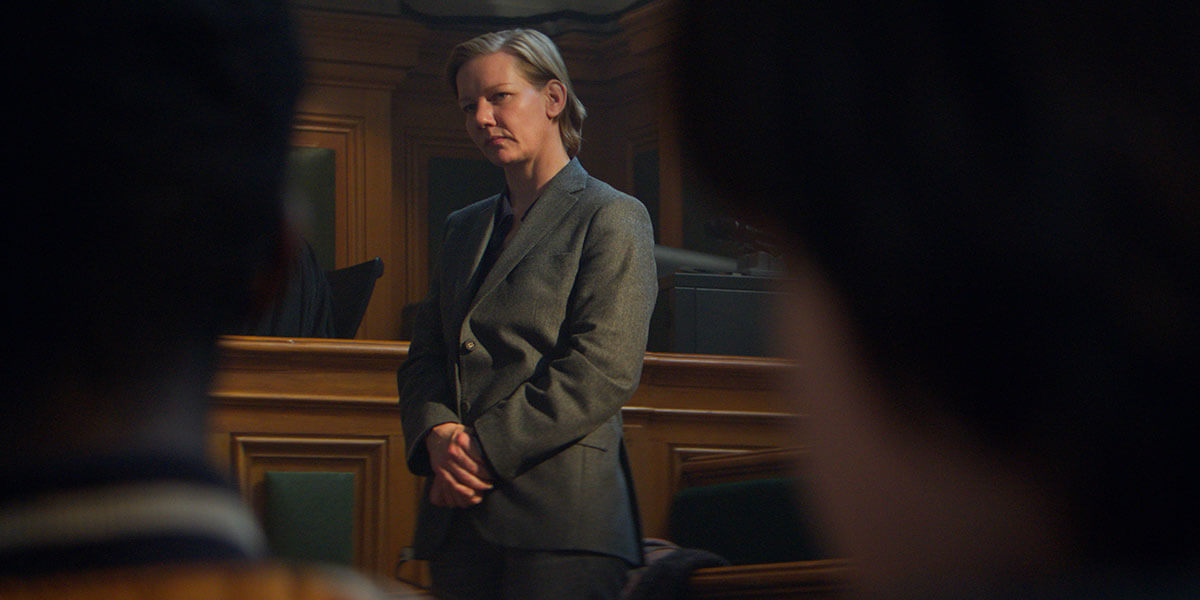
You see all these aspects through Hüller’s powerhouse performance. In a role Triet wrote specifically for her, Hüller carries the film, marvellously capturing the grief of losing her husband, her desperation to preserve her son’s happy memories of his father, and her own complicated relationship with her husband and her career. The rawness of her performance transcends acting. She’s so authentic. Her hesitations when Sandra struggles to articulate in French and asks to switch to English; her annoyance when she’s interrupted; the calm manner with which she states her right to have her career and her crescendo to yelling when Sandra doesn’t feel heard. This is some of the best acting I’ve ever seen. There’s this moment early on when Sandra angrily yells into the fridge of all places that she’s tired of crying—it’s like watching a real neighbour or an acquaintance, not an actor.
This is some of the best acting I’ve ever seen.
Triet spoke about Hüller’s “opacity” and her “ungraspability” but I don’t think that quite describes what we see. Hüller brings a sense of uncertainty to Sandra but she isn’t completely impossible to understand. Sandra appears complex because humans are complex—you can’t truly know anyone completely, not even yourself. That’s what makes relationships so hard, and rewarding, as Anatomy of a Fall posits.
Another powerful performance comes from young Graner, who plays Daniel. Though initially Triet and her team searched for a visually-impaired actor to play the role, it took five months for them to find Graner, who is sighted. I’m not entirely sure what that says about the casting process in France but the world of entertainment has a habit of lauding actors for portraying people with disabilities instead of, you know, casting actual people with disabilities!
Having said that, Graner is remarkable in the role—Daniel’s grief is almost too painful to watch at times and his growth is immense as the trial progresses and he learns there’s more to his parents than he ever realised. The Daniel we meet at the start of Anatomy of a Fall is a far more innocent little boy than the one who’s forced to grow up by the end of the film.
I know there’s some discussion about the ending of Anatomy of a Fall being too ambiguous, but I quite liked the way Triet chose to end it. The central premise is given enough resolution to satisfy the audience while still leaving enough room for suspicion. What more could one want?
Anatomy of a Fall was one of the films I really wanted to catch at TIFF 2023 and I’m delighted I saw it. Such a layered, fascinating, yet engaging film, Anatomy of a Fall has one of the best acting performances I’ve seen on the big screen. Thoroughly deserved the Palme d’Or and the resounding applause at TIFF.
