

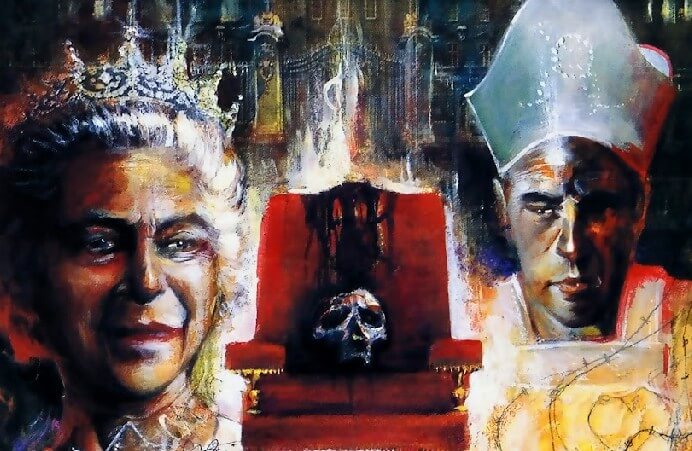
Continuing a series that celebrates the fifty-fifth anniversary of Night of the Living Dead with a look at the classic zombie film and its many follow-ups.
As mentioned earlier in this series, zombie cinema owes something to the world of comics. The imagery of rotting zombies rising from their graves, embraced by the likes of Zombi 2 and Return of the Living Dead, was a central motif in the EC horror comics of the 1950s. Yet it was some time before comics adapted to the shape of the post-Romero zombie genre.
To some extent, this resulted from the strictures of America’s Comics Code Authority. Even the looser 1971 version of the code, which removed an earlier ban on vampires and werewolves, still prohibited “scenes dealing with… walking dead.” The CCA cannot have been solely responsible, however, as demonstrated by the Marvel Monster Group’s non-code Tales of the Zombie. The 1973 debut issue of this magazine included a story bearing the obviously Romero-inspired title “Night of the Walking Dead,” starring a pre-Romero interpretation of a zombie: that is, a lone, supernaturally-created being, rather than an apocalyptic mass created through pseudoscience. The latter variety would turn up occasionally (as in Stuart Kerr and Ralph Griffith’s Deadworld, launched in 1987) but by and large, comic-book zombies were behind the times.
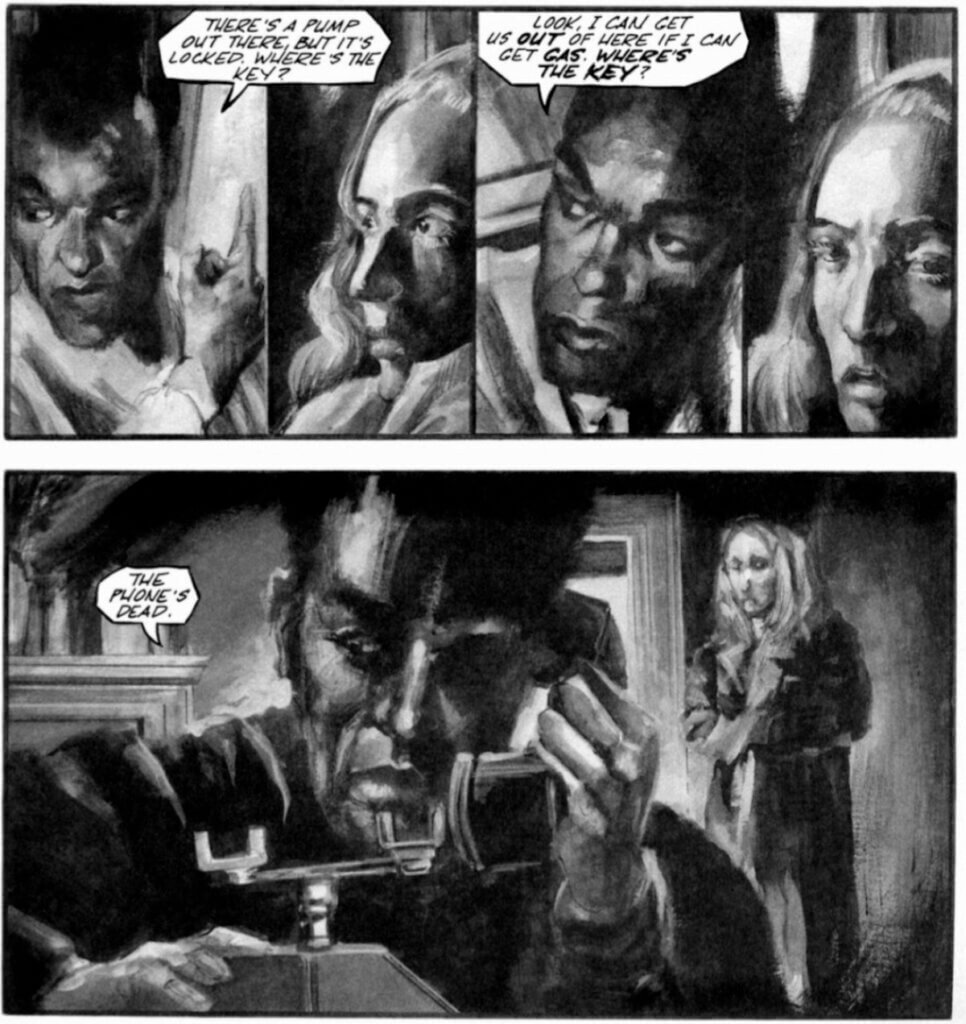
Then, in the 1990s, FantaCo Publications filled a gap in the market by giving Night of the Living Dead an official comic adaptation. This ran for four issues from 1991 to 1992, with Tom Skulan and Eric Stanway scripting, Carlos Kastro providing artwork (assisted by Eric Mehéu), and Romero’s co-writer John Russo credited with “taking care of the detail work.”
Comic adaptations of films rarely achieve prestige, the main exceptions being those with well-known artists taking part (Jack Kirby’s 2001: A Space Odyssey, for example). But FantaCo’s Night of the Living Dead surely deserves recognition as being among the strongest entries in this limited field.
The comic’s visual storytelling faithfully translates the plot and dialogue of the film while also standing as a well-crafted comic narrative in its own right. Kastro’s lush, painterly art shows the influence of Goya’s darker work: when in close-up, the characters are recognisable likenesses of the film’s cast; as they retreat into the background, they fade into swirls of expressionistic despair, scarcely less disturbing that the zombies that attack them. All of this makes for a macabre treat, one that certainly stands up better than the film’s prose novelisation.
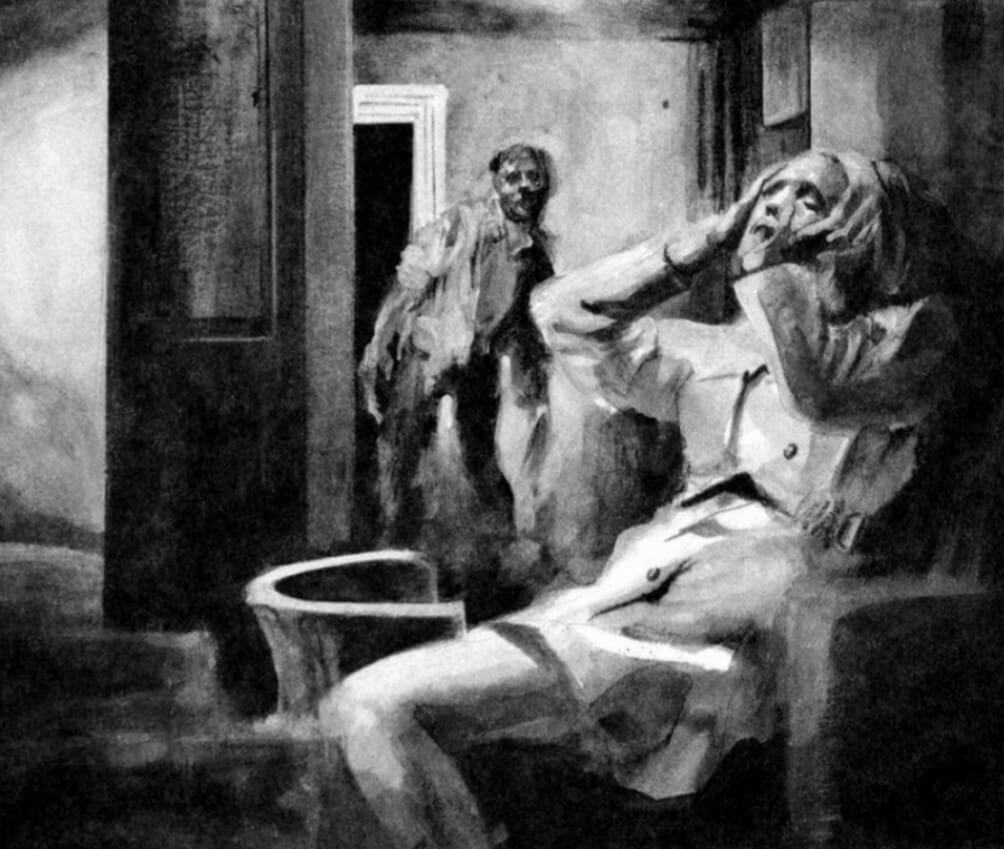
There was more to come from FantaCo. Instead of adapting Romero’s sequels, though, the publisher began creating all-new material. As supplementaries to the four-part adaptation, it put out two unnumbered issues by Skulan and Kastro, labelled “prelude” and “aftermath.” These marked FantaCo’s first forays into expanding Romero and Russo’s story.
The prelude issue squeezes whatever droplets of backstory it can from Night of the Living Dead. We see what Tom and Judy were up to before they arrived at the farmhouse (not much, as it happens). We learn just what Mr. and Mr. Cooper were bickering about when their daughter got bitten. We see NASA scientists self-destructing the Venus probe in a sequence apparently included for the benefit of anyone desperate to know what the probe looked like.
Summing up the issue’s determination to tie up the smallest loose ends, we even get a joint origin story for the Graveyard Ghoul and the decomposing farmhouse corpse (it turns out the former was the farmhouse’s owner, Fred Eastman, and the latter was his wife). The general impression is that the comic would have been better off picking one of these plot threads and fleshing it out to fill the issue, although the artwork is as lush as in the main series.
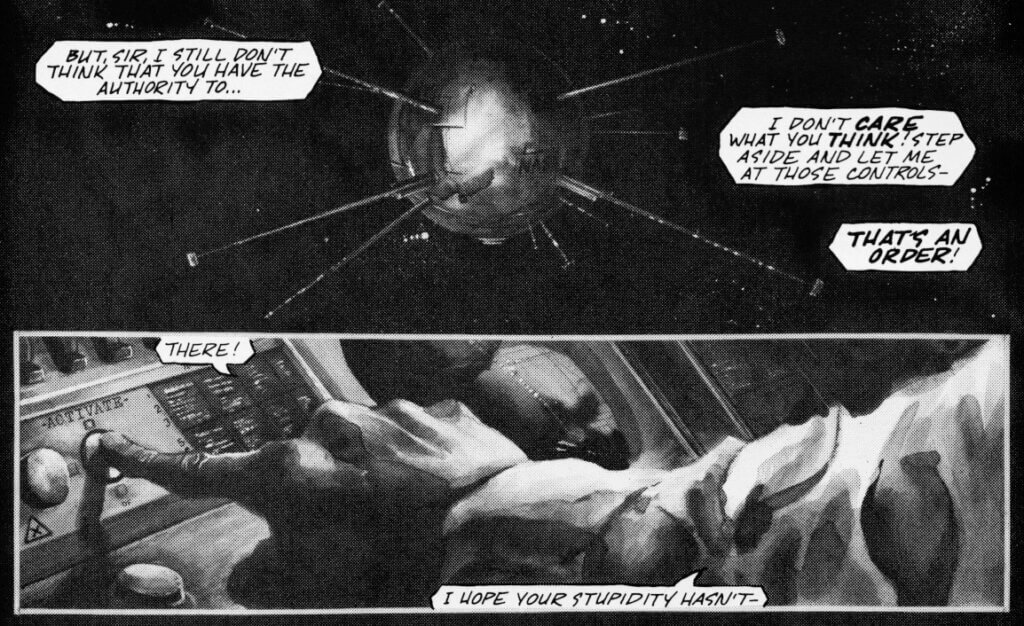
The aftermath issue is similarly thin. Its first half is an unnecessary coda to the film, with the posse that killed Ben being eaten in turn by zombies. The second half, about a woman dodging zombies to catch a plane, merely leads into FantaCo’s next project for Romero and Russo’s universe – one in which the zombie plague reaches a whole new country.
The two-part comic Night of the Living Dead: London was published in 1993. Carlos Kastro remained as artist, now working alongside storyboarder Eric Stanway, while the writing duties went to a new two-man team. One of the writers, Steve Niles, was a fresh talent whose success with 30 Days of Night would not come until almost a decade later. The other was a major name in horror: Clive Barker, author of Books of Blood, writer-director of Hellraiser and frontman of Marvel’s Razorline imprint, which also launched in 1993.
The involvement of the Liverpool-born writer can be seen as part of the so-called British Invasion, when such UK talents as Alan Moore, Neil Gaiman and Grant Morrison joined the US industry, often bringing with them a certain countercultural cheekiness associated with British comics like 2000 AD.
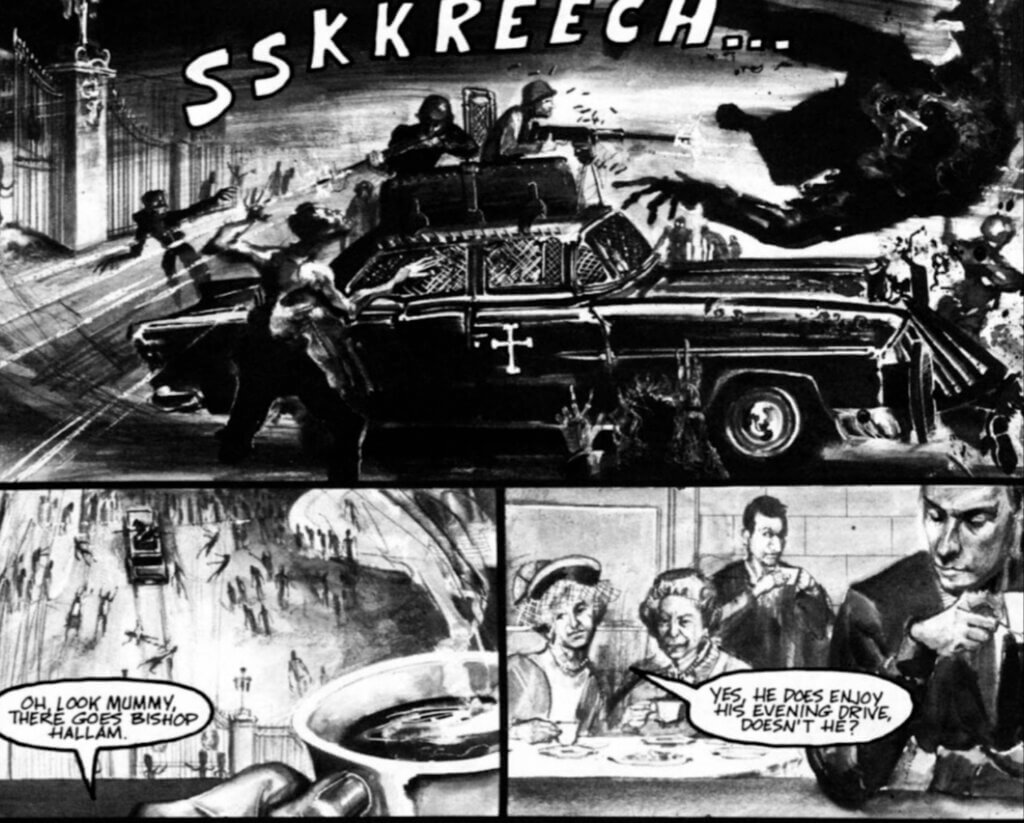
Night of the Living Dead: London posits that the zombie apocalypse spread to Britain in 1968, but the royal family and the upper echelons of the Anglican clergy could afford sufficient fortifications (and enough disposable servicemen) to survive. Jumping forward to 1993, we see a London in which guardsmen stand outside Buckingham Palace with protective cages to keep the zombies away, and the royal family is kept comfortable by a bevy of servants. There are even plans for a royal wedding – albeit one that will have few guests.
As for the church, it remains rife with classism and sexual hypocrisy. This is made clear by the narrative captions that introduce the comic’s main character, Bishop Hallam:
Understand, my dears, beauty was always my downfall. Even when I was a young priest aspiring to archbishop I always had to have my covert affairs. And these affairs were usually with the hoi-poloi. I was never interested in my own class. Only with rough trade. I used to like boys I found in the street.
Like many a 2000 AD antihero, Hallam combines a corrupt ideology with a flair for derring-do. We see him riding around in a car with a crucifix on the side, two gunmen on the top, and a zombie-smashing snowplow on the front, while the tea-sipping royals watch from Buckingham Palace. “Oh, look, mummy, there goes Bishop Hallam. He does enjoy his evening drive, doesn’t he?”

While Hallam appears content to let the soldiers and his chauffeur do the actual work, he leaps into action when he sees an angelic, longhaired young man being attacked by zombies. Rescuing the ephebic lad from danger, Hallam takes him back to the palace to keep as a personal plaything. The boy, however, has other ideas, ones that feed into a bizarre family drama featuring a prince with erectile dysfunction, a sexually-frustrated Norwegian princess, and a senile king who believes himself to be fighting Germans in World War II.
Night of the Living Dead: London never quite comes together as a satirical story. A major weakness is its decision to avoid portraying any real-life royal family members, which inevitably dulls its bite. Although the comic includes two characters who clearly resemble Elizabeth II and Princess Diana, these are identified as Queen Mother Florence and her unnamed daughter; the remainder of the family is made up of King James and Prince Randolf (the zombified Princess Anne on the second issue’s cover has no counterpart in the actual story.)
By comparison, only one year earlier, Garth Ennis’ run on Hellblazer showcased a demonically-possessed Prince Charles and a plot by Prince Andrew (hidden behind only the thinnest of veils) to claim the throne for himself by sabotaging his brother’s exorcism. Using a cast of generic stand-ins, Barker and Niles missed the opportunity for similarly caustic commentary. Some might argue that it would be implausible for, say, the 1981 wedding of Charles and Diana to have taken place in a Britain gripped by a zombie plague since 1968, but in a comic of this type, such implausibilities are features rather than bugs.
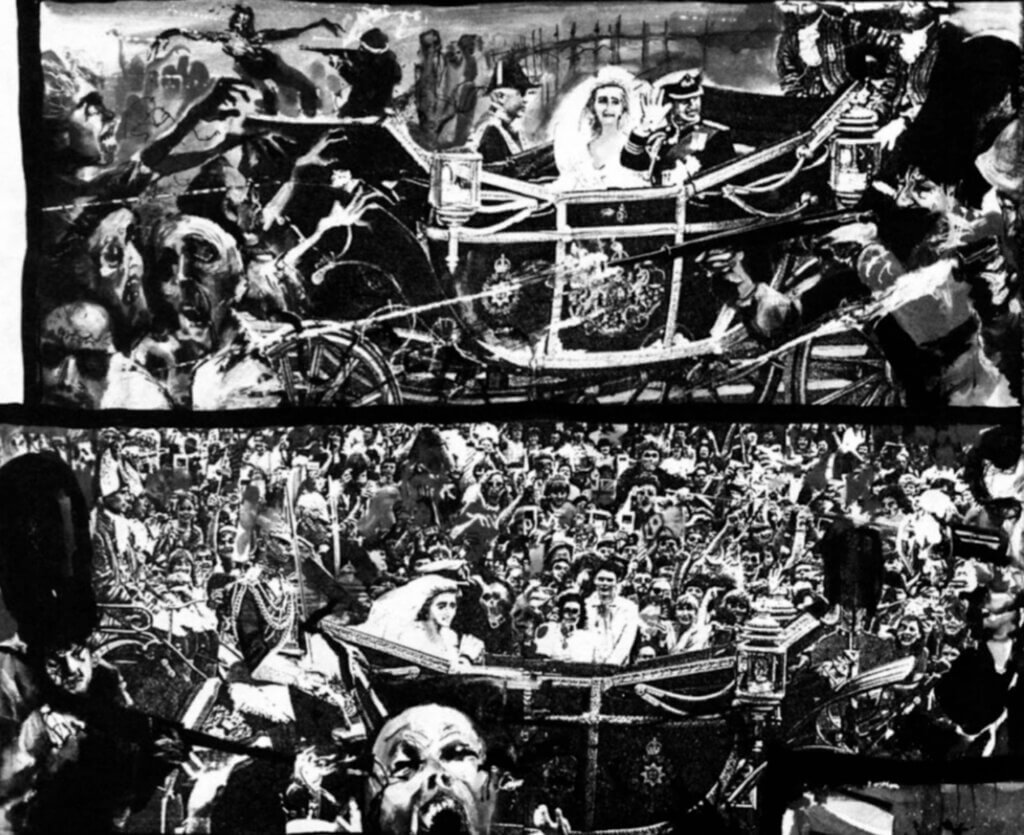
Despite some shortcomings, Night of the Living Dead: London has its share of virtues. Kastro’s artwork remains one of the main draws, this time experimenting with photomontage: the first issue climaxes with a royal carriage driving past skull-faced crowds and tumbling buildings, the scene mixing actual photography with horror-comic illustration to good effect.
The queer aspects of the story are also intriguing. When the characters refer to the zombies as “papists,” apparently believing that all of those who fell victim were Roman Catholics and therefore deserving of their fate, we see a chilling reflection of the ongoing AIDS crisis – the victims of which were likewise dismissed by many on the religious right as punished sinners. All in all, it is easy to imagine the comic blossoming into something special had it lasted longer than two issues.
But instead of continuing London, FantaCo followed up with a new series entitled Night of the Living Dead; catalogue listings referred to it simply as “New NLD” to avoid confusion with the film adaptation. This ran for four issues, numbered from #0 to #3, all published in 1994.
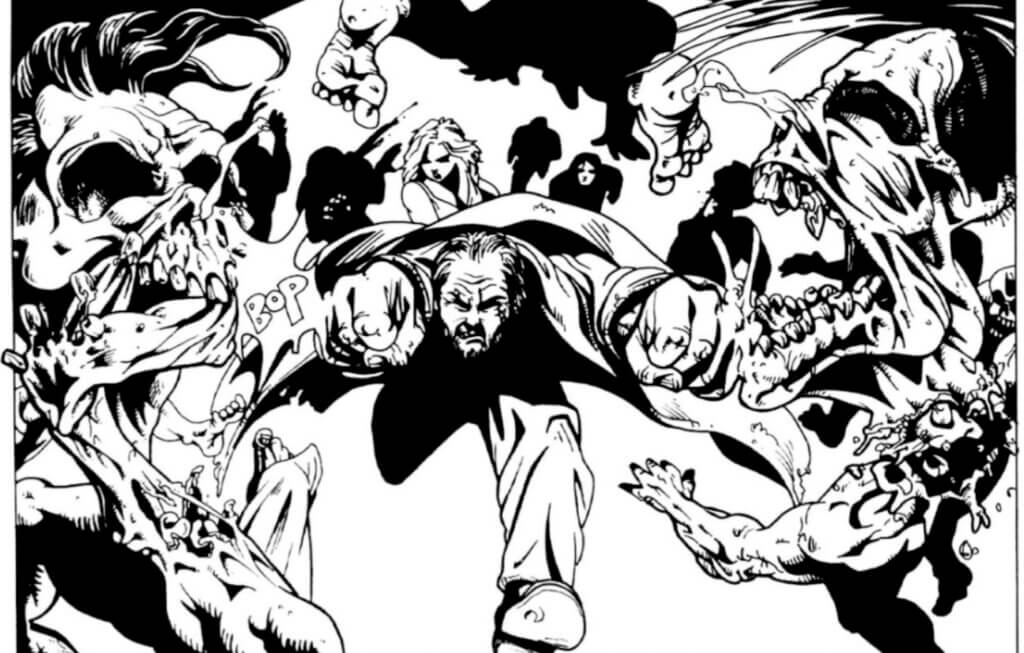
The new creative team comprised writer Noel K. Hannan and artist Rik Rawling, two more British talents who, although they never worked for 2000 AD, would have fit right in. Gone is Carlos Kastro’s Goya-infused work, with Rawling specialising in a much more cartoonish and absurd sort of illustrated violence.
Ignoring the events of the previous comics, New NLD comes up with a novel origin for the zombie plague. Here, a satellite built as part of Ronald Reagan’s so-called “Star Wars program” is repurposed by a shady government body called the Black Room as a mind-control device. It then malfunctions and begins turning the people of Earth into zombies.
Into this new zombie apocalypse arrive new heroes. Randy von Richtofen is a seasoned monster-hunter, part Dirty Harry and part John Constantine, who carries out errands at the behest of dreadlocked Vodun sage Papa Shaka. Kate Koresh is a stand-in for Pamela Anderson (she stars alongside David Weeniehoff in Surfwatch) and initially appears as a damsel for Randy to rescue from distress, only to show that she is quite adept at zombie-smashing herself.
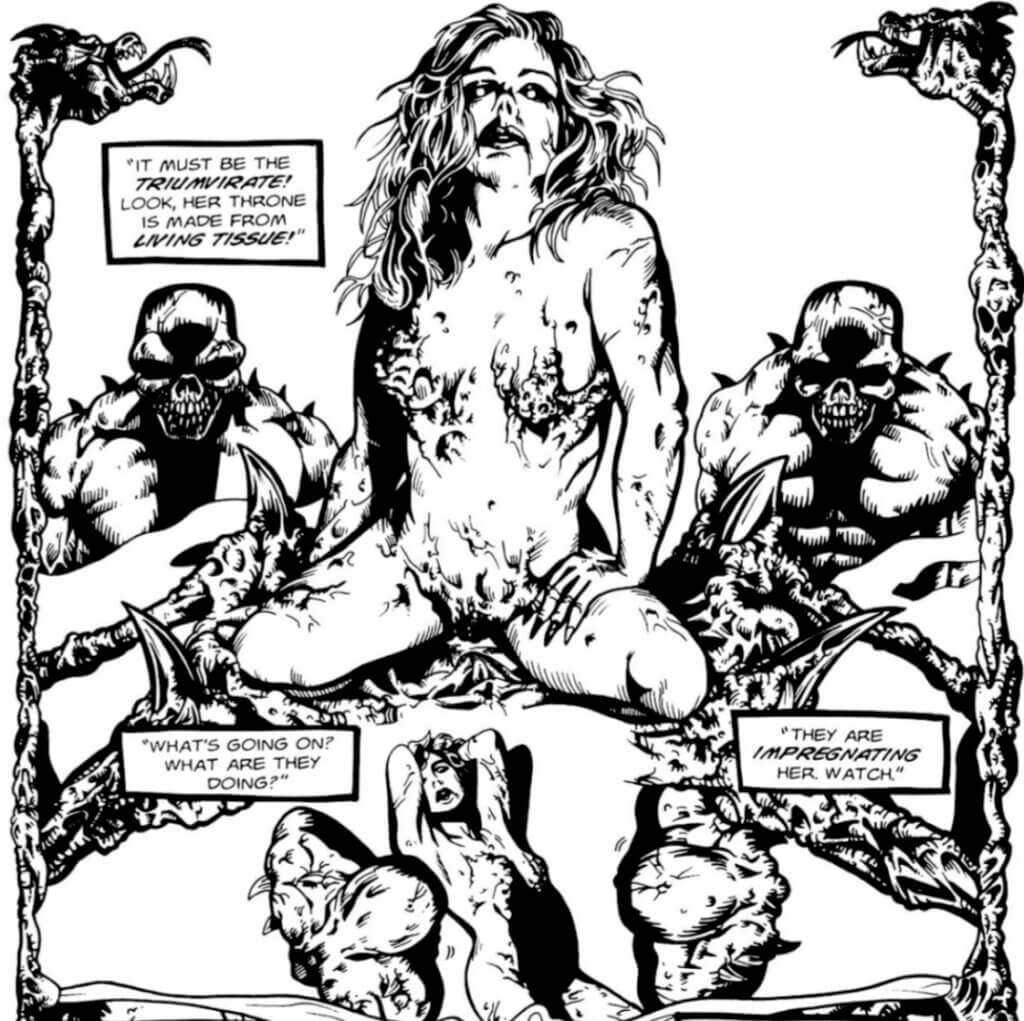
Each issue tells a mostly self-contained story with its own absurd setting. We first visit Haiti, where exploitation-movie “houngans” are conjuring up zombies the old-fashioned supernatural way to appease their deities, the Bikini Demons. Next is California, where the set of Surfwatch is hit by ghouls. After that comes Florida, where the US President (who looks like Bill Clinton and talks like John Belushi in Animal House) wants his daughter rescued from a Disneyland-like theme park. The final destination is Berlin, where the zombies have mutated into something out of a body horror manga.
A palpable irony permeates every page, this being the sort of comic where a character will admit to delivering exposition for the benefit of readers who missed the previous issue. A lot of the humour is referential, with nods made to such contemporary pop culture as Reservoir Dogs, The Simpsons, Bill Hicks, Akira, and even Nicole and her Papa from the UK’s notorious Renault Clio advertising campaign. These references sometimes become a sort of droll transatlanticism on the part of the British team: the Chelsea Clinton stand-in is named Tottenham, in homage to London’s Chelsea/Tottenham football rivalry.
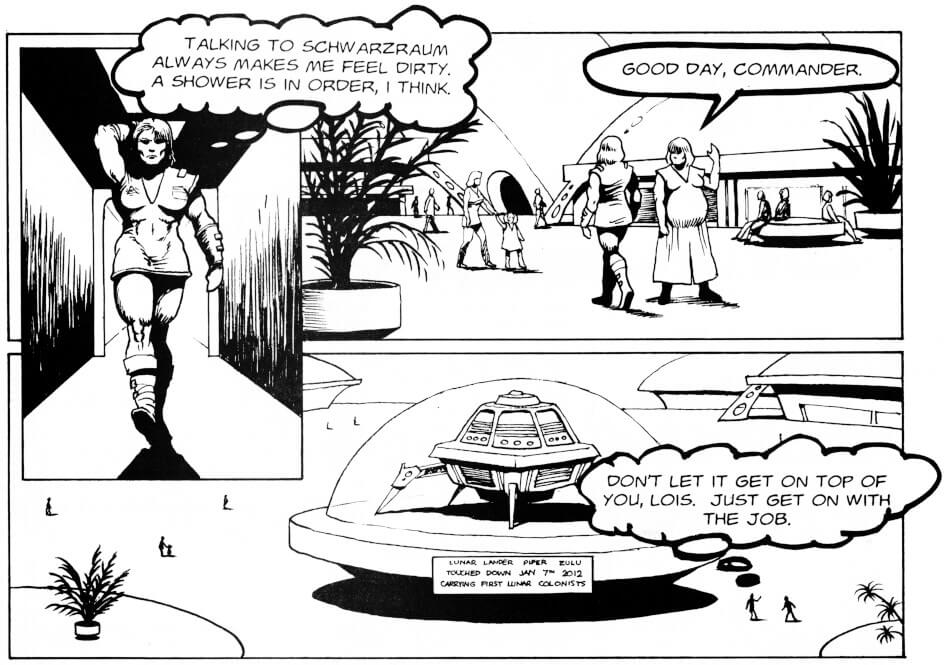
The silliness of New NLD was followed later in 1994 by Legends of the Living Dead, also written by Noel Hannan but with Richard Winn taking over as artist. In a futuristic setting clearly derived from Alien, butch heroine Lois Lockheed runs a moonbase where she butts heads with her cold corporate overlords. When a mysterious flying saucer crashes on the moon, it brings with it a virus that infects the base and begins turning its crew into zombies.
Compared to the previous series, Legends sucks the fun out of things. There is less humour, and the pop culture riffing (specifically the debt to Alien) seems lazy rather than endearingly cheeky. Rawlings’ gag-packed cartooning is also missed, being replaced with sparse, generic sci-fi imagery – although Winn admittedly shows a flair for drawing busty, musclebound Amazon women, who resemble Sigourney Weaver as envisioned by R. Crumb. Legends of the Living Dead was billed as a two-part series, but the second issue was never published, leaving Lois Lockheed’s adventures on a cliffhanger.
Released concurrently with Hannan’s comics was King of the Dead, a series scripted by Night of the Living Dead: London co-writer Steve Niles. This ran for five issues (numbered from #0 to #4) and lasted into 1995; aside from the first issue, which was drawn by Brian Clark, the artwork was provided by Rich Nelson.
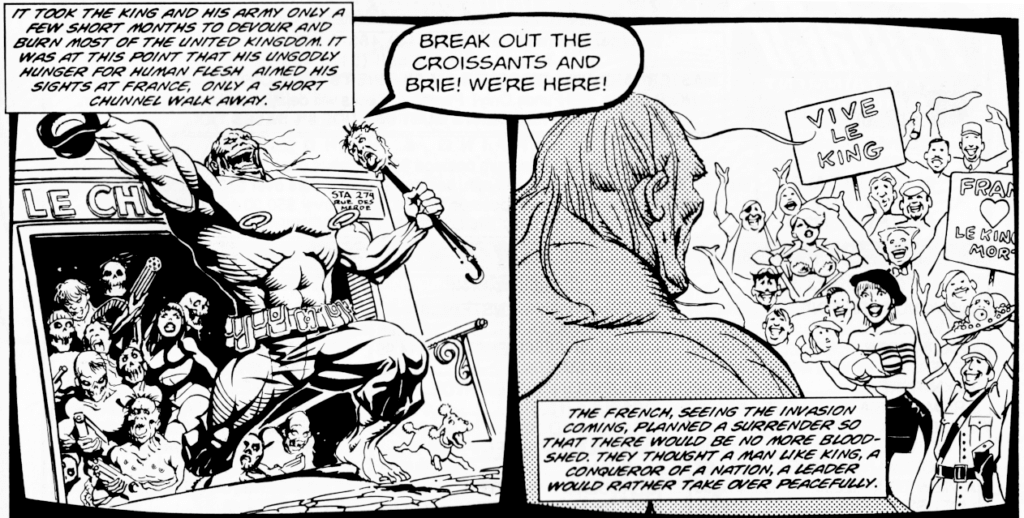
Set in a post-apocalyptic then-future of 2011, the series introduces a type of zombie in the titular King of the Dead. A hulking brute with a musclebound body, a near-skeletal face, a functioning brain, a sadistic personality and a fondness for wisecracks, this character resembles a cross between DC’S Lobo and Iron Maiden’s Eddie. The comic’s storyline charts the remnants of humanity watching on in horror as the King spreads a trail of destruction from country to stereotyped country.
Where Legends borrowed from Alien, King of the Dead is closer in spirit to the Mad Max series and its imitators. Rich Nelson’s depictions of a wasteland where towering men inflict elaborate bodily violence upon one another are strongly reminiscent of another Mad Max-esque comic series: Fist of the North Star, the animated version of which had recently become available in English. The visual influences upon FantaCo’s Living Dead comics are nothing if not diverse, drawing variously from Goya, 2000 AD and the hot-in-the-90s manga scene.
Although the letters column in New NLD touted King of the Dead as a continuation of Night of the Living Dead: London, it is more of a sequel to an earlier series written by Niles: Scab, published in 1992. The title character of that comic, a gun-toting adolescent boy who somewhat resembles a male Tank Girl, turns up as the good-guy rival to the King. Significantly, neither Legends nor King of the Dead credit the original Night of the Living Dead film, indicating that the project had moved from a media tie-in to an in-house franchise for FantaCo.
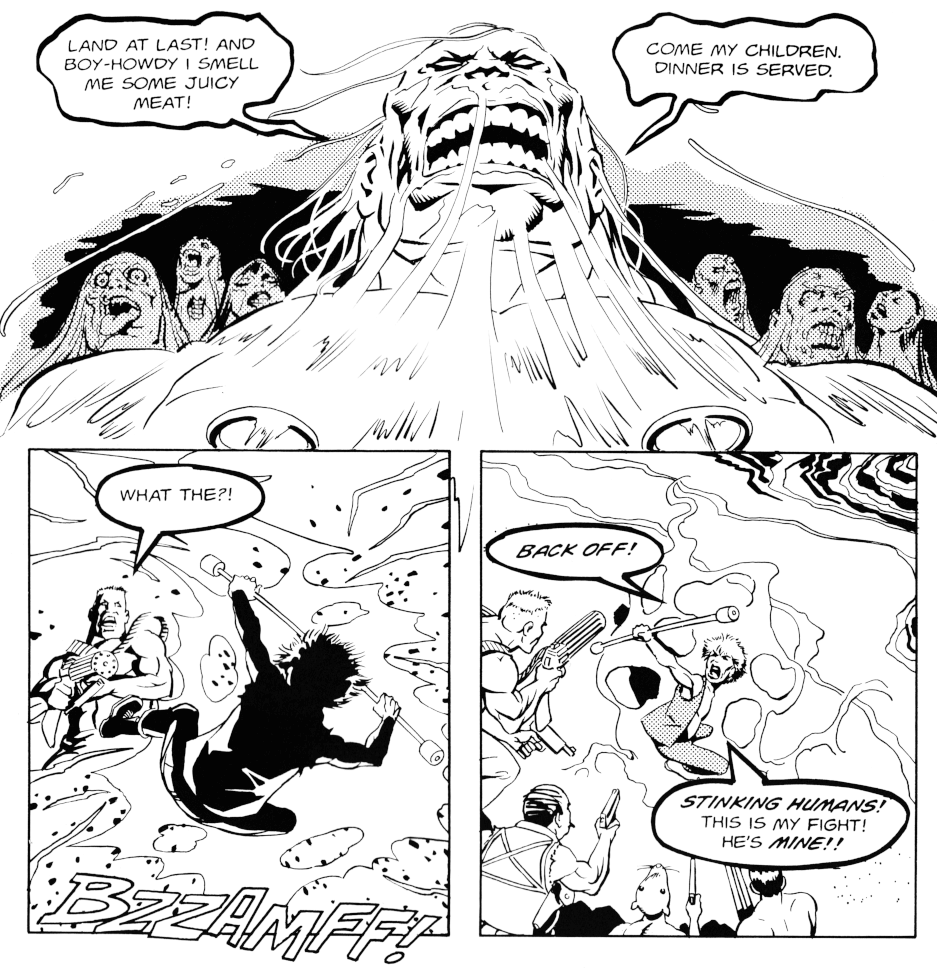
King of the Dead’s final published issue concludes with Scab confronting the King and a “to be concluded” tag. As with the second issue of Legends, however, this conclusion was never published. FantaCo lasted for a few more years, focusing on such titillating fare as Permwoman and Amazing Colossal Amazon Woman before shutting up shop in 1998.
The 1990s were a volatile decade for English-language comics. On the one hand, the medium had been given newfound legitimacy by the rise of the “graphic novel,” which encouraged artistic experimentation. On the other, countless comic creators remained attached to that familiar realm of ultraviolent men, hypersexualied women, and endless genre riffs. Occurring in the background was the swelling and bursting of the speculator bubble, leading to an industry-wide crash that lasted for years.
FantaCo’s Night of the Living Dead comics are very much a product of this era. Where one series will evoke Goya, another will parody Baywatch. Social satire mingles with gross-out gags. All show an urge to take Night of the Living Dead and do something different, even if, as in the weaker comics, that turns out to be no more than borrowing from other films. The bubble burst and it all ended rather abruptly. But when it was finished, it had more hits than misses.
Next: Building an extension…

