
Continuing a series that celebrates the fifty-fifth anniversary of Night of the Living Dead with a look at the classic zombie film and its many follow-ups.
The early days of the World Wide Web were, as the cliche goes, the Wild West. Recently, cyberspace appears to have flipped genre from Western to cosmic horror, as anyone hoping for a public profile is obliged to swear fealty to some combination of Musk, Zuckerberg, Bezos and other such eldritch horrors or else face darkest oblivion, and our entire lives are watched by an infinity of unblinking eyes. But back around the turn of the millennium, things were very different: the Web was a fresh terrain filled with opportunity.
One by one, creative spirits rode in to see what the new era had to offer. Hot new talents like J. Michael Straczynski and Neil Gaiman were naturally among the first to get involved, and joining them were curious members of older generations – including George A. Romero. Certain reports indicate that georgearomero.com existed as far back as 1998, although Archive.org copies of this now-defunct site stretch only to 2000.
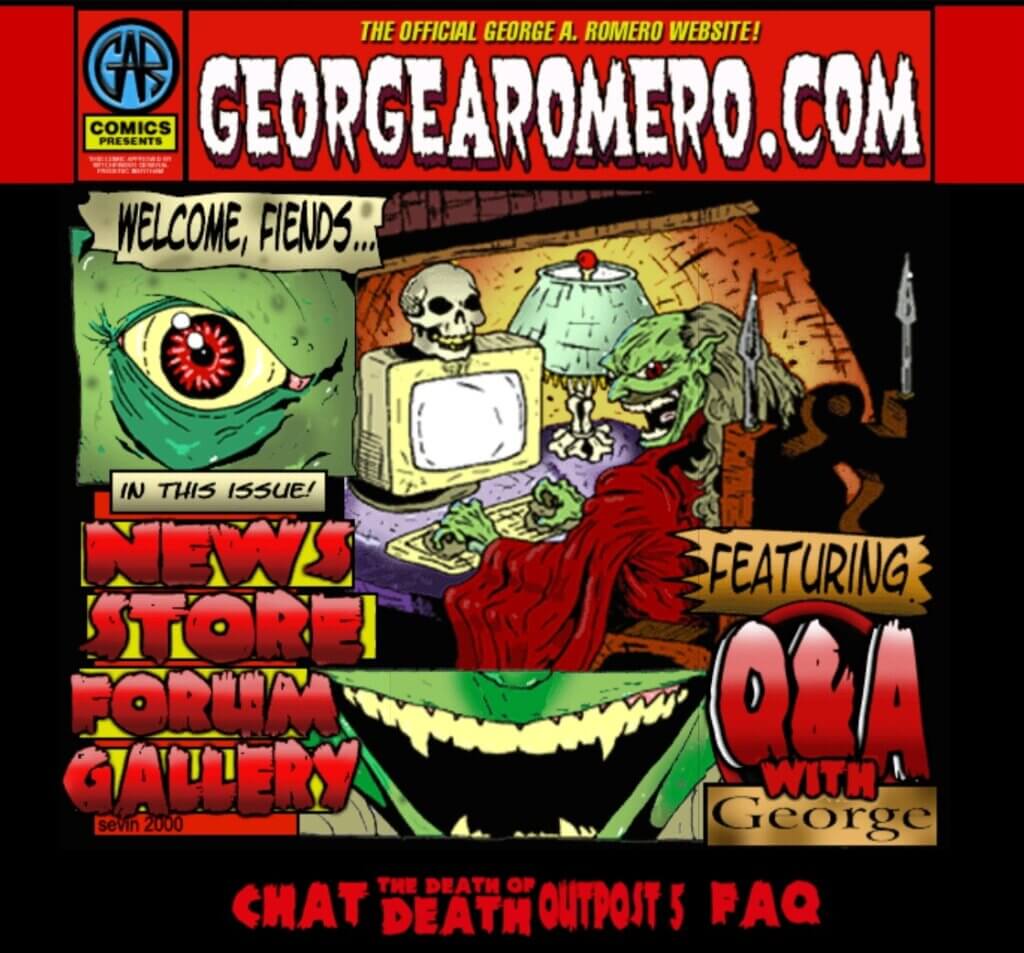
Here, viewers could take a peek at behind-the-scenes photographs from his zombie films, pick up merchandise at the online store, meet each other in the site’s chat room, or spend time pursuing an FAQ section compiled by special effects artist Chris Stavrakis, with orange-highlighted contributions from Romero himself.
The latter section had details on the director’s upcoming projects, his personal taste in films, and the thought processes behind the political undercurrents of his work. Befitting the fact that the web was still largely the domain of nerds and geeks, the FAQ also includes clarification as to the “rules” behind the living dead; far from providing a role-playing sourcebook, however, Romero took the opportunity for a rather catty swipe at the director of Return of the Living Dead: “As I’ve said, anybody’s rules are good rules…(except for Dan O’Bannon’s, of course).”
But for anybody hoping for all-new trips to the land of zombies, the main attractions of the website were two pieces of original fiction by Romero.
One of these, “Outpost #5,” was published on a dedicated page of the site and offered a zombie’s-eye perspective on the world. Romero never completed the story, the existing portion serving more as a character introduction than a coherent narrative and ending with “to be continued” after a little over 2,200 words. Still, it remains a halfway-intriguing attempt by Romero to make his ghouls into more empathic figures, something that started with Bub in Day of the Dead and would become a major theme in his twenty-first-century films:
It had no language. It had come to recognize a few words and phrases that were frequently used by the fast-moving ones…“gun”, “weapon”, “kill”, “fucker”, “shit”, “piece-of-shit”, “pile-of-shit”, “pile-of-walking-shit”…but it had never heard the word “flower” spoken by anyone. So, it didn’t know what the pretty things were called, but it had always had a great affection for them. Since the time when Scud walked on those pretty things, it had been following that fast-moving one’s spoor, reasoning that it shouldn’t be following…it remembered that Scud, and other fast-moving ones who were normally in Scuds [sic] vicinity, possessed “guns”. But, driven by rage, it followed. And followed.
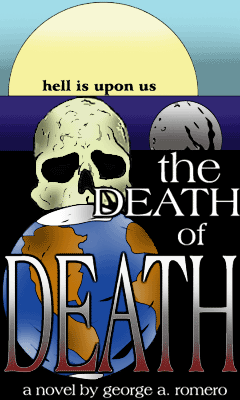
The other story offered by the site, The Death of Death, was more ambitious in terms of both length and distribution format. Romero conceived it as a complete novel readers could purchase in serialised form: at the sum of $3 per PDF chapter. Once again, though, he would never complete this project. He wrote only two chapters, entitled “Timing is Everything” and, intriguingly, “You Beat My Dog, You Eat My Frog” – although since the chapters took up a combined total of 99 pages, this was still something of an achievement on his part.
Romero was not completely alone in publishing books over the Internet. 2000 saw a high-profile attempt by Stephen King to put both his original novella Riding the Bullet and his earlier book The Plant online, via a process rather more sophisticated (and easier to hack) than Romero’s low-fi PDF-by-email.
The simple truth, though, is that electronic publishing was not quite ready to take off. Ebook readers, although in existence, were prohibitively expensive. Mobile browsers were in their infancy, and users were left reading these cutting-edge electronic novels while hunched over the glare of their desktop computers. This might have been bearable with King’s fast-paced, punchy storytelling, but the prospect of reading a 50-page chapter in this manner is enough to make one’s eyes and back muscles go on strike.
Beyond the abortive self-publishing, the original version of georgearomero.com was itself short-lived. In early 2002 the webmaster apologetically reported that, “It’s been quite some time since I‘ve heard from George,” and then, a week later, announced the “cruddy news” that Romero had failed to renew the hosting service and the site would be closing.
When it went down, it took both “Outpost #5” and The Death of Death with it. Details around their creation are scarce, with even the years of their publication being hard to pin down. According to the George A. Romero Foundation, “Outpost #5” dates from 1998, while this Tripod-hosted fansite (itself a relic from the turn of the millennium) lists The Death of Death as a 2000 release.
The Death of Death was evidently good enough to turn up in two more of Romero’s projects: first as the name of his story in DC’s 2005 Toe Tags comic, and later as the title of the fictitious documentary in Diary of the Dead. But when he returned for another attempt at a zombie novel, he went with the more succinct title of The Living Dead. This, too, he would leave unfinished, sadly dying in 2017 before he could complete it; the book was finished by Daniel Kraus and published in 2020.
At which point we loop back to the turn of the millennium and to georgearomero.com.
In his afterword to The Living Dead, Kraus reveals that, when he embarked on the project, he had no idea that Romero had also left an earlier novel unfinished. Only when reading the comments section on an article about the posthumous collaboration did Kraus happen upon a brief reference to The Death of Death, a project which had been almost totally forgotten – and, given its subscription-based digital distribution, was no longer available to the public.
It was Romero’s widow, Suzanne Desrocher-Romero, who finally provided Kraus with The Death of Death‘s two chapters in PDF form. These, along with “Outpost #5”, he was able to incorporate into The Living Dead. Kraus rejected certain elements from the aborted novel, however, and his afterword gives us a glimpse of the lurid, pulpish saga that Romero had apparently envisioned circa 2000:
While the Death of Death pages lacked the structure of The Living Dead pages, they were brasher and darker. Some of it had no place inside The Living Dead, no matter how much I adored them. (Case in point: a bonkers sequence in which a woman is rescued from ritual genital mutilation only for her rescuer to crash their getaway jeep and be thrown into a river, whereupon he turns zombie and starts after her, only to be suddenly ripped apart by hippopotamuses.)
It has to be said that this description recalls Lucio Fulci’s work on Zombi 2, with that memorable shark-versus-zombie-versus-topless woman sequence, at least as much as it does anything in the Romero canon.
As for the demise of georgearomero.com, and the director’s loss of interest in his online projects, Kraus has still more light to shed:
Around 2000, there was a feeling the independent film world was on the brink of a paradigm shift that would allow directors to bring their work directly to the people. It didn’t happen, for lots of reasons. [Romero’s manager] Chris Roe recounted to me how the site’s chat rooms got nasty – of course they did – and George pulled the plug. It was one more heartbreak: his hopes lifted by a new democratic ideal only to see it ruined b familiar, ugly behaviors. Exactly the sort of thing he made movies about.
The Wild West of the Web is different from the cowboy films on screen. When the good guy rides into the sunset, the bad guys are free to take over the town.
Next: Children of the damned…
