

Continuing a series that celebrates the fifty-fifth anniversary of Night of the Living Dead with a look at the classic zombie film and its many follow-ups.
The twenty-first century brought with it a new era for cinema zombies. Before the renaissance, however, came a miniature dark age in the form of 2001’s abysmal Children of the Living Dead.
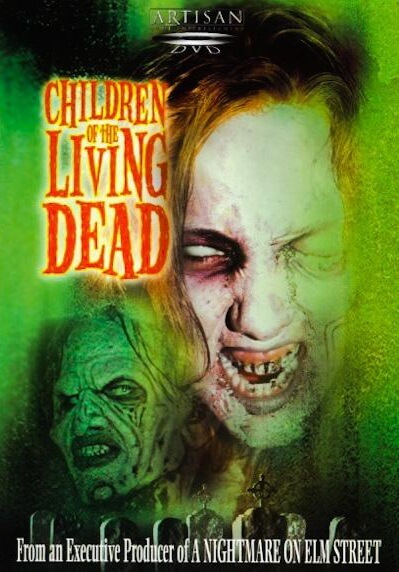
Those with long memories might recall how Bill Hinzman, who played the Graveyard Ghoul in the original Night of the Living Dead, cobbled together a spin-off about his character: the 1988 film Flesheater. Children of the Living Dead is effectively a remake of Flesheater, again focusing on the antics of a specific zombie character with the potential (in the eyes of the most optimistic backers, anyway) to become a Freddy Krueger-like franchise character. This time the zombie was played by an actor named A. Barrett Warland rather than Bill Hinzman, although Hinzman served as cinematographer; his daughter Heidi Hinzman also performed in the film.
Just why anyone would want to remake the disastrous Flesheater is open to question. Still, this effort at least had more the way of established Living Dead talent: Night’s co-writer John Russo was one of the producers, and Tom Savini was on board with the project, albeit as an actor and stunt co-ordinator rather than his usual capacity as gore effect maestro. Consequently, there was room to hope that, perhaps, things would work this time around.
Those hopes were cruelly dashed.
In an interview with HorrorNews.net, Russo described the movie as, “probably the worst film I’ve worked on.” He related how the project started with a script he had written, which caught the attention of veteran horror producer Joe Wolf. Russo then pulled together a crew of talent, only for his script to be completely rejected in favour of one written by Joe Wolf’s daughter, Karen Lee Wolf:
It was horrible. By that time I had gotten Tom Savini signed to it and Jeff Gergely who has two Emmy’s from Babylon 5 and he’s worked on a number of my movies, I had Vince Guastini who worked with me on a couple of films and he did some of the tech make up for Dogma and Last of the Mohicans and so on. So I had all of these great people that gave up a summer’s work to do this Children of The Dead project and then it turned into his daughter’s script. By that time I wanted to resign every day but I couldn’t because these people would’ve lost a summer’s worth of work. We hoped for the best and hoped it’d get revised and instead it’s a piece of crap. I call it The Living Abomination of Children.
Tom Savini, interviewed for Glenn Kay’s book Zombie Movies: The Ultimate Guide, was even more upfront in his disdain:
Throw it away. It’s the biggest piece-of-shit movie ever made […] the producer on the show was an idiot. I think her father gave her that movie as a present, and she didn’t know what the hell she was doing. And it’s really an abysmal piece of crap. It shouldn’t even be on the shelves of video stores.
Savini did, however, add a caveat: “The first ten minutes is great – I’m in it.”
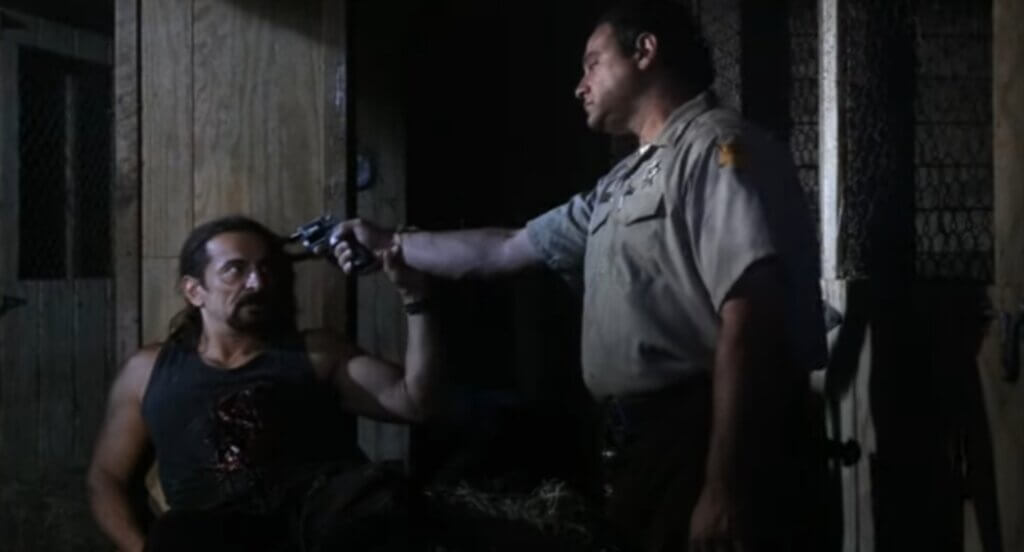
Those first ten minutes depict what appears to be the point where Night of the Living Dead left off, with a posse taking out zombies in the countryside. However, the film later establishes that, according to its overcomplicated backstory, this is a separate zombie outbreak that occurred eighteen years after the events of Night. The sequence is focused on a tank-topped Tom Savini in action hero mode, gunning down ghouls and stunt-jumping over vehicles.
His Ash Williams-esque antics take him to a farmhouse where, to his surprise, a group of children are being held captive – even though zombies, according to this film’s rules, have no interest in youngsters. By the time the local sheriff arrives to help, Savini has been fatally injured by the house’s mysterious occupant. With his dying breath, he utters a name: Abbott Hayes.
Fourteen years later, the zombie plague has been so thoroughly suppressed that a group of college kids in a camper van are able to scoff at claims that the dead ever walked. Their trip takes them past the same farmhouse in which Savini’s character died, allowing an excruciatingly-acted conversation about the house’s former owner: the murderer Abbott Hayes, who according to legend, is still out there. To the relief of the audience, the zombified Hayes jumps out in front of the van, sending the whole obnoxious band plummeting off a cliff to their deaths.
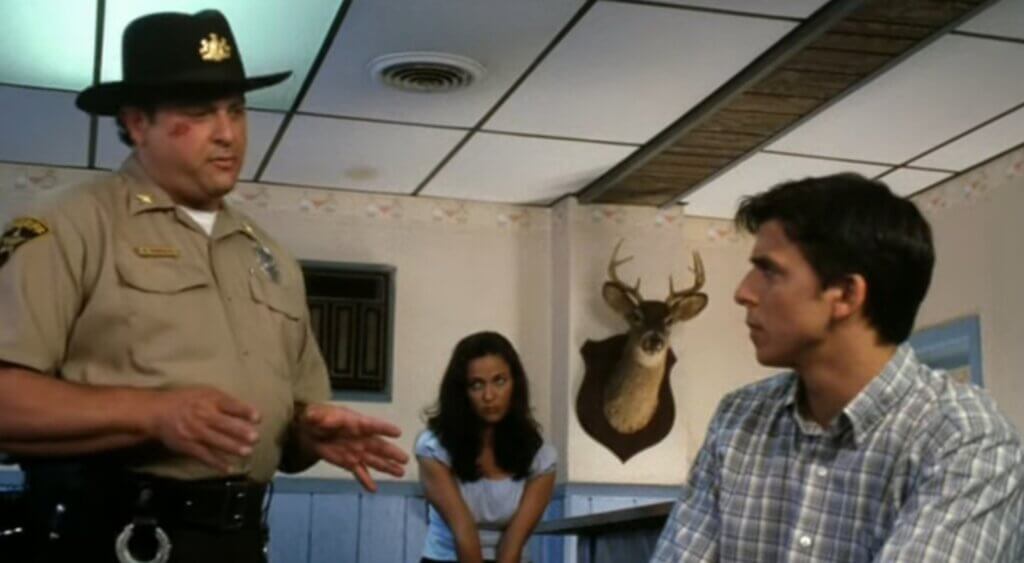
After the funeral proceedings, Abbott Hayes turns up at the graveyard to resurrect his latest victims as zombies. For good measure, he also kills the graveyard’s proprietor before hiding the body in an empty coffin. The film then skips forward in time again, taking us to the year after the crash. Matthew Michaels, a young newcomer to the town, has become involved with operating the cemetery – and piece by piece he begins to uncover the sordid history of the living dead.
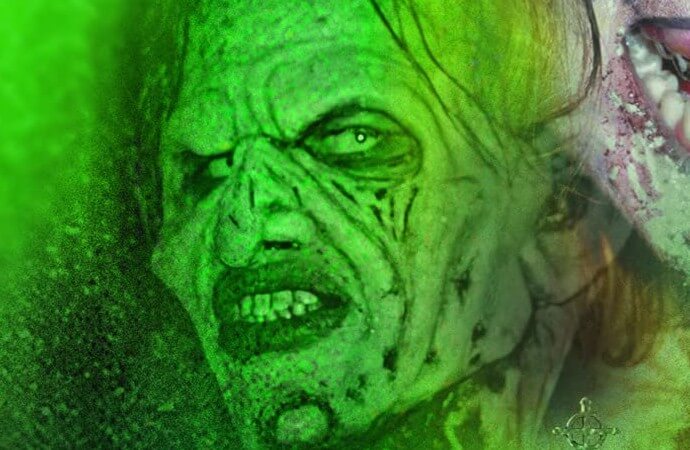
Whether the audience cares enough to follow his investigation is questionable, as Children of the Living Dead never misses an opportunity to drive its viewers away. Every lesson taught by Night of the Living Dead’s shoestring-budget success is ignored, with this follow-up looking utterly cheap. The dialogue sequences have the headache-inducing tendency to flip between medium shots and extreme close-ups of people’s jowls, while Abbott Hayes shambles about wearing what looks like an upmarket Halloween mask.
The fact that Karen Lee Wolf has no screenwriting credits either before or after Children of the Living Dead should come as little surprise, as her script is likewise amateur-hour work. The film manages to burn through two sets of protagonists in its first third – Tom Savini and his buddies, followed by the doomed college kids – before settling on the completely uninteresting Matthew Michael.
Very little in the story stands up to close inspection, being filled with details that are both nonsensical and superfluous. One typically bizarre plot point has the graveyard being secretly relocated by its owners to make way for a car dealership; somehow, the townspeople are kept oblivious to an operation that involves cranes and forklifts spending days in the cemetery. Although the plot incorporates themes of corruption and cover-ups, all of the human characters end up working on the same side against the zombies, which completely misses one of the main appeals of Romero’s zombie films: seeing the faultlines that appear between the characters when placed under stress.
And then we have the bizarre handling of Abbott Hayes as a character. Unlike the other zombies, he possesses a degree of sapience: he laughs maniacally, holds grudges, and is capable of using stealth to both hide and exhume bodies. He functions as a sort of super-zombie in the same way that Dracula is typically cast as a super-vampire. Yet we are never given a clear, let alone convincing, explanation as to how he achieved this status.
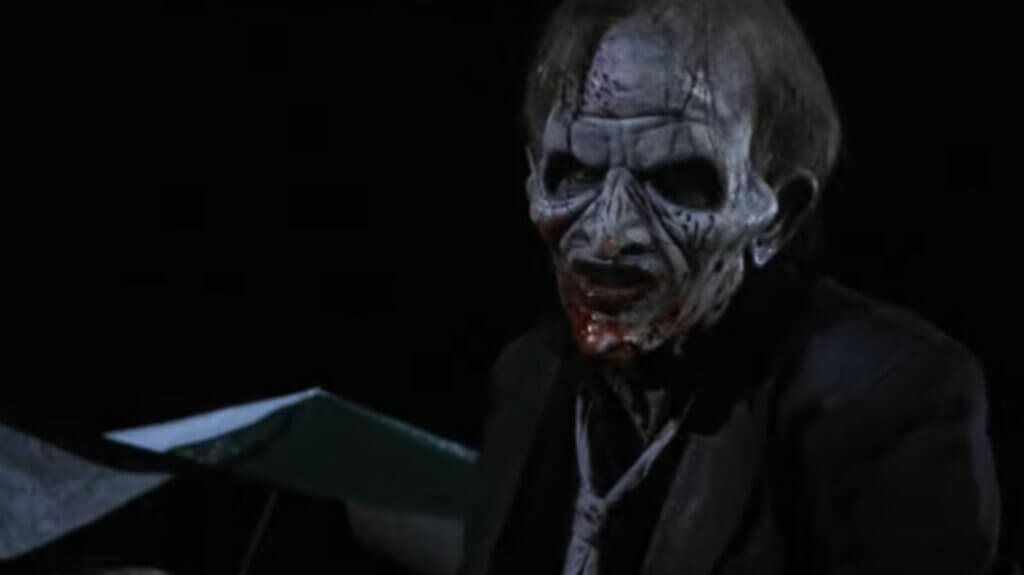
Flesheater, for all of its flaws, understood that if a zombie film is to star a special ghoul, then there needs to be a reason for it to be special. And so, the zombie in Flesheater was established to be the pet project of Satanists and responsible for creating all subsequent zombies in the film. But in Children of the Living Dead, Abbott Hayes is merely one of many zombies created by the radiation from Night of the Living Dead’s Venus probe, and not even a member of the first generation.
The general implication is that Hayes is the worst of the zombies because he was an evil person in life:
“What did Abbott Hayes do?”
“Well, his mother was probably the root of his rampage.”
“Okay, and what did she do so different from every other mother or stepmonster-mother, stepmother, in this world?”
“She dressed him up as a girl, sent him to school as a girl, took him around town as a girl.”
“That’s horrible. No one in town noticed the abuse?”
“Nobody knew anything. He was raised as Elana, everybody in town knew him as Elana.”
“Wow.”
“So for almost seven years he abducted women, mostly teenagers and young girl from here and surrounding areas. And the way he got caught was one night the sheriff pulled him over because he had a busted taillight. And when he opened up the trunk, he found a young girl tied up in the back. Then they went to his house. In his house, they found two decaying corpses in his living room.”
“Wow. That upbringing would make anyone crazy.”
The detail of Hayes being forced to dress as a girl was likely influenced by the case of real-life serial killer Henry Lee Lucas, who claimed to have been subjected to similar treatment by his mother (he also claimed that this was just one detail in a larger pattern of sexual abuse committed by his mother, a detail ignored by the film). In the context of the horror genre, the combination of a controlling matriarch and gender-bending also evokes Norman Bates in Psycho.
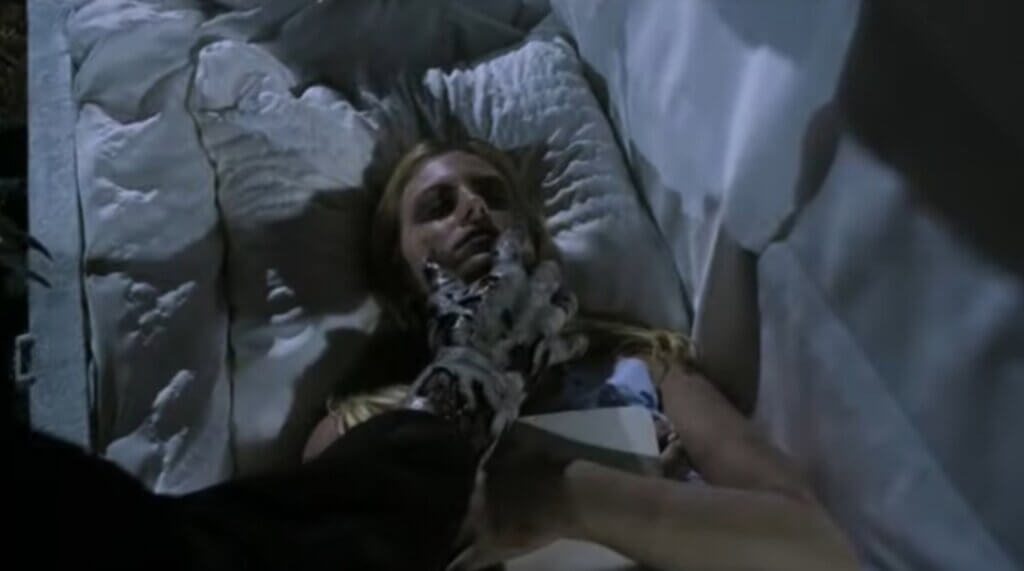
So, Children of the Living Dead carelessly slops together elements from different horror films, namely the zombie genre, the serial killer genre, and A Nightmare on Elm Street (like Freddy Krueger, Hayes hunts down victims who evaded him as children). The trouble is that a lone serial killer and an apocalyptic mass of zombies are two distinct motifs that play upon very different fears, and successfully combining the two is a tall order: too tall for the crew behind this film.
Of course, serial killers were in vogue at the time. Just as the zombie was the horror icon of the eighties, the serial killer films from The Silence of the Lambs (1991) through to American Psycho (2000), along with the post-Scream slasher revival, loomed over the twentieth century’s final decade. It should come as no surprise, then, that a Norman Bates-alike was used in a last-ditch effort to inject new life into the ailing zombie genre.
As it happened, there was no need for such desperate measures. Children of the Living Dead came right at the end of the bleak period for zombie films, and over the following years, it would become clear that serial killers were out and zombies were very much in. Horror history would forget the regrettable Children and remember the glut that followed.
Next: A new Dawn…
