

Content warning: This article contains illustrated scenes of graphic violence, including sexual violence.
Continuing a series that celebrates the fifty-fifth anniversary of Night of the Living Dead with a look at the classic zombie film and its many follow-ups.
Anyone who takes a close look at Night of the Living Dead must surely feel pity for the film’s co-writer, John Russo. After all, it was Russo who suggested that George A. Romero’s scenario use reanimated, flesh-eating corpses as antagonists: without him, the zombie genre as we know it today may never have emerged. Yet while Romero went on to become one of horror’s crowned auteurs, Russo was stuck directing such less-than-illustrious fare as The Booby Hatch (1971), Scream Queens’ Naked Christmas (1996), and My Uncle John is a Zombie (2016).
That said, Russo was given a fresh opportunity in a different medium altogether courtesy of Avatar Press. During the 2000s, this comic publisher had established itself as an outlet for big-name horror franchises, putting out titles based on Friday the 13th, A Nightmare on Elm Street, and Texas Chainsaw Massacre. A Night of the Living Dead comic was a natural addition to this line-up; while DC Comics bagged George A. Romero for Toe Tags, Avatar managed to team up with the other zombie-father.
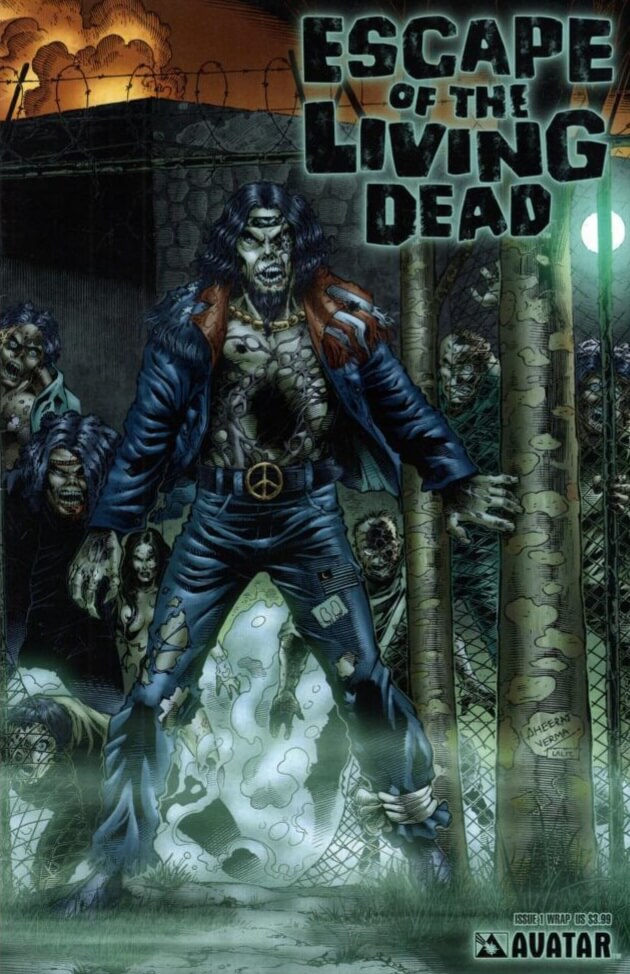
Russo’s first project for Avatar was the five-issue miniseries Escape of the Living Dead, where he worked alongside co-writer Mike Wolfer and artist Dheeraj Verma. Russo’s official biography states that it was based on a screenplay; however, despite a casting call going out in 2010, the film has never been made. After this series, which was published between September 2005 and March 2006, the same team put together the three-issue 2006 miniseries Escape of the Living Dead: Airborne along with two special issues (a 2006 “Fearbook” and a 2007 annual). Escape was subsequently collected in two trade paperbacks, one containing only the original miniseries, the other reprinting all ten issues.
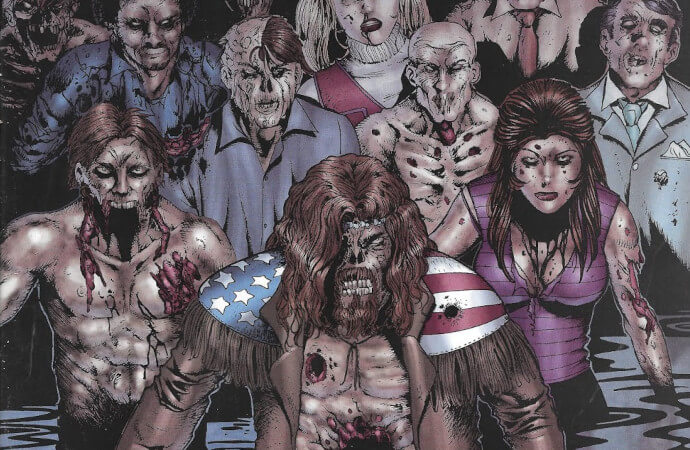
Russo’s story ignores Romero’s apocalyptic scenario from Dawn of the Dead onwards and offers an alternative series of events: the zombie plague of 1968, as depicted in Night, was safely contained and passed into urban legend. Now, three years later, the zombies are back. Issue #1 opens by establishing that one Dr. Melrose was responsible for harbouring zombies after the original outbreak; he is grievously injured in the second outbreak, leading the police to pursue his son in the hopes of finding the doctor’s mysterious serum. Meanwhile, two criminals inadvertently open a truck that unleashes yet more zombies on the world, led by a seemingly sapient zombie who picks up the nickname Deadhead.
Into this mayhem are thrown two groups of survivors. In one corner we have farmer Brinkman and his daughter Sally, who embody rural American values. They stand in stark contrast to the Sons of Satan, a gang of criminal bikers (at least, the other characters refer to them as such, even though their preferred method of transit is a van). Like many a band of zombie apocalypse survivors before them, these mismatched characters must put aside their differences if they wish to avoid becoming ghoul fodder.
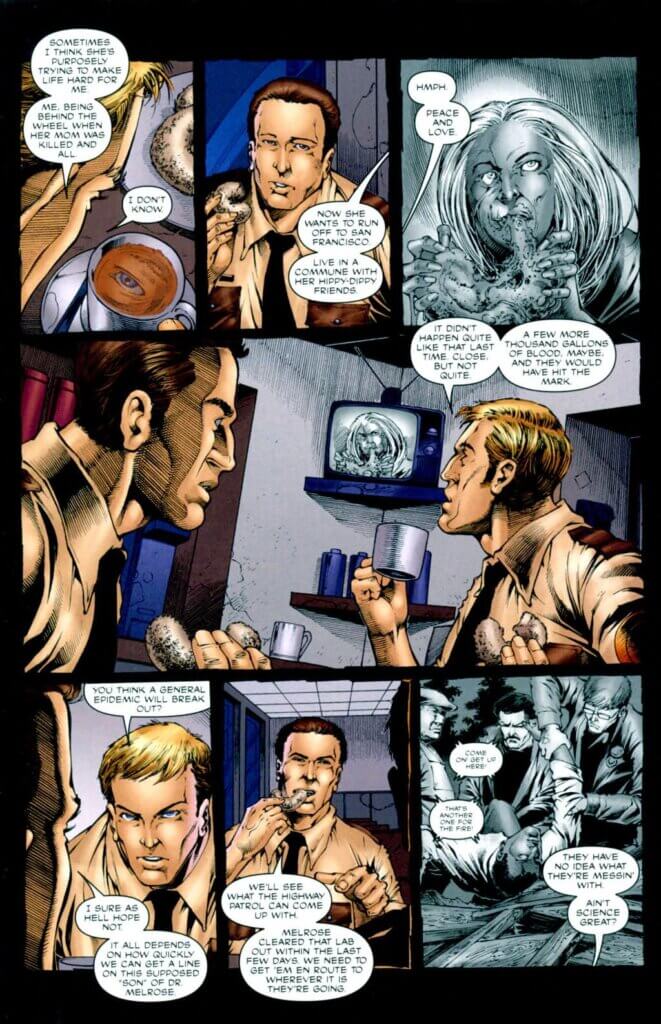
Much of Escape of the Living Dead is a hodgepodge in which moments of inspiration flash up amidst some generally dry stretches. The early home invasion sequence at Brinkman’s farm makes good use of its domestic setting with one zombie getting electrocuted in a bathtub, and the subsequent involvement of the criminals adds a new twist: nobody can use a shotgun against the zombies for fear of alerting the police. At the same time, though, we have such clunky pseudo-sixties dialogue as: “we blow his brains out, like Walter Cronkite used to say on the news” and a screw-up where the line “money makes you forget about being scared” is used in two panels in a row.
The pace admittedly picks up when the dialogue stops, but much of the plot appears to be an excuse to depict lashings of gore, curvaceous women in revealing clothes, and combinations of the two in which lashings of gore emanate from curvaceous women in revealing clothes (indeed, so much female flesh is on display that Avatar felt the need to include a disclaimer assuring us that all characters are over the age of eighteen). Penciller Dheeraj Verma certainly comes through in this regard, showing an eye for composition that allows plenty of peeks up skirts and down blouses, along with a relish for detailed viscera.
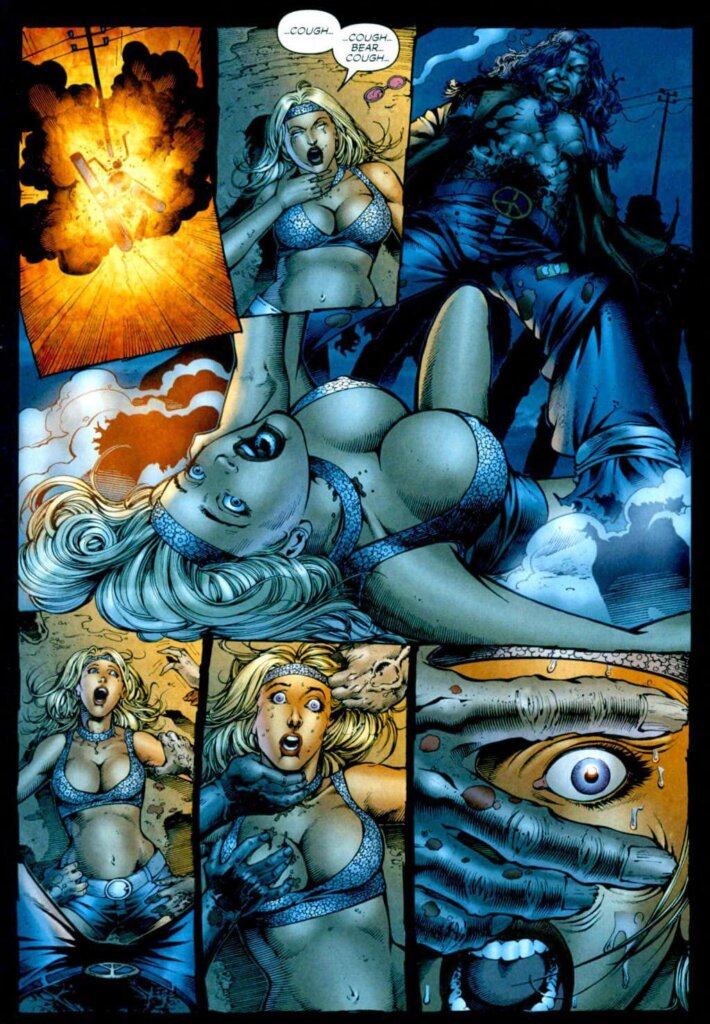
A clear sign of the script’s priorities comes when Honeybear, the bikers’ hippie-chick moll, divulges her backstory. “I used to be a goody two-shoes,” she says. “A bank teller. Then one day, they came in. Took all the cash in the place and me. I gave it up to them, too. Just so it wouldn’t feel so much like rape. Funny thing is, because of that, they treated me like a queen. Whatever I wanted, they bought or stole and I liked it.” Having detailed this turbulent history, she steps out and begins performing a striptease for the male survivors. Not long afterwards, she gets set upon by zombies who make a point out of groping her breast in the process. We are a long way from Judith O’Dea’s convincing portrayal of the traumatised Barbara.
By its end, the Escape of the Living Dead miniseries has failed to find new ground for the zombie genre, instead retreading the farmers-versus-hoodlums-versus-ghouls material from Russo’s Return of the Living Dead novel. Its only halfway novel spins on the formula – the sapient zombie Deadhead and the hunt for Dr. Melrose’s son – turn out to have negligible roles in the plot. The character of Dr. Melrose is also subject to some bizarre inconsistencies: in the prologue, he is clean-shaven, has no glasses, and is shown being fatally injured; yet the end of issue #5 he turns up alive and well, with a bushy moustache and glasses. Something appears to have gone wrong behind the scenes of Escape of the Living Dead.
Both Melrose and Deadhead were repurposed for the sequel miniseries Escape of the Living Dead: Airborne. This opens with the two Melroses (the father having reverted to his clean-shaven appearance) examining the recaptured Deadhead and musing over his mental state, before the action cuts to a new set of survivors: a gaggle of hippies whose bus has gotten stuck in the middle of a swampy forest. They take the opportunity to head out for some sex, drugs, and poetry recitals, but their free-loving idyll is shattered when zombies, among them the escaped Deadhead, turn up to chomp on the flower children.
Airborne shows what would become a recurring trait of Avatar’s Living Dead series: a desire to lean in on the social backdrop of their post-Summer of Love setting. The hippie characters represent different aspects of the youth counterculture. Captain Trips is the resident Jesus Freak; E.C. and Starlight are African-American, allowing the story to touch upon the civil rights movement; and the hitchhikers Apollo and Mercury are a pair of Vietnam vets who do not entirely fit the scene into which they have fallen.
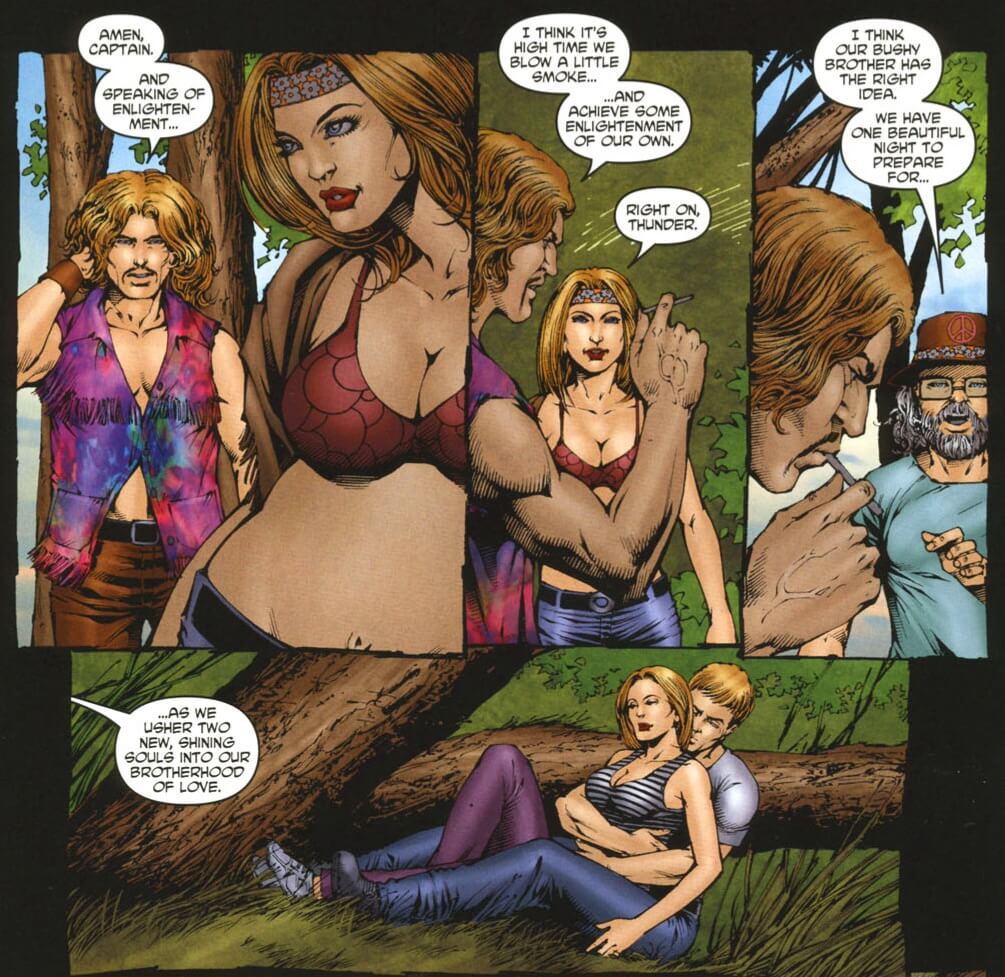
Yet the story does little with these character dynamics, as summed up by the painful scene where E.C. is forced to shake hands and make up with Apollo, even after the latter has been yelling slurs at him. “You two can continue the race relations after we get the fuck out of here,” chides Scorpio, one of the group’s balloon-breasted free love enthusiasts. Elsewhere, a plot point in which Captain Trips goes mad and sees the Deadhead as his messiah is introduced just panels before the Captain gets killed, wasting a promising concept.
With Airborne squandering its potential, what we end up with is essentially a slasher: a backwoods setting, a band of uninhibited youngsters ripe for the plucking, and an emphasis on a central killer in Deadhead. But the Living Dead saga had already tried to enter slasher territory with Flesheater and Children of the Living Dead, and Avatar’s comics should really have had higher aspirations than emulating those two turkeys.
The two specials saw co-writer Mike Wolfe taking over as artist. The annual is really the final issue of Airborne, pitting the few survivors against an appropriately apocalyptic flood (“…and worst of all, these boots are ruined. You know what water does to suede?”). As a conclusion, this turns out to be somewhat anticlimactic with the zombies – including the much-hyped Deadhead – being literally swept away.
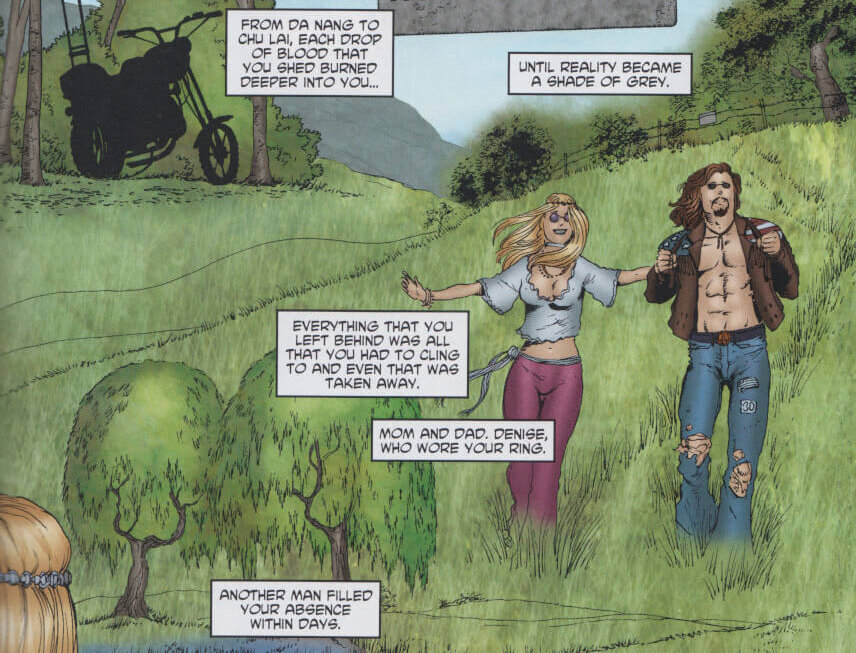
The more interesting of the two is the Fearbook which reveals Deadhead’s origin story. We learn that he was a biker in life — not a neo-Nazi biker like the Sons of Satan, but rather a hippie-adjacent biker who simply wants to enjoy nature, sex, and LSD with his girlfriend. His portrayal clearly owes something to the 1969 film Easy Rider with the living Deadhead resembling a mash-up of that film’s leads, sporting Dennis Hopper’s bushy moustache and fringed jacket alongside Peter Fonda’s stars-and-stripes aesthetic. And as in Easy Rider, the two leads are done in by a band of intolerant rednecks — only unlike Hopper and Fonda, Deadhead can rise again for his revenge.
Although its core narrative is merely a well-regarded film filtered through an EC comics stock plot, the Fearbook stands out for its straining effort to be comics-as-literature. It flirts with Watchmen-style nine-panel grids and employs self-conscious symbolism, as when a panel of a swimming frog is followed by a similarly-composed panel of Deadhead’s girlfriend skinny-dipping. And above all, it has narrative captions of a sort rather more ambitious than the pseudo-Poe of EC. Written in second-person so that the reader is placed into Deadhead’s shoes, these cover a separate narrative showing Deadhead’s history in Vietnam, beginning with anti-war poetry (“My country, ‘tis of thee… the death of liberty… I spread your disease no more”) and going on to describe such sights as the effects of agent orange on Vietnamese villagers.
The effort is unsuccessful, as the underlying narrative is simply too thin to sustain such heavy subject matter. But it remains an interesting example of Russo and his collaborators trying to push the boundaries of their comics and also prefigures the direction that Avatar’s Living Dead projects would later take.
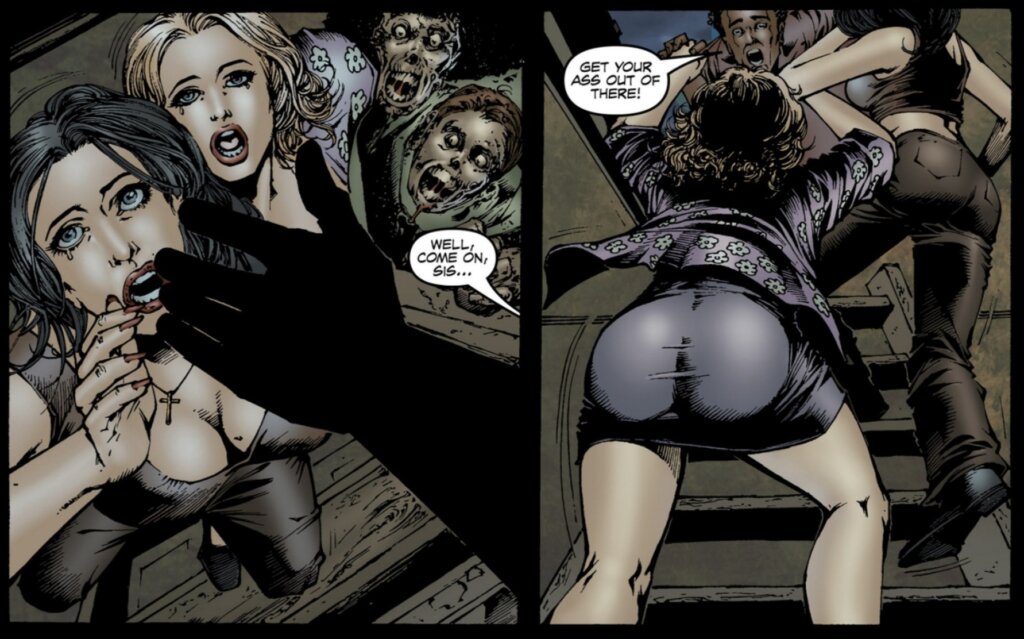
After Escape, the Russo-Wolfer-Verma team reunited for Plague of the Living Dead. This ran for six issues and a special in 2007 – the special actually being the first instalment of the story – and oddly remains the only Avatar Living Dead comic never to have been collected as a trade paperback.
The story is again set in 1971 and introduces a new group of characters: a band of young funsters who are gathered together to talk about sex and Vietnam while preparing for a peace rally. Elsewhere, three soldiers – all romantically involved in one way or another with the peaceniks – are placed under psychiatric observation after claiming to have seen walking corpses in Vietnam. This turns out to be a cover-up: having burnt the evidence, the powers that be are now disposing of the witnesses.
The soldiers manage to escape confinement and head back to their hometown which is, coincidentally, now being attacked by zombies. The story leads to the squaddies and peace-lovers holed up together as the living dead chomp down on their latest smorgasbord, leading to a routine and drawn-out zombie yarn with the same combination of sex and violence embraced by Escape of the Living Dead. In this war, the first casualty is not truth, but rather the tops worn by the female characters.
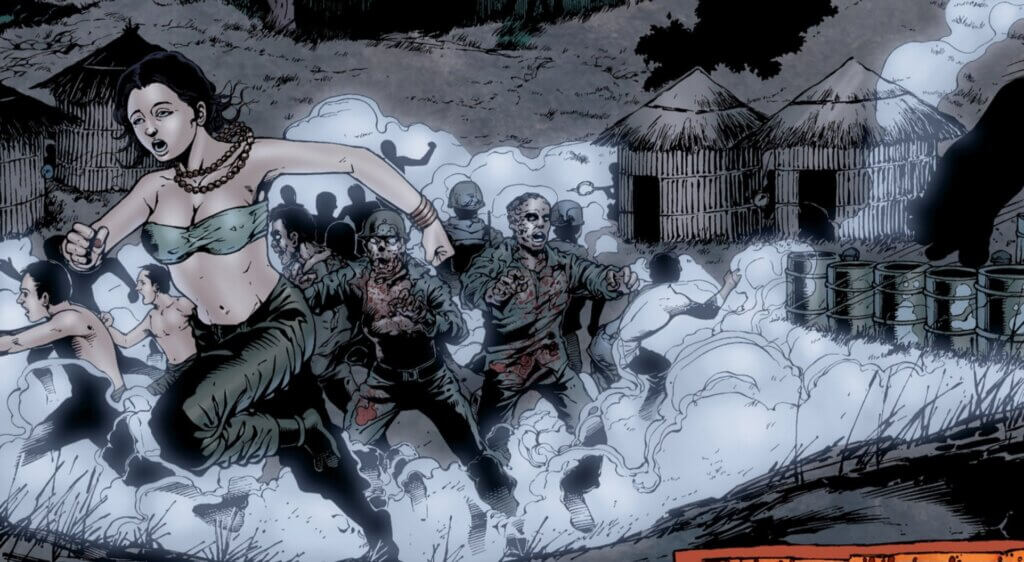
Although Plague of the Living Dead makes an effort to pad itself out with soap operatics about the characters’ love lives, the main problem with the series is that its most intriguing idea – the US military deploying dirty tricks to cover up the presence of the living dead in Vietnam – is relegated to its backstory. But then, the comic again shows little sign of being in any way equipped to tackle such heady themes. Despite an eagerness to say something about the Vietnam War, Plague settles for treating that conflict in the same way that Nazisploitation films like Gestapo’s Last Orgy treat World War II: witness the flashback that culminates in a weirdly sexualised scene of Vietnamese villagers (led by a busty young woman in a tube top) fleeing from zombie soldiers.
While Plague of the Living Dead was still running, Avatar had begun putting out short-form comics under the official Night of the Living Dead title, typically with George A. Romero’s name on the cover despite his lack of direct involvement. These were eventually collected into the 2010 trade paperback, Night of the Living Dead Volume 1.
Their centrepiece was Night of the Living Dead: The Beginning, a three-issue miniseries from 2006 in which Russo and Wolfer partnered with artist Sebastian Fiumara to deliver a prequel to the film. Depicting the diner attack mentioned onscreen by Ben, the story goes along the same general trajectory as the previous Avatar series with zombies munching guts, women flashing their nether-regions, and broad gestures towards social issues (in this case, a white racist gets his just deserts at the teeth of the living dead). By virtue of being squeezed into three issues, The Beginning is much more tightly-paced than Escape or Plague and stands as a solid and engaging, if hardly groundbreaking, zombie romp.
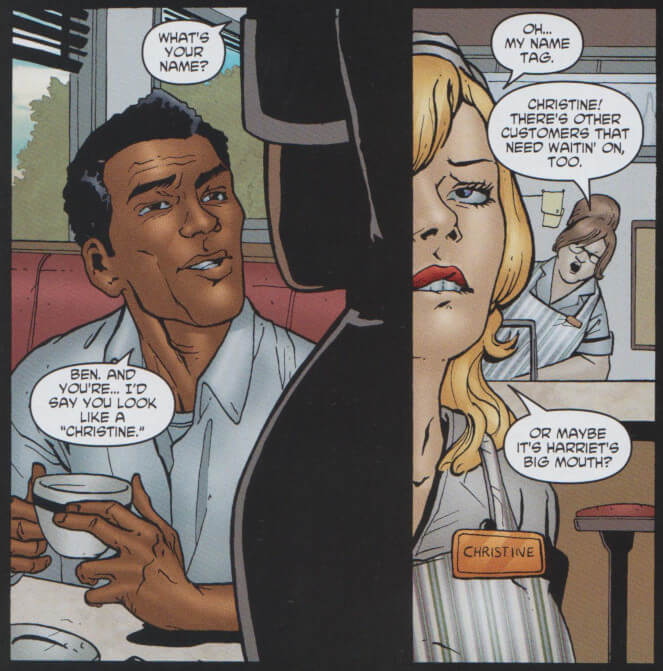
It does, however, fall into the basic conceptual problems faced by the extended edition of Night of the Living Dead and the FantaCo Prologue/Aftermath comics: how, exactly, do you expand upon the plot and characters of the film when the whole point is that the characters are ordinary people caught up in a single taut narrative? The Beginning shows us the initial resurrection of Bill Hinzman’s Graveyard Ghoul, offers an abortive subplot about the woman whose body is found in the farmhouse, gives a brief cameo to Barbara and Johnny as they drive to the cemetery, and has a supporting role for Sheriff McClelland. The central character in all this is Ben, who receives a dramatic half-page introduction at the end of issue #1 – the sort of scene used when, for example, a Batman comic reveals the Joker is loose again. This shows a failure to grasp the basic fact that Ben is an everyman: outside the context of the film’s plot, he has no particular interest.
As for the one-shots scripted by Russo and Wolfer, the most interesting by some margin is Night of the Living Dead: Just a Girl, published in 2007 and drawn by Edison George. Here, the last hours of the little girl Karen in the farmhouse basement are used to frame a narrative of her hard life: we read of her parents’ death, her time in an orphanage where she was bullied by other children, and her adoption by the Coopers.
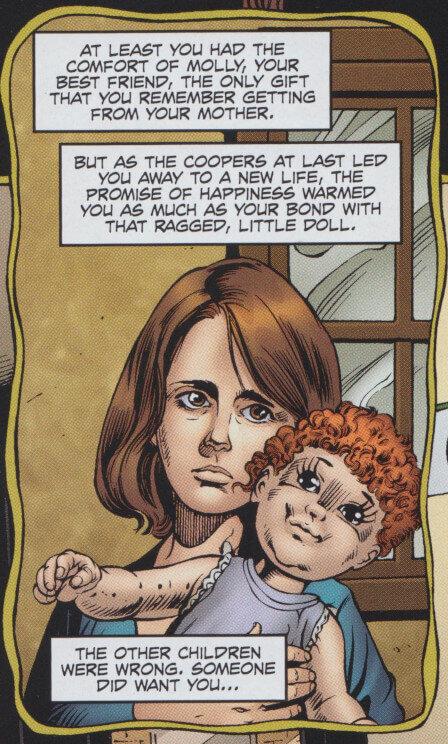
Her new father is revealed to have abused her, and her new mother to have enabled the abuse; the comic’s climax, which restages the film’s depiction of Karen eating Mr. Cooper’s corpse before stabbing Mrs. Cooper becomes a story of monstrous revenge in the 1950s EC Comics tradition. Just a Girl is distinctly coy about its chosen topic of child abuse which is shown only in a panel sequence and rendered in vaguely Dickensian terms: Mr. Cooper forces little Karen to work in his dry-cleaning business, and when she leaves a stain on a suit, he yells at her and takes away her doll. While not entirely convincing, this broad-strikes melodrama is, again, consistent with how EC Comics tackled social issues. Just a Girl stands as one of the more successful attempts to expand upon the characters of the original 1968 film, even if it ends up a throwback to a pre-1968 horror mode.
The other one-shots are less ambitious. 2006’s Night of the Living Dead: Back from the Grave, an eight-page special with a paper-thin plot about zombies attacking campers, is more than anything else a showcase for Sebastian Fiumara (who is, in fairness, about the most accomplished artist to have been associated with the Avatar Living Dead projects). The following year brought Night of the Living Dead: Hunger. Set at a drive-in cinema that gets attacked by both armed robbers and zombies, this gives a hyper-concentrated helping of grindhouse gore and sleaze, courtesy of the intricately gruesome art of Ryan Waterhouse. A particularly memorable two-page sequence includes a pair of men having their brains literally blown out by guns while a woman survives having her head shoved into a deep-fat fryer only to sustain a massive bullet wound in the chest – and this is before the zombies turn up.
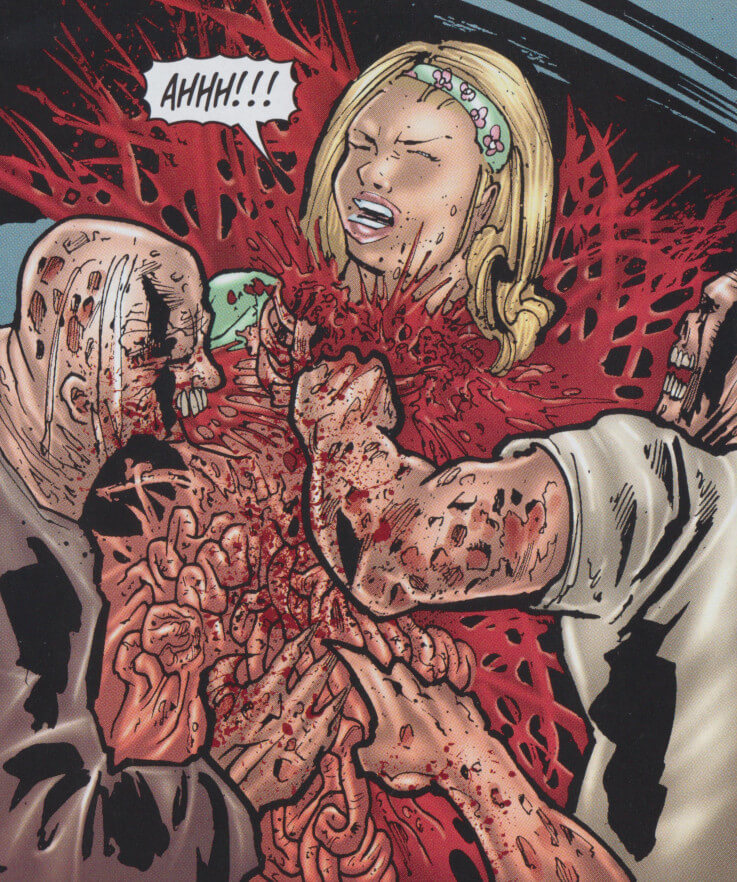
The 2008 Night of the Living Dead Annual, drawn by Edison George and Luis Czerniawski, serves as a coda to both the film and the three-issue miniseries. It is memorable mostly for having one of its protagonists attacked by a zombified Barbara – an image that stems naturally from the film, yet took a remarkably long time to be used by any of the tie-ins. A year after this came Night of the Living Dead: New York, an extra-sized issue that ditches the backwoods and smalltown settings of the other comics in favour of an urban milieu, but otherwise consists of the same combination of naked women, headbanded hoodlums and gut-munching zombies, here drawn by Fabio Jansen (and also committing the astonishing faux pas of naming a character “Knuckles” in the year 2009).
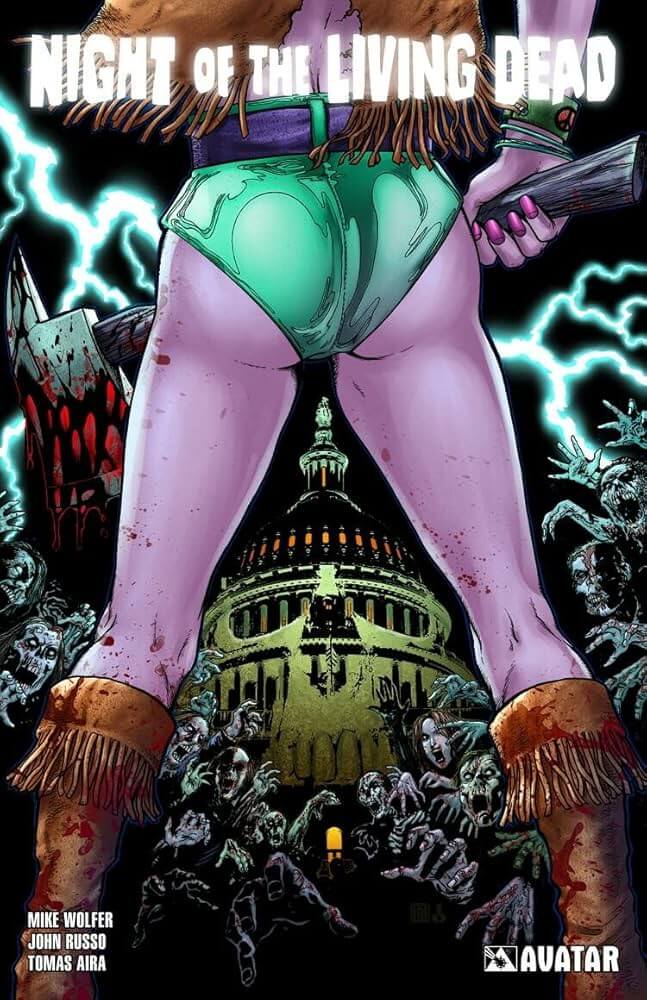
Avatar’s next outing for Russo and Wolfer was a five-issue miniseries, titled simply Night of the Living Dead, which ran from 2010 to 2011. Drawn somewhat wonkily by Thomas Aira, this moves the action to another big city: Washington D.C. in 1968, where anti-war protesters and the National Guard are preparing to face off. This premise appears to be derived from the fact that 1968 was the year in which the capital saw days of rioting and a protest at Howard University in response to the murder of Martin Luther King Jr. However, the comic mentions King only once in passing and instead leans once more into the topic of the Vietnam War and its opposition. Unlike the more superficial Plague of the Living Dead, the series shows a determination to get its hands dirty in the politics behind this conflict, even including Lyndon B. Johnson in its supporting cast.
While it is easy to be cynical about the comic’s emphasis on scantily-clad hippie chicks (the cover to the Night of the Living Dead Volume 2 trade paperback collection shows an extreme close-up of a girl’s backside), the general impression is that the comic is sincere in both its countercultural nostalgia and its indignant condemnation of US foreign policy. It also comes up with innovative ways of exploring its themes: two of the reader-identification characters are African American soldiers in the National Guard, faced with both a racist white superior and the cluelessness of white hippies who apparently believe all “soul brothers” carry marijuana.
Which raises the question of exactly what the story gains from having zombies. One character, a soldier sent home with an injury, spends a chunk of the narrative planning to expose an atrocity that he witnessed in Vietnam; those who kept up with Avatar’s comics might assume that this involves the presence of zombies in the conflict, a plot point in Plague of the Living Dead. But no: his two-page speech, given at the midpoint of the series, turns out to be a description of the My Lai massacre (thinly fictionalised as the Hoi Lai massacre). This is all commendably earnest – but it clashes absurdly with the lurid, gut-munching zombie yarn that surrounds it.
Watchmen inserted superheroes into the Vietnam War, yes. But the superhero genre is one inextricably bound with the themes of power, authority, and American self-image, and any attempt to deconstruct it will lead naturally into such topics as the bloodier aspects of US foreign policy. Zombies do not work the same way as superheroes. While topics from the Vietnam War to 9/11 can be read into the subtext of the genre, Avatar’s comics fail to make the case for elevating this subtext to literal subject matter.
Only towards its close does the miniseries show any sign of uniting its disparate components. The penultimate issue has scenes of soldiers firing on protesters who then rise as zombies and keep on marching; living protesters march alongside them, only to be eaten in turn. Although not entirely coherent, there is an undeniable rawness to this imagery – behind the crude, muddied execution we can glimpse a Kent State-era update of the ghostly World War I soldiers in Abel Gance’s J’Accuse.
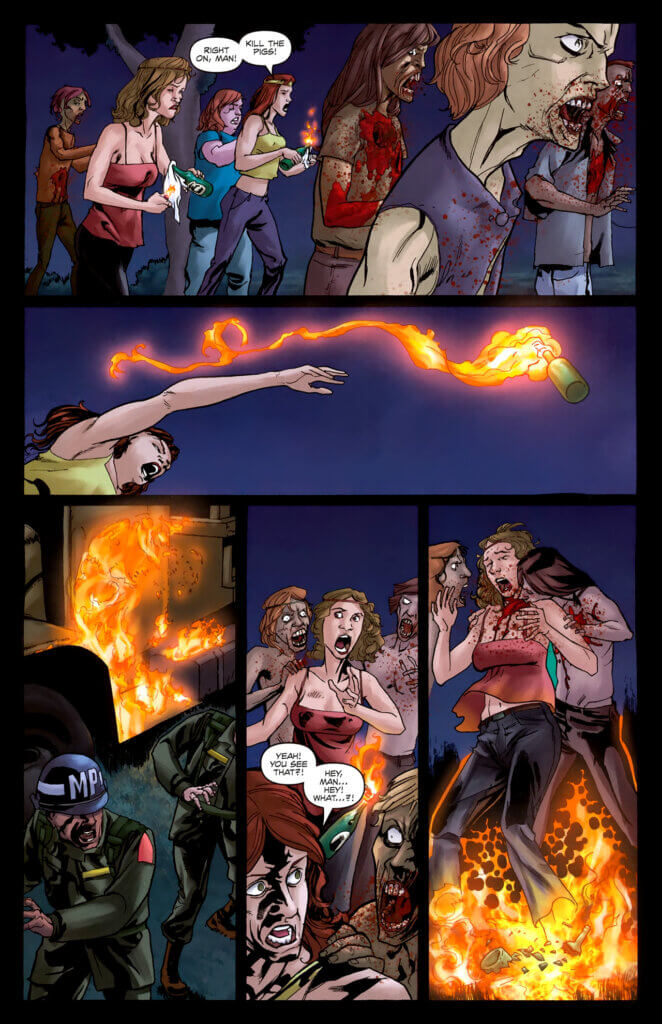
This spirit fizzles out by the end of the comic with the final issue being largely a routine barricade-the-doors zombie narrative, this time set in a church. It does, at least, mount a clever reversal of Ben’s death from the original film: one of the Black soldiers shoots his racist (and still) living superior in the head. All those who witnessed the act agree to roll with the story that the man had become a zombie and needed to be put down.
This was Russo’s last contribution to the line, although Avatar had a few more Living Dead comics in store. Mike Wolfer served as solo writer and artist on the 2010 Night of the Living Dead Holiday Special and the 2011 Night of the Living Dead Annual, as well as re-teaming with artist Dheeraj Verma for the 2011 miniseries Night of the Living Dead: Death Valley. The three titles show a marked departure from their precursors.
Although the stories are still set in the late 1960s, they never engage into their era to anywhere near the same extent as those co-written by Russo. Each uses an isolated setting (a snowed-in cabin, a Louisiana bayou, a desert) so far removed from the Washington D.C. of Johnson and Nixon that it may as well have been a different country. The occasional references to current events could easily have been swapped out: when a racist character rants about Martin Luther King Jr., he may just as well have been ranting about President Obama. About the only significant element of 1960s culture is the presence of a Charles Manson-like antagonist in Death Valley – and even then, Manson had already been used as a character in Barbara’s Zombie Chronicles, which was set in the 1980s.
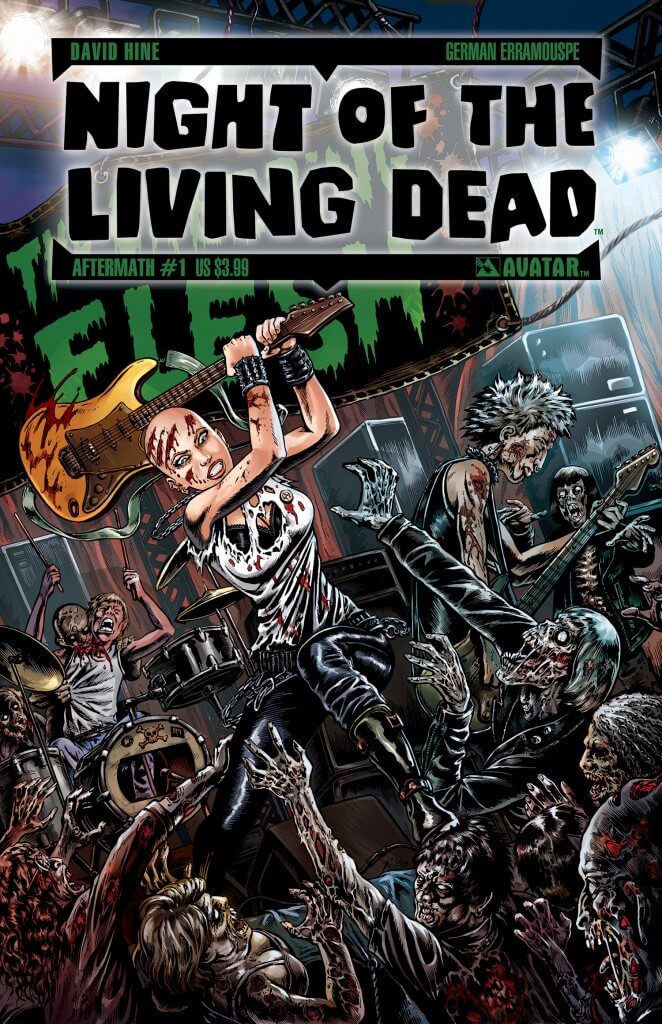
Then came Night of the Living Dead: Aftermath. Not to be confused with the identically-named FantaCo one-shot, this was a twelve-issue series that ran from 2012 to 2013. David Hine, an alumnus of 2000 AD, scripted the story while German Erramouspe, Ernesto Chaparro, and Tomas Aira led the art team. The comic flings together a likeably oddball cast including a zombie insurance salesman, zombified Elvis impersonators, and a punk-rock chick who happens to be the daughter of a Republican senator, all against a backdrop of Las Vegas in 1977. The second half, which relocates to a shady military establishment, loses the more inventive and humorous touches.
And those inventive and humorous touches that Hine brought to the start of Aftermath highlight what Avatar’s earlier titles had been missing. Russo and Wolfer’s zombie comics flicker like a strobe light between earnestness and schlock, but fail to include a vital quality: a sense of fun and an acknowledgement of how absurd it all is.
Notably, this is an element present across the previous attempts at Night of the Living Dead comics from FantaCo, Dead Dog Comics, and DC. Those titles showed us the British royal family sipping tea after London has fallen to the living dead, Chelsea Clinton battling zombies in Disneyland, a gun-armed good-guy ghoul riding into the fray atop his trusty elephant, and Barbara fending off zombie aliens only to run into President Manson. This is the kind of material that Avatar’s comics desperately needed – yet ultimately sacrificed in favour of muddled baby-boomer ruminations and panel after panel of ghoul guts and girl butts.
Which brings to mind an oft-quoted comment by Pauline Kael: “movies are so rarely great art that, if we cannot appreciate great trash, we have very little reason to be interested in them.” Such a standpoint is, if anything, even more applicable to zombie comics. John Russo’s Living Dead comics, despite stretching across 28 issues, missed their chance to become great trash.
Next: Shambling into the sunset…
