

Continuing a series that celebrates the fifty-fifth anniversary of Night of the Living Dead with a look at the classic zombie film and its many follow-ups.
Less than a year before George A. Romero made his long-awaited return to zombie cinema with Land of the Dead, comic fans had the opportunity to see him take his living dead in a rather different direction. Toe Tags, a six-issue series published by DC Comics between October 2004 to March 2005, gave the world an all-new story scripted by the auteur himself. Although it has no official connection to any of his films, any zombie apocalypse narrative penned by Romero surely deserves a mention among the many follow-ups to Night of the Living Dead.
The director-turned-comic scribe talked about the origin of the project in a 2004 interview with Dread Central:
I loved doing it! They called up and wanted to do some limited edition, six-issue stories written by filmmakers instead of comic book guys. They called me up first and asked if I had any ideas. I said to give me a couple of days, and I came up with one. They dug it, and so I wound up writing it. I just had a ball doing it.
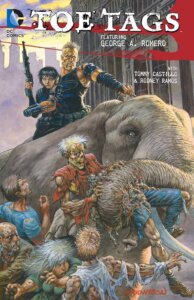
The main character is Damien, a college student who (as revealed in flashbacks) lost his parents and very nearly his life in a zombie attack. Badly mutilated and succumbing to infection, he sought refuge with scientist Professor Hoffman. With the professor’s help, Damien was saved from full zombification – albeit only through being transformed into a stitched-up, Frankensteinian creature with a gun for a hand.
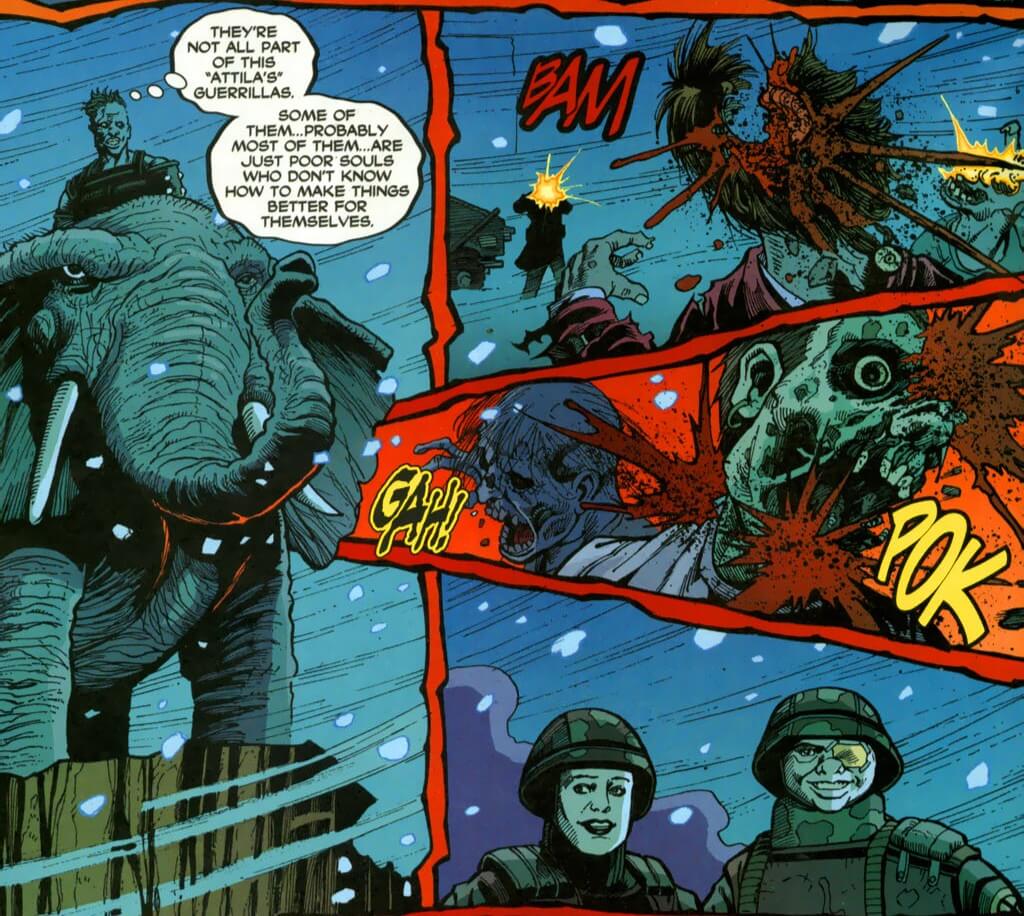
Hoffman happened to have his own zoo, and Damien went through the trouble of freeing the caged animals to save them from the zombies. And so we arrive at the story’s present, when gun-handed Damien rides his pet elephant Mister Tembo through hordes of the living dead. Along for the ride is Damien’s girlfriend, Judy McMillan, who is fast adapting to the apocalyptic environment: her lab-coat even gets torn into a very chic midriff-baring garment.
Damien is not the only sapient zombie. Newspapers report that the flesh-eating horde is led by a ghoul dubbed Attila; in turn, Attila has an advisor named Rasputin, who serves as a sort of PR department by trying to keep his comrade from eating too many reporters (“That food is not good to eat. It used to be a newsman. Newsmen tell stories about us. Make people think we are heroes! Revolutionaries!”). But are Damien and Attila destined to become enemies, like the Professor X and Magneto of the zombie world – or allies against humanity’s evils?
A story about a “good guy zombie” is an entirely natural fit for Romero’s entry into comics, and the concept is rich with potential. American comics have a longstanding tradition of monster-heroes: the partial loosening of the Comics Code in the 1970s led to a tide of comics like Swamp Thing that were, essentially, superhero stories in Halloween dress, putting good ghouls against badder beasts. Meanwhile, Romero had evidently become interested in the notion of the humanised zombie, an idea he introduced with Bub in Day of the Dead and would return to in his subsequent zombie films. With the character of Damien, Romero was in a position to explore that boundary between human and monster using all of the larger-than-life melodrama associated with superhero stories. Which makes it a shame that Toe Tags’ whole model of good and evil is based on a major misjudgment.
The relevant plot point comes into play when the ailing professor passes his work on to Damien. “If there is something…different in you, Damien, there’s got to be some way to identify it, isolate it…so perhaps…maybe it could be used.” As well as science, he is interested in moral philosophy: “a dead man…is still a man. There are good men…and evil men.” Then, shortly before his death, the professor begs the good zombie Damien to unite science and morality: “Look for the difference. The difference between good men and evil men. It has to be there. Somewhere in the blood. And as long as it’s there…it can be found. Find it, Damien! Find it!”
Damien initially dismisses all of this as nonsense. But then, studying a blood sample beneath a microscope, he notices something among the cells: a curling strand, like a spiral bacterium or Ebola virus. “It’s there!” declares Damien, having found the biological root of evil. “There is a difference between good men and evil men.”

Given the liberal-minded outlook that characterises most of Romero’s work, this is remarkably reactionary. What we have here is the sort of pop-eugenics found in the 1930s pulp stories of Doc Savage, where violent criminal tendencies were blamed on a certain gland in the human body and could be cured via surgery. Seeing the concept revived in the twenty-first century is regrettable, to say the least. The ugly business also distracts from the comics’ better-considered musings about the morality of power and conflict.
Damien’s personal morality is defined by his mistrust of humanity’s tendency towards militarism: the urge to follow the most violent person in society. He is unconvinced by survivor Billy, who is forming a militia.
“If guys who wanna do wrong can recruit armies,” asks Billy, “why can’t guys who wanna do right?”
“No reason…” replies Damien. “Except… it’s never happened… all through history.”
Damien’s argument is reinforced when, shortly afterwards, a heavily-armed settlement turns its guns on Billy’s militia without provocation, Small wonder that our rotting hero ends up feeling more sympathy with the zombie leader, Attila. However, Attila’s zombie horde turns out to have a traitor in the form of a human spy.
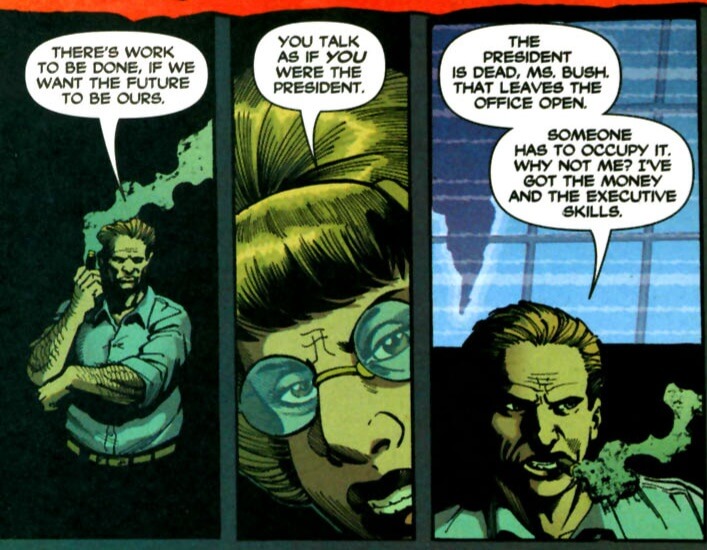
Which brings us to the comic’s main villain: Mr. Rice, former CEO of Entron, and the man responsible for creating Atilla using a tampered version of the professor’s serum. He may have bankrupted his multi-billion-dollar company, but the zombie apocalypse has given him a new opportunity for power. “Do I want to be president?” he asks. “No. I want more than that. I want to be king! Emperor if things keep going the way they are. I might even end up ruling the world!” The political commentary is so unsubtle as to be rather charming: not only does Romero associate his villain with a satire of the 2001 Enron scandal (if adding a “T” to the corporation’s name can be called a satire), he also gives Rice a pair of underlings named Bush, Powell and Cheney.
A large amount of Toe Tags amounts to Romero having fun with a medium in which he can get away with far more than the film industry would allow. The results are occasionally clunky, as when Judy’s reaction to seeing Damien resurrected as a gun-handed revenant is to take him to task for being late (“You said you’d be back in an hour. That was weeks ago!”) For the most part, however, what we get is an infectious sense of fun. Here, Romero can throw such mundane concerns as effects budget and critical acclaim to the wind and tell the story of a heroic super-zombie riding around on an elephant.
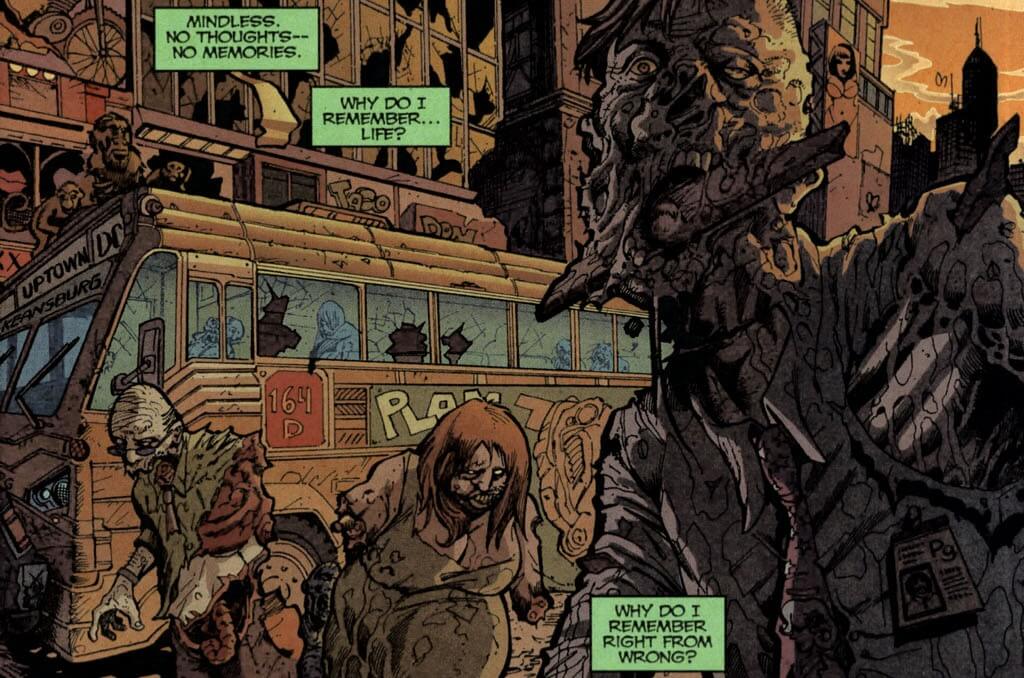
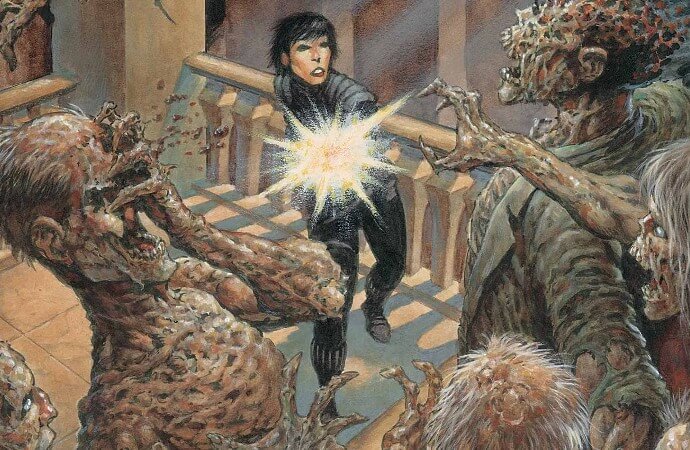
As writer, Romero is joined by an accomplished set of artists – penciller Tommy Castillo, inker Rodney Ramos, and colourist Lee Loughridge – to bring his visions to life. Although the legendary Bernie Wrightson was the artist used to sell the comic, his work adorning the covers, no reader should be disappointed by Castillo and company providing the interior art. The kinetic panel layouts, the lashings of intricately-drawn gore that contrast with the clean compositions, and the occasional moment of off-colour humour (witness the flies buzzing around Damien’s head) are exactly the aesthetic that the pulpy adventure needs.
Also helping the project is the grounding of Romero’s plot in the same essential set of themes as his ongoing zombie films. Beyond the wacky matters of cyborg anti-heroes, rampaging undead monkeys and evil blood, we have a story that climaxes with a band of sympathetic zombies marching upon the corridors of money and power – not too far removed from Land of the Dead, which Romero was working on at the same time. What makes the writing in Toe Tags a cut above that of Barbara’s Zombie Chronicles is that it is still, at heart, very much a Romero project.
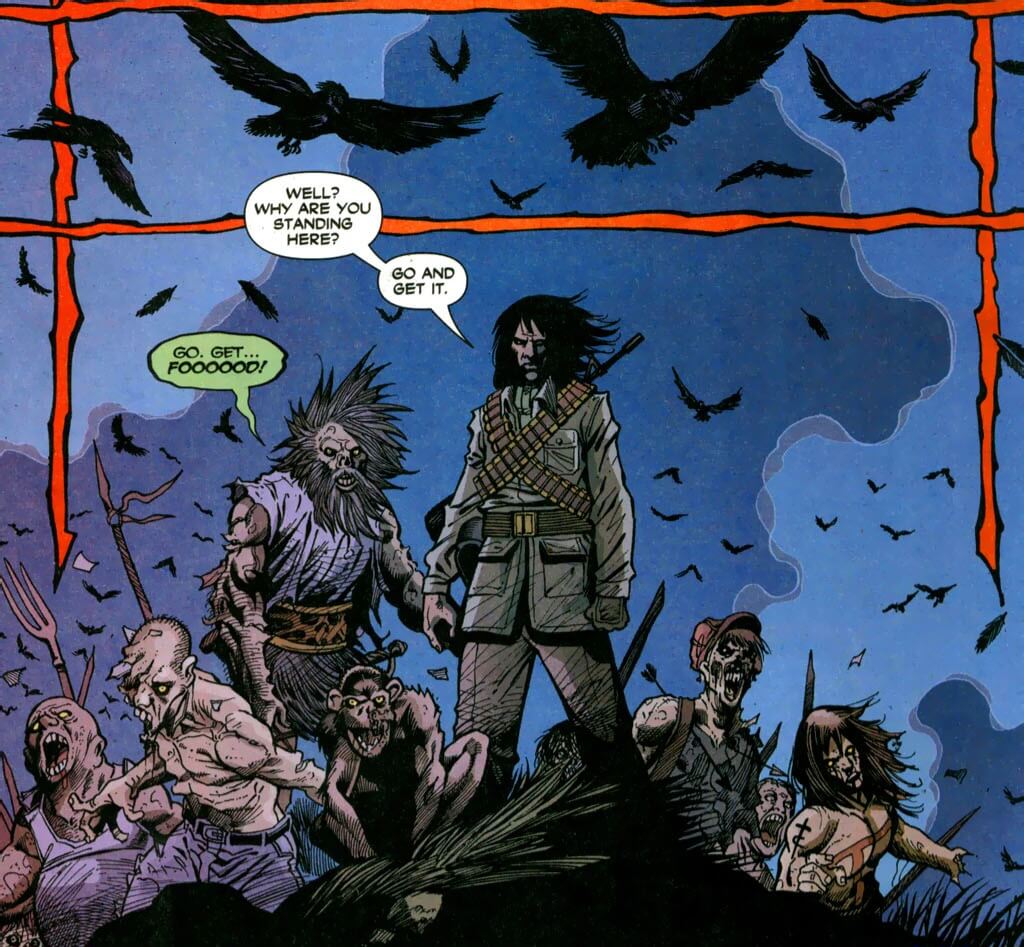
In the 2004 interview cited above, Romero suggested Italian horror director Dario Argento as a man who could write a future story for Toe Tags. This was not to be: the series ended when Romero’s story was wrapped up after six issues. It appears to have been soon forgotten, as it was not collected as a trade paperback until 2014; this was likely an attempt by DC to cash in on Empire of the Dead, a series Romero wrote for Marvel Comics which debuted that year.
Given the comic’s eccentricities, few would be surprised at Toe Tags failing to enmesh itself as a classic. Yet it allowed Romero the opportunity to have some additional fun with the ghoulish playground to which he had, at long last, returned. Who could begrudge him?
Next: Land ahoy…!
