

Continuing a series that celebrates the fifty-fifth anniversary of Night of the Living Dead with a look at the classic zombie film and its many follow-ups.
Throughout the nineties, horror aficionados had been tantalised by the prospect of a fourth Living Dead film directed by George A. Romero. Fans had even come up with two catchy nicknames for the hypothetical release: Dusk of the Dead and Twilight of the Dead (this was, of course, some time before the word “twilight” became indelibly associated with sparkly vampires).
Romero himself had long expressed enthusiasm for such a project. In an October 1998 chat session with online fans, he gave his thoughts on what a Living Dead film should look like in the century’s final decade:
I do think that the films are different, but I think that all three are different. The Dawn is very bawdy and silly, Day to me is in a way even darker than the original Night. As I said before, the 90’s version would probably be the silliest of all! Because the 90’s are the silliest decade that I’ve ever lived in! So, you’ve just got to be silly! I hope that if I get to do it, that it will reflect the 90’s adamantly, and I hope that the other films reflect the decade in which they were made.
His enthusiasm did not necessarily translate to optimism, however. In another online chat from the same month, Romero talked about his struggles to obtain financing for full-blooded horror in an era when self-parodies like Wes Craven’s Scream (1996) were in vogue:
I would love to do it, and I would love to do one in the 90s and I have an idea, but no one will support the budget. There is a new attitude out there that makes it very hard to do unrated films. I wound up cutting a lot of DAY – except for a couple, no one wants to go with a non rated film. Everyone is afraid to take a chance. […] I am not a big fan [of contemporary horror films]. Wes is a good friend and I have great fun watching his films, but I don’t think they are advancing the genre, some of it is just humor, and I don’t find much of it at all that is using the genre as metaphor, it is just a thrill ride and not much more. I wish more studio people were into the genre and willing to finance it.
All of this was before the zombie renaissance of the twenty-first century, of course. Come the new millennium, Romero was finally able to deliver the fourth chapter in his zombie saga: not Dusk, not Twilight, but Land of the Dead, released in 2005.
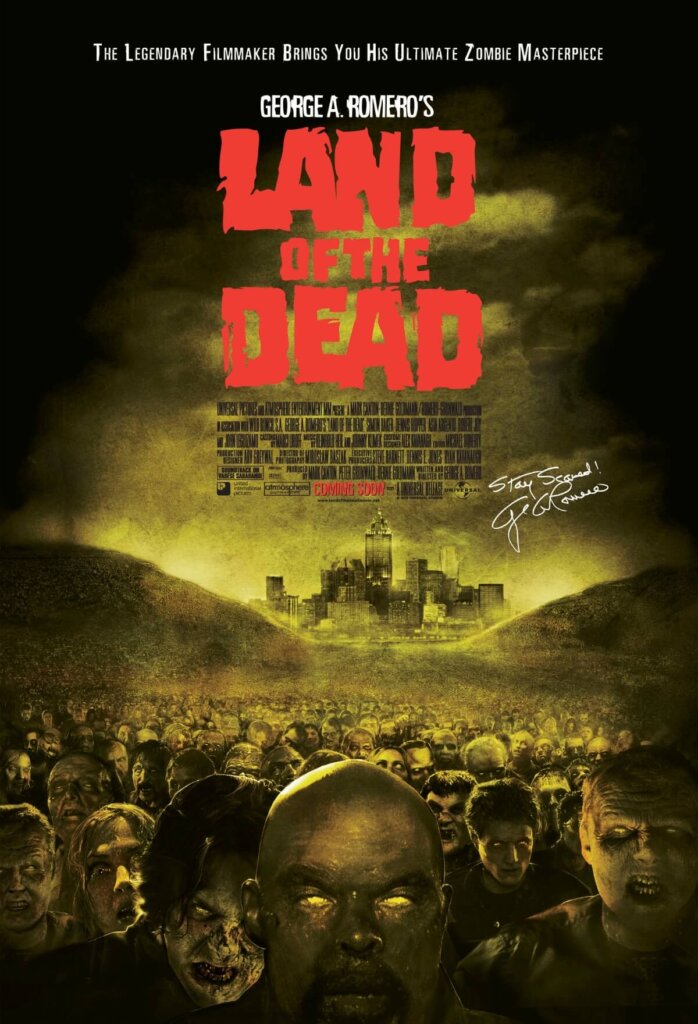
Like Day of the Dead, the film takes us to a world entirely overrun by zombies. Where its direct predecessor focused on a single community living underground, Land shows us life on the surface. In the remnants of Pittsburgh, a wealthy elite has retreated into the safety of a skyscraper dubbed Fiddler’s Green, while an underclass is forced to scrape by in a heavily-armed shanty town. Typical of the hardware necessary to stay alive in this environment is Dead Reckoning, a military-grade road vehicle manned by Cholo DeMora (John Leguizamo) and Riley Denbo (Simon Baker).
In turn, these two characters embody different sides of the post-apocalyptic underclass. Cholo is a self-serving character whose only desire is to survive his dog-eat-dog existence long enough to be accepted into Fiddler’s Green. Riley, on the other hand, is a kind soul who helps those in need. He recruited the third member of the Dead Reckoning team – twitchy, nervous Charlie – after saving him from fire, and during the course of the film also rescues Slack (Asia Argento), a sex worker used as bait in a zombie pit fight.
But humans are not the only characters of note. With the test-subject zombie Bub in Day of the Dead, Romero had begun exploring the possibilities of zombies becoming individual characters in their own right; in Land of the Dead, he takes this idea further.
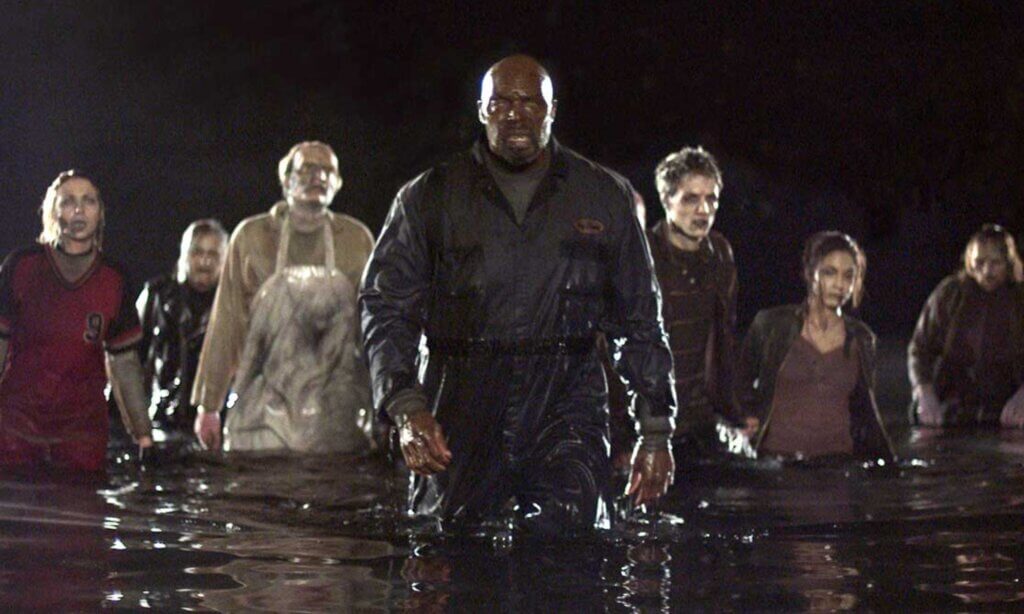
An early scene introduces a community of zombies as they go about their daily un-lives. We see a zombie postman slogging from mailbox to mailbox; a pair of zombie lovers strolling side-by-side (and looking oddly like Edward and Bella from the yet-to-be-made Twilight films); and even a zombie band, each member tunelessly playing his instrument. Rather than a mere joke, this is a major part of how the film conceives zombies: like Bub, they are regaining some semblance of sapience.
So, when the Dead Reckoning vehicle and its band of gun-toting zombie hunters drive into the area and begin gunning down the ghouls, the audience is primed to side not with the survivors but with the living dead underdogs – who were, after all, simply minding their own business. The zombie postman survives the attack and becomes a sympathetic figure, rallying others of his kind to march upon Fiddler’s Green in revenge.
The film’s determination to do something new with zombies is palpable, with just about every set piece managing to squeeze in a new way to make the flesh-eating corpses visually interesting. Romero and company appear to have absorbed some of the cartoon inventiveness from the Return of the Living Dead series: in one scene, a character is attacked by a zombie that initially seems to be headless, only for its head to swing onscreen by a flimsy piece of tissue like a ghoulish, chomping tetherball. The methods of zombie hunting are kept similarly engaging. Forgoing the empty slow-mo gun fetishism of the Dawn of the Dead remake, Land of the Dead gives its cast innovative methods such as distracting zombies with firework displays.
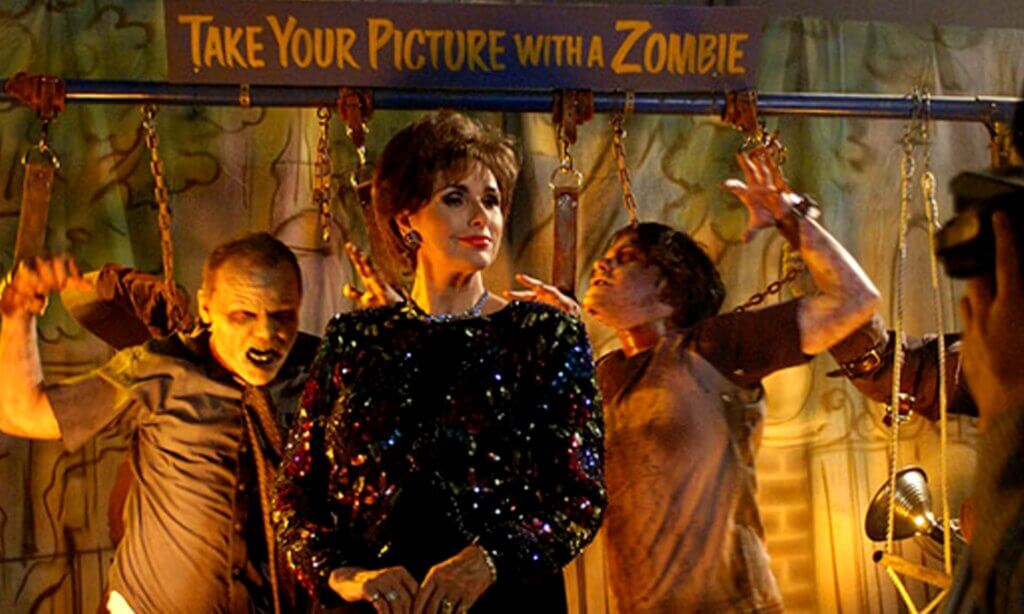
And then we have the setting. For the first time in his zombie series, Romero does away with his typical choice of confined, high-pressure locations (the farmhouse in Night, the mall in Dawn, the bunker in Day). Instead, we are given a varied range of backgrounds: an underground nightclub where zombies are used for pit-fights and photo ops; the all-too-easily shattered glass walls of Fiddler’s Green; and between these two, a full-on road trip through a scarred wasteland between the two. The film’s title is entirely accurate.
This expansion of the series’ setting comes with a trade-off. The pressure-cooker tension that was present in Night of the Living Dead, and which gradually dissipated over the course of the sequels, is almost completely absent in Land of the Dead. If Day of the Dead was summed up by the intriguing yet completely restrained zombie experiments in Logan’s laboratory, then Land is summed up by the slow, steady march of zombies, who regularly find interesting things along their way but are evidently in no hurry to reach their destination.
Having been given a considerably larger budget at his disposal than in any of his previous zombie films, Romero used it to build not a twisty-turny rollercoaster but a lavish stage for his actors. A lot of the character interactions feel like the result of the cast being given minimal lines and allowed to simply get on with things themselves. Sometimes this results in sequences best described as grittified Scooby-Doo routines ( a running gag involves people firing guns too close to each other’s ears). For the most part, however, it works.

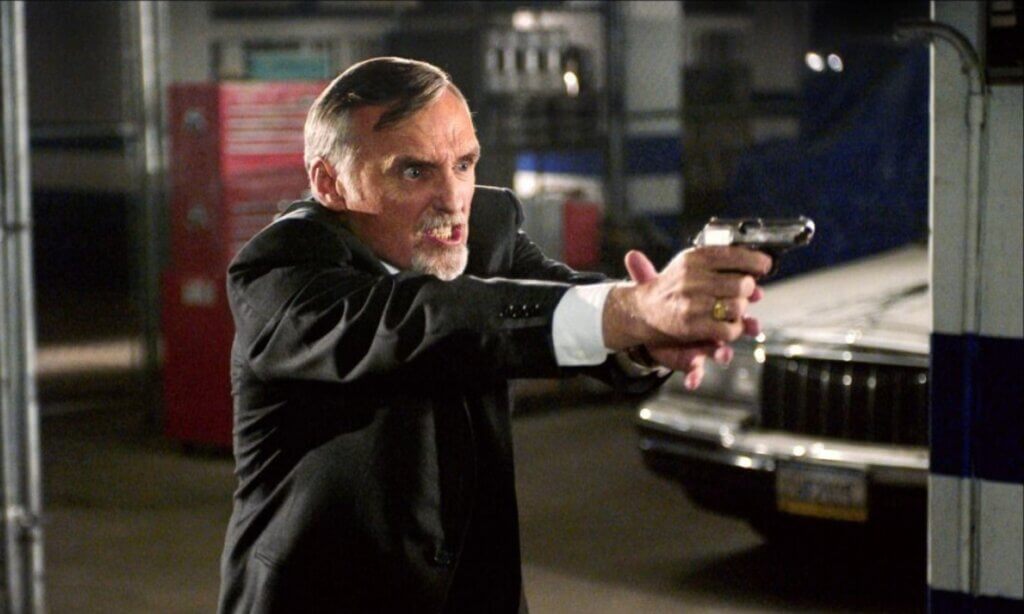
Particularly watchable are the two main villains, Leguizamo’s Cholo and Dennis Hopper’s Paul Kaufman (their previous dystopian film together was, of all things, 1993’s Super Mario Bros). Perhaps drawing upon his past roles in Carlito’s Way (1993) and Romeo + Juliet (1996), Leguiziamo plays Cholo as a fast-talking, smart-mouthed gangster. As Kaufman, the plutocrat at the top of Fiddler’s Green, Hopper portrays a man who has come to take his tremendous privilege for granted and seems largely unflapped by the chaos of the outside world. His dialogue is calculatedly clueless: “Zombies, man. They creep me out.”
At first, the two ostensibly work together, with Cholo acting as Kaufman’s mercenary. When Cholo asks for a place in Fiddler’s Green, the reactionary dimwit-in-chief Kaufman comes to see him as no more than a terrorist. The connection between Kaufman and American President George W. Bush was pointed out by various reviewers upon the film’s release, although Roger Ebert, in a curious instance of precognition, instead compared the character to Donald Trump.
Some viewers found the film’s sedate pace and less-than-subtle satire to be off-putting. Reviewer Nick Schager, for one, derided it as being “about as lively as a piece of roadkill” and opined that “[h]aving to listen to Dennis Hopper’s materialistic fiend pronounce, ‘We don’t negotiate with terrorists’ and Leguizamo’s Cholo claim ‘I’m gonna do a jihad on his ass’ is enough to make anyone want to permanently bury their head in the ground.” On the whole, however, the reception was positive, with Land of the Dead pleasing both those who wanted lashings of inventive gore and those who were hoping for a twenty-first century update of the more cerebral aspects of Romero’s past zombie films.
That said, looking at the film’s contemporary reviews, there is a distinct impression that Land of the Dead was being admired rather than enjoyed in the same straightforward manner as, say, Dawn of the Dead (either the original or the remake).
Going back to Roger Ebert’s review, it is remarkable how, even though his take is broadly favourable (he gives the film three stars and describes it as “interesting” and “intriguing”) he spends most of his time pointing out holes in the premise. How do the residents of Fiddler’s Green earn their living? Why do they advertise to the outside world when they are closed to outsiders? Why do zombies still pose a threat when they are so easily mown down into oblivion? Ebert concludes by effectively dreaming up his own hypothetical fifth instalment in the series:
This and other questions may await Romero’s next movie. It’s good to see him back in the genre he invented with “Night of the Living Dead,” and still using zombies not simply for target practice but as a device for social satire. It’s probably not practical from a box office point of view, but I would love to see a movie set entirely inside a thriving Fiddler’s Green. There would be zombies outside but we’d never see them or deal with them. We would simply regard the Good Life as it is lived by those who have walled the zombies out. Do they relax? Have they peace of mind? Do the miseries of others weigh upon them? The parallels with the real world are tantalizing.
Yes, this is to a large extent merely an insight into Ebert’s personal eccentricities. Nonetheless, his comments sum up an essential trait of Land of the Dead: that its appeal lies not so much in what the film is, but what it shows a zombie film can be. Romero was back – so what next?
Next: The other sequel to Day of the Dead…

