

Continuing a series that celebrates the fifty-fifth anniversary of Night of the Living Dead with a look at the classic zombie film and its many follow-ups.
While American zombie films were growing increasingly silly, as seen in the Return of the Living Dead series, their Italian counterparts were also facing problems. The poor health of Italian cinema as a whole is summarised by Troy Howarth in his book Splintered Visions:
The Italian film industry was in very bad shape by this time, and most filmmakers were forced to retreat to the no man’s land of television or make films in cheaper locales like the Philippines in order to survive.
Amid this grim state of affairs, producer Franco Gaudenzi took it upon himself to conjure up a rosier time for Italian cinema in general, and Italian horror in particular. He set about uniting the talents behind two of the nation’s most notorious Dawn of the Dead cash-ins: Lucio Fulci’s Zombi 2 from 1979 and Bruno Mattei’s Virus, a 1980 film which was known in the English-speaking world variously as Hell of the Living Dead and Zombie Creeping Flesh. (Unlike Zombi 2, Virus was not cheeky enough to pass itself off as an actual sequel to Dawn of the Dead, and was content to stand as a mere imitation).
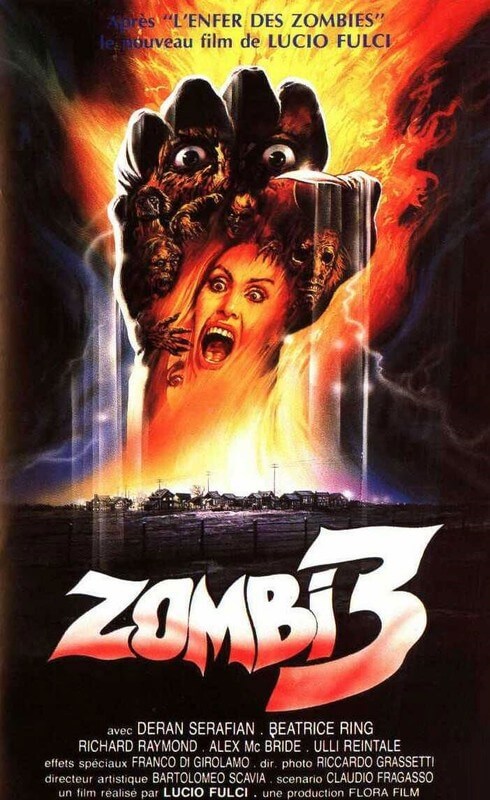
Despite ignoring the plot of Zombi 2, and ditching that film’s supernatural Caribbean zombies for the sci-fi variety, the new film was entitled Zombi 3 in an optimistic attempt to suggest the good old days were back. But, as Howarth’s book describes in grim detail, things did not go entirely to plan.
The team assembled for Zombi 3 included Fulci as director and Mattei as second unit director, who were both assigned the job of shooting in the Philippines. Other veterans involved were the husband-and-wife screenwriters Claudio Fragasso and Rosella Drudi, who had previously worked together on Virus. Drudi reportedly did most of the work on the script for Zombi 3 and yet, as with Virus, received no credit. Complicating things further, Fulci disliked the script he was handed and heavily rewrote it with the aid of his daughter, Camilla although Fragasso remained the only credited writer.
In addition, Fulci was suffering from cirrhosis and was unable to finish the film, entrusting a substantial portion of work to the (uncredited) Mattei. Producer Gaudenzi was not satisfied with how the project was shaping up, and so both Mattei and co-writer Fragasso came up with some new material and returned to the Philippines to have it shot.
As for Fulci, he was unhappy with the entire process. He poured scorn on his collaborators in an interview for a 1995 issue of Draculina magazine, accusing them of sins that ranged from professional incompetence to sexual predation:
You see, I don’t repudiate any of my movies except Zombi 3. But that movie’s not mine. It’s the most foolish of my productions. It has been done by a group of idiots, which are Claudio Fragasso – natural born cretin, Bruno Mattei – who before becoming a “director” was a house painter, and a guy named Mimmo Scavia – the director of productions, who arrived in the Phillippines and his first thought was to just fuck some Oriental girls. I refused to end Zombi 3. I took the plane and came back to Rome. On the screen you can only see fifty minutes directed by me, and that’s because Fragasso continuously changed my screenplay. “We can’t do this, we can’t do that…”
The behind-the-scenes saga of Zombi 3, as it happens, is considerably more interesting than much of what happens on-screen.
To start with, the plot of Zombi 3 was clearly pieced together from various earlier films. It begins with young, bespectacled scientist Dr. Holder reviving a corpse with a syringe of fluid (see also Re-Animator). A thief steals the serum and is himself contaminated; he hides out in a hotel room, where he is forced to amputate his own infected hand (see also The Evil Dead). Soldiers track the thief down and kill him, but when his body is disposed of in an incinerator the contagion is spread far and wide by contaminated smoke (see also Return of the Living Dead).
The first sign of zombie activity is when a flock of dead birds come to life and attack passers-by (see also The Birds). Later a young woman investigates noises in an abandoned building, and is attacked by a machete-wielding ghoul (see also your favourite slasher film). Meanwhile, Dr. Holder tries to find an antidote, and butts heads with military men who favour dealing with the plague by gunning down the infected (see also Day of the Dead).
Granted, Zombi 2 was equally derivative. But as with most of the more interesting Italian exploitation films, it borrowed from a varied range of sources: Dawn of the Dead, earlier Caribbean-set zombie films such as I Walked with a Zombie, H. G. Wells’ The Island of Doctor Moreau and even Jaws. In Zombi 3, aside from the rather quaint throwback to the twenty-five-year-old The Birds, the reference points are exactly what would be expected from a derivative horror film released in 1988.
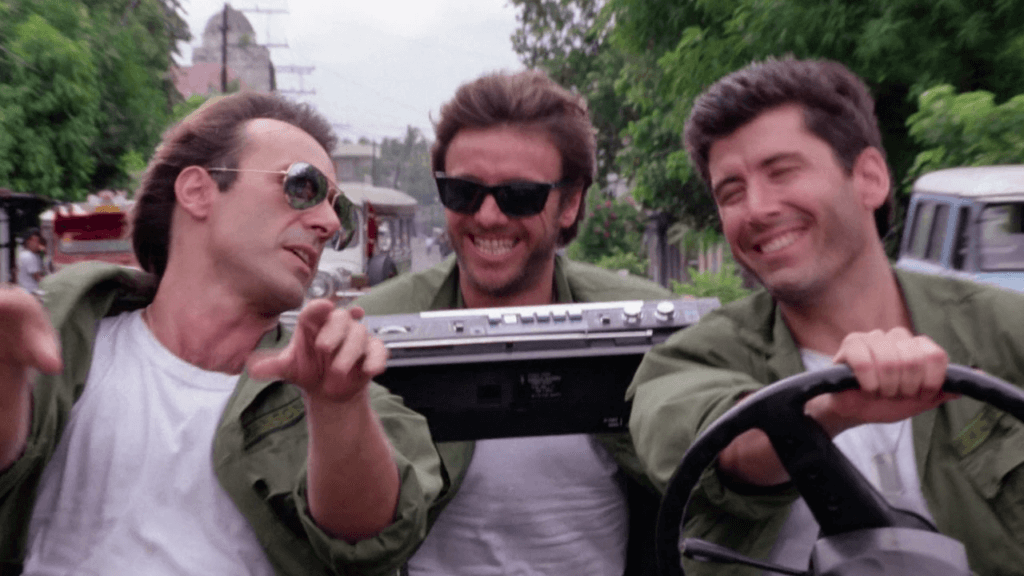
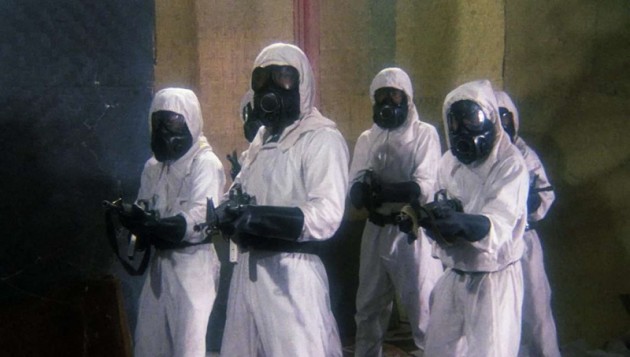
Once Zombi 3 has set its stage, it switches between multiple groups of characters. Most prominent are a vanful of flirty young women and a Jeep-load of randy soldier boys, who bump into each other on the road before becoming embroiled in the zombie mayhem. Elsewhere, Dr. Holder continues his comically overacted argument with the army, while gas-masked soldiers are sent in to prevent the zombie spread with any force necessary.
The trouble is that none of the characters are especially engaging (least of all the literally faceless military men) and so the only way the film could conceivably have built tension is through straight-ahead, closely-confined, zombies versus survivors action. Yet it also fumbles this latter option through its constant back-and-forth scene-swapping. The subplot that does the most to drag down the pace is the one in which two women keep an eye on their slowly zombifying third; this resembles the scenes between Mrs. Cooper and her daughter in Night of the Living Dead but without the pathos, or the fate of Frank and Freddy in The Return of the Living Dead without the humour.
Some of the shortcomings of the generally superior Zombi 2 return as well. Just as the earlier film took place around an Afro-Caribbean village oddly devoid of Afro-Caribbean people, Zombi 3 is set in a Philippines where Filipino people are hard to come by. We hear reports of widespread destruction, but we are never shown any of this occurring outside a few isolated locations. The film’s attempts to build a tone of apocalyptic dread amount to nothing when the area appears to already be largely uninhabited.
Still, the cycle of Night of the Living Dead sequels and quasi-sequels was not yet at its lowest ebb, and there are a few touches to Zombi 3 that prevent it from being a complete loss. First, the film benefits a hallucinatory cartoonishness that occasionally – too occasionally – bubbles to the surface.
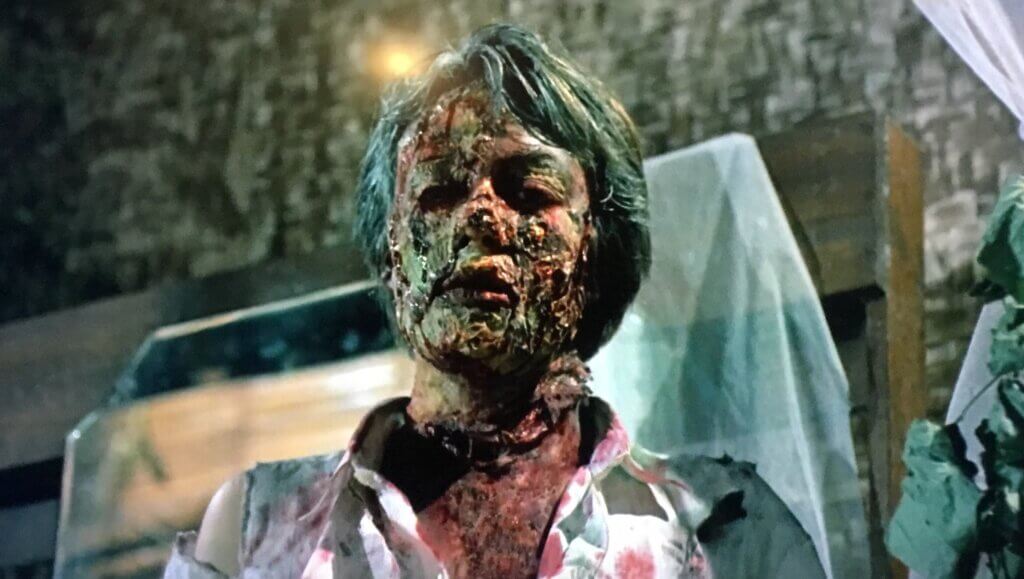
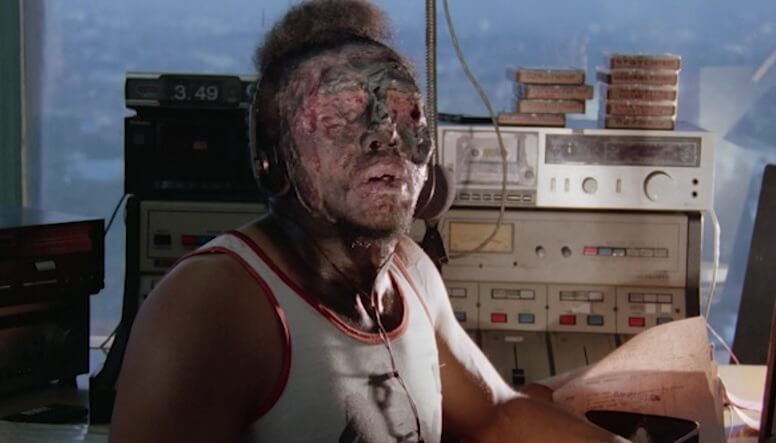
In one scene a character opens a fridge to find a rotting head inside; this somehow levitates out of the fridge and bites her (in his Draculina interview, Fulci justifiably points to this as the one scene in the film that he feels proud of). Later, a seemingly pregnant woman has the hand of a full-grown zombie erupt from her stomach and tear off a hapless bystander’s face in one of cinema’s weirder reimagining of Alien’s chestburster. Finally, at the very end, a zombified yet fully articulate DJ delivers a speech announcing a new world order of the living dead. Such moments come across as an attempt to emulate the cartoonishness of Return of the Living Dead through Fulci’s own oddball aesthetic, and give hints of a much more inventive Zombi 3 that could have been.
In its half-competent way, the film also blunders into an effective concept by treating the gas-masked soldiers sent to mow down potentially infected survivors as an equivalent threat to the zombies. A mistrust of armed authority figures had been baked into the zombie apocalypse genre since Ben got shot in Night of the Living Dead, and the faceless gunmen of Zombi 3 take this element to its logical conclusion. If nothing else, they give the film something of its own identity: “the one with the men in gas masks.”
Similarly, Zombi 3 expands upon the environmentalist implications of Return of the Living Dead’s acid rain imagery. What was previously hinted at is now spelt out, with characters openly discussing the hole in the ozone layer (the Montreal Protocol, an international treaty banning multiple ozone-depleting chemicals, had been signed the previous year). The complete removal of subtext is not necessarily a good thing, of course, but it would be hard to argue that Zombi 3 would be any more interesting without this element.
These glimmers of unfulfilled potential were scarcely enough to save the film, and Lucio Fulci’s strand of pseudo-sequels to Romero’s series ended here. There was never to be a Zombi 4.
Unless, that is, you dig up some old VHS tapes.
In a turn of events entirely appropriate for a series that used a canny choice of title to pass itself off as a Dawn of the Dead follow-up, video distributors simply changed the names of various films to give the impression that the Zombi series was continuing. Dedicated genre enthusiasts, among them Ray Marek III of The Horror Syndicate and “Tsumi” at Medium, making valiant attempts to untangle this bewildering and only half-documented mess.
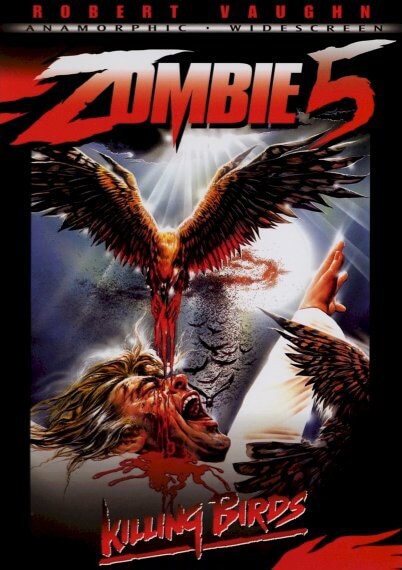
A 1989 film called Oltre la morte, directed by Zombi 3 co-writer Claudio Fragasso, was repackaged as Zombie [sic] 4: After Death in the US; it was also released as a sequel to the Zombi films in the UK, where the series is known as Zombie Flesh Eaters. A 1988 film called Uccelli assassini followed suit when it became America’s Zombie 5: Killing Birds. The nineties saw an all-new set of supposed Zombi 3 continuations on US video; to pick one example from this line, Joe D’Amato’s terrible 1982 slasher Absurd was renamed Zombie 6: Monster Hunter.
Australia, meanwhile, got its own continuation, with assorted European zombie films from the seventies and eighties being passed off as Zombi IV through to Zombi VII. In 2021, mockbuster maestro Dustin Miller cashed in on this line with the all-new film Zombi VIII: Urban Decay. Various cult film websites carry reports of still more examples from elsewhere in the world, although these are hard to verify. One recurring claim, which admittedly holds more than a whiff of Internet hoax, asserts that the series’ Pakistani incarnation got as far as Zombi 34: The Communist Bull Monster, a rebranding of the North Korean kaiju movie Pulgasari. This film is itself notorious for having been directed by South Korean filmmaker Shin Sang-ok after he was kidnapped at the behest of Kim Jong Il.
If a feature-length documentary were ever to be made about the Zombi series in all of its mutations, the result would doubtless make better viewing than Zombi 3.
Next: Plumbing still deeper depths…
