


Two guides are hired to lead a hunting party. Black and white artwork marries a short narrative of some privileged yet unfortunate souls, with a surprising supernatural twist at the end that stayed in my brain years later. The first version of this supernatural western comic, titled simply Darlin’, was created by Olivia Stephens back in March 2021. Now available to read for free via a later compiled Twitter thread and also a pdf available for sale, this sixteen-page comic “functions as a spiritual (rather than canonical/chronological) predecessor to my current long-form comic, Darlin’ and Her Other Names.” For her work on Darlin’, Olivia has received a Fellowship Award from Artist Trust, as well as residencies at Tin House and MacDowell.
Stephens used the original comic as a way to dip her feet into a universe she was researching and reworking, only to later deliver an eighty-eight first part of a much larger story with help from her Patreon. What she self-published earlier this year was Darlin’ and Her Other Names, Part 1: Marta: a tale of survival, desperation, and love bleeding into the foreground across Colorado and Kansas in 1881. This work, with words and art by Stephens, title designs by Binglin Hu and dialogue font created by Nate Pikos for Blambot Fonts, is intended for mature readers only. Note that body horror, blood, gore, nudity, gun violence, animal cruelty, and death are among some of the elements in the book that readers may find distressing.
Darlin’ And Her Other Names, Part 1: Marta
Olivia Stephens
Spring 2023
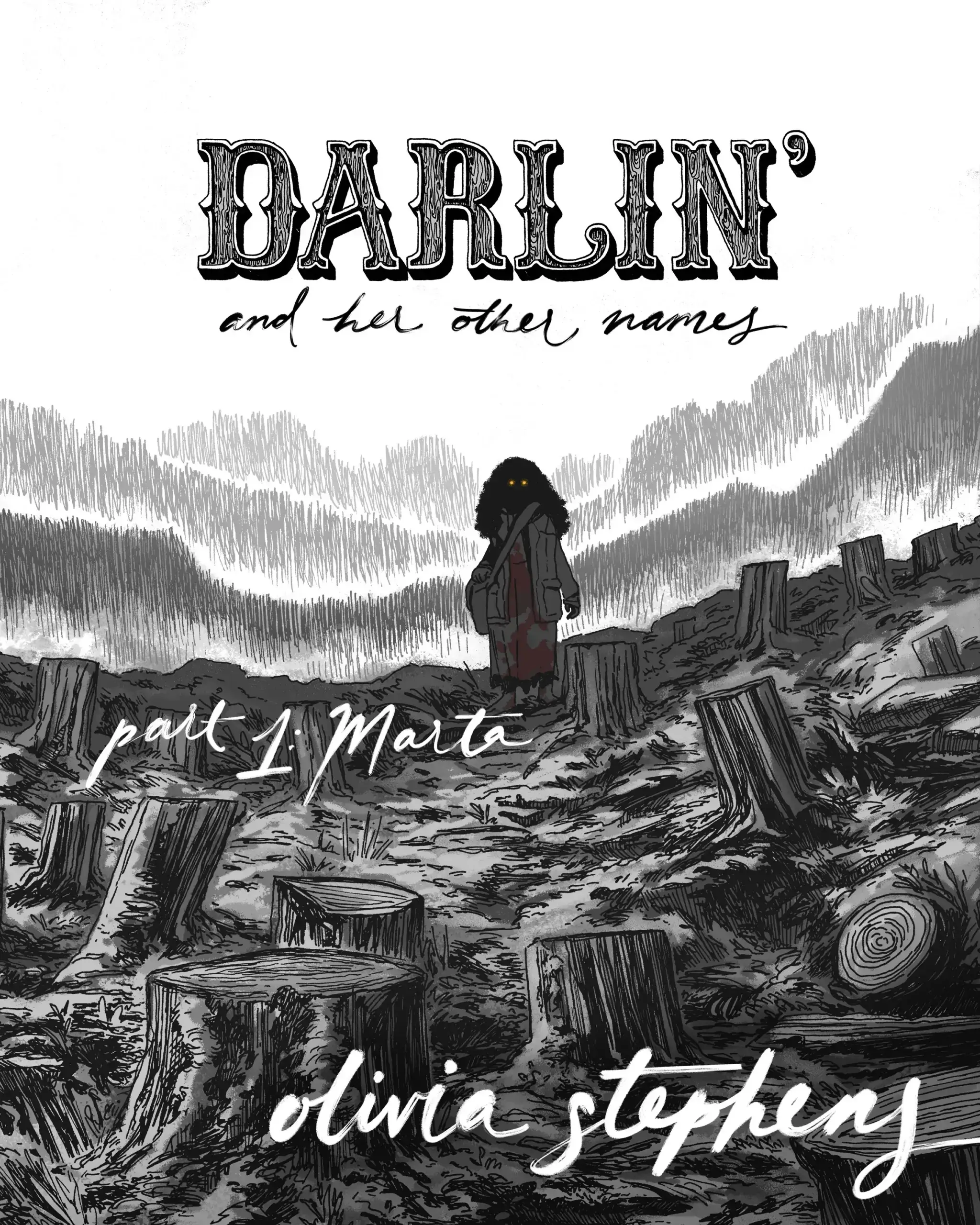
Darlin’ and Her Other Names begins with a spread of the outdoors, tree stubs littering the space with soft mist hiding a mountainside. There’s a quote at the top of the page by Theodore Roosevelt, “The wolf is the arch type of ravin,[sic] the beast of waste and desolation.” This page feels presented like a graveyard in this grayscale color scheme, lifeless. No trees means no shade, no foliage, no roots and no animal life to help support the creatures who need all of it to survive. Perhaps it looks like the long-term start of a hunt, instead.
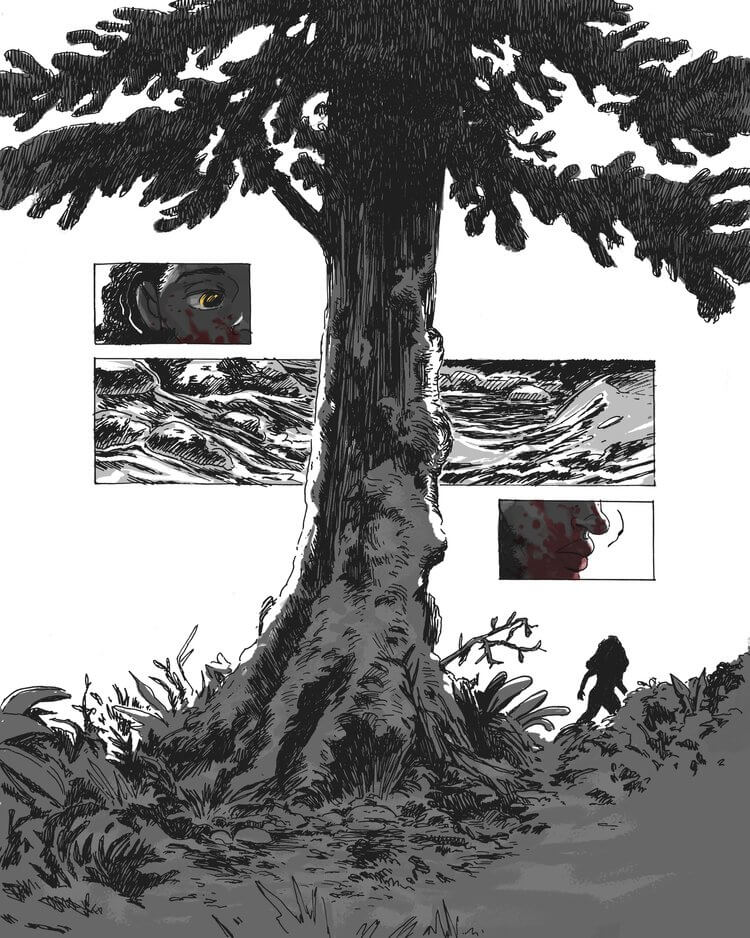
And in the next page, we see our first glimpse of the woman we will soon learn is Marta. She’s there, in a silhouette far off on the right side of the page, hair unbound and body naked, seemingly. A large tree takes up most of the space on the page, splitting it down the center. Two small panels, both separate on either side of the tree, show a close-up: one of her darker face, revealing a yellowish eye with a hint of blood. The second small panel is a close-up of her mouth, blood splattering the bottom half of her face. These two panels have the only color on the page, and that is how Marta is introduced–she’s moving, on the go and looking for something.
What you must know is that Darlin’ and Her Other Names, is a werewolf-western-horror-romance. Yet even that does not fully describe the depth of this comic. Marta is no beast of burden, nor damsel in distress. She’s neither and more. And she meets Edgar on a night when she is hurt, and most vulnerable, having just shifted back into her human form. She’s bleeding and naked.
This work only gives us readers glimpses into their lives before: Marta’s family were probably Black homesteaders. She returned one day to find her home on fire and her family–gone. Edgar is even quieter about his life: as an Indigenous man, his opportunities were in short supply, and he failed — or was failed by — a stint with a mining company. He’s bruised, beaten, and quiet about that time. He’s alone too, like Marta who blazes into his life, forever changing it.
In the woods, as Marta and Edgar discuss future plans, she brings us the idea of turning him into a werewolf so he can keep up with her as they travel. She tosses up a possible type of partnership but quickly retracts her offer, realizing the weight of her proposition, and to her surprise, Edgar unflinchingly agrees. “I want it. Make me a new man,” he says as he looks up at her. Edgar is bloodied, bruised with one eye swollen shut, in that same background from the first page of the many tree stubs and a wide open sky.
It’s a quiet and bold declaration that makes Marta’s eyes open in surprise and serves as a startling page of visual and layered meaning. Edgar is exposed. He’s vulnerable and ready to reinvent himself, to perhaps redeem himself from the failures of his past — all in this quest to survive. He’s all in. It feels like a baptism as he stands in front of Marta seated on the bank, proclaiming that he wants more to this life of his and seeks to be remade by her. He’ll do it and accompany her for her great revenge to set her rage upon those who deserve it.
The visual appeal of Stephens’ artwork here makes Darlin’s textured grayscale and dramatic spot color a masterclass of illustration in the making. Most of the pages live in this grayscale color scheme yet when there is color, Stephens makes use of it to make action bloom on the page or keep a certain character in our sights. There’s enough dramatic shading for pages where violence rules supreme, where Marta cuts short the lives of wicked men. Certain sequences of the story, like Edgar’s rebirth, are too beautiful and gruesome to look away from with enough details to fill up a page.

When I was rereading this first part of Darlin’ and Her Other Names, I kept thinking about a certain poem by a Black woman poet I just recently became acquainted with. Gwendolyn Bennett, a poet and artist of the Harlem Renaissance era, wrote a poem titled, “Moon Tonight” which is a short collection of words of a speaker praising and sharing their love for the night and all the nighttime wonders. Feminizing the moon, the poem is a mini love letter:
“Moon tonight,
Beloved . . .
When twilight
Has gathered together
The ends
Of her soft robe”
I think of Marta and the time she perhaps feels safest — in her werewolf form in the dark curtains and helm lines of the night. Nighttime is a sacred time of communion but also a great time for vengeance. I also think of Edgar and his almost pure devotion to Marta before and after his turning from man to something much more. He’s not afraid of her. He’s much more in awe of her and this way she can transform her rage into animalistic action and beyond. Like me, he is awed by her ability to shift into new skin to not just survive but thrive in a world, in a country that wants both versions of her dead.
The ending of this poem, that is nearly one hundred years old reads:
“Moon tonight—
Cool as a forgotten dream,
Dearer than lost twilights
Among trees where birds sing
No more.”
Darlin’ and Her Other Names is a quiet song amongst all the noise. This reworked version of Stephen’s much larger, open sandbox is full of tender moments and some that only exist in stark, bloody rage. Stringing together the themes of redemption, reinvention, and revenge makes the opener of this ongoing narrative a treasure to read, reread, and even to wait for the next installment. Marta and Edgar are souls now much more in tune with each other using both versions of themselves to travel and survive a land that wants both of them and their wolf selves as trophies.
After reading Darlin’, I feel very compelled to see not just more works with folks of color set in time periods like the late 1800s. Where at least in the United States, it seems like every day we are bearing witness to even more book bans (and even AI is being used in the fight to ban books, to no one’s surprise) and outlandish educational curriculums from state to state, dismissing and erasing the histories of marginalized groups — reading Darlin’ is like a balm, quietly passed to me by Stephens. I feel reminded not only that we exist but our stories, by our own hands will always matter.
As for the world of comics, I love that Darlin’ exists. I love that it exists, especially this reworked version placing a Black woman in charge of her own destiny. This story of Marta striking back, making her own ally, and being beloved in a time when she wasn’t thought of as much by others, feels thrilling. After a weekend of looking at the photos of Black folks slain in the recent hate crime in Jacksonville, Florida and fending off weird comments regarding my face masks by strangers in public spaces, rereading Darlin’ feels like a hard-won reward.
In many ways, I’m envious of Marta and her ability to protect herself and wreak havoc on those who hurt her and those who would hurt her as I question my own mortality as a Black woman who feels unprotected in today’s world, but especially this country. Darlin’ and Her Other Names, Part 1: Marta is the first installment of a story that I hope continues in exactly the same fashion it roared in with — uncompromising, full of hope and wonder and of being ready for anything life throws at it.
