
Continuing a series that celebrates the fifty-fifth anniversary of Night of the Living Dead with a look at the classic zombie film and its many follow-ups.
1988 saw the twentieth anniversary of Night of the Living Dead, but the celebrations were hardly enthusiastic. The year’s attempts to follow up on the various strands of the series – Return of the Living Dead Part II, Zombi 3 and Flesheater – were a trilogy of disappointment, and a fourth Romero-directed sequel had yet to solidify.
If zombie cinema was past its heyday, zombie literature was something that had barely even started. Circa 1988, only a handful of books had translated the Living Dead saga to the written word, and most of these had been novelisations of the films. John Russo’s Return of the Living Dead, published back in 1978, remained the one original prose story set in Romero’s universe.
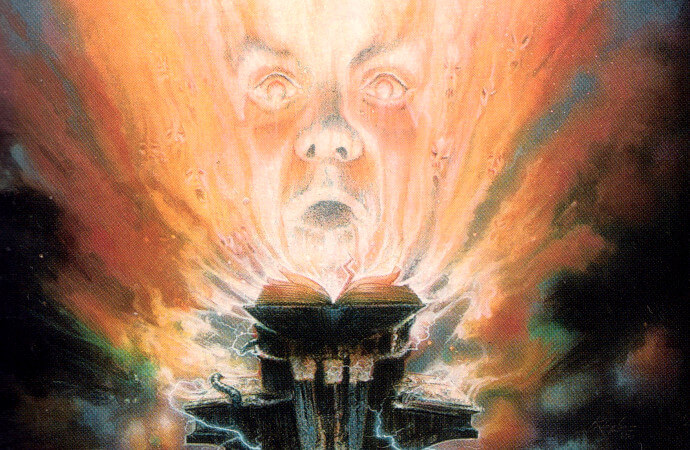
Then, in 1989, that number suddenly exploded from one to seventeen, all courtesy of a single volume: Book of the Dead, a short story anthology edited by John Skipp and Craig Spector.

Granted, Book of the Dead is not an “expanded universe” book in the literal sense associated with the innumerable tie-ins for franchises such as Star Wars and Star Trek. Indeed, the book’s front and back covers make no direct reference to Romero’s films (although its 1992 sequel Still Dead would proudly proclaim its stories to be “based on the universe of George Romero”). Once the reader opens the book, however, the connection becomes clear.
In their introduction, Skipp and Spector argue the horror genre should always penetrate the margins of culture, and cite Romero’s Dead trilogy as a prime example of this (even if doing so involves the unconvincing case that Day of the Dead is a boundary-pusher). Also included is a foreword by Romero himself, in which he specifically mentions the influence of his Pittsburgh-based Night of the Living Dead on the project:
Not long ago I was talking with two friends of mine, John Skipp and Craig Spector, who suggested that while the dead were walking in Pittsburgh, they were probably walking in other places as well. After all, whoever… or whatever… causes the dead to walk, isn’t going to go to all that trouble just to terrorize Pittsburghers. These things tend to be more than just localized phenomena. “Maybe we can find some first-hand stories from other parts of the world,” they said. “If we can collect enough stories we might be able to publish a book. A…. Book of the Dead.”
At least as significant as Book of the Dead’s connection to the Romero films is its connection to the splatterpunk movement.
In an essay for Neil Barron’s 1999 volume Fantasy & Horror, Stefan Dziemianowicz describes splatterpunk as “the first generation of writers nurtured on horror fiction of the Stephen King era.” In his view, this wave of new talent also continued a tradition set forth by British writers like James Herbert, Guy N. Smith, Shaun Hutson and, most of all, Clive Barker. Indeed, it is Barker whose taboo-breaking Books of Blood series from the mid-eighties is framed by Dziemianowicz as the starting point of splatterpunk. As its name suggests, splatterpunk had roots outside of literature, namely punk rock and splatter films. Dziemianowicz cites Romero’s zombies as symbolising the latter influence:
[Splatterpunk] arose in direct response to the quiet horror of dark fantasy, whose subtle merging with the mainstream some writers deemed a betrayal of horror’s unique attributes, and its totem was the flesh-eating zombie of George Romero’s cult film Night of the Living Dead, adopted as a symbol of the brutality and moral anarchy of modern life.
In citing the zombie as the “totem” of splatterpunk, Dziemianowicz is perhaps alluding to Book of the Dead and its sequel Still Dead, which he briefly mentions as being typical of the movement. Skipp and Spector’s introduction to Book of the Dead likewise presents this new breed of horror fiction as the spawn of Romero, providing a choice opening quotation from Psycho author Robert Bloch: “What’s going to come out of these people who think that Night of the Living Dead isn’t enough?”
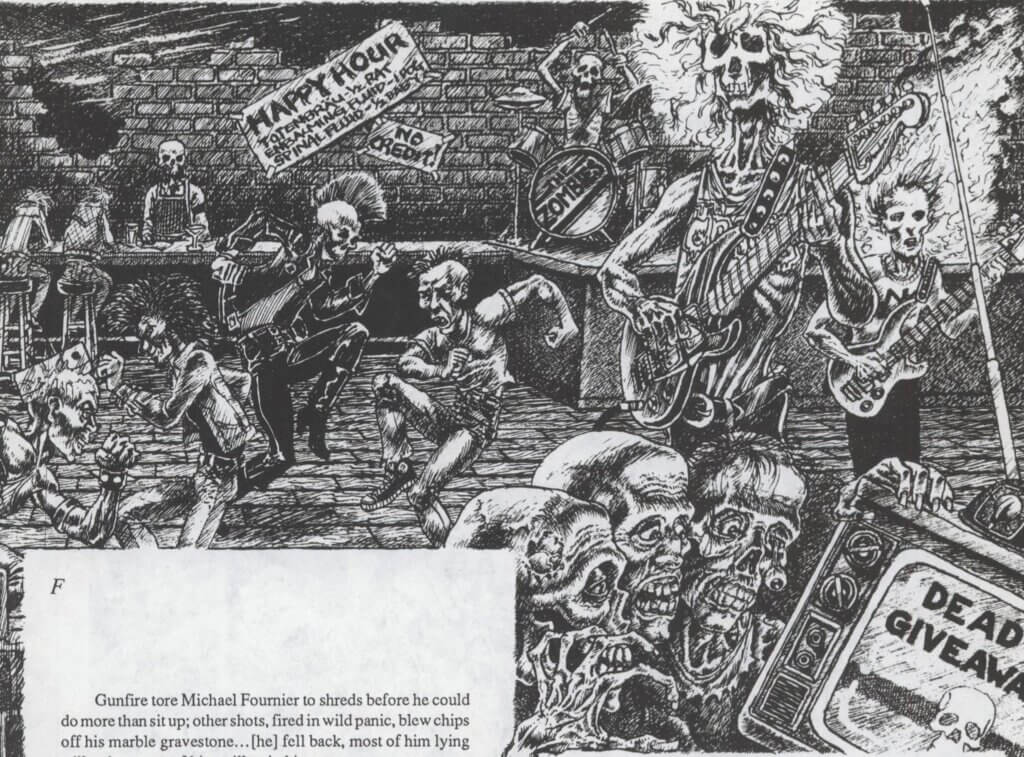
Bloch’s question (culled from a 1984 interview with Douglas E. Winter, a full copy of which can be found in The Lost Bloch Volume Three) would be answered in the January-February 1989 issue of Fear magazine. It included interviews with multiple splatterpunk authors, including what Fear termed the “Power Trio:” Skipp, Spector, and the writer who coined the term “splatterpunk” in the first place, David J. Schow. Here, Schow discusses the movement’s cultural influences:
We’re talking about the period of time in horror literature between Shirley Jackson’s The Haunting of Hill House and The Exorcist. That’s where we got our basic input – from television violence, The Outer Limits, Vietnam, Night of the Living Dead and rock ‘n’ roll. We absorbed it directly because as youngsters we had no built-in defence mechanism. […] We’re tuned into the younger generation who listen to the music we do; they understand the rock ‘n’ roll attitude.
The emphasis on rock music is partly because the interview focuses upon two rock music-themed novels: Skipp and Spector’s The Scream and Schow’s The Kill Riff. Nonetheless, Schow’s words remain entirely relevant to Book of the Dead.
David J. Schow is himself represented in Book of the Dead by two stories. The first is “Blossom,” credited to Schow’s pseudonym of Chris McConnell; this is an up-close erotic story of fetishistic sex between vengeful protagonist Amelia and a predatory older man, Quinn. Seething with AIDS-era anxiety, the story depicts Amelia becoming a flesh-eating zombie during sex, and killing Quinn to then shamble away to join her new kind. The story shows a loose attitude towards the “rules” set forth in Romero’s films: Amelia is able to eat flesh not only through her mouth but also through her vulva, biting off Quinn’s manhood at the same time that she consumes his face.
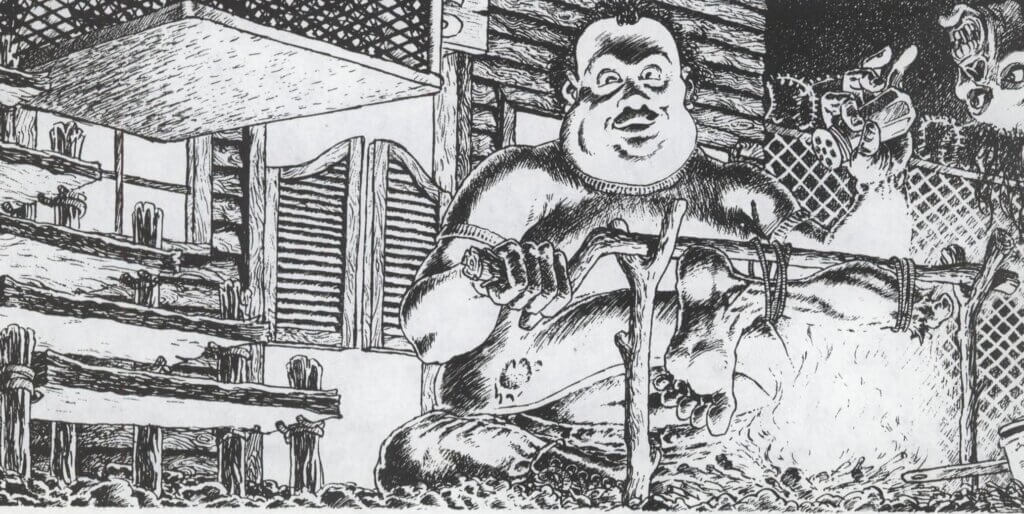
Schow’s other story is “Jerry’s Kids Meet Wormboy,” which focuses on the adventures of a hardy zombie-busting survivor. Rather than a conventional Charlton Heston-alike, Wormboy is a corpulent, pasty-skinned individual who survives by eating worms and eyeballs from slain zombies (“The fresher ones were blue… Eat a green one and you’d be yodeling down the big porcelain megaphone in no time.”) He obtained his clothes from a burnt-out rock shop, and so sports XXL t-shirts for such bands as Butthole Surfers, Fat & Fucked Up, Rudimentary Penii, Shower of Smegma and Dayglo Abortions – some of which are so obscure that, even today, they lack Wikipedia pages.
A hero of this sort needs a similarly colourful villain, and so Wormboy is pitted against Jerry, a man who maintains a gang of zombies named after famous comedians; even the name “Jerry’s Kids” is a nod to the charity work of Jerry Lewis. This detail might suggest that Jerry has a sense of humour, but in fact, he is the sort of hellfire-and-brimstone preacher who served as the default antagonist to any self-respecting 1980s rocker:
“…God is a loving God, yet a wrathful God, and so he struck down those beyond redemption. He closed the book on secular humanism. His mighty Heel stamped out radical feminism. His good right Fist meted out rough justice to the homosexuals; his good left Fist likewise silenced the pagans of devilspawn rock and roll. And He did spread His arms wide to gather up the sins of this evil world, from sexual perversion to drug addiction to Satan worship. And you might say a memo came down from the desk of the Lord, and major infidel butt got kicked doubleplusgood!”
Schow’s contributions show two paths for this new era of splatterpunk: “Blossom” adds graphic sex to what is essentially an ironic-punishment narrative straight out of a 1950s EC horror comic, while “Wormboy” immerses itself in gross-out transgression. Some of the other writers in the book follow one or the other of these paths. A case in point is “Mess Hall” by Richard Laymon, which goes down the EC-comics-with-sex route. Laymon opens with a couple copulating in a public park, their coitus being interrupted by a passing serial killer who blasts the man’s head off and abducts the woman. But just as he begins to have his way with his latest victim, he is visited by his past targets. Each one has been resurrected as a testimony to how she was killed – one is scalped, another skinned and so on – and all are prepared to give him his just desserts.
Other writers found different approaches for translating Romero’s zombies to the late-80s horror literature landscape. Some stories in Book of the Dead combine horror with horror by taking a character type or setting with obvious potential for violent storytelling and dropping them straight into a Romero-style zombie apocalypse: see the brief-yet-visceral “Wet Work” by Philip Nutman, which pits zombies against a hitman. Similarly, some stories insert zombies into an already brutal setting, as Nicholas Roym’s “Saxophone” does with the break-up of Yugoslavia.
The opposite tack is to create queasy comedy by adding zombies to the mundane, as when Brian Hodge’s Return of the Living Dead-influenced “Dead Giveaway” depicts a society where zombies are used as contestants in a macabre daytime TV game show. Throwing in stomach-churning sexuality is yet another recurring technique: Les Daniels’ “The Good Parts” is about a porn-addicted man who, after turning into a zombie, settles down and becomes the father of a grotesque family.
A distinct tension runs through Book of the Dead, arising from its contributors’ urge to provide boundary-pushing fiction while ultimately working within the framework of what was by then a decades-old movie series. Some of the authors come across as Romero-traditionalists, penning stories that could conceivably have served as the instalment following Day of the Dead. Not, it should be stressed, that this necessarily makes their stories unoriginal. “Like Pavlov’s Dogs” by Steven R. Boyett has a novel setting in a research facility with an artificial environment similar to Biosphere 2.
At the other end of the scale are stories that make a point of abandoning Romero’s additions to the zombie mythos. Ramsey Campbell’s “It Helps If You Sing” is about a man visited by two representatives of an unorthodox religion; the men turn out to be zombies, but not in the Night of the Living Dead mould. Instead, they serve Father Lazarus, an evangelist who travelled to Haiti to convert the populace, only to adopt forbidden zombie-raising practices himself. The revenants’ general portrayal is closer to the modern folklore of the Men in Black than to the zombies of cinema, be they pre- or post-Romero.
Campbell’s story is something of an outlier in the anthology, not just in abandoning Romero but also in embracing a quieter, more old-fashioned sort of horror. But Campbell, a devotee of M. R. James, was never really part of the splatterpunk movement. Nor, indeed, was Stephen King, who is also represented in the book.
King’s contribution, “Home Delivery,” must surely be the best-known story in Book of the Dead, given that the author later reprinted it in his 1993 collection Nightmares & Dreamscapes. The plot follows a group of survivors in the midst of the zombie apocalypse (one of them a pregnant woman, hence the title) and has the feel of a Romero zombie film running at breakneck speed. Going on in the background, and frequently leaping into the foreground, is a conflict between superpowers as both America and the USSR try to blame each other for the zombie outbreak.
In King’s version of events, neither side is responsible. Instead, the resurrections are caused by a living satellite (“Not one of ours, not one of theirs. Someone else’s”) which is dubbed Star Wormwood and turns out to be, quite literally, a cluster of worm-like organisms. While riffs on Night of the Living Dead generally move away from the original film’s “Venus probe” plot device, King puts his own memorable spin on it. This should not be too surprising, given how he emphasises his childhood memory of the 1957 Sputnik launch – a show of Soviet power as well as a technological leap forward – in his nonfiction book Danse Macabre.
Further undermining any assumption that Book of the Dead is cover-to-cover gore, are the sedate pace and cerebral tone of the longest story in the book, Glen Vasey’s 57-page “Choices,” Granted, the story also has bouts of splatter – particularly chilling is a sequence in which a little girl runs to greet her dead father, only for him to eat her – but these are few in number and positioned with care. The rest of the narrative follows a man, Dawson, as he tries to survive the zombie apocalypse, reminisces about the old days, and jots philosophical musings into his journal. As his life story unfolds, we see his viewpoint being shaped by people around him. These range from his banal, football-preoccupied friends before the plague, to a Kenneth Patchen-idolising hobo, to a preacher returning to the roots of his faith. A major theme of the story is how people in tense situations can make bad decisions, making Vasey’s story a close thematic follow-up to Night of the Living Dead – albeit one that takes a less obvious path than any of the officially-sanctioned sequels.
Another lengthy story is Edward Bryant’s “A Sad Last Love at the Diner of the Damned,” which uses its additional pages to explore the mundane side of the zombie outbreak. It takes place at an early stage of the apocalypse when the existence of the zombies is established, but everyday folk, represented by the staff and customers of a diner, carry along business as usual. This has its comical aspects, as when the diner is attacked by a group of zombified elderly women at the start, but it soon bleeds into tragedy when we are forced to consider that those zombies were, indeed, once elderly women, beloved members of the community. Protagonist Martha recognsies her childhood friend Mrs. Hernandez from a fragment of the latter’s blasted-off head. The story climaxes with Martha being gang-raped by zombies, a stark reminder that we are still in a taboo-breaking anthology.
In Steve Rasnic Tem’s “Bodies and Heads,” we see the spreading zombie plague from the perspective of hospital staff who must deal with the growing problem. The characters are consumed by an overall mood of denial, evoked by the motif of shaking heads that first appears in the opening line: “In the hospital window the boy’s head shook no no no.” The staff’s sole exposure to the wider zombie apocalypse is from TV broadcasts, and they are faced with a choice between watching the bloodshed unfold and turning off the TV for the sake of their own sanity.
As with Bryant’s diner staff, the hospital workers have their mundane life torn apart in the story’s climax. This time, rather than the brutality of a gang rape, the story concludes with surrealism as a freshly-decapitated zombie retains some form of consciousness:
The body stood motionless, staring at Elaine. Staring at her. The nipples looked darker than normal and seemed to track her as she moved sideways across the room. The hairless breasts gave the body’s new eyes a slight bulge. The navel was flat and neutral, but Elaine wondered if the body could smell her with it. The penis – the tongue – curled in and out of the bearded mouth of the body’s new face. The body moved stiffly, puppet-like, toward its former head.
The stories about the mundane side of the end times reach their peak with Douglas E. Winter’s “Less Than Zombie,” in which even the counterculture is crushingly banal. The main character is a young hedonist whose life of sex, drugs, and rock and roll has become mere wallpaper; bootleg horror videos by Romero and his imitators are part of this milieu, blurring together with news reports of the dawning zombie apocalypse.
Given the book’s significance to the movement, there is some temptation to try and pick out the most archetypally splatterpunk story to be found within. A strong candidate for the title would be “On the Far Side of the Cadillac Desert with Dead Folks” by Joe R. Lansdale, which captures the sort of free-wheeling absurdity that elevates splatter into splatterpunk. The story concerns a bounty hunter, Wayne, who must transport low-down criminal Calhoun through a zombie-infested wasteland to face justice in one of the law-abiding settlements that remain. Along the way, the hard-boiled hero and villain encounter such bizarre characters as gun-wielding sex-worker-nuns and a cult of zombies who wear Mickey Mouse ears. Lansdale is best known for his Elvis-versus-mummy novella “Bubba Ho-Tep,” with which “Cadillac Desert” shares a certain sense of humour.
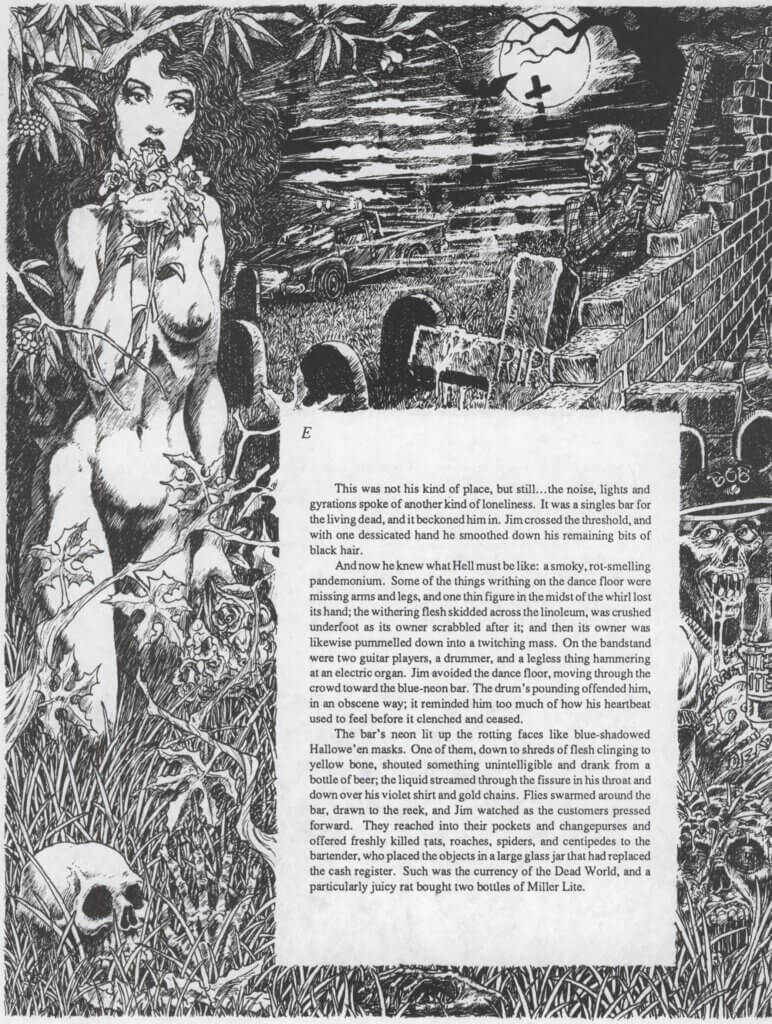
The final story in the book is “Eat Me” by Robert R. McCammon. This opens on a melancholy note, focusing on a single man who, having failed to find love before the zombie apocalypse, concludes that love is dead. The story’s twist is that its zombies are capable of enjoying their own nightlife, visiting bars and even building sex lives:
Their bodies entwined, the flesh being gnawed away, their shrunken stomachs bulging. Brenda bit off his ear, chewed, and swallowed it; fresh passion coursed through Jim, and he nibbled away her lips – they did taste like slightly overripe peaches – and ran his tongue across her teeth. They kissed deeply, biting pieces of their tongues off. Jim drew back and lowered his face to her thighs. He began to eat her, while she gripped his shoulders and screamed.
Book of the Dead turned out to be a favourite on the awards circuit. At the 1989 Bram Stoker Awards, Lansdale’s “Cadillac Desert” took the prize for Long Fiction, while McCammon’s “Eat Me” won in Short Fiction; the contributions by Steve Rasnic Tem and Edward Bryant were runners-up in the latter category, meaning that three of the five Short Fiction finalists were from Book of the Dead. The anthology as a whole, along with the Lansdale and Bryant stories, were also nominees at the 1990 World Fantasy Awards, while Lansdale took home the British Fantasy Award for Best Novelette.
The zombie apocalypse had well and truly arrived on bookshelves, and it received the acclaim that zombie cinema was fast losing.
Next: Remade for the nineties…
