
Earlier this year, artist Julia Warren independently published an edition of Alice’s Adventures in Wonderland with her new illustrations, surreal digital collages with rich color and a fitting dream-like quality. She corresponded with me extensively to answer my many questions about her inspirations and process.
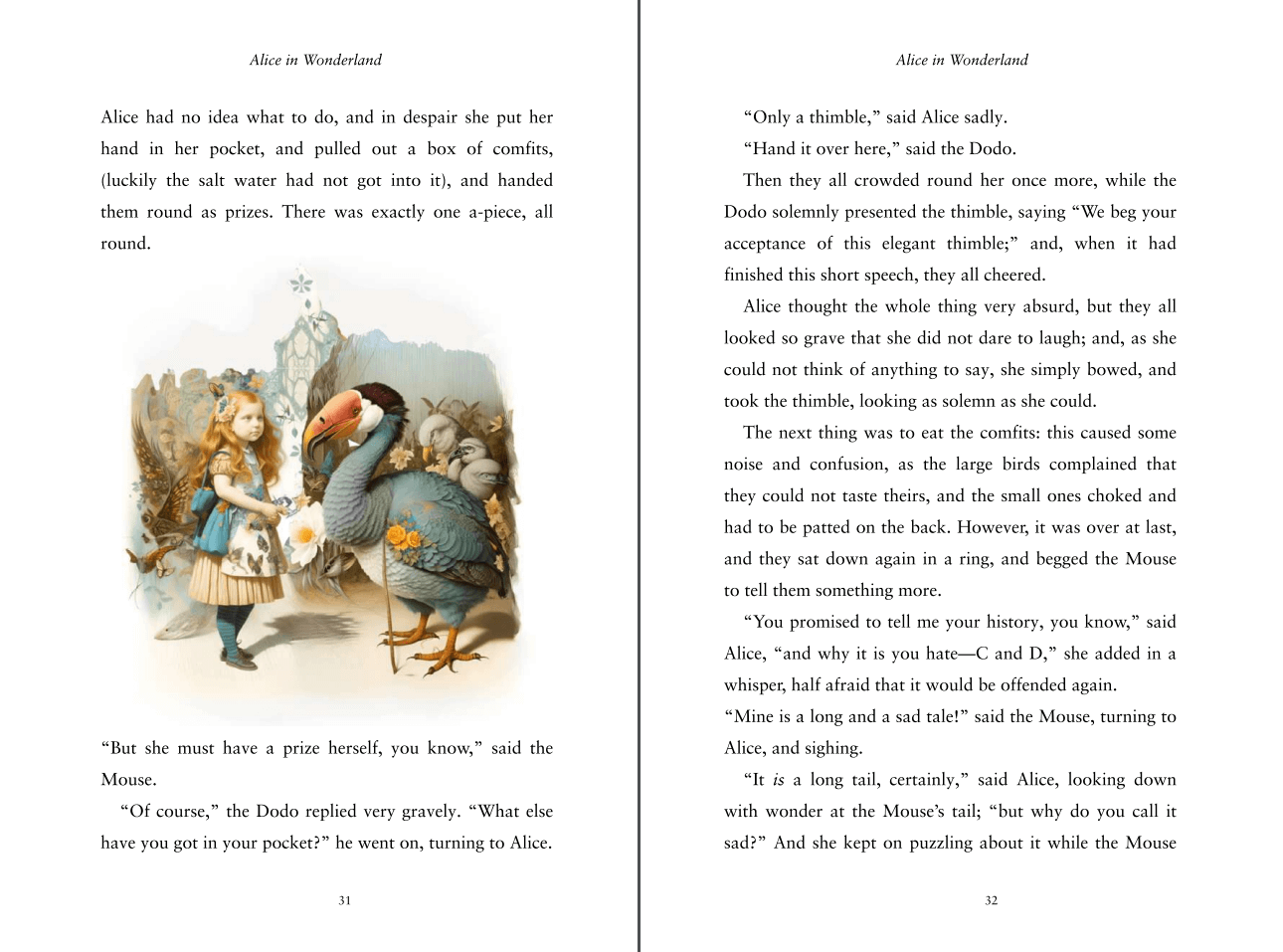
Emily Lauer: Julia, thank you! First I have some questions about decisions for the illustrations. Unlike many who add new illustrations to Alice, you also leave in John Tenniel’s original black and white illustrations! What inspired you to do so?
Julia Warren: I guess it’s a combination of reasons: Like many other children in the world I’d grown up loving both the stories and Tenniel’s illustrations for them; I remember one rather worn copy we had, possibly handed down, bound in cream linen, with soft, aging paper, and this contained full-page colour plates by an artist whose name I regretfully cannot remember, combined with Tenniel’s black and white illustrations. I went back to that early memory, and it actually didn’t really occur to me to exclude Tenniel—which brings me to my other reason:
I so enjoyed inhabiting Tenniel’s world, and yearned to create one like it (yet different)… Later, after completing art academy in Venice, I painted Tenniel’s White Rabbit and White Knight in oils, for the simple pleasure and satisfaction of doing them. Alice would not be complete without Tenniel; and, as he was my inspiration, it just seemed to make sense to have both!
Emily: A lot of your illustrations play with scale, such as having giant flowers over architectural arches. Of course, Carroll’s text also plays with scale! How were you thinking about issues of size and depth when making the images?
Julia: I wasn’t consciously thinking about playing with scale—in a sense, I was going by a kind of visual stream of consciousness—it either looked ‘right’ or ‘not right’; I tend to create instinctively, rather than through conscious thought. Once I started developing the images as collages, it had to look ‘right’: both sufficiently real and unreal at the same time, a mixture of choice and randomness. Part of the beauty of working with images in this way is how one thing can lead to another; a fusion of opposites and contradictions—much like the Mad Hatter’s Tea Party itself!
Emily: Your newly written introduction for the edition addresses a lot of Carroll’s influences, like poetry and photography. I get the feeling that these informed your choices about what to include in your digital collages, along with Tenniel’s own work?
Julia: Growing up with Alice meant growing up with Carroll. His interests were very varied, and it wasn’t possible to include all of them. He was something of a Renaissance man, trying out new things, experimenting and inventing—so in this sense, I think I followed in the wake of his creative ethos: experimenting, trying out stuff, and, possibly, inventing.
Emily: That leads me to my questions about your process: You’ve told me that your process includes digital collage, and your Afterword details some of the tools you used. Can you take our readers through your steps for creating one of the illustrations, from conception, through image sourcing and composition, to finishing?
Julia: You can start with an idea, but allow for the fact that you will probably have to compromise.
The process is actually very similar to physical collage, once you have cut out all the photographs from the magazine, only instead of glue, paper and scissors, however, I was using the digital equivalent of erase, copy and paste. This essentially was probably not much quicker than physical collage—you are still foraging for images, collecting textures, colours, and forms with a view to finding something that matches the other jigsaw pieces. And instead of trawling through old magazines, I was creating my ‘source’ images in AI, often starting from an original Tenniel colour illustration, which would come out a warped shadow, or a detail, or half of what I wanted—a bit like playing Heads, Bodies and Legs. Again, suitably surreal…
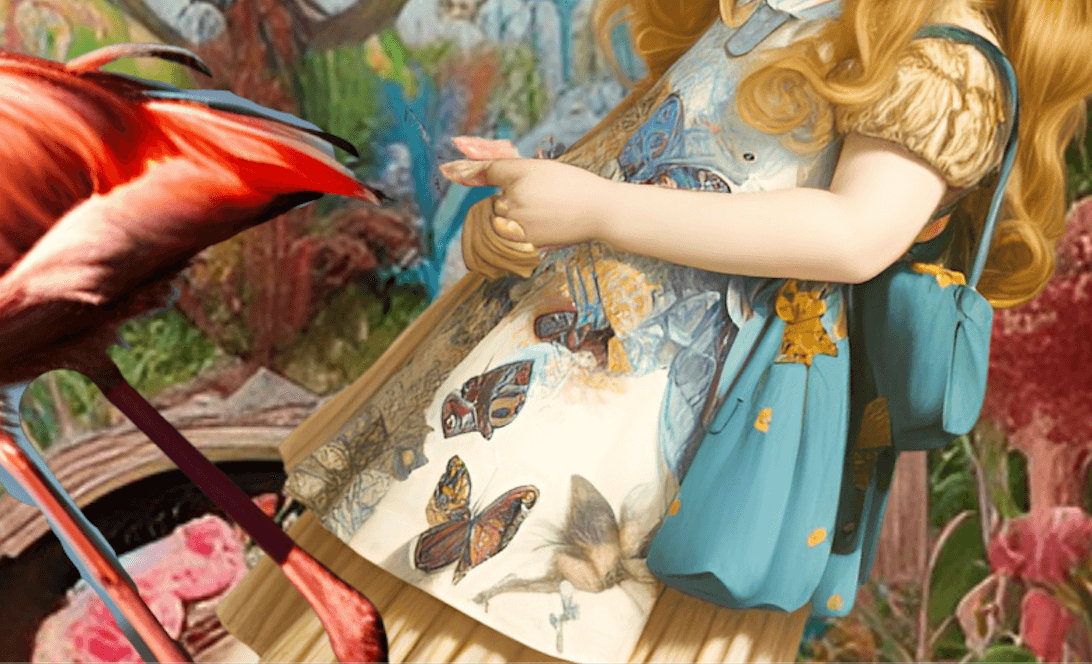
Let’s take the example of Alice at the croquet game, holding a flamingo. We needed a garden, Alice and the flamingo. This meant a minimum of three elements to source. I created several gardens, and made a choice (again, very much like collage) after trying out variations and combinations, until I had a garden that ‘fitted’. I created various flamingos, before finally discovering one which could be snuck in behind the figure of Alice so as to look as if she was holding it in one arm.
(I created a lot of hedgehogs too, which I am rather fond of, but in the end, I focused on Alice holding the flamingo).

I might begin methodically enough, but sometimes things would grow (quickly or slowly) in a way of their own. Occasionally I have to leave them, go away and come back, and try again. I might have the right face, but the wrong hands, or there’s a missing rosebush ….
Rather like making a film or painting, it can be a serendipitous journey.
Emily: Can you tell our readers more about your use of AI in these collages?
Julia: I have tried out various AI apps with different capabilities; I am not a program writer (although I am interested in ‘training’ models), I simply used the AI as a tool for creating elements, whether from text (occasionally quoting directly from Lewis Carroll’s text) or from images (i.e. Tenniel’s illustrations, as mentioned above). No matter how many times you generate using that same quote or image, no two images are ever alike—not even remotely. When I tried searching online for the original images I created, I could find none that were even vaguely similar. On top of that, I was isolating elements and re-mixing with other elements to create new images.
I still cut, paste, isolate, modify, adjust, erase, blend, merge, as one would with a physical collage. And, in the same way as with physical collage, they become part of a new image, one that evolves as the artist’s own creation. The original images are no longer in their own settings; they become elements of a new one—rather as the Surrealists pulled together illustrations from periodicals and journals, and re-imagined new scenes, new worlds (like Max Ernst with his Une Semaine de la Bonté, for example).
I still cut, paste, isolate, modify, adjust, erase, blend, merge, as one would with a physical collage. And, in the same way as with physical collage, they become part of a new image, one that evolves as the artist’s own creation.
I have tried, after creating an image, to search and source the image online, without finding anything that could be said to be identical or even very similar. This is the claim made for imagery created this way, and as far as I have been able to tell, this is actually the case. With Alice in particular, when using Tenniel as a visual prompt, it would never create a duplicate, or even anything similar: whether it is the algorithms at work, or another process, either way, it does create a unique work, one that does not get duplicated.
Emily: Thank you! And finally: This volume is independently published. Why did you decide to go that route?
Julia: Freedom—freedom of creative choice, combined with comparative speed; I have also long been involved in publishing (design, editing, illustrating and formatting), and it made sense to do something that I wanted to do for myself. It is experimental, new, and I plan to do a sequel, possibly also The Hunting of the Snark. Of course, if a bigger publisher takes an interest and offers a good enough deal, well, I am open to offers!
I am also interested in creating a series of illustrated literary classics; for example, I have also been working on developing a style for Jane Austen. Early days yet, but we will see.
Emily: Thank you, Julia, for this peek at how you work! I look forward to seeing your sequel, your Snark, and your Austen in the future.
—
Note: This interview has been edited for length and clarity.

