

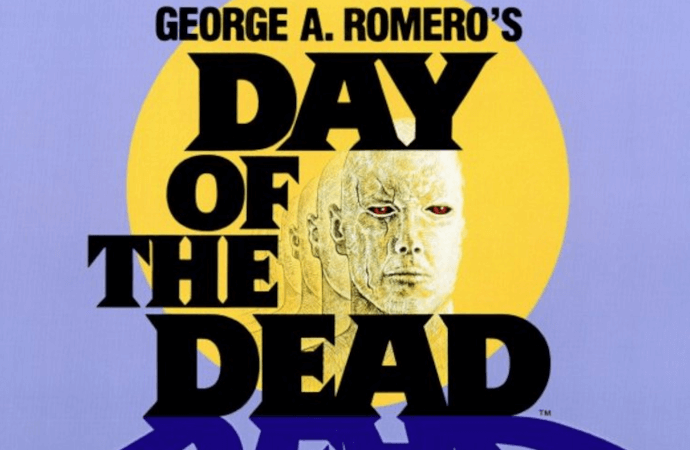
Continuing a series that celebrates the fifty-fifth anniversary of Night of the Living Dead with a look at the classic zombie film and its many follow-ups.
Nine years passed between Night of the Living Dead and Dawn of the Dead, after which another seven years went by until Day of the Dead was released in 1985. Unlike certain sequel-makers, George A. Romero can hardly be accused of rushing his zombie trilogy – and a trilogy it would remain until the twenty-first century. This steady-going ethos sums up Day of the Dead, which is above all a careful film: it takes its time in showing us its scenario and central concepts, making sure that we appreciate how different it is from the zombie films that came before.
The various attempts to imitate or continue Night of the Living Dead had, by and large, focused on the start of the zombie apocalypse (or the re-start, in the case of John Russo’s Return of the Living Dead novel). Even Dawn of the Dead merely depicted a later stage of the same process, and followed the same general outline of its predecessor, albeit on a grander scale: a group of characters shelter in a building and watch civilisation fall via TV broadcasts.

Day of the Dead, meanwhile, introduces audiences to the world that remains after the zombie apocalypse has taken place. As the opening scenes make clear, the new normal consists of abandoned cities haunted by the living dead. Zombies outnumber humans by a vast number (400,000 to one is the estimate given in the film). The narrative focuses on a community of scientists and military men residing in an underground bunker, apparently with enough resources to eke out a stable existence.
Unlike the protagonists in Dawn of the Dead, who enjoyed amusement arcades and candlelit dinners as the world crumbled, the scientists in Day of the Dead have no time for such frivolities. The main character, Dr. Sarah Bowman, intends to find a cure for the zombie plague, and is aided by her lover Miguel even as the latter’s mental health deteriorates. Helicopter pilot John is unconvinced by her efforts, arguing that the apocalypse is God’s will: “He visited a curse on us, so we might get a look at what Hell was like. Maybe He didn’t want to see us blow ourselves up and put a big hole in His sky.” Shades of Peter’s “no more room in Hell” speech from Dawn of the Dead; significantly, Peter was identified as being of Trinidadian descent, and John has a Caribbean accent. Even in this era of science fiction zombies, the associations with Caribbean folklore have not quite been severed.
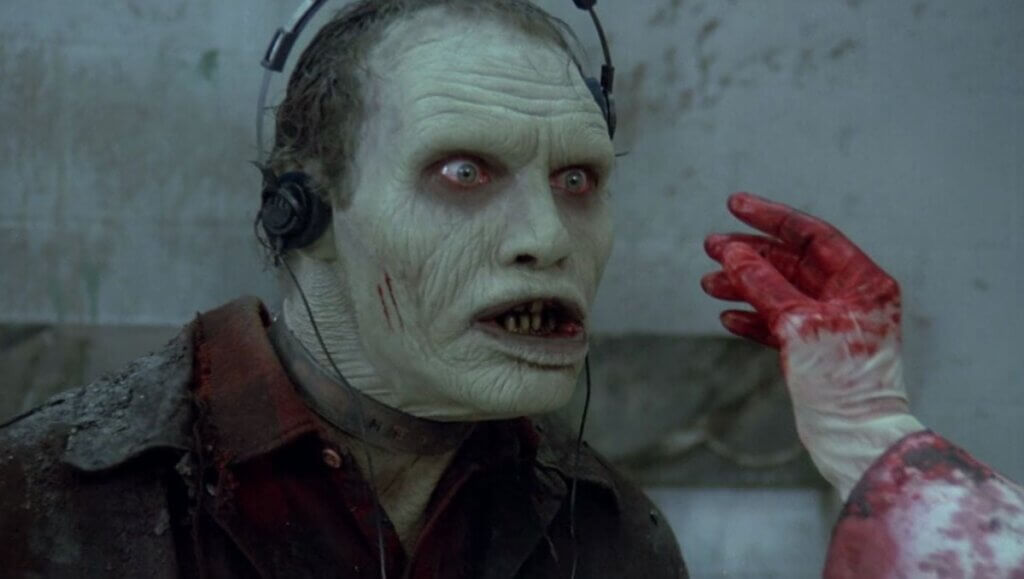
Another key member of the compound is Dr. Logan, a scientist conducting experiments on captive zombies. Logan’s laboratory, containing an assortment of part-animated corpses in various states of vivisection, provides the film with some of its most striking scenes of gross-out gore: a particularly memorable moment involves a zombie who has no head, only an exposed brain, yet remains mobile. But Logan’s mad-scientist exploits also lend Day of the Dead a considerable degree of pathos. His end-goal is to return the zombies to a state of sapient humanity, and he has succeeded in teaching rudimentary communication and tool-usage to a test subject nicknamed Bub. The interactions between the two recall the meeting of the monster and the blind hermit in Bride of Frankenstein.
1985 was the right year for zombies to be placed under the microscope. By this point, zombies in the Romero/Savini mould had lost their novelty value, having passed through a string of post-Dawn imitations until they ended up as back-up dancers for Michael Jackson in 1983. Zombies had even been commodified for children. In 1985, kids were collecting zombies in the form of bouncy form-rubber balls (Madballs) and comical trading cards (Garbage Pail Kids). The latter found its way into Turmoil in the Toy Box, a notorious work of polemic by Christian author Phil Philips:
These cards do not picture little babies doing cute things. Instead, they show babies whose heads are being decapitated by a guillotine, babies smoking cigarettes, and another of a baby whose arms and legs have been cut off and scattered on the floor. Cute? […] Dead Ted shows a badly decomposing boy rising from a grave.

This was the natural life cycle of a film monster: a recurring celluloid nightmare could remain scary for only so long. Just as an earlier generation of horror-film antagonists had been demoted into foils for Abbott & Costello and spokespersons for breakfast cereal, zombies were becoming a bit of a joke.
Romero had already been ahead of that curve with Dawn of the Dead’s pie-in-the-face scenes; come Day of the Dead, he adapted to the new situation by treating zombies as objects of intrigue and analysis. If audiences are no longer afraid of zombies, then they can be invited to take a closer look and perhaps find something new. After all, Night of the Living Dead was inspired by Richard Matheson’s I Am Legend, a book that offered a scientific analysis of vampires. Now, the process could begin anew.
Except that, as much as it plays with its genre elements, Day of the Dead turns out to be a thoroughly conventional piece of storytelling.

The film has a set of full-fledged villains in the form of the brutal, bigoted Captain Rhodes and his men, who are established early on as moral opposites to Sarah and her associates. This is something that sets it apart from the earlier films in the series. Granted, there had been unlikable characters before, from Mr. Cooper in Night to the biker gang at the climax of Dawn. But Day is the only one of the three to feature a group of characters who are clearly defined as antagonists throughout its entire length.
In the introduction to their 1989 anthology Book of the Dead, John Skipp and Craig Spector argue that Night of the Living Dead “did an end run around the tidy horror convention of good vs. evil, subbing the far more morally ambiguous and provocative equation of living vs. dead.” This factor is completely abandoned in Day of the Dead. We are no longer seeing a senseless world where the sole survivor can be mistaken for a zombie and shot dead. When a sympathetic character perishes in Day, it serves a purpose – either a heroic act of self-sacrifice, or a narrative point to emphasise just how bad the bad guys are.
Eventually, the villains themselves get their just deserts at the hands (and teeth) of the zombies. The graphic scenes of dismemberment and evisceration that ensue are the film’s gruesome money-shots, repulsing the audience yet also offering the base catharsis of the baddies getting punished while the goodies escape to safety. Having experimented with zombies, Day of the Dead returns them to their role in the old 1950s EC horror comics: as agents of retribution, rising from the grave to slay wrongdoers.

When viewed today, Day also has the overfamiliar feeling that comes with its setting having been imitated more closely than that of its predecessor, Dawn. A shopping mall is still a fairly out-there choice of location in a zombie apocalypse story. Laboratories and military installations, meanwhile, have since become default settings for the genre, as seen in the Resident Evil and 28 Days Later series to name just two examples. All of this adds to the lingering impression of Day having not so much broken new ground as hit a dead end.
Most film trilogies have a weak link, and given that Romero’s zombie triptych began with two films that became enduring classics of the genre, it was perhaps too much to expect the third outing to be up to the same standard. Day of the Dead is a solid effort, and has enough on offer to make it worthwhile, but the end result is something like the vivisected zombies in Logan’s lab – outwardly alarming, yet incapable of bite.
Next: Time for a party…

