

Continuing a series that celebrates the fifty-fifth anniversary of Night of the Living Dead with a look at the classic zombie film and its many follow-ups.
John Skipp and Craig Spector’s Book of the Dead series can be claimed as the horror equivalent to Harlan Ellison’s Dangerous Visions trilogy: each series began with an influential, zeitgeist-capturing first volume, begat a sequel within a few years, and then had a projected third instalment slip into the limbo of publishing delays.
The third Book of the Dead anthology had been mooted as far back as 1999, when it was briefly mentioned in Neil Barron’s volume Fantasy & Horror. Yet Mondo Zombie, as the book was eventually named, was not published until 2006. To give an idea of its gestation period, Skipp’s foreword – which is dated August 2000, with a revision date of December 2004 – describes the volume as having been “over ten years in the making.”
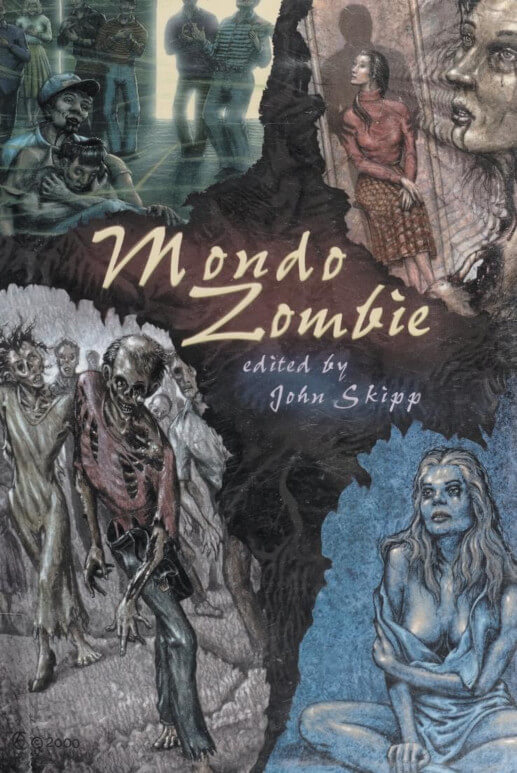
Mondo Zombie arrived fourteen years after Still Dead, and the intervening period had seen a lot of change. The third book was issued not by major paperback publisher Bantam, as its two predecessors, but by the horror speciality press Cemetery Dance Publications. John Skipp and Craig Spector had ended their creative partnership, leaving Skipp to edit the anthology alone. And zombies, even literary zombies, had absolutely none of the novelty value that they still grasped back when the first Book of the Dead came out in 1989.
The anthology opens with “Next to Godliness,” in which author Anne Abrams keeps zombies at arms length by acknowledging the living-dead apocalypse only at the very start and the very end. The main character in the interim is a necrophilic mortician; although such sexual proclivities were by now common in horror fiction, this story provides an additional twist on the character type by giving its corpse-kissing heroine a complex about cleanliness: when the dead start rising, she sees this as an unsightly contamination. In other words, zombies are used as a punchline to an already sick joke.
Another trick employed by the assembled authors to keep the zombie theme fresh is to insert zombies into specific social issues. Lisa Morton’s abortion-themed “Sparks Fly Upwards” depicts the ironic spectacle of zombie pro-lifers: the debate is settled by the confirmation that aborted fetuses do not return from the dead, and so cannot have been living humans to start with. Simon McCaffery’s “Connections,” about a father protecting his autistic son in the zombie apocalypse, posits the novel but highly questionable notion that the zombie virus “cures” autism.
Still another tactic is to choose an unusual setting, one that brings its own cultural backdrop and, sometimes, a distinct writing style. In “Levanta Muertos,” by Stephen L. Antczak and Gregory Nicoll, we visit a compound whose occupants enjoy such activities as brewing beer, cooking chilli, and taking part in the Olympics (which honours not athletics but useful tasks like plumbing). “Holy Fast, Holy Feast,” by Robert Deveraux. is one of the longer stories in the book, and also one of the more literary-minded, telling a spiritual saga against the backdrop of a Hindu sect – one that melds birth and death, the sacred and the profane, and sex with cannibalism. In “Zaambi,” writers Terry Morgan and Christopher Morgan pit zombies against samurai; aside from the novelty of its setting, the story benefits from the theatricality and artifice of its prose. The zombies are described in terms of masks and costumes. Also notable for its technique is Brian Hodge’s “Naked Lunchmeat,” a story of two characters addicted to a substance derived from the bodies of zombies. As suggested by the punning title, this dips its toes into a William Burroughs-esque stream of consciousness while showing us a society that has broken down into sex-and-drugs subcultures.
Mondo Zombie is in many ways a backward-looking project, with even its title being a self-consciously retro riff on trashy 1960s exploitation documentaries (Mondo Cane, Mondo Hollywood, Mondo Topless) that seemed quaintly old-fashioned in the increasingly online era. Likewise, the stories included in the book often harken back to earlier stages of the zombie genre.
The clearest example of this can be found in “God Save the Queen” by John Skipp and Marc Levinthal, which is merely a prose adaptation of the Barker/Niles/Kastro comic Night of the Living Dead: London from more than a decade earlier, but there are other cases. Jay Alamares’ “Rise” employs a set of cultural reference points rooted in the 1960s: the resurrected dead include such figures as Charles Manson, Viet Cong guerillas, and even the Beatles, all retaining something of their personalities even as they harbour cravings for human flesh. The story’s sense of humour, meanwhile, is reminiscent of Return of the Living Dead, mixing cartoonish gore with a dab of conspiracy: here, the zombie plague is a government plan for world domination.
Similarly, Marc Levinthal’s “Kids” is a direct sequel to Night of the Living Dead, taking place in an alternate 1970 and mentioning the original film’s campiest detail: the crashed Venus probe. Still, the story does find a fairly novel twist on its old material, following a group of scientists using zombie-children as test subjects as they take longer to rot. Although the figure of the zombie-child can be traced at least as far back as Karen in the original Night, it is rarely placed under the microscope as here.
Arguably the anthology’s biggest example of genre-regression is “Maternal Instinct,” written by none other than Psycho author Robert Bloch – the same man quoted in the original Book of the Dead as representing a staid, conservative horror establishment. Bloch offers a restrained and left-brained treatment of the zombie apocalypse, depicting a rational (if gloomy) White House debate on exactly how to handle the issue of the risen dead. When it draws upon existing fiction as a reference point, this resolutely old-fashioned story chooses not a Romero film but rather Tiffany Thayer’s 1934 novel Doctor Arnoldi, about a world where humanity has become immortal but human bodies remain all too fragile. As befits a writer whose best-known work explores the minds of serial killers, Bloch concludes in the perspective of a zombie that remains sapient and retains sexual drives – yet now has a craving for human flesh.
Then we have the stories that embrace the same gross-out absurdity as the first two anthologies, something that may have lost its shock-of-the-new but still possessed some vitality. One of the entries that comes closest to recapturing that spirit of ‘89 is “Anonymous” by Buddy Martinez. This is narrated by a grizzled zombie hunter who looks back with macabre, terse humour on the suburban life that has gone forever (“all the folks at home that day were appetizers. First on the menu. Even Snowball had a few chunks chewed off – cocktail weenie.”) Perverse sex often factors into these stories, as in Richard Laymon’s “The Living Dead,” a sick-joke narrative about an amorous couple retreating into the wilderness only to find their love-life attacked by ghouls. That particular story is a relic of the time when the idea of sex with zombies was inherently novel – something that the subsequent tide of monster erotica has eroded – but other zombie-sex entries in Mondo Zombie retain their gut-punch.
Ian McDowell’s “Dead Loves” sees a mortician secretly shipping zombified celebrities as sex toys to wealthy clients, a job he risks losing when he accidentally kills a zombie implied to have been Dolly Parton. The story works in a number of satirical asides (once again, we have ruminations on how the zombie plague affects foetuses, and consequently the abortion debate) alongside some weirdly poignant gross-out humour. The comedy in Lucy Taylor’s “Fuck the Dead” is more pungent than poignant: the story opens with a description of a vehicle resembling an ice cream truck that drives around an apocalyptic city, asking for the public to hand over their zombified relatives for safe disposal. Siblings Eddie and Sharee have a zombie mother in their home; but instead of letting go, they pimp her out to necrophiles.
The theme of bizarre sex is taken to an extreme in Adam-Troy Castro’s “From Hell it Came.” This is a long romp through a land of cartoonish slapstick-splatter, where the humour derives partly from the weird nature of the threat (a severed, reanimated penis capable of impregnating zombies) and partly from the satirical portrayal of the victims:
They’d come to this isolated campground for an expensive encounter-group weekend designed to help get them back in touch with their threatened maleness. Before the zombies showed up, they’d been beating drums, running around naked, eating raw meat, and primally screaming at each other, which may have gotten them back in touch with their threatened maleness but didn’t prevent them from screaming like 1950s-vintage bad monster-movie women as the living dead burst in on them from every side.
Such stories hark back to the days when the splatterpunks first arrived on the scene like the bikers in Dawn of the Dead, thrusting pies into the faces of a shambling horror establishment. Yet the melancholy fact remains that much of Mondo Zombie is characterised by an unspoken acknowledgment that those days were in the previous century. This is summed up by the opening to “Going Down,” a story by Nancy Kilpatrick in which classic Hollywood blurs into the apocalypse:
Shortly after the Deadies got up to troll the boards of Manitoulin Island, Paddy ran out of meds.
She’d been on Largactyl for years – brain mangulations, dry gut ruttings, critical BO. The stuff stripped polish off floors and tasted rat-poison sweet so her insides undoubtedly resembled the arm of a kid she’d seen gnawed by a combine. She could’ve lived with that, though. But when everyone started coming back from the dead and chomping on everybody else, what was the point of taking drugs, even if she had any, with so much good film noir available?
This sense of zombie burnout can manifest as authors showing interest less in the ghouls themselves and more in the warped remnants of contemporary society that linger on in the apocalypse. M. Christian’s “The Buried and the Dead” takes us to a bunker containing all that is left of the US political class: the zombified President is fed on the remains of his own administration, and anyone who ventures down into the lowest echelons for toilet roll will have to brave a mob of zombie congressmen. Dana Fredsti’s “You’ll Never Be Lunch in this Town Again” is set in a cheap Hollywood studio where film-school idealism is crushed by the demands of showbusiness. Here, the spread of the zombie plague raises a health-and-safety nightmare, but on the plus side, any cast members who perish can be reanimated without the aid of CGI. Yvonne Navarro’s “Feeding the Dead Inside” has a curiously optimistic slant on the theme: the zombie outbreak has led to increased upward social mobility as people in minimum-wage jobs are absorbed into the expanding police force which has successfully contained the living dead.
“Eye Gouge,” by Del James, pictures the zombie plague as something like AIDS: terrible, frightening, but distant enough for the teenage protagonist to be preoccupied with pro wrestling. He believes the sport has been watered down in recent decades by the WWE (referred to by its pre-2002 name of the WWF, a reminder of how long the book was in development) and so he is pleased to find an underground promotion where the wrestlers are chainsaw-wielding zombies. It is hard to shake the feeling that, had this story been written for the 1989 anthology, its teen-boy love of horror would have been less obscured by irony.
Elsewhere, the zombie burnout leads to the walking dead being used in a manner Romero long evoked but never fully committed to: as symbols of humanity at its most callous and indifferent. In “Pit’s Edge” by Steve Rasnic Tem & Melanie Tem, the zombie plague takes the form of icy social alienation. Any inarticulate, self-absorbed passer-by might be a zombie; but equally, any zombie is harmless if left unantagonised. The actual narrative is a Kafkaesque affair in which a father watches his family members transform one by one into people who no longer show him affection. Caitlín R. Kiernan’s portrait of countercultural burnout, “Two Worlds and in Between,” takes place after an “end of the world rave” is attacked by the living dead, leaving the survivors (and their zombie flatmate) to share a decaying world.
“The Visitor,” by Jack Ketchum, is a drily poignant story about an elderly man witnessing those around him dying, even as others are coming back from the grave. Ketchum’s other story for the anthology, “Twins,” reserves zombies for its very end: until then, the narrative follows two youthful twins who, having witnessed a primal scene of sex and violence in early childhood, develop an incestuous attraction strong enough to survive even when the dead start walking.
Douglas E. Winter’s “The Zombies of Madison County” is the penultimate entries in the book and the ultimate encapsulation of the “bored with zombies” tone that manifests across the stories discussed above. The author inserts a fictionalised version of himself as the main character into the story, looking back on his life as a lawyer and a lover, and looking out on a contained apocalypse where zombies are herded like cattle to their destruction. The world has not ended; it has simply lost any veneer that hid its crushing banality:
He was too tired to count the zombies, or to count the mass of undead bodies that already crowded each wide rectangle of fencework with emigrants from the grave. But he remembered each of them, fascinated by the faces of the American dead; for here, at last, was a democracy where all men were created equal, mindless husks of grey with little to distinguish them but hair, clothing, shoes – and hunger. The tired, the poor, the huddled masses, yearning, yearning…to feed.
Mondo Zombie ends with “Dead Like Me” by Adam Troy Castro, which could be termed classic splatterpunk: down-and-dirty; formalistically playful (being written in the second person, with an opening framed as an essay prompt); knowing in terms of genre (the protagonist is implied to be the brother of Ben from Night of the Living Dead) and always willing to put fresh paint on old gore. After the anthology regularly expressing a degree of boredom with zombies, we arrive at a story that does its bit to remind the readers why they love the genre with a lively, invnetive zombie romp..
While there was never an official fourth Book of the Dead volume, John Skipp did assemble one more compendium of zombie tales. Published in 2009, Zombies: Encounters with the Hungry Dead included a few original pieces with a “greatest hits” selection of reprints, some of which date from well before George A. Romero reinvented zombies (the earliest is an excerpt from William B. Seabrook’s 1929 book The Magic Island).
From here, though, Skipp’s anthology projects went in a different direction, as Zombies: Encounters with the Hungry Dead was followed by Werewolves and Shapeshifters: Encounters with the Beast Within (2010), Demons: Encounters with the Devil and His Minions, Fallen Angels, and the Possessed (2011), and Psychos: Serial Killers, Depraved Madmen, and the Criminally Insane (2012), which shared the format of mixing new work with reprints both recent and vintage.
Back in 1989, the idea of writing literature riffing on Romero’s zombie films was a groundbreaking one for the horror genre. Come the twenty-first century, however, the ghouls from Night of the Living Dead were simply one more classic monster to be shelved alongside the werewolves of Saki and Stenbock, the devils of Jacobs and Lovecraft, and the murderers of Bloch and Poe.
Next: A new dimension… or not.
