

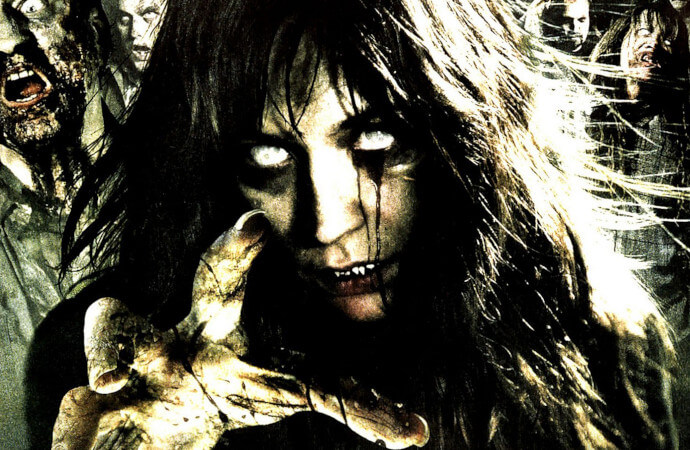
Concluding a series that celebrates the fifty-fifth anniversary of Night of the Living Dead with a look at the classic zombie film and its many follow-ups.
And here we come to the end of the line. George A. Romero’s Living Dead series – a series that lasted long enough to see official sequels, semi-official splinters, Italian mutations, and the birth of the splatterpunk movement – reaches the final instalment of its six-film canon with Survival of the Dead.
Not that anyone would have known, at the time of release, that this was the end. The Living Dead revival had seen a machine-gun production schedule (Land in 2005, Diary in 2007, Survival in 2009) and it would have been reasonable to speculate that more would be coming through the 2010s.
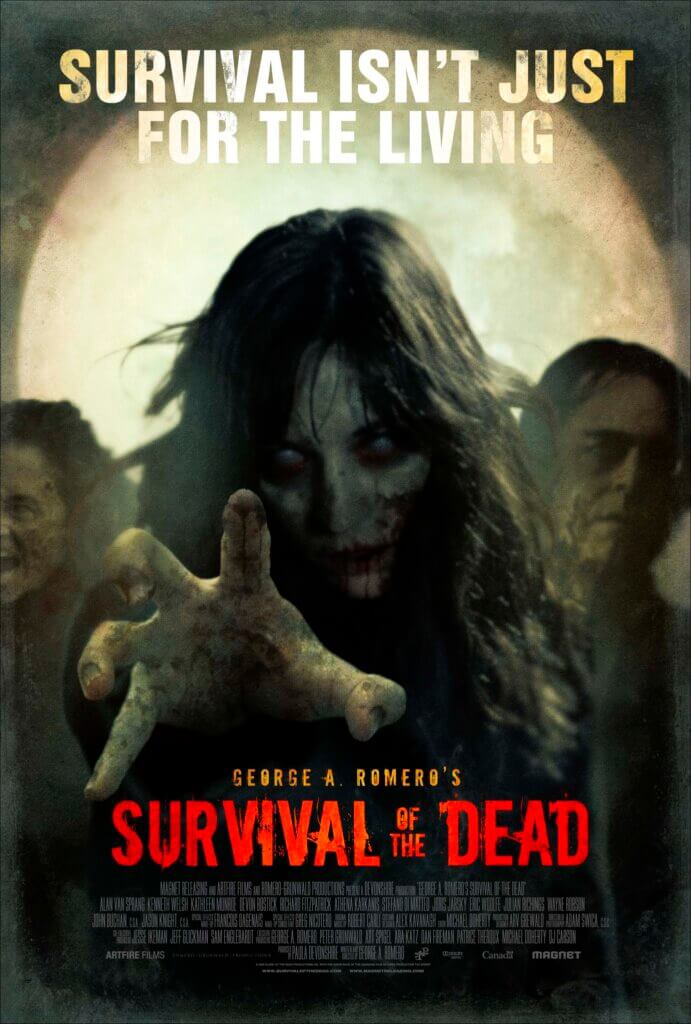
But Survival flopped. The film’s IMDB page lists a $386,078 worldwide gross against an estimated budget of four million; compare this to Diary of the Dead, which grossed over five and a half million over an estimated budget of two million. It was also a critical failure and (as dubious a metric as this may be) has the distinction of being the only entry in the six-film series to be “certified rotten” on the Tomatometer. This was a disastrous showing, which obliterated prospects of any studio backing a seventh outing for Romero’s zombies.
At the same time, though, Survival never seems to have earned the sort of reputation shared by Highlander II, Batman & Robin, or roughly one-third of Star Wars: the “bad one,” the point at which a film series lost the plot and abandoned all dignity. Instead, it seems largely forgotten and left to languish among the other products of the millennial zombie glut. Except, that is, by those sympathetic to auteur theory: to those within that group, any zombie film by George A. Romero is deserving of analysis.
In the only instance of Romero re-using a character from an earlier zombie film, Survival takes Alan van Sprang’s Sarge Crockett – who appeared in one scene of Diary of the Dead as a minor antagonist – and turns him into one of the main protagonists. Sarge leads a band of survivors comprising Stefano Di Matteo’s Francisco (the sensitive one), Eric Woolfe’s Kenny (the loose cannon), Athena Karkanis’s Tomboy (the girl), and Devon Bostick’s Boy (the teenage sidekick). Kenneth Welsh plays Patrick O’Flynn, a man who appears in online videos offering to ferry survivors to his homeland of Plum, a small island off the Delaware coast. Having already bagged a truck full of money, Sarge and his crew set off to meet O’Flynn in hope of finding a new life.
It turns out to be a trap and O’Flynn’s scheme is simply to rob anyone who comes to him for help. But since the meat and potatoes of the zombie apocalypse is mixing together the unlikeliest set of survivors, O’Flynn ends up as part of Sarge’s group on a ferry to Plum. What O’Flynn has not revealed is that he is an exile from the island: his family is locked in a bitter feud with a rival clan, the Muldoons, whose patriarch Seamus (Richard Fitzpatrick) now controls Plum. O’Flynn wanted to destroy the zombies that infected the island; Seamus Muldoon, however, believed that they could be contained and rehabilitated. When Sarge and company arrive, they see the fruits of Muldoon’s experiments firsthand…
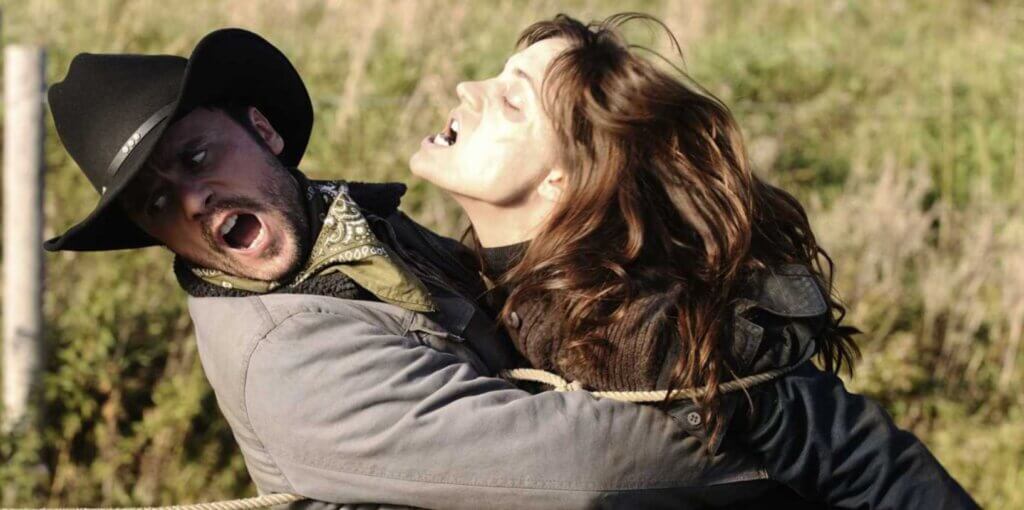
Romero has cited as an inspiration The Big Country, a 1968 Western film adapted from a novel by Donald Hamilton. This told the story of an outsider arriving in a town gripped by a feud between two families: the affluent and elitist Terrills and the uncouth, borderline-destitute Hannasseys. As the plot developed, it became clear that the feud was upheld not so much by the rank-and-file members of either family, but by the two respective patriarchs who were willing to pursue each other to the bitter end even when everyone else had moved on.
Survival of the Dead borrows this basic premise, although it removes the element of class conflict. More than that, it makes an effort to capture the broad-sweeping aesthetics associated with epic Westerns. Notably, when Romero mentioned the influence of The Big Country in interviews, he emphasised how he and his collaborators drew upon that film’s aesthetic rather than the more obvious debt in terms of plot.
On paper, Romero’s decision to head West (figuratively speaking, given that Survival’s actual setting is off the East Coast) might seem like a backward-looking move. After all, the Western is a genre whose heyday was decades past, and the combination of the Western with a monster franchise inevitably evokes such desperate fare as Billy the Kid vs. Dracula and Jesse James Meets Frankenstein’s Daughter (both 1966). Yet the concept is both logical and bold.
Romero had already started mashing his zombies with established genres, Diary of the Dead having been part of the found footage horror trend. From the perspective of the late noughties, the obvious next step would have been to ride the bandwagon of torture-based films or perhaps to wallow in self-aware snark as Rob Zombie did with his Halloween remakes (Saw VI and Halloween II came out the same year as Survival, so these were evidently approaches with box-office appeal). Instead, Romero chose to blend his zombies with the Western – and not even with the shoot-’em-up cowboy clichés that would have made an easy transplant to a post-apocalyptic setting, but with the more serious-minded horse opera where the likes of William Wyler and John Ford used the epic scope of the Old West to tell grand stories of America’s dreams and foibles. Riffing on The Big Country, of all things, marks a genuinely outside-the-box direction for the series.
Watching the film, it soon becomes clear that Romero’s Westward migration was justified. Survival of the Dead opens with two prologues, one introducing Sarge and his band, the other establishing the situation at Plum. The latter is by some distance the more promising. The setting of a rural community fighting over whether or not zombies can be rehabilitated is much more intriguing than the prospect of watching yet another militaristic gang of survivors making it through an apocalyptic urban wasteland – and it helps that the Plum sequence is more credibly acted, as well.
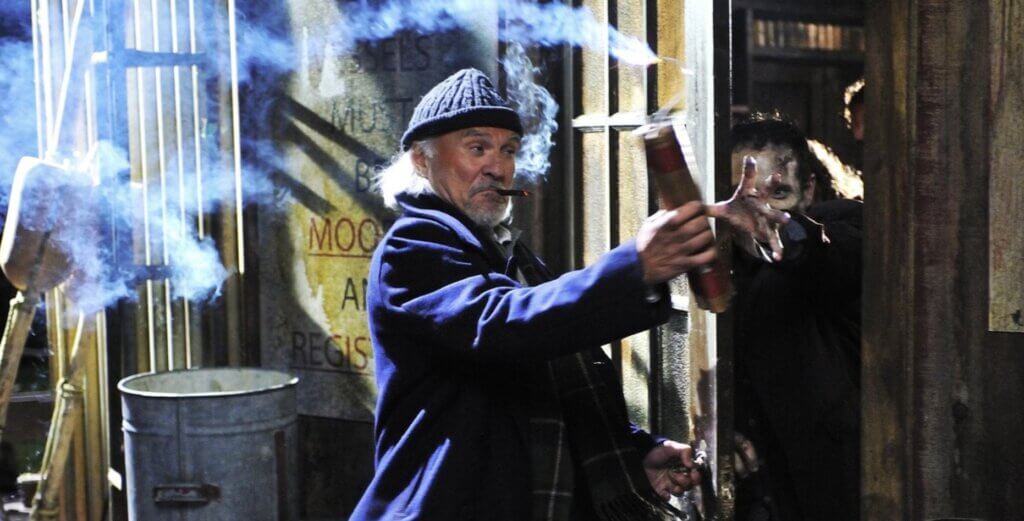
Early impressions are only reinforced by the first act which follows Sarge and his crew on their journey to the harbour. The best parts of this stretch are the bouts of Looney Tunes-esque humour: an angler hooking a submerged zombie; a zombie staring stupidly at a stick of dynamite before it goes off in his face; a zombie having fire extinguisher foam pumped into his mouth until his eyes pop out (this last gag was routinely mentioned in the film’s reviews with even Survival’s detractors citing the scene as a highlight). However, these moments of broad comedy are spread too thinly for Sarge’s exploits to stand out in an era when zombie spoofs had become a well-established subgenre.
Then O’Flynn returns to Plum Island, with Sarge and the rest in tow, and Survival gets a lot more interesting. While still not especially sharp in terms of writing (this is a film where a newly-infected character describes the surrounding countryside as “a beautiful place to live… and to die”) it benefits from a definite oddball quality. Plum Island is portrayed as a place out of time, out of genre, and beyond what we might expect from a zombie film.
In one scene, Seamus Muldoon shows pictures of his teacher and other authority figures from his childhood. These appear to be Victorian-era post-morterm photographs, depicting period-dressed corpses propped up before an antiquated camera. Muldoon, a man who seems to be in his sixties, apparently has had a Victorian childhood. Had Survival of the Dead been set in 1968, the year of the original Night of the Living Dead, this would have been something of a stretch; given that the film clearly takes place in the twenty-first century, it becomes so ludicrous as to be irresistible.
Romero’s zombies have reached a land where the nineteenth century never ended. Given that the plot deals with an effort to rehabilitate the ghouls, this leads us to a surreal setting that resembles a sort of zombie settler-colonial town, complete with a zombie lumberjack, zombie postman, and a young zombie girl riding about on horseback. But where, exactly, is this imagery going?
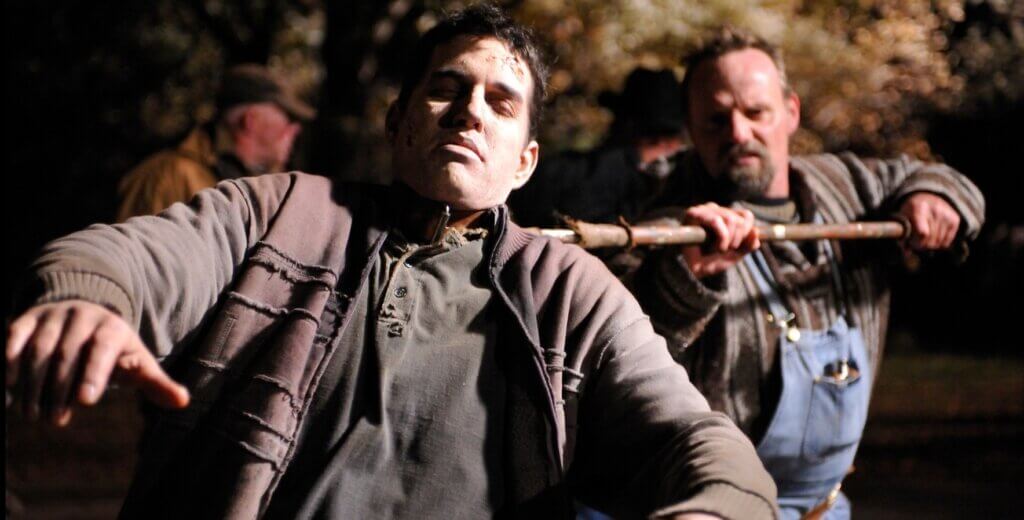
For years now, Romero had been playing with the concept of his zombies being given a role in society – or perhaps even an entire society of their own. We saw this idea in Day of the Dead’s Bub, and then on a larger scale in both Land of the Dead and Romero’s Toe Tags comic. Seamus Muldoon’s goal of keeping the zombies animated and allowing them to exist on the island, rather than wiping them all out as Patrick O’Flynn prefers, therefore meshes with Romero’s own interests.
Yet Muldoon is also depicted as a reactionary, making him the classic Romero villain: witness him telling Tomboy, the lesbian character, that women belong in the kitchen. Moreover, he is a violent reactionary, gunning down visitors to the island and euthanising the zombies which, to him, show insufficient promise. The decision to cast the character invested in rehabilitating the zombies as a villain effectively turns Survival of the Dead into a Western where the antagonist is a mad scientist. This is an unusual combination, but stock genre elements are still stock genre elements, and the film offers no indication of a way foreward for zombie cinema – even though, with the theme of humanised zombies, finding a way forward is one of Survival’s biggest concerns.
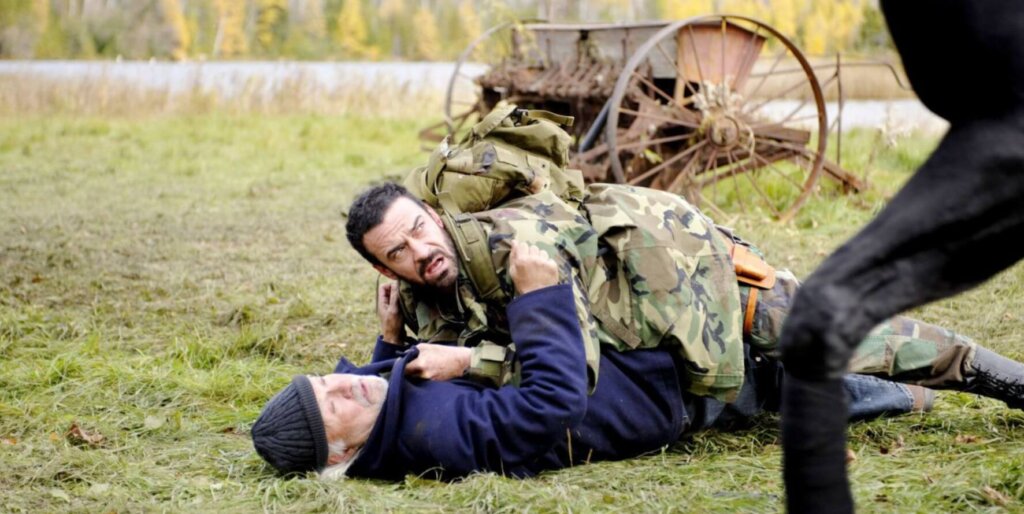
The film’s climax has its strong points: the final confrontation makes full use of the settings and implements of its farmland backdrop, and the conventions of the zombie apocalypse and the western are melded with skill. Yet while it works as spectacle, it lacks tension or coherence. The various threads of characterisation and themes struggle to weave together, and the central concept of zombie domestication reaches a muddled conclusion built around a shot of a ghoul biting a horse – something well below Romero’s usual flair for the iconic.
At its most successful, Survival of the Dead is less a reinvention of the zombie film, but rather an update of the Western. The Big Country was conceived well into the Cold War and ended with mutually assured destruction for its two rival family heads. Survival, meanwhile, is a product of the millennial zombie glut that is itself a product of the post-Cold War era: a time that has seen the supposed end of history and yet keeps slogging along. Now, the warring patriarchs can carry on their feud even when both are dead, making for a genuinely intriguing addition to twenty-first-century Western cinema.
But an intriguing modern Western is not what horror audiences of 2009 wanted. They had a point. As interesting as it may be to pick apart Survival’s treatment of genre, it is also easy to imagine ways that it could have been better: more exciting in its action and tension, better-constructed in its character-based drama, perhaps even funnier (bear in mind that the biggest zombie hit of the year was, by some distance, the comedy Zombieland).
It seems unfair to say that any of these shortcomings are major misjudgments on the part of Romero; nonetheless, he paid a high price for them. Survival of the Dead was not merely his last zombie film – it was his last film. The auteur who had not only created the zombie genre, but also peppered the horror landscape with the likes of Season of the Witch (1972), The Crazies (1973), Martin (1977), Creepshow (1982), Monkey Shines (1988), The Dark Half (1993), and Bruiser (2000) had ended his run.
Looking at the interviews undertaken by Romero during the eight years between Survival of the Dead and his passing in 2017 is a melancholy experience. As with almost any artist near the end of their life, his head was full of grand creations that would never see the light of day. He talked about the possibility of making a zombie noir film, or adapting Steven C. Schlozman’s pseudo-nonfiction book The Zombie Autopsies, or doing both with the same project. He considered turning Empire of the Dead, the zombies-versus-vampires comic he wrote for Marvel in the years following Survival, into a movie.
But Romero’s most poignant comment on the matter must surely be from the Little White Lies interview that was conducted in 2013 but published posthumously:
Well, I’m trying to avoid zombies now. All of a sudden the whole world is zombified. I could never sell a zombie movie now unless I promised to spend $250m and filled it with the most amazing CG effects. That’s all they’re buying right now.
