

Continuing a series that celebrates the fifty-fifth anniversary of Night of the Living Dead with a look at the classic zombie film and its many follow-ups.
From today’s perspective, we see Land of the Dead and Diary of the Dead as the fourth and fifth installments of George A. Romero’s six-part zombie series. But this obscures the drastically different circumstances in which each film was made.
When Land of the Dead came out in 2005, it was the end of a twenty-year wait and followed up on a trilogy released at a rate of one film per decade. The phrase “long-awaited” scarcely does justice. Diary of the Dead, however, came out in 2007, only two years after Land. Given that the millennial zombie glut had by this point peaked, with even the most dedicated fan of the subgenre surely glutted, audiences were apt to ask a fair question: was Romero making another masterpiece or just a rushed-out franchise sequel?
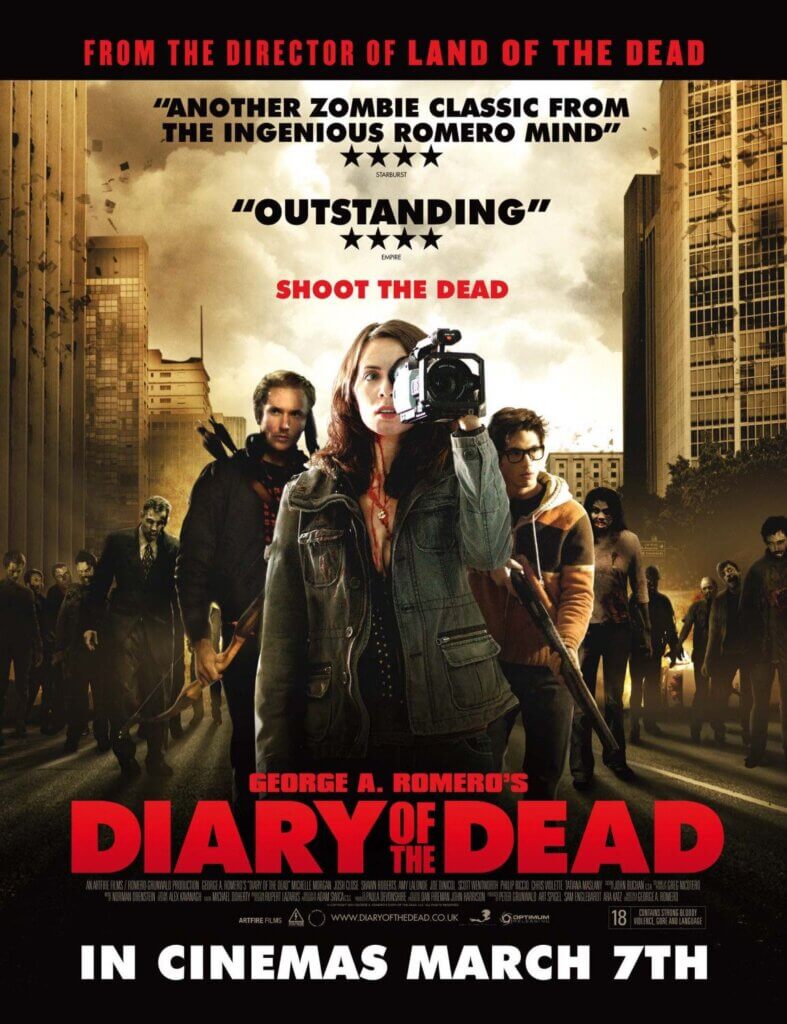
As it happened, though, Romero was in the perfect position to inject new life into his series. As well as a zombie renaissance, the 2000s saw a boom in found footage horror films: this form had already produced a few canonical works (Cannibal Holocaust, 1980; Ghostwatch, 1992; The Blair Witch Project, 1999) but did not come into its own until the smartphone era. 2007, the year in which Diary of the Dead premiered at the Toronto International Film Festival, also saw the first films in the Paranormal Activity and Rec franchises. Romero’s high concept for Diary of the Dead was to ride both trends by mixing zombies with found footage.
Granted, this idea was not entirely new; The Zombie Diaries having already come out in 2006. Yet, it remained a good idea, one that allowed Romero to head back to the very beginning of his zombie apocalypse and view it through a twenty-first-century lens. And he was most certainly keen for his film to be of-the-moment: his DVD commentary reveals that the radio broadcasts heard in the film combine scripted exposition (spoken by Tom Savini) with genuine police broadcasts from 9/11.
Like any found footage film, Diary found itself faced with a central aesthetic choice. Should it emulate an authentically clunky and amateurish filming style and thereby risk alienating the audience; or should it take artistic license and add more layers of polish than credibility allows? Where Blair Witch Project chose the former option, Diary of the Dead takes the latter path. The entire film is presented as having been edited together and released online by the character of Debra (Michelle Morgan) after the events of the plot, and given the circumstances, Debra has certainly done a professional job.
The film incorporates faux news footage (purportedly downloaded from the Internet), uses canny editing between the perspectives of multiple cameras, and even has a background score. At many points in Diary of the Dead, it becomes easy to forget that we are watching a found footage film, rather than a zombie movie that happens to have unusually wobbly camerawork. So what, then, does the movie gain from its found footage aesthetic?
The answer is that the format allows Diary of the Dead to tackle head-on one particular topic: the media. While it is debatable as to whether this had been a central theme of the Living Dead series, there had long been signs that Romero was interested in what role television – with all of its associated distortions – might have in the zombie apocalypse. Night had broadcasts in which various talking heads tried to reassure the public from their own positions of safety. Dawn of the Dead began its story in a television studio, and Land of the Dead featured spoof adverts for the affluent survivors’ settlement Fiddler’s Green.
In addition, Romero was now able to indulge one of his personal tics as a director: a tendency to stop the action and have his characters wax philosophical about the zombie apocalypse. This had been visible since Ken Foree’s “when there’s no more room in hell” speech in Dawn of the Dead, and it becomes inescapable in Diary, the first film in the series to have a character acting as narrator. This is a fair creative decision on Romero’s part as our millennial heroine Debra has plenty to ponder.
Many commentators have suggested a connection between the grainy, TV newscast aesthetic of Night of the Living Dead and the footage of atrocities in Vietnam that aired in the homes of the viewing public. To pick just one example, Sumiko Higashi, a contributor to the book From Hanoi to Hollywood: The Vietnam War in American Film, suggested that the “shocking imagery associated with media reports of the Vietnam War … seems especially apt for a horror film such as Night of the Living Dead in which the role of television is pivotal.”
By 2007, however, footage of real-life death and destruction had very much escaped black-and-white TV screens. The notorious website LiveLeak had launched the previous year, providing a convenient and readily accessible hub for all of the street violence, executions, and terrorist beheadings that a curious video-viewer could desire. Such is the society in which Debra and her friends live: things have come a long way from Barbara’s brother Johnny doing Boris Karloff impressions in 1968.
We meet Debra and her friends, a group of film students, as they are shooting a movie in which a girl is chased through a forest by a mummy. This prompts discussions about how fast the living dead can run (an acknowledgement of the speedier zombies popularised by 28 Days Later) and the portrayals of women in horror films; the self-awareness indicates that Romero is doing not only Blair Witch but also Scream.
Although the film begins with several central characters, three in particular play prominent roles once the zombies turn up. Would-be director Jason (Joshua Close), who shoots much of the found footage, is the passion behind the project: his determination to capture the changing world around him leads him to tread the fine line between journalist and voyeur. Debra, meanwhile, is the group’s conscience, often arguing with Jason over his exploitative urges (although we know from the start that it is Debra who ultimately completes the film).
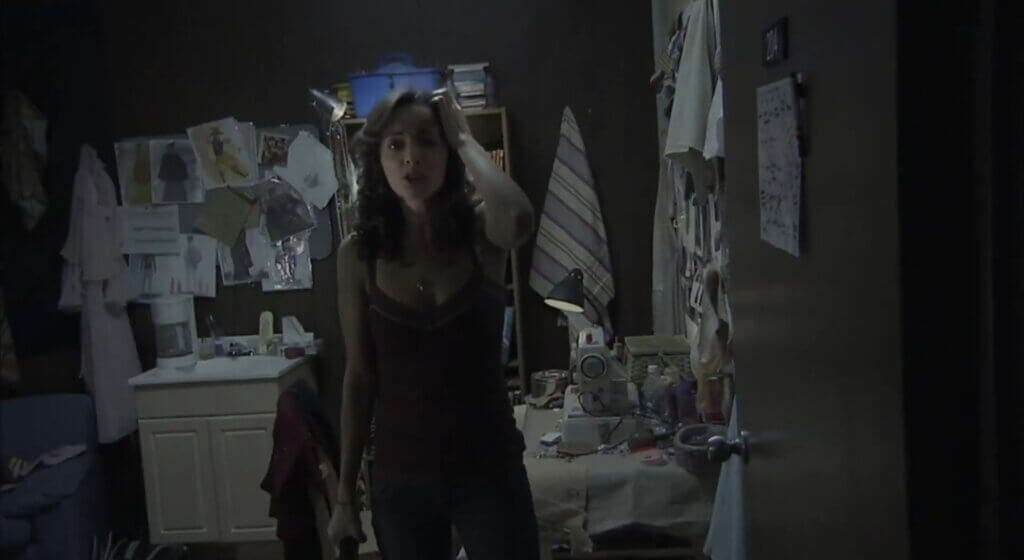
And then there is the teacher Maxwell (Scott Wentworth), always on hand to offer a dry piece of philosophy. While many a film would have killed off this character to focus on the younger, hipper members of the class, Diary of the Dead chooses to keep him around. Swigging whiskey and talking like the classic “luvvie” of the English stage, Maxwell is implied to be a washed-up director who never made it big. Romero appears to feel a certain empathy with this character: after all, in Hollywood, it really is potluck whether someone becomes a George A. Romero or a Professor Maxwell.
Like any band of self-respecting zombie survivors, these characters deal with internal strife. A memorable sequence, shortly after the group suffered its first casualty, has Jason narrowly miss filming Debra gunning down a zombie, an altercation that we hear, but do not see. When Debra emerges onscreen, she proceeds to shoot Jason–filmically and verbally, that is. She turns her own camera on him and pointedly grills him, interrogating him about his assumption that reality only matters if caught on film, and then performs a mock scream of fright in the manner of a stereotypical horror heroine. The characters in Night argued about leaving the basement to watch television; the characters in Diary, hailing from an era when atrocity-blaring screens fit right in our pockets, argue about the ethics of appearing on television.
Admittedly, Diary of the Dead sometimes overeggs its meta pudding. The idea of having the finale mirror the mummy-movie sequence near the start is nice on paper, but completely undercut by having the characters specifically point out the similarities. Such moments of spelling-out already clear subtext appear to have been added for the benefit of people unwilling to watch the film with an analytical eye; which is odd, as much of Diary of the Dead does require an analytical eye to enjoy: this is not one of the more visceral, thrill-packed zombie films. As with Day of the Dead and Land of the Dead, Romero turns in a slow-paced, brooding film where the audience is expected to sit back and soak up the atmosphere and themes alike.
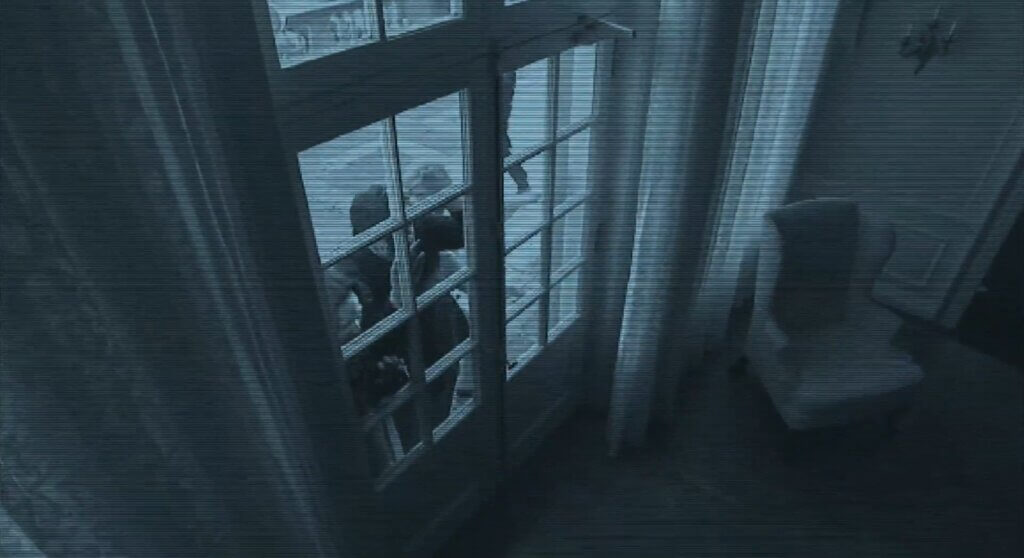
We still see the bouts of gonzo inventiveness that characterise Romero at his peak and separate him from his many tawdry imitators. In one sequence, the protagonists meet a deaf Amish man who turns out to be a dab hand with explosives; later, we see a household swimming pool being used as a means of containing the animated dead with zombies shambling about beneath the chlorinated water. Such moments are rolled out as part of a slow, steady road trip, the characters travelling from one place to another with little forward momentum and, even after the deaths start, not a great deal at stake, until the story reaches its abrupt conclusion.
This appears to have been off-putting for audiences who hoped for a violent thrill ride rather than a series of gallery exhibits. Fairly typical of the critical reception is Peter Hartlaub’s favourable review for the San Francisco Chronicle which hails Diary as “extremely vital” but acknowledges that this effort from Romero is “one of the least scary films that he’s made.”
Perhaps those concerned about the short period between Land of the Dead and Diary of the Dead were correct. The film might well have benefited from a longer time in conceptual development to help it become the equal mixture of thrills and thoughts that it so clearly needed to be. Still, the Diary that was made is the Diary that we are left with, and it remains an inventive twist on a series that was fast approaching its fortieth anniversary.
The film has also picked up something of a poignant aura. While the march of time has obscured how quickly Diary of the Dead followed its precursor Land, it has also driven home just how little time Romero’s zombie saga had left. He had only one more film to make.
Next: Another day, another dollar…
