

Chicago became the host of the 80th World Science Fiction Convention at the start of this month, with the annual Hugo Awards handed out on Sunday. A new round of recipients, voted for by the convention membership, went home with the iconic rocket-shaped trophies to honour their contributions to the previous year’s science fiction and fantasy.
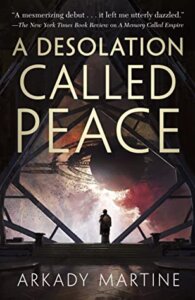
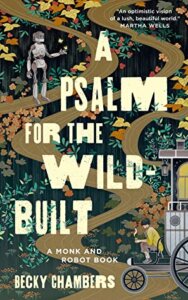
Arkady Martine won her second Hugo for Best Novel with her space opera A Desolation Called Peace, the sequel to her previous Hugo-winner A Memory Called Empire. Moving into the categories for shorter fiction, it would appear that the Hugo voters have a fondness for stories that draw humorous contrasts between humans and robots: Becky Chambers’ A Psalm for the Wild-Built (Best Novella) and Suzanne Palmer’s “Bots of the Lost Ark” (Best Novelette) each use this theme, albeit in very different settings.
While the above categories were taken by works of science fiction, the fantasy genre claimed Best Short Story and Best Series — awards that went to Sarah Pinsker’s “Where Oaken Hearts Do Gather” and Seanan McGuire’s Wayward Children respectively.
Seanan McGuire was also honoured in the Best Fanzine category for Small Gods, her collaboration with artist Lee Moyer. A website devoted to flash fiction about modernised versions of mythological figures, this shows how Best Fanzine can reach beyond the genre news-and-reviews blogs that typically win. The Best Semiprizine Hugo, meanwhile, went to Uncanny Magazine — a publication that previously had a winning streak from 2016 to 2020.
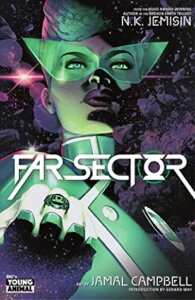
Outside of the prose categories, the two Best Dramatic Presentation awards went to Dune (Long Form) and “Nemesis Games”, an episode of The Expanse (Short Form). The title of Best Graphic Story was claimed by N. K. Jemisin and Jamal Campbell’s Green Lantern re-imagining Far Sector. Between these three winners and A Desolation Called Peace, the 2022 Hugos show a clear appetite for stories of space voyages and alien planets: always popular with SF audiences, of course, but not necessarily a trend at the awards.
Charlie Jane Anders won Best Related Work for her essay collection Never Say You Can’t Survive. She was also recognised in Best Fancast, as Our Opinions Are Correct — a podcast that she hosts alongside Annalee Newitz — won its third Hugo. Cora Buhlert, blogger and fiction author, won her first Hugo for Best Fan Writer.
In the artist categories, Rovina Cai won Best Professional Artist while Small Gods co-creator Lee Moyer was named Best Fan Artist. The winners of the Best Editor categories were Ruoxi Chen (Long Form) and Neil Clarke (Short Form).
Finally, we have the two awards that are part of the Hugo voting system but not officially Hugo awards themselves. The Lodestar Award for Best Young Adult Book went to Naomi Novik’s The Last Graduate, while Shelley Parker-Chen — author of the Best Novel finalist She Who Became the Sun — won the Astounding Award for Best New Writer.
For those who require further information, the official convention website provides a PDF document with a full breakdown of the voting stats — and the bombshell revelation that Jorts the Cat made the longlist for Best Fan Writer.

