

Our coverage of the 2022 Hugo Awards continues with a look at the final two contenders for Best Short Story: “Where Oaken Hearts Do Gather” by Sarah Pinsker and “Unknown Number” by Blue Neustifter.

“Where Oaken Hearts Do Gather” by Sarah Pinsker
This is a story about a folk ballad, the eponymous “Where Oaken Hearts Do Gather”. Although the ballad is fictitious, author Sarah Pinsker takes the time to give it a convincingly rich history. The ballad, we are told, exists in numerous forms; has been performed by bands ranging from the Grateful Dead to Metallica, sometimes under such bastardisations as “Where Broken Hears Do Gather”; and has been indexed by both Francis James Child and the Roud Folk Song Index (although the index numbers provided are, in reality, both empty). Yet, as is typically the case with folk ballads, its exact origin is obscure, its history muddied by different variations, and its narrative peppered with enigmatic details.
The story is framed as a discussion at a fictional website named LyricSplainer, with each verse of the ballad followed by a set of comments by various posters as they analyse and interpret the age-old tale.
The plot of the ballad itself deals with a young man, William, who attempts to court a maiden named Ellen. Although Ellen’s sisters warn her against seeing him, the two meet in a certain location – where oaken hearts do gather. It turns out to be William who was in danger, however, as Ellen tests his love for her by removing his heart and replacing it with a bird’s nest. William still lives and calls for help, but has lost his voice; Ellen, meanwhile, mourns that the boy she loved could not pass her macabre test.
Much of the conversation between the LyricSplainer members focuses on strange or ambiguous wording, as with this verse:
His beating heart she placed inside
A gnarled and knotted ancient
to quicken come the springtime thaw
Where oaken hearts do gather
As one poster remarks: a gnarled and knotted ancient what? An oak tree, presumably, but why is the line cut off? The verse becomes stranger still when another commentator points out early variants that use the phrase “her gnarled and knotted ancient”. Pinsker’s portrayal of a folk-ballad containing such oddities that later reworkings have tried to iron out is entirely credible, as are the hit-or-miss theories floated by the commentators: one idea floated is that William represents Prince William, Duke of Cumberland, while another suggestion is that Ellen and her sisters represent the three mythological Fates; neither theory catches on.
All of this makes for an intricate story structure, and the surrounding discussion adds much to the ballad’s narrative, even in terms of such basic storytelling techniques as foreshadowing (one commentator mentions the “Temple-of-Doom-style” heart removal long before the reader comes across it in the ballad’s climax). More than that, the conversation turns out to be telling a story of its own. We learn that a certain researcher followed a trail of clues to find the exact location where the ballad is set, and one of the LyricSplainer posters follows in his footsteps, posting regular updates from the place where oaken hearts do gather.
Some readers might argue that the two stories comprising “Where Oaken Hearts Do Gather” are not, in themselves, particularly remarkable. The ballad is a well-executed modern pastiche but is still, ultimately, a modern pastiche, and so evokes rather than carries the appeal of authentic folk-ballads. Meanwhile, the story of the researcher’s trip to the village – told through hints and implications – is simply a stock folk-horror scenario (the character is filming a documentary, and it is easy to mentally insert any number of found-footage movies into the background).
But take a step back, and it can be seen that the story warrants that oft-used phrase “more than the sum of its parts”. The various elements that make up the piece – the ballad itself, the detailed fictional history of its numerous variations and interpretations, the subtextual story of the research trip, the banter-laden conversation, the abiding passion for both folklore and traditional ballads – each succeed on their own terms. There is no weak link here, which is an accomplishment indeed in a story with such an unorthodox structure.
“Unknown Number” by Blue Neustifter
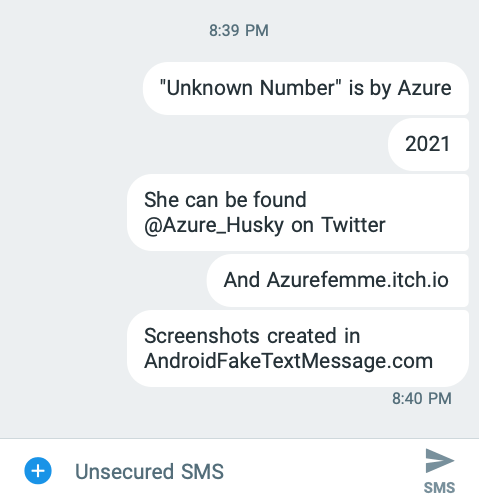
“Unknown Number” is another formalistic experiment, albeit one more straightforward than “Where Oaken Hearts Do Gather”, being made up simply of a two-person text message conversation. The most unusual aspect of the story’s presentation is that author Blue Neustifter published it on Twitter as a series of screenshots – certainly a first in the annals of Hugo Award-nominated fiction.
The narrative begins with protagonist Gaby receiving a message from an unknown number. At first, Gaby is disturbed: the anonymous texter knows about her life in uncanny detail. The reason for this, it transpires, is that the texter actually is Gaby – that is, a version of Gaby from a parallel universe.
There are two main points of diversion between the twin-selves. First, where recipient-Gaby studied coding, her doppelganger pursued a PhD in physics – and eventually devised a way of making contact with other timelines. Second, while Gaby eventually came out as a trans woman, her other self remained in the closet and continued to live as a man.
The premise of “Unknown Number” reaches into a deep area of transgender experience. If you were to gather together a group of trans authors and ask them to write a specifically gender-themed science fiction story, then certain themes are likely to recur – and one of those will be the alternate timeline communication at the centre of “Unknown Number”. After all, it seems safe to say that every transgender person will, at one point, have asked themselves how their life might have turned out had they followed the other path: a story that articulates this question can be both deeply personal and broad-ranging.
“Unknown Number” is in large part a trans writer’s intimate reflection on being trans. It takes a swipe at more mainstream narratives (the work of “cis people writing movies about how sad and pathetic trans people are… [who] don’t know what they’re talking about”) and, within the confines of its length and format, tells a detailed coming-of-age story that is shared by both versions of its main character.
Gaby and Unknown (the latter’s name – Gaby’s deadname – is blocked out) discuss their shared formative years, where their struggles with gender identity were impacted by the media landscape: preferring to play as April O’Neil over the Ninja Turtles; being fascinated by an episode of Sliders where the male lead meets a female version of himself from another universe; being repelled by the portrayal of Buffalo Bill in The Silence of the Lambs; and, in the case of the primary Gaby, choosing to name herself after Xena’s girlfriend.
The story makes a few gestures towards the worldbuilding arising from its central science fiction concept. Unknown has contacted enough alternate timelines to understand that there are different “distances” between them, with earlier or later points of divergence, and so is able to access an alternate self with a similar childhood.
But such matters are not really the point. “Unknown Number” is the sort of story in which a character can use the ability to communicate between alternate timelines for purely personal reasons, as acknowledged in a typically snarky manner by Gaby: “you know that therapy is easier than proving multiverse theory, right?”
Although a two-character piece – arguably a one-character piece, depending on perspective – “Unknown Number” does a good job of fleshing out its leads. At the beginning, Unknown is characterised by cautiousness and Gaby by hostility. While the two develop over the course of the narrative, these traits remain, each one turning out to have arisen from the simple fact that the main Gaby transitioned while Unknown did not (as Gaby puts it, “when you’re not being crushed under a mountain of dysphoria you find a lot of energy for, like… being a person”).
Gaby is assertive and willing to press forward with her life no matter how much of the world rejects her. Unknown, meanwhile, is trapped with a more defeatest outlook, being stuck on the inside gazing out – in this case, across timelines. Gaby is not impressed by the personality of her parallel self: “in that timeline am I seriously one of those people who hears a sympathy ‘sorry’ and misinterprets it to deflect??? That’s disappointing”.
Still, Gaby is in the perfect position to give Unknown advice on life. The story, having spent so much time exploring the pain that so often comes with being transgender, concludes on a positive note by affirming that – yes – Unknown is Gaby after all, and always should have been.
