

WWAC’s coverage of the 2022 Hugo Awards continues with reviews of two more Best Novelette finalists: “Colors of the Immortal Palette” by Caroline M. Yoachim and “Unseelie Brothers, Ltd.” by Fran Wilde…
“Colors of the Immortal Palette” by Caroline M. Yoachim
Mari is a model who resides in nineteenth-century Paris, where she is surrounded by such creative geniuses as Édouard Manet, Victorine Meurent and Émile Zola. Even amongst these talents, however, there is one artist who has carved out a central role in Mari’s life. The artist in question, left unnamed throughout Mari’s first-person narration, is immortal, and has the ability to pass this trait on to others.
Years pass and the relationship between Mari and the immortal artist fractures, but the two are eventually reunited, and Mari – already granted figurative immortality by appearing in the painter’s work – accepts immortality of a more literal sort. By this point an artist herself, Mari obtains the mixed blessing of being able to capture the passing of time as the people around her die off to make way for the strange new world of the twentieth century.
“Colors of the Immortal Palette” comprises a series of vignettes, each identified with a specific colour and each depicting a point in the life of Mari. The core elements of the story – Mari, the vampire-like artist, the relationship between the two, and the symbolic use of colour – are established in the very first paragraph:
LEAD WHITE
I will always remember the view of Paris from his window. Snow, pure and untouched, softens the outline of the buildings and covers the grime of the streets. White, the color of beginnings. His canvas is primed and ready to be painted, and stark winter sunlight glows bright on his undead skin.
From here, these elements are used in different combinations – often with further elements added for contrast – to build the different vignettes. The analogy to an artist’s palette being used to create a series of paintings is almost too obvious to be pointed out; yet pointing it out is the quickest way of describing the story’s structure. The narrative takes place offstage (or between the brushstrokes) at least as much as it occurs in the vignettes themselves.
Granted, it is in the focal scenes that we see many of the most significant events, all daubed in bright colours. Mari’s rivalry with other young women – a narrative of youth and envy – is coloured in green. Glamorous displays of art take place in scenes of chrome and cadmium yellow. Mari’s complex relationship with Victorine, who sometimes serves as a rival and other times as a muse, is associated with vermillion; so much so that Mari finds herself unable to paint with this hue after outliving Victorine.
With the motif of colour comes the theme of racism: Mari is of mixed French and Japanese ancestry. Across the story, she witnesses the people and culture of Japan being commodified as exotic curiosities in nineteenth-century Paris, and later being demonised and interred in wartime America. The latter period is where she falls in love with an African-American jazz musician, who likewise faces immense racial prejudice.
Yet the roll-call of famous incidents and persons, some better-known than others (readers might miss that Victorine Meurent was a real person: she modelled for Manet’s Olympia) makes up only a portion of the story, the rest being coveted through hints and implications, as though we are hopping on stepping-stones across the pool of time. This is common enough in fiction that deals with immortality, of course, but “Colors of the Immortal Palette” is unusual both in just how much it allows to take place outside Mari’s present-tense narration, and in the care with which it picks and chooses its focal points.
Indeed, this sense of thoughtful curation can be seen in the story’s treatment of the vampire theme. “Colors of the Immortal Palette” has similarities to another of the year’s Hugo finalists, Jonathan Wiswell’s “That Story isn’t the Story”, in that both adopt elements of the vampire genre while pointedly rejecting others – and yet the two end up as wildly different pieces of work.
Although Mari’s immortal partner is described as “undead” in the first paragraph, there is only one exchange in which he is referred to as a vampire – and Mari explicitly objects: “Victorine! You must not call him that. People will think he drinks blood.” In many respects, the artist is a conventional vampire lover, with Mari speculating that he once knew Jane Austen and inspired Mr. Darcy (if Lord Byron is the father of the vampire-lover archetype, Mr. Darcy must surely be the godfather). Like Dracula, meanwhile, he is able to transform into mist, a trait that the story adapts into an erotic symbol:
After, when other artists might hold me and drift off to sleep, he dissipates into a white mist that swirls in restless circles around the room, chilling me down to the bones when it touches my skin. His mist seeps into me and pulses through my veins for several heartbeats. I feel energized, an exhilaration more intense than watching him work, a connection closer even than our sex. He withdraws, and I am diminished. I hadn’t known until this moment what I was lacking, but now I am filled with a keen sense of my incompleteness. I long for him, for the sensation of vastness I felt when we were one.
While Mari is quite right to say that the artist does not drink blood, the story’s vampires nonetheless feed upon mortals – they drain time. This is an issue that Mari herself must confront upon becoming immortal:
Even being immortal, which should be simple enough, is a task that I am failing for I cannot bear the thought of stealing time from mortals whose lives are already so fleeting. I take just enough here and there from models—always with their consent—to maintain a human form, but if I cannot create beauty, cannot leave my mark on the world of art, their time is wasted, and nothing is so precious as time.
By placing itself in the world of artists and modelling – a world of men immortal in name and women immoral in image, where muse after muse is sucked dry and abandoned – “Colors of the Immortal Palette” finds fertile ground in which to explore the theme of vampirism. Once literal immortality is introduced to the scene, all of the bitter ironies become just that little bit more potent.
“Unseelie Brothers, Ltd.” by Fran Wilde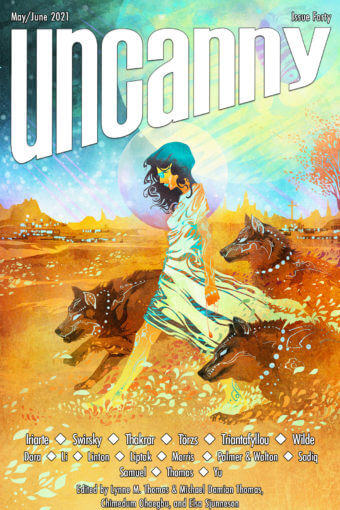
Socialite Venessa Saudners receives a phone message alerting her to the appearance of a certain doorway – a doorway leading to the shop of dressmakers Unseelie Brothers, Ltd. This is the same business responsible for such legendary garments as the Butterfly Gown, a dress adorned with actual, fluttering butterflies. Whenever the door appears, those with an appreciation of the highest fashion take notice before the shop vanishes once more – and this time around there is a particular urgency to the situation, as it will soon be the conclusion of the Season, when the finest dresses will be displayed by their wearers at an extravagant ball,
Mrs. Saunders’ daughter Rie and niece Sera have little interest in either the magic shop or the Season. The two cousins are focused instead on a collaborative project for Sera’s graduation from her art classes. But Mrs. Saunders herself is determined to reach the shop: in her younger days, she and her sister Serena – Sera’s mother, now missing and presumed dead – were belles of the ball in their Unseelie Brothers dresses; indeed, they each found their respective husbands at the event. And so, she insists on sending the two girls to locate the shop for her. The experience eventually leads Sera to confront both her own future and her family’s past.
Many beloved fairy tales hinge on exchanges, from the Faustian bargain arranged by Rumpelstiltskin to the kiss of a frog in exchange for a handsome prince. “Unseelie Brothers, Ltd.” – a fairy tale that, notable, takes place in a world of modern commodities like mobile phones and 3D printers – places this aspect of the genre under the microscope.
Mrs. Saunders, the first character we meet in the story, comes across as brand-label hedonism personified (can it be a coincidence that she shares her surname with one of the leads in Absolutely Fabulous?) When she visits the shop, she promptly begins doting on her daughter while remaining oblivious to her niece:
When the young man approached her, Sera and Rie were stunned to see Mrs. Saunders dip the deepest curtsey possible to him. “Sir. I paid for a gown from your shop, long ago. I wish another for my daughter. Whatever the cost.”
A smile broke across the man’s still face. “Vanessa. How nice to see you again. Please call me Beau. And gowns for both young ladies?”
“Both?” Sera’s aunt blinked, confused. Then she said, “No. For my Merielle. The other’s not mine.”
Initially, Sera and Rie are unified against the world that Mrs. Saunders represents (“I don’t want to do the Season, not without you,” says Rie to Sera. “I hate the balls. And the stodgy people. I refuse to try on any more gowns. Your dress would have been so much better”). But the trip to the Unseelie Brothers shop changes things. Rie becomes captivated by the garments on show, and with the idea of appearing at the ball wearing one; in another example of an exchange, she forgets all about the design that Sera offered her.
For Sera, the negative aspects of the visit to the shop are at least partially balanced by a positive: the prospect of getting a job (“If I can do it, then I’ll have something amazing on my resume”, she says, reminding us that this is a story about modern students as much as it is a tale of faerie). Her father disapproves, however, knowing the shop’s reputation for unfulfilled bargains. And so begins the age-old conflict between the weariness of a past generation and the optimistic ambition of youth.
This conflict is also one between different generations of fairy tales. The unfolding backstory deals with a time in which the joint matriarchs – the now-callous Mrs. Saunders and the now-absent mother – were Cinderella-like heroines themselves, attending an enchanted ball. But such youthful infatuations do not always end well, as the story makes clear. Will Sera make the same misjudgments as her elders, or will she learn from their mistakes…?
The strength of “Unseelie Brothers, Ltd.” is that it takes the sort of fairy tale subject matter (specifically, the sort of modernised, post-Disney fairy tale subject matter) that could have been trite and moralistic, and handles it with an infectious sincerity. The story uses the familiar motif of the fractured family, with Mrs, Saunders serving as a sort of wicked stepmother to Sera; meanwhile, Sera’s real mother haunts the narrative like a ghost, glimpsed by her daughter in the occasional was-it-just-her-imagination moment. The factor that tears the family apart, and which drives a wedge between Sera and Rie, is materialism, defined as a lust for the magical ballgowns and glass slippers, the attainment of which is treated as an entirely admirable goal by more traditional fairy tales.
The story’s climax brings together its various thematic strands – the fate of Sera’s mother; the central image of the otherworldly dresses; Sera’s renunciation of the exploitative, commercialised world around her – and does so without sacrificing the iconic simplicity of all the best stories from Perrault, Andersen and the Grimms. Writing a revisionist fairy tale is not in itself a mean feat, but “Unseelie Brothers, Ltd.” does more than revise: it demonstrates the true sticking power of the old tales, showing how their raw material can be updated to fit new eras without losing its essence.
