

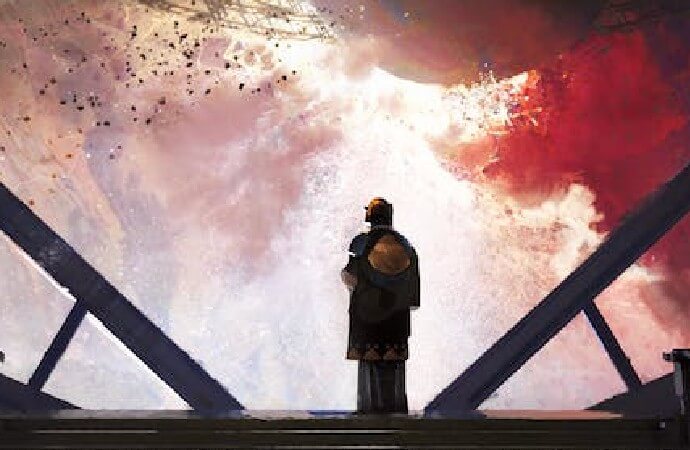
The sequel to Arkady Martine’s earlier Hugo-winner A Memory Called Empire, this novel returns to the realm of the interplanetary Teixcalaan Empire. A Desolation Called Peace takes place early in the reign of Her Brilliance Nineteen Adze, an emperor, faced with an encroaching threat: humanity is making first contact with aliens – and those aliens are both advanced and hostile.
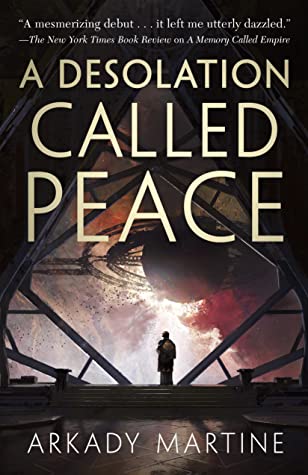
Mahit Dzmare, ambassador to Teixcalaan, returns from starring in the previous novel. Thanks to the technology of Imago she still shares her mind with the consciousness of the previeus ambassador Yskandr – specifically, two different versions of Yskandr, his consciousness having been recorded at two points in his life, twenty years apart. This, however, remains her secret…
The space opera is – like its more (middle)earthbound cousin, epic fantasy – a genre that teeters between the personal and the universal. By its nature it deals with a vast spread of worlds and populations, yet we are acutely aware that no matter how rigorous the worldbuilding, the setting has ultimately been tailored to fit the central characters and their individual arcs. Arkady Martine’s novels have found a successful way to engage with this trait.
The first book in the series introduced a sprawling empire while homing in on themes of individual identity through the central conceit of the Imago implant, which lent Mahit multiple personalities. The Imago takes a step out from centre stage in this second novel, with the alien attackers replacing it as the high concept. The ongoing autopsy of a captured extraterrestrial corpse, along with the accompanying ground-up analysis of its morphology, provides one of the most memorable plot threads; and one tied to the motif of identity, with the aliens’ consciousness turning out to involve a novel form of hive mind.
A Desolation Called Peace flits between the perspectives of different characters who occupy very different parts of its imperial setting. Nine Hibiscus is a fleet captain who takes charge against the alien attackers, and so presides over many of the more visceral stretches of the novel; she is accompanied by Twenty Cicada, whose nickname Swarm eventually becomes appropriate (the role of nicknames in the story is another example of Martine’s playful attitude towards identity). We also meet Eight Antidote, a clone of the previous emperor and current heir to the throne. He is adept at balancing multiple personas, his outward appearance of an innocent eleven-year-old boy contrasting with the knowledge that he has inherited:
Eight Antidote made himself look like his ancestor-the-Emperor, composed his mouth and eyes into that same knowing, interested, serene expression that had made Nineteen Adze flinch bak from him in surprised recognition. He was getting good at it. It worked even on people who hadn’t known his ancestor so well; it was an adult expression, and people got nervous in a useful way when he made it with his kid’s face.
At the centre of this are Mahit and Three Seagrass, whose relationship reflects how an individual identity – or the perception of that identity – can be shaped by their wider cultural backdrop. Three Seagrass is a representative of the Teixcalaan Empire, and so embodies its standards of civilisation; but Mahit is seen as a barbarian by those in the empire (albeit “the best of the barbarians”). This cultural clash, however, does not stop romance from developing between the two of them. A most physical romance, it must be said, with the novel pulling out all the stops when the couple’s relationship reaches the erotic.
Far more than just another trite forbidden-love-between-cultures narrative, the relationship between the two ties into both the politics of the Teixcalaan Empire and its conflict with aliens. If the goal is to find a way to communicate with an alien race, Three Seagrass argues, then she can put forth Mahit as a communicator – after all, as a barbarian, she is herself seen as something of an alien by much of the empire.
Balancing the grand sweep of space opera with the concerns of individual characters is no mean feat. For an idea of what can go wrong, consider Kevin J. Anderson’s Saga of the Seven Suns, where the constant hopping between far-fling storylines causes both small- and large-scale drama to lose focus and become abstract. A Desolation Called Peace avoids this.
The novel covers a vast range of material: here, a love story; there, a tale of epic space battles; and elsewhere, a cerebral exploration of identity through implanted consciousnesses and cloned emperors (there are even hints of alternate history, with the Teixcalaan Empire implied to be descended from an unconquered Mesoamerica, although this element is not as strong as it was in the first book).
We also see regular flits between external matters – alien autopsies, planet-destroying superweapons – and purely internal concerns as characters silently ponder questions of duty and civilisation. Yet all of this holds together in a single, convincing portrayal of an interplanetary empire straining from tension both within and without, populated by a fundamentally human cast.
A Desolation Called Peace makes for an interesting comparison to the other space opera in the Best Novel line-up: Becky Chambers’ The Galaxy, and the Ground Within. That novel depicts a group of aliens who, although coming from different species with wildly different morphologies, are able to form a close-knit community. Arkady Martine’s novel is the opposite: it takes the human spirit and spreads it across the spaceways – with captivating results.
