

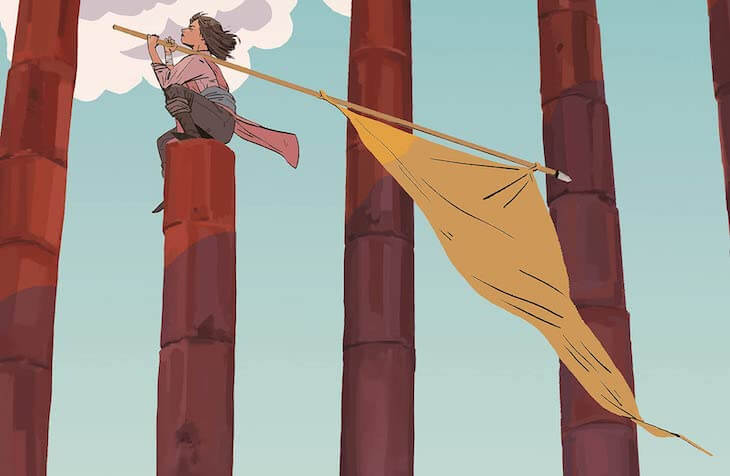
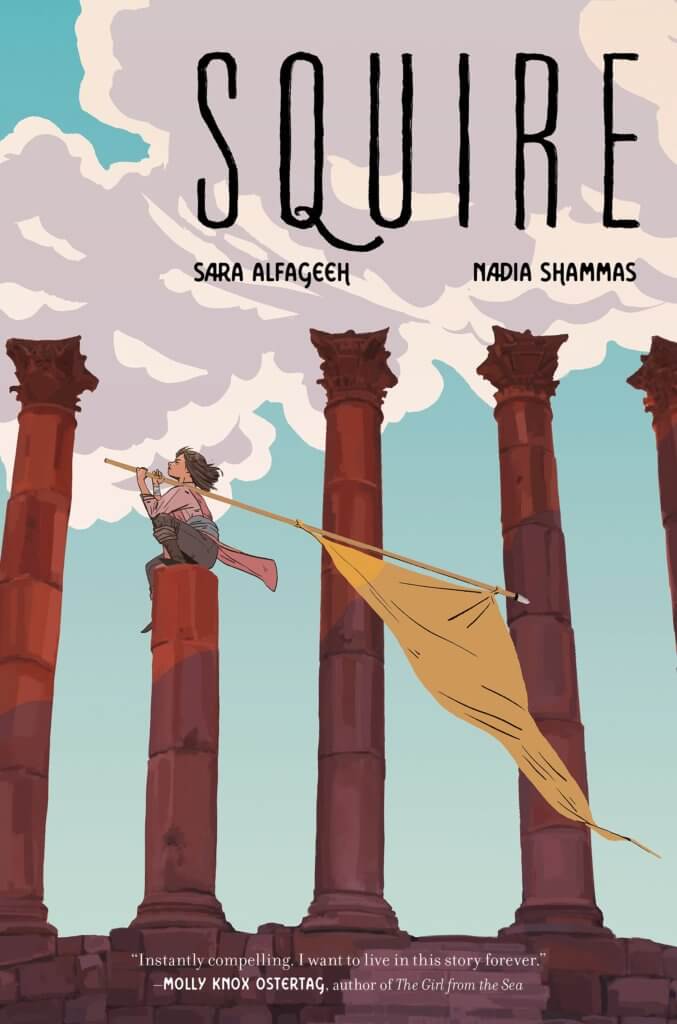
Sara Alfageeh and Nadia Shammas’s Squire is a comic I have been waiting for — not just since it was announced, but also my entire life.
Squire
Sara Alfageeh (artist), Nadia Shammas (writer)
Harper-Collins
March 8, 2022

As an Arab American woman born after Disney’s Aladdin (1992), the first time I saw anything like myself in popular media was in Princess Jasmine, the love interest in the titular male protagonist’s story. Three decades (and a live action adaptation) later, Arab women still rarely appear in American film, television, or comics, let alone star as leading characters. Squire puts a young Arab woman, Aiza, at its center, and she is less Jasmine than Mulan.
In fact, artist Alfageeh and writer Shammas cite Mulan (1998), alongside Avatar: The Last Airbender (for which they did a Free Comic Book Day story in 2021) and Fullmetal Alchemist as influences. However, Squire, despite being marketed as a fantasy graphic novel, diverges from these works in a significant way: there is no magic in Aiza’s world.
There are knights and squires and swords and sword fights, but all of those things (deftly drawn in a style that evokes both manga and Adrian Alphona’s superhero comics) are, like the rest of Squire, rooted in (meticulously researched) history. Casual clothing and formal armor eschew Orientalist fiction and instead pull from real world Middle Eastern/Southwest Asian fashion, especially the Ottoman Empire. However, despite the sources, the story is set in a metaphor for the region: the (richly colored by Alfageeh with assistance from Lynette Wong and Mara Jayne Carpenter) Bayt-Sajji Empire. Neither Aiza nor her peers (Husni, Sahar, and Basem) would canonically call themselves Arab, but they can be read as such (not despite but because of their diverse appearances) and as members of their respective ethnic groups. Sahar’s red hair, fair skin, and muscled build mark her as someone from the mountainous Gihre, analogous to northeastern parts of the Arab world, while the al-Baharyi Husni and Basem’s darker brown skin tones and taller figures show that they are from another part of the empire, having grown up closer to the water. Every character looks like someone I know, and each of their designs tells its own story.

Aiza belongs to a marginalized minority ethnic group, the Ornu, who are distinguished by tattoos (inspired by Bedouin and Berber/Amazigh traditions) on their forearms and excluded from citizenship. Aiza hides hers in order to blend in with her fellow recruits after enlisting in the Empire’s military, enticed by the citizenship that successfully becoming a squire offers. Although Aiza is not Arab American, this is an Arab American story, and that is not just because the creators are Jordanian and Palestinian American. Aiza’s citizenship being contingent on her ability to assimilate into the culture of an imperial power echoes Arab immigrant experiences for much of the 20th century, with those from the Levant (Jordan, Lebanon, Palestine, and Syria) having had to become white (in theory if not in practice) in order to become citizens of the United States (and remain counted as such in the Census in spite of campaigns for a Middle Eastern and North African category). But citizenship is not the only thing that drives Aiza or her story.
Aiza is further inspired by the recruitment poster of a knight on horseback framed by the words, “Begin Your Adventure!” In this image, which makes Aiza want to become a hero like Juhyn the Shining or Layla the Night Lily, the unnamed knight’s body faces the reader, who takes Aiza’s perspective, her hands (framing the image) becoming theirs. It is as important that Aiza is inspired by an image in which she can see herself, as it is that the recruitment poster is produced, circulated, and protected by the state actively oppressing her people via colonization. It is even a crime to steal it, as she does. Representation may be empowering but it is not power. And power in a system like the empire is zero-sum.
Aiza’s adventure begins, but she is smaller and less studious than her fellow squires-in-training, and subject to a process not designed with someone like her in mind. She struggles and fails her first exam. She is subsequently tasked with guarding the armory at night, where and when she meets the former knight Doruk. Aiza asks him to train her so that she does not get sent to the front lines (and an early death). Doruk, an adult and member of another generation, knows something she, a teenager, does not: that while becoming a squire may not cost her life, it still comes at a high price. Still, he (reluctantly) agrees, understanding citizenship to be better than death but misunderstanding that alternative as the only one. Aiza begins to excel and, having caught up to her friends and (extremely shonen) rival, is rewarded with a mission.
 The mission proves to be a turning point for Aiza, who must struggle with and against what it means for someone like her to serve the empire. The last page of the story returns to Aiza’s hands. Unlike the knight in the recruitment poster, Aiza stands with her back to the reader, her right (visibly tattooed) arm raised towards the sky. She has chosen something other than the options originally presented to her, assimilation or death, and she has her whole life to live, even if readers never get to see it.
And, as much as I love what Alfageeh and Shammas have made, part of me hopes we never do. Squire does not need a sequel, at least not a direct one. Aiza’s story will inspire a generation of Arab American creators who got to grow up with it. And their readings of it will change as they grow up, reread, and more deeply understand its themes. Reading Squire as an adult who has spent years learning about the cultures and histories that inform it is bittersweet because despite drawing on heritage I share with the comic’s creators as a Lebanese American reader and centering a protagonist like me, Aiza will never have just been a girl on an adventure for me. I have no desire to be her because I have already been a girl in a system that was not designed for her. But she will be what Jasmine was for me, in spite of her flaws — a starting point.
