

Across a nearly 60-year career, Ursula K. Le Guin left an indelible mark on speculative fiction. She is best known for her fantasy work A Wizard of Earthsea and the science fiction novels The Left Hand of Darkness and The Dispossessed. The latter two belong to the Hainish Cycle, a series of five books that explore far-flung planets. The lesser-known books of the series, and the first published, are Rocannon’s World, Planet of Exile, and City of Illusions. In Tor’s new collection, these first three overlooked books comprise Worlds of Exile and Illusion.
Worlds of Exile and Illusion
Ursula K. Le Guin
Tor Trade
March 15, 2022
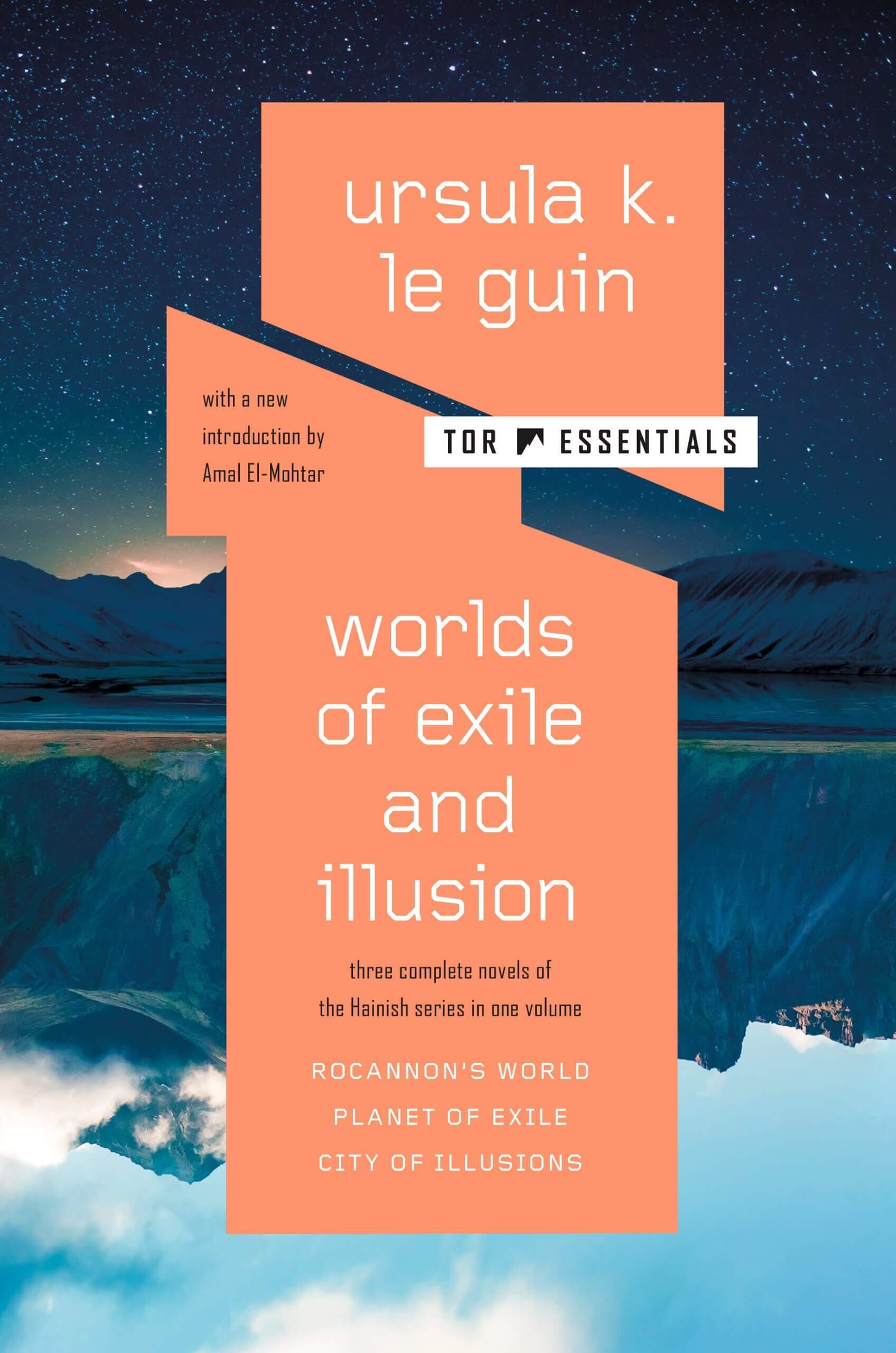 One of the best things about this new 2022 version of the collection is Amal El-Mohtar’s earnest and heartfelt introduction. She tells a personal story of her relationship to Le Guin’s work that many can relate to. El-Mohtar was unacquainted with Le Guin’s work until after the author’s passing. She admits she imagined that one day she would be able to meet the author and discuss her life with her, only to realize at the time of Le Guin’s death, she hadn’t read her most famous books. It would be easy to use the introduction to give a thin account of Le Guin’s life and her process of writing the books, but El-Mohtar’s personal history with the works yields a compelling example of how individual readers interact with and make sense of the author’s work across the years.
Although this collection has a lovely introduction, it’s a shame it’s missing Le Guin’s own prefaces to her 1970s editions of Rocannon’s World and Planet of Exile. In the Rocannon’s World introduction, she defines the differences and the “spectrum” upon which fantasy and science fiction exist. If one is the color red, the other is blue, but she admits that Rocannon’s World is “purple,” a mixing of the two that might have been a bad idea, especially when it comes to the inclusion of magical details alongside advanced technology like the space suits the characters wear. In the Planet of Exile introduction, she confronts the gender politics of her books head-on, explaining how they were written prior to the women’s liberation movement. She admits her books are not the most progressive, a confession that creates a different kind of reading experience for those working through the book today. Le Guin’s reflections on her own work are worth carrying into readings of these books, as she both offers a reflection on the stories’ failures as well as a confident insistence on their value.
Although we miss out on these introductions, what we find in this collection is, of course, Le Guin’s first three books. The two of which I cover in this review are very different in tone and approach. Rocannon’s World is an adventure story – a journey-based book. It covers the plight of Rocannon, an anthropologist whose ship is destroyed when he visits a distant planet. In space, time is a messy ordeal, and depending on where you are, people on other planets can experience years passing where for others, it would be a much shorter period of time.
Rocannon’s World didn’t quite capture me. The characterization was thin and much of the plot felt like escapade piled on top of escapade without a lot of connective tissue. This was Le Guin’s first published novel, though, and doesn’t show some of the rich maturity of A Wizard of Earthsea, published just two years later. Rocannon’s World is a must-read only for Le Guin fans who wish to see the ways her style developed and improved over the years.
Planet of Exile felt more character-driven, more cohesive. It focuses on two groups with strained relations: the humanoid Tevarans who occupied the planet originally, and a group of Earth humans who arrived later. Although they aren’t all that different, their cultures have mostly avoided intermarriage. The young Tevaran woman Rolery, however, falls for a young human man named Jakob Agat. As the two groups face a common enemy, they’ll have to join together and work past their differences in order to survive.
Unlike Rocannon’s World which felt meager in the connections between each adventure, Planet of Exile felt better streamlined. The characterization felt purposeful and the investigation of cultural differences more relevant.
Although I didn’t read City of Illusions (yet), I can still recommend this collection for those interested in the early days of Le Guin’s career. These aren’t as compelling as A Wizard of Earthsea or The Tombs of Atuan (the latter of which might be my favorite of the four of her books I’ve read), but they still feature Le Guin wrestling with her inclusion of interesting places and fantastical elements that will mark her later works.
