

This year marks the turn of Glasgow to host the World Science Fiction Convention (Worldcon), and Sunday saw the convention’s best-known event: the presentation of the Hugo Awards.
Controversy of one sort or another has become something of a tradition at the Hugos, and this time around, award-watchers were still reeling from last year’s disorder. The 2023 Hugo Awards, handled under the eye of now-disgraced award administrator David McCarty, saw multiple finalists unjustly disqualified. McCarty, along with 2023 Worldcon co-chair Ben Yalow, were subsequently barred from attending this year’s convention.
The 2024 Glasgow Worldcon shows every sign of ensuring that each T is crossed and each I given the appropriate dot. When Game of Thrones author George R. R. Martin was barred from convention programming on the grounds that he had failed to fill in a particular application form, this was eyebrow-raising treatment of a genre superstar, yet also evidence that the Glasgow WorldCon was following regulations to the letter. Meanwhile, when the administration team detected 377 apparently fraudulent ballots cast in favour of a particular finalist, the matter was dealt with swiftly and transparently.
During this year’s Hugo Award presentation ceremony, John Scalzi (author of the Best Novel finalist Starter Villain) delivered a speech on the controversies that have plagued the awards over the years, the most recent being the “highly irregular and almost certainly censorious” actions that occurred last year, also displaying a graphic for Chris M. Barkley and Jason Sanford’s report on that matter. He concluded on a note of optimism and fun, however, setting the stage for the latest set of winners to be announced.
There is some evidence that not only the administrators but also the voters were trying to make up for last year. The Astounding Award for Best New Writer went to Iron Widow author Xiran Jay Zhao, while the Hugo Award for Best Fan Writer was won by Paul Weimer: the two winners in question were among those ruled ineligible in the 2023 disaster. Zhao, during their acceptance speech, described themselves as “one of those people who got disqualified for no reason last year”; their eligibility period for Best New Writer, which ordinarily would have ended after the 2023 Worldcon, was extended to make up for this.
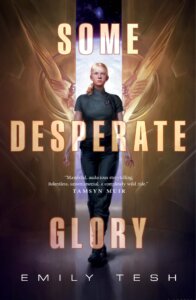
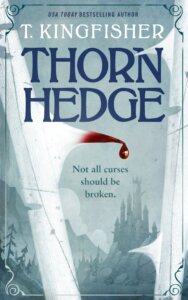
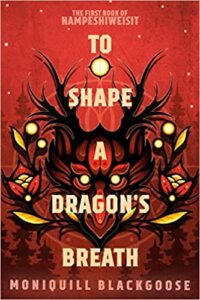
Space opera was a recurring theme this year, with Emily Tesh’s dystopian debut novel Some Desperate Glory winning Best Novel while Ann Leckie’s Imperial Radche was named Best Series. On the fantasy front, Thornhedge, T. Kingfisher’s reworking of Sleeping Beauty, was voted Best Novella, while To Shape a Dragon’s Breath by Moniquill Blackgoose won the Lodestar Award for Best Young Adult Novel.
Naomi Kritzer took two Hugos on the night, winning Best Short Story for “Better Living Through Algorithms” and Best Novelette for “The Year Without Sunshine.” The two stories make interesting counterparts: the former examines the future of online apps and our reliance upon them, while the latter depicts a community in the face of technological failure brought on by an ecological catastrophe. “The Year Without Sunshine,” which was published in Uncanny Magazine, also touches upon the topic of disability; accepting the award, Kritzer took the opportunity to honour the memory of Caitlin Thomas, the daughter of Uncanny editors Michael and Lynne. Caitlin had Aicardi syndrome, and passed away at the age of fourteen this April.
The eleventh volume of Brian K. Vaughan and Fiona Staples’ Saga took Best Graphic Story; the series is a regular finalist in the category, but this marks the first time since its debut volume that it won the trophy. The award for Best Related Work went to Kelly and Zach Weinersmith’s nonfiction book A City on Mars: Can We Settle Space, Should We Settle Space, and Have We Really Thought This Through?
In the Best Dramatic Presentation categories, Long Form was taken by Dungeons & Dragons: Honor Among Thieves (beating Nimona, Barbie, Poor Things, Spider-Man: Across the Spider-Verse and The Wandering Earth II) while Short Form was won by the Last of Us episode “Long, Long Time” (beating episodes of Doctor Who, Loki, and Star Trek: Strange New Worlds).
In the Best Editor categories, Ruoxi Chen took Long Form for the second time, while Clarkesworld editor Neil Clarke won his third award in the Short Form category. In his acceptance speech, Clarke commented on the perils of editing a fiction magazine in the era of AI submissions and the closure of Amazon’s magazine subscription service. Octothorpe took Best Fancast. Rovina Cai was named Best Professional Artist while Laya Rose was named Best Fan Artist.
The award for Best Fanzine went to nerds of the feather, flock together, which is frequently a finalist in this category but has won only once before, in 2021. Accepting the award, senior editor Adri Joy condemned the recent racist rally in the UK and expressed the opinion that “Neil Gaiman can fuck off into the sun,” referring to the serious sexual assault allegations against the writer in question. Strange Horizons won its first Hugo for Best Semiprozine, having previously been a runner-up eleven times.
The year also introduced a new category: The Hugo Award for Best Game or Interactive Work. The inaugural winner was Baldur’s Gate 3.
