


Fresh off the publication of Ms. Marvel: The New Mutant #1, I got the chance to talk to the comic’s co-writer Sabir Pirzada, about working with the onscreen Kamala Khan, Iman Vellani, and writing for comics and television across his career (including the Disney+ Marvel Studios Ms. Marvel and Moon Knight series). In addition to talking about the comic and comic series, we also discussed identity and authenticity, and his experiences with collaboration in both comics and television.
This interview has been edited for length and clarity.

How did you get involved in this project?
Sabir Pirzada: It felt like I was joining more midstream because Iman had already been involved. The editor of the series, Jordan White, reached out to me and said, “hey, just so you know, this is kind of what we’ve been working on for Kamala and what’s next for her.” They told me what was gonna happen in Amazing Spider-Man #26 and about how Kamala was going to be resurrected as a mutant, discovering that she had the X-Gene, even though the X-Men had kind of known about it for a little while before then, and that she was gonna be making her debut as one of the X-Men in the Hellfire Gala. And that Iman was going to be co-writing this and would I be interested in co-writing it with her.
Instantly, I sort of jumped at the chance to do that because I had worked with her briefly on the TV series and had a great time collaborating with her on that. I thought this would be a really fun thing for us to do together in sort of a different context as co-writers. So we got started very quickly from there. Iman had already kind of been noodling on this by the time I had joined the project.
You and Iman Vellani are the first Pakistani writers to write Kamala Khan in her solo series. Does that figure into your writing and the ways you’re handling all of this stuff?
Pirzada: All the time. Iman and I are constantly drawing from our personal experiences and half the time it’s almost not veiled at all. It’s just exactly what has happened to us. And that goes back to the TV series. Episode 4 is very much informed by my most recent trip that I took to Pakistan in 2019, and some of the things that had happened to her happened to me in my real life. You’ll see some sprinkles of that in the comics as well.
There’s lots of opportunities to draw from real life and real experiences and just put that into the series. And that’s one of the most fun parts for me of writing the Ms. Marvel series, is that I can draw from my own well of experience to put in it. That’s probably why Kamala will always remain my favorite character. That makes it really authentic.
What was it like working with Iman Vellani on her first comic?
Pirzada: I was very impressed and surprised by just how well she knew everything, from her comics history to even the comics format of writing, thinking about artwork first and what would be really fun for the artists to draw, how to create a story using the visual cues within panels and panel arrangements, and how to show the passage of time on the page.
She had already been thinking about all those things and had very specific ideas for what she wanted to emulate from other comics. We really hit the ground running and she started off as a pro instantly, so there really wasn’t any handholding that I had to do on my part. And I found myself learning from her constantly.
Iman Vellani has pretty famously grown up watching the MCU and reading comics. Did you grow up reading comics?
Pirzada: From a very young age, comics was kind of all I read. Pretty much since I could read, I’ve been reading comics and in particular, it was Marvel comics that I’ve been reading and collecting pretty much my entire life. Massive X-Men collection. I read a lot of Spider-Man growing up. And I was a fan of Ms. Marvel from day one. I knew about it from the moment that it debuted and have been reading it ever since.
To address the mutant in the room, this is her first solo comic since she died and was resurrected. How far in advance do you learn about when these things are going to happen and how much do they affect the story you’re telling?
Pirzada: The turnaround in Marvel comics can be pretty tight at times. We were given the script before the artwork had been finished for the Hellfire Gala and put in touch instantly with Gerry Duggan, who has been a really great mentor to both of us, guiding us through this process of joining the X-Men world of things. We were given a heads up, certain things there weren’t even scripts for yet the editor Jordan White looped us in and told us, “just so you know, these are some of the signposts coming and certain things can and do change, but I’ll keep you posted on how that develops.”
If we ever had questions about which character would be appropriate to talk to Ms. Marvel about a particular thing, Gerry Duggan was always available to us as was Jordan White. It’s a tight turnaround and we’re not as far ahead as you might expect given that some of the artwork isn’t even there. And so we’re sort of left to imagine some of these events for ourselves before we get a chance to see them in script form.
What can longtime Ms. Marvel readers expect? And what might new readers coming from the Marvel Cinematic Universe TV show or other X-Men comics expect?
Pirzada: I think viewers of the TV show will be a bit surprised because at first glance you’re saying, “oh, she’s a mutant that lines up with the series.” But the truth is we don’t really know what being a mutant in the MCU means yet. Whereas we do know what being a mutant in the comics means very specifically because that has been lived in for so many years and decades at this point. So if you’re coming into that, hopefully it’ll be a wild ride, but you’ll be familiar with the tone of Ms. Marvel, which was the most important thing to us, making sure that when you’re diving into her world and her mindset, that the character feels the same.
There is one defining quality that I do think is a bit different from both of those things, which is her experience. The Kamala in comics has had so many more adventures. She’s been an Avenger already, she’s been a Champion, she’s done all these things. And so when she joins the X-Men, she’s gonna go in with a sense of confidence that she knows how to handle what it’s like to be a mutant. She knows what it’s like to handle being hated and feared to some extent because she’s been outlawed before. What she’s gonna discover is that it’s a little bit of a different thing when you’re one of the X-Men, that that’s more dangerous than she would expect. And the hatred and the fear is real.
And that’s gonna be different for somebody who’s been raised with a loving family her entire life with all this unconditional love and support, how does somebody like that respond to being hated and feared so suddenly in your life? That was something that we were really excited to tell, and we felt that that was new territory for Kamala, in the comics and in the series. Iman and I were very excited about the possibilities of exploring that.
Since she debuted in 2014, Kamala has been on teams, but she’s usually also had her own solo title. Is it a tight rope to walk between her doing her own thing and joining the X-Men?
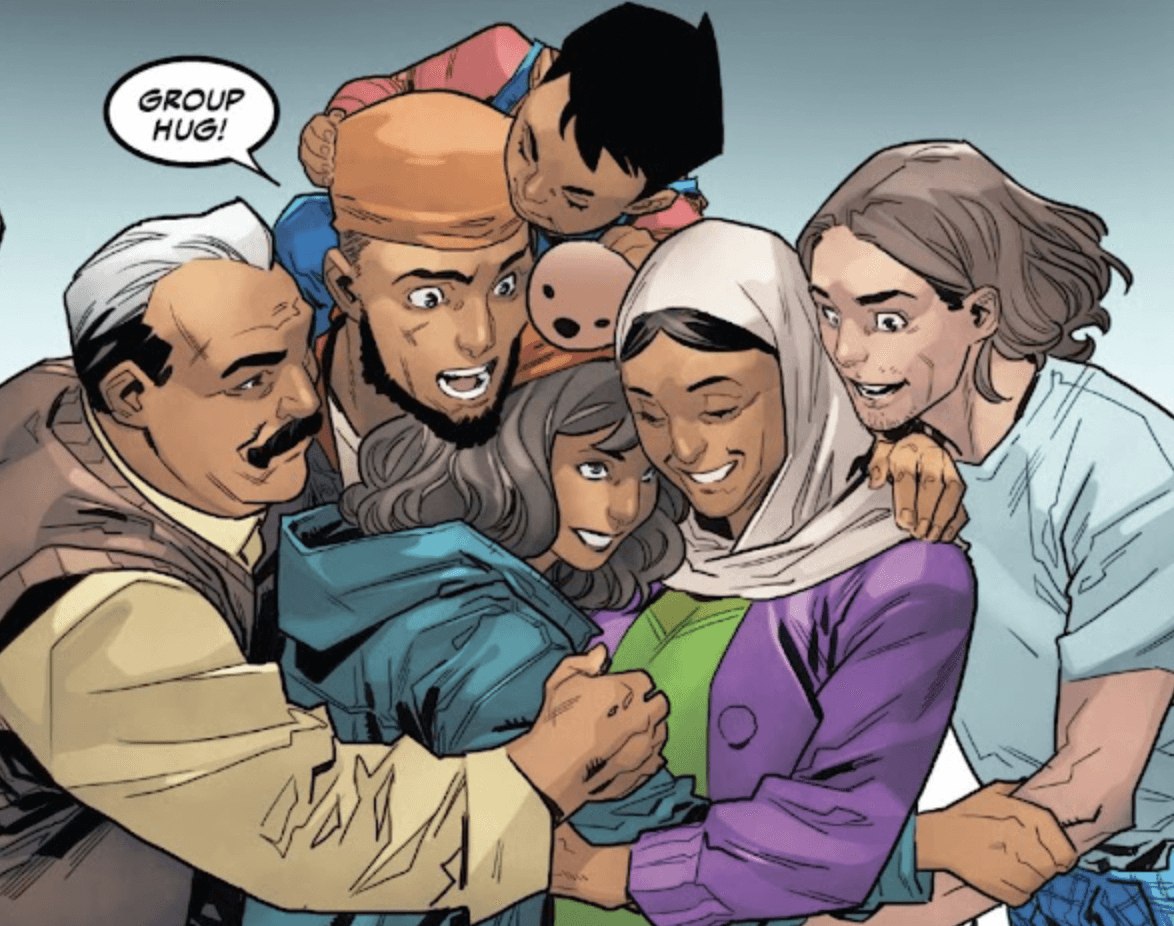
Pirzada: It was a challenge. I’ll be honest. Kamala has a very strong supporting cast already when it comes to her family and her friends, and we’re all fans of that material. We wanna see more of that. And we didn’t want to crowd it so much so that there’s no room for Kamala herself when you now have to service all the X-Men. We basically decided not to worry about it.
We decided to say that the X-Men are gonna need her just as badly as she needs them, and they’re another side of her world and story that we can dive into now. But we knew that we needed to strike the right balance in terms of how much they’re in the series and know that Kamala is around in the X-Men world now so there’s no immediate need to service every single X-Men interaction on every page when we have a whole story we want to tell also.
So you’re right, it’s a very tight rope we had to walk. It was challenging, and it took us a little while to figure out what was the right balance of bringing the other X-men in so that they’re there to help service her story. But they don’t take over the story themselves because the X-Men have their own books. They’ve got several of them.
Emma Frost has been a big part of Kamala’s story this summer. Why Emma?
Pirzada: It was an informed decision, based on where Emma is in her life and in her story. We felt that that was a ripe opportunity for us to sort of combine some of the mentalities that these characters were having and contrast them against each other. And we were excited about all the relationships that we could build for Kamala that were gonna be new to her, where we could start her with a character in one place and sort of finish her with the character in another place by the end of this series.
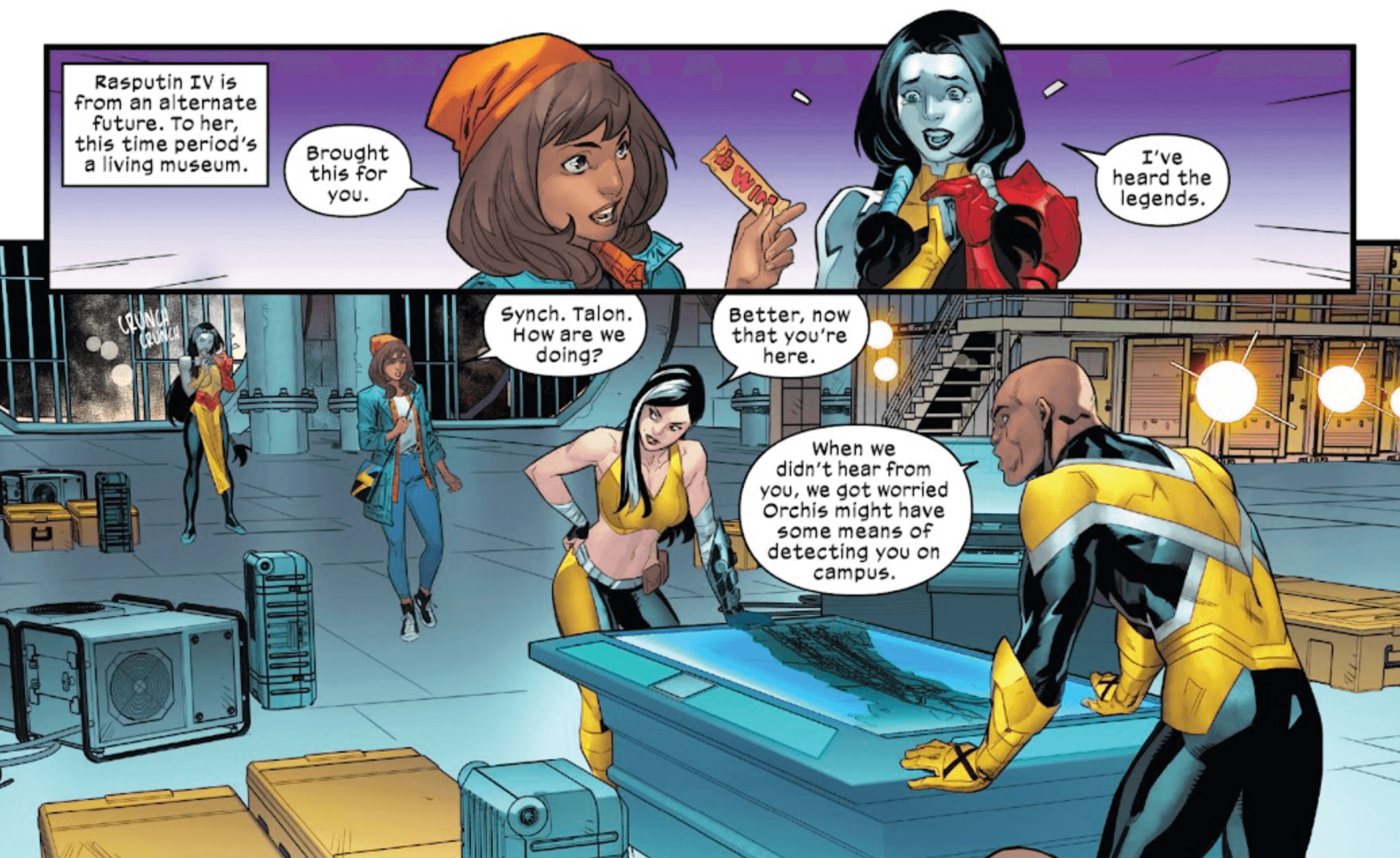
We also get to see Kamala interact with the underground X-Men: Kate Pryde, Synch, Talon, and Rasputin IV. Is it safe to assume they’ll figure more into her story?
Pirzada: You’ll definitely see more interactions with X-Men. I cannot say which ones, but you’re definitely on the right track.
How did you pick and choose what to reference from other comics?
Pirzada: Anything that Ms. Marvel has appeared in before was fair game. We started with the obvious things like G. Willow Wilson’s run, Saladin Ahmed’s run, we had Champions, the All-New, All-Different Avengers run that Mark Waid did. All those things were big influences for us.
And then beyond that, there were other things that Iman was interested in drawing from. She had some favorite Silver Surfer and Fantastic Four comics. Those things might become a little bit more apparent moving forward. We had a giant wishlist and specific panels that we would crop out from our favorite comics and say, can we use these things as inspiration? We didn’t get everything in there. It was more of a mood board than anything else, but it was fun to draw on all these different influences and see what we can throw together that would fit Kamala’s story and her mindset.
Artists Adam Gorham and Carlos Gómez do two different phases of the book, because there’s the dream sequences and the real world. How did that come about?
Pirzada: That came a lot from Iman, who really wanted to use the dreamscape, one as a vehicle to showcase artwork, but two, as a way to showcase where Kamala’s mindset is at. And we thought collectively that it would be such a fun way to sort of delineate the artwork by saying, let’s have one artist tackle the dreams and another artist tackle reality, and let’s run with that. That was up to Jordan White and the editing team to figure out how is that gonna work schedule wise, which artists are available and interested in doing this with us, and how do we play off of each other.
So sometimes we had large email chains where all the artists were involved, and they had to send references back and forth to each other because certain things might play out differently than they would from dreams in reality, but they needed to be aware of what each other was doing. I’m really excited to see how that all comes together in future issues.
One of the things I really love about the G. Willow Wilson and Adrian Alphona Ms. Marvel comics is how they guide readers across the page. Is that something you were thinking about?
Pirzada: Yes, we were, but I don’t want to take full credit for that. The artists, Adam Gorham and Carlos Gómez, are pros at what they do. They’re experts at doing that. So we actually were very hands off in terms of panel, like the specificity of the size of the panels and the panel layouts. We left a lot of that to them. We basically said here’s what needs to happen in every panel and let them decide how best to guide the eye.
You’ve written Kamala before in Marvel’s Voices stories, which are much shorter than a single issue or miniseries. What’s it like moving from those to four twenty-page issues of Ms. Marvel: The New Mutant?
Pirzada: It’s different in the sense that you do need to allow yourself a little bit of room for exploration along the way, because we had signposts as we were writing the series, but we weren’t entirely sure how long certain elements of the plot were going to take until we really got into it. Getting used to the fluidity of that was something that was new for me. I did write Dark Web: Ms. Marvel a few months back, and those were full issues as well. So it wasn’t as if I jumped from the short form Marvel’s Voices straight to this.
I do feel like it was a perfect road for me to sort of develop my voice on the page as a Ms. Marvel comics writer to start with a five-page story in Marvel’s Voices, then a ten-page story, then the two-issue Dark Web: Ms. Marvel. And then to get to co-write this thing with Iman, I felt prepared for it, but the fluidity was something I had to sort of get used to, to say, “it’s okay that we don’t know exactly how long certain sequences are gonna take in issue three before we get there, but know already where we’re going in issue four, and we’ll figure it out as we go.” As long as we had the signposts firmly planted in the ground, the rest we could sort of figure out as we went along.
And that’s different from TV, too?
Pirzada: It really depends on what you’re doing. I’ve written on some broadcast shows where the turnaround is so tight and fast that you don’t really have time to make big changes. Once you’ve planted those flags in the ground, you have to go and shoot ’em quickly. And that’s not the case on the Marvel productions.
We were in the writer’s room for Ms. Marvel for quite some time, and we did go down certain roads and realize that those roads were not the best path for the story. From the beginning we could sort of scrap that and start over just keeping the things that we liked and go in a whole new direction. So it depends on the TV project. If you’re in broadcast, it’s tighter and more similar to the comics pace of things. But there is still fluidity in everything.
As a comics reader turned comics and television writer, do you feel like you’re more drawn towards serial storytelling? Does that impulse inform your career?
Pirzada: I’m drawn to all types of stories in different forms. There’s something nice about being able to pick up a story that does tell you a beginning, middle, and end, and that’s finite in any form, whether that’s TV or a book or a graphic novel. I’m not opposed to doing those types of stories. But the serialized nature of comics and television, I do think one informed the other because since I grew up reading comics where every month you only got one chapter, TV is somewhat similar in that way, right? Every week you’re only getting one chapter and you gotta come back next week to find out what happens next. They were overlapping more than one of them led directly to the other in that consequential way.
I was trying to write comics before I ever tried to write television. I had lots of false starts as a writer, even back in college where I would find artists online and I’d write my own scripts and try to get them to bring those scripts to life on the page. And then we’d go out with pitches to all the different publishers and see if anybody was interested in publishing them. That was hard to do, particularly because I had to pay the artists for their time. And I didn’t have much money at the time because I was either a student or an assistant in the entertainment industry, and those jobs don’t pay very well. It took me a long time before I could come up with a few independent comics to share with people.
It was one of those comics that one of the editors at Marvel read where all my experience sort of came together, where he knew that I had worked on the Ms. Marvel TV series and that he could read some of my work on the page already as a comic book writer that then opened the door for me to write comics for Marvel. I would say I started in comics, but I wasn’t successful in them. Then I was able to grow as a writer in television. I’ve come back to comics and sort of weave back and forth between the two, which has been really fun for me, because I love both mediums very much.

You’ve written for Marvel Studios’ Moon Knight and Ms. Marvel, so you have experience in writers’ rooms, and now you’re co-creating a comic book with another writer and artists, what was that collaboration process like and how does it compare to writing for television?
Pirzada: Writing a comic to me feels like a much more intimate process because the team is that much smaller. When you’re making a TV show, especially on bigger Marvel productions, that’s hundreds of people you’re collaborating with and there’s different department heads sending you all kinds of things, whether it’s like a pre-visualization of an action sequence or storyboards about how they’re gonna shoot a certain scene. And then you’ve got notes from actors and the director and different executives telling you all the things that they want to see in a certain scene or an episode. So much gets funneled into that, it’s also collaborative, but it’s with so many different people.
Whereas with comics, it’s basically five or six people. It’s a couple of editors, your co-writer if you have one, your artists, sometimes you have two artists, colorist and a letterer. And so it gets to be a much more personal process, and consequently you have to trust each other that much more because you feel like so much of that is on everyone’s shoulders to carry this project forward. A lot of that is sometimes done over email where we get preliminary sketches from the artists and we can weigh in at an early level to say, “oh, we imagined it this way. Perhaps we should have mentioned this in the script, but certain elements are gonna pay off later, so we need to see it in frame over here or this is the real thing to focus on.”
It’s basically letters that you’re exchanging back and forth from the writers to the artists. You really get to build a relationship and a rapport with each other that way much faster than you would in a television series.
In addition to Ms. Marvel: The New Mutant, you’re also writing Cult of Carnage: Misery. What’s that about?
Pirzada: It features Liz Allan, who has been around for as long as Peter Parker, Spider-Man himself. Her first appearance goes way back to the very first page of Amazing Fantasy #15. She’s never had her own series, so she’s always been this supporting character in his world. In Cult of Carnage: Misery, she’s the head of a company called Alchemax, where they have in their possession symbiote strands and are experimenting on them. And she’s had a very interesting history in publishing, so I was very excited when the opportunity came up to say, “hey, can we tell a story that spotlights Liz Allan and shows everything from her perspective as someone who for the longest time has only ever been on the periphery.”
She’s been the wife of Harry Osborn, the Green Goblin, and she’s had a very fraught marriage with him. She’s now the head of this company. The idea that we could tell a story about this sort of vigilante who I describe as a power mom.
She’s taking care of two young boys and is running this company by day, and then she comes into possession of the symbiote by night. That was really exciting to explore. Issue four of five came out the same day as Ms. Marvel: The New Mutant #1. Francesco Mortarino, who I worked with on Dark Web: Ms. Marvel, is the artist. It’s a nice crossover series in the sense that it ties into the symbiote stories that are being told and with the Spider-Man stories. Marvel has really built out both sides of that. And everything is fair game for Liz Allan. I’m excited for the final chapter to come out next month.
Can you give us any hints about what’s next for Ms. Marvel?
Pirzada: There’s one corner of Kamala’s life that is often referenced but rarely seen. We’re going to finally show some of it visually in some surprising ways over the coming issues.
