

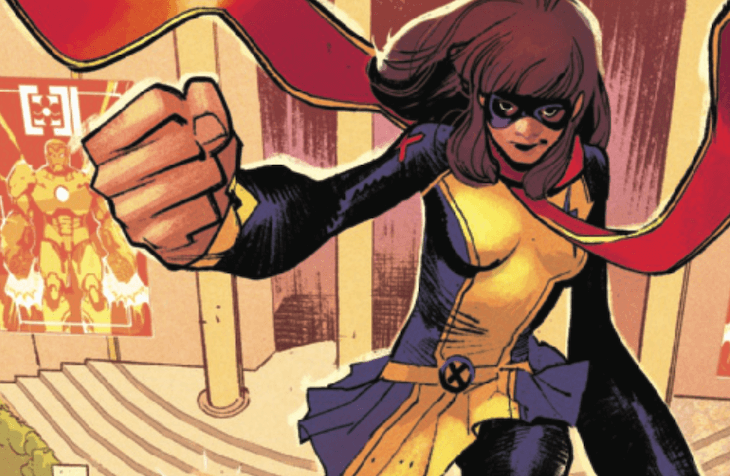
Following Kamala Khan’s death in The Amazing Spider-Man #26 and resurrection in this year’s Hellfire Gala, Ms. Marvel is back and an Inhuman and a mutant, but will she survive the experience?
Ms. Marvel: The New Mutant #1
Iman Vellani and Sabir Pirzada (writers), Carlos Gómez and Adam Gorham (artists), Erick Arciniega (colorist), VC’s Joe Caramagna (letterer), and Tom Muller and Jay Bowen (designers), with Sara Pichelli and Matthew Wilson (cover artists)
Marvel Comics
August 30, 2023

First, a quick recap: more than two years after the Ms. Marvel ongoing ended, Kamala sacrificed herself to save Peter Parker (Spider-Man) in his titular series, only to be brought back to life on Krakoa weeks later, just before the evil Orchis organization orchestrated what’s now being referred to as a “mutant massacre” (not to be confused with 1986’s Mutant Massacre). In X-Men (2021-) #25, Emma Frost erased both the evidence for and memory of Kamala’s death. Ms. Marvel: The New Mutant picks up ten (X) weeks after the Hellfire Gala, as Marvel’s newest mutant prepares to infiltrate Orchis in the first issue of four in a miniseries co-written by the Marvel Cinematic Universe’s Kamala Khan/Ms. Marvel, Muslim and Pakistani Canadian actor Iman Vellani.
Vellani cited Sandman as an inspiration, and its influence is evident in the Adam Gorham-drawn dream sequence that opens the issue. Less a dream than a nightmare, Gorham’s Carol Danvers, wearing her 1970s Ms. Marvel costume, introduces Kamala, wearing her 2010s Ms. Marvel costume, to an audience full of Marvel’s mightiest silhouettes before her own embiggened fist punches down at her. I love how Gorham highlights the body horror of Kamala’s Inhuman shapeshifting powers by having just the pinky of the giant hand wrap around Kamala’s body.
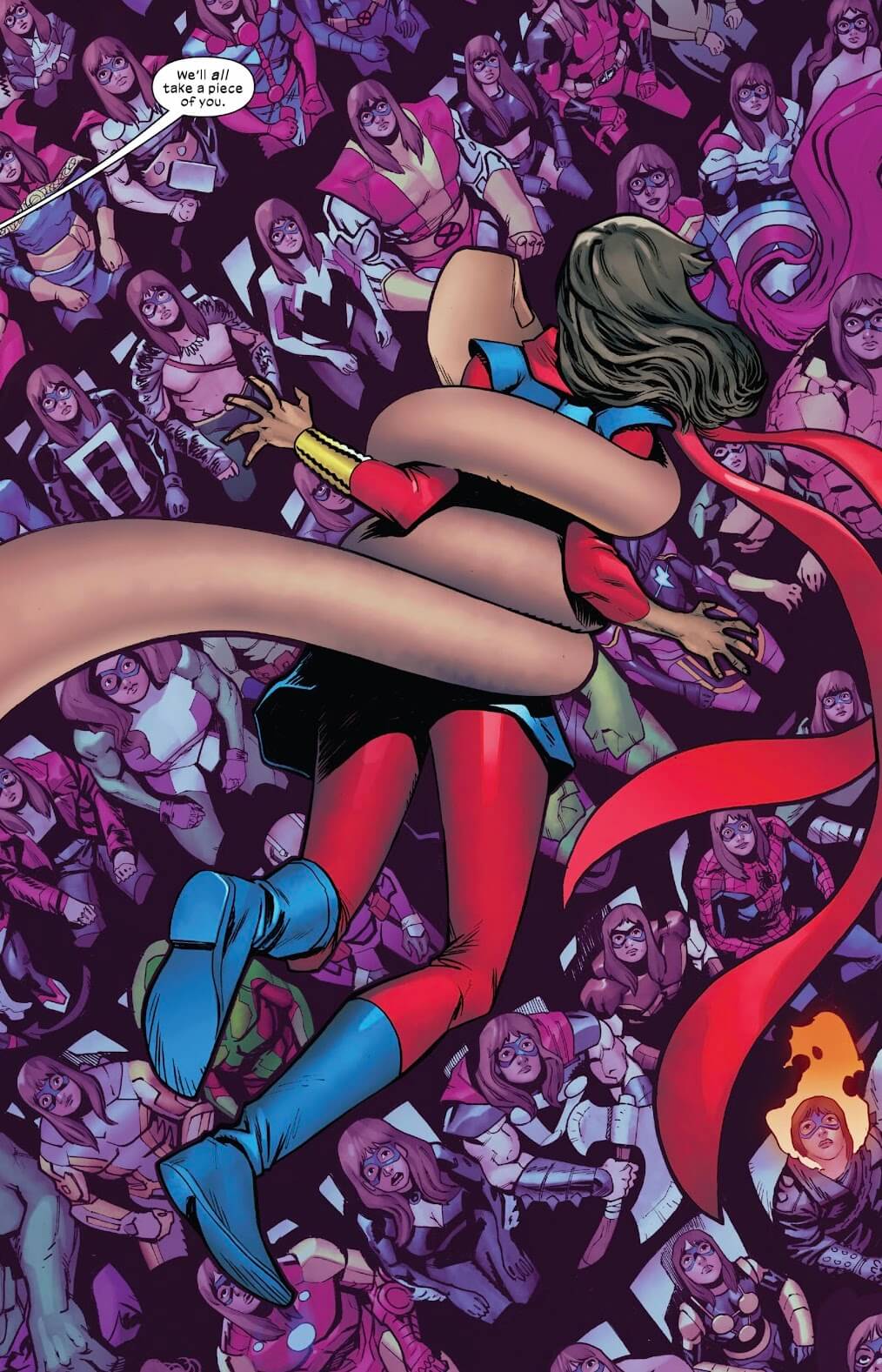
Body horror leads to full blown horror when the finger suspends Kamala over dozens of superheroes who wear her face like she once wore that of Carol Danvers. The end of the dream evokes the end of G. Willow Wilson and Adrian Alphona’s Ms. Marvel #1, although this time, she emerges not from her Inhuman cocoon but from her mutant egg.
The waking world is drawn by Carlos Gómez. Joe Caramagna’s letters and Erick Arciniega’s colors keep the issue cohesive across the different artists’ styles, which both hew closer to the house than Ms. Marvel typically does. Vellani and co-writer Sabir Pirzada use Kamala’s first-person narration, a staple of her solo series, to catch readers up. These formal elements make the story accessible to both returning Ms. Marvel and new Fall of X readers. The change of setting helps too, as Kamala and her best friend Bruno Carrelli leave New Jersey so that she can take up residence at New York’s Empire State University to take part in a summer program sponsored by Orchis. At the college, after finding out that this is Kamala’s first time at ESU, her new roommate Michelle says, “That’s so exciting! You’re gonna love it, everyone is SUPER welcoming!” Of course, while Michelle can see Kamala’s brown skin and make an educated guess that someone with a name like Kamala is Muslim, she doesn’t yet know that her roommate is a mutant.
As Kamala contemplates telling Bruno just that, she recalls a conversation with Emma Frost. In the words of Vellani and Pirzada, the first Pakistani writers to give Kamala her voice in a Ms. Marvel comic, Emma said, “They hate mutants most of all, because they’re afraid we’ll replace them. / When they perceive you as a threat to their survival… / …that’s a danger unlike any other.” Vellani and Pirzada’s Kamala doesn’t (and doesn’t have to) address the irony of having this explained to her – an alien, immigrant, Inhuman, brown, South Asian, Pakistani, Muslim, and mutant teenage girl – by a white woman who, apart from her own mutation, is the epitome of privilege.
Kamala’s underground interactions with other mutants in this issue – Kate Pryde (Shadowkat), Rasputin IV, Everett Thomas (Synch), and Laura Kinney (Talon) – are minimal but meaningful, situating Kamala in her new team without sidelining Ms. Marvel as yet another member of the X-Men. Then, above ground, the eight-panel sequence over which Bruno digests the news that Kamala is a mutant while she eats a gyro is now one of my favorite Ms. Marvel pages.

Bruno’s unconditional acceptance of a mutant Kamala Khan makes the ESU students’ utter rejection of a mutant Ms. Marvel more bearable, although now Kamala is haunted by their hate, the knowledge that Orchis is experimenting on aliens like the Chitauri who attacked campus, and her recurring nightmare. This issue had everything I expect from a Ms. Marvel comic – friendship, drama, complex metaphors for racial and religious identities, supervillains – and gave me more to look forward to: if the next three are anything like it, then I can’t wait to read them.
Ms. Marvel: The New Mutant #1 introduces Ms. Marvel’s new normal by reminding readers that there is no such thing as normal, and that’s a good thing.

