

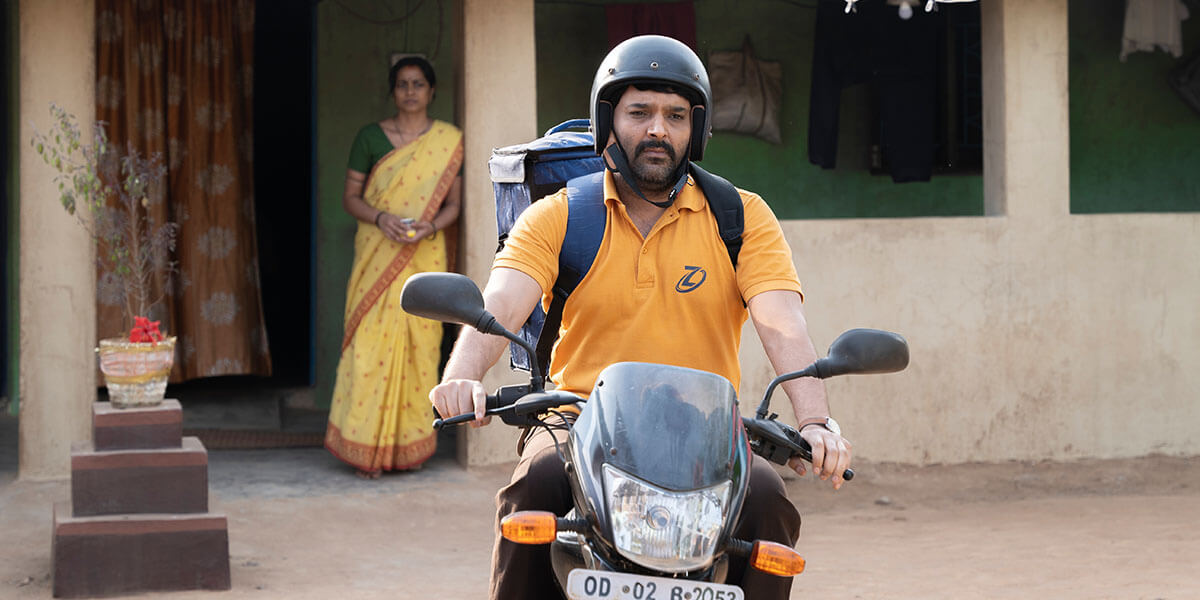
With a focus on the gig economy in India, Zwigato follows Manas (Kapil Sharma), a man who lost his job during the pandemic and becomes a food delivery app driver to make ends meet. But the daily grind of ratings and quotas makes him reconsider how life is really meant to be lived.
Zwigato
Nandita Das (director and writer), Samir Patil (writer), Ranjan Palit (cinematography), Jabeen Merchant (editor)
Kapil Sharma, Shahana Goswami (cast)
September 14, 2022 (TIFF)
Zwigato was a deeply depressing film. It’s a harsh look at the realities the gig economy, of being forced to be a gig worker with incentivized pay, no benefits and no recourse when things beyond one’s control go wrong. These are issues that workers are facing throughout the world but Zwigato highlights the peculiarities of the Indian gig economy.
Though I’ve lived outside of India for over a decade now, I do try and keep an eye on things in my home nation. But even I was surprised at some of the happenings in Zwigato. There are certain constraints in India that one is unlikely to see in other places in the world. For instance, there’s a short but memorable scene that underscores the religious tensions in the country. Another shows the blatant casteism still prevalent in the job market. These scenes are designed to make you empathize with the particularly awful circumstances that gig workers have been forced into. But mostly it just makes you angry that India and the rest of the world has just sat back and left workers to their own devices.
There are two parallel stories in Zwigato. The majority of the film’s runtime is dedicated to Manas’ disillusionment with the company he works for, Zwigato. But there’s also the story of Manas’ wife, Pratima’s (Shahana Goswami). Pratime is the quintessential Indian housewife. She takes care of the home, cooks and cleans, and looks after the children along with Manas’ invalid mother. But because Manas’ delivery job brings in so little, Pratima starts looking for options. Her friend gets her a job as a home masseuse and Pratima successfully gets a cleaning job at a mall. Manas, however, is dead set against Pratima going out to work. He’s afraid she can’t cope and worried about who will take care of the home.
But as Manas starts talking to more of his fellow Zwigato riders and meets more unsavoury customers, he begins to realise that Zwigato may not be the saving grace it was promised to workers in India. And that maybe Pratima is right to look for work for herself.
I’m very impressed by how Zwigato explores Manas and Pratima’s relationship. This is a couple that has been married for a while but still hold genuine affection for each other. They have their ups and downs during the film, particularly when either one is stressed, and it’s obvious that the domestic workload falls squarely on Pratima’s shoulders. But the gender dynamics evolve as the film makes it clear that only one of them is going to come out of this with a steady income. I was surprised and impressed to see a Hindi film go beyond simply presenting a gender-divided household. Zwigato interrogates the gendered roles and attempts to subvert them.
I also love that Zwigato is based in Bhuvaneswar. As writer-director Nandita Das said in the Q&A, Hindi films are largely set in the metro cities—Mumbai, Delhi, Chennai, and Kolkata. She wanted to show audiences something beyond those cities. And Bhuvaneswar is visually a good choice with its great mix of old India and modern architecture. We see how Manas and his family live in a hovel yet the homes he delivers to are from another world. They’re mansions and condos. The city itself shows the divide between the haves and the have-nots without the narrative having to be explicit about it.
The performances by Sharma and Goswami are some of the best acting I’ve seen in TIFF 2022, and probably in all of the Hindi films I’ve watched in my life (granted, that’s not much). Sharma, who I learned is a very well-known comedian in India, gives such an organic performance as the downtrodden but hopeful Manas, I was surprised by his effervescent personality on stage after the film screening. For fans of Sharma looking for laughs, this dramatic role might come as a surprise. But he does an incredible job and I foresee him having more to do in the Hindi film industry.
Likewise, Goswami completely embodies Pratima. Her timidness, her determination, her curiosity are palpable on the screen. She’s completely believable as a housewife with aspirations. The chemistry between the two leads also helps propel the story and underscores the characters’ friendship even when they are arguing.
There’s a political subplot that I think Zwigato could have explored a little more. It’s a short scene but an impactful one for Manas. It would have been interesting to see how Manas would have reacted with more time among this political group.
At the end of the film, the fictional company Zwigato comes out looking pretty bad. This isn’t a Nomadland situation where Amazon granted permission to be a part of the film. Zwigato isn’t a real app, but is based on apps used heavily in India. This gave Das and co-writer Samir Patil the ability to be as honest about the inner workings of these types of apps and the companies’ treatment of gig workers.
I’m pleasantly surprised that two of my favourite TIFF 2022 films are Indian stories—Kacchey Limbu and Zwigato. Both have unusual protagonists in believable circumstances. Though Zwigato is undoubtedly a very sad film to watch, it does have several strong messages that people in India and beyond need to take note off. You will get angry watching this film but that’s the whole point. So get your pitchforks ready!
