

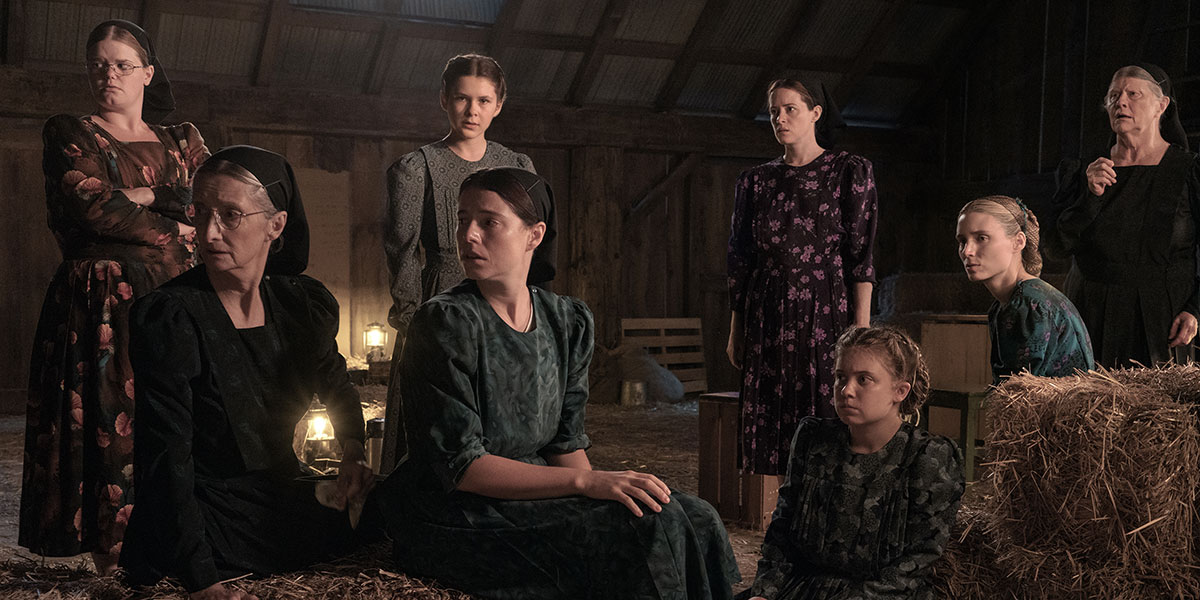
In Women Talking, a group of women come together to discuss their options following a wave of violence in their tight-knit colony. They each have different opinions about what to do next but all have one hope—they need to make this stop.
Women Talking
Sarah Polley (director and writer), Luc Montpellier (cinematography), Christopher Donaldson, Rosyln Kalloo (editors)
Rooney Mara, Claire Foy, Jessie Buckley, Judith Ivey, Ben Whishaw, Frances McDormand, Sheila McCarthy, Michelle McLeod (cast)
September 13, 2022 (TIFF)
Content warning: sexual violence
Based on the book by Miriam Toews, Women Talking largely takes place in a hayloft where a group of women elected by their colony gather to debate what to do after their attackers have been caught. Minds will be changed, people will be forgiven, and new bonds will be forged by the end of this debate.
Considering the subject matter of the film, I honestly didn’t want to watch Women Talking. My tolerance for hard-hitting stories has plummeted during the pandemic. But, as with many of the TIFF 2022 films, there was just way too much hype around this film for me to avoid it.
I thought the sexual abuse angle was very deftly handled. I was so concerned that we’d get horribly gratuitous scenes but we get nothing of the sort. Instead, the audience is only shown the aftermath and the women’s reactions to their assaults. Having a female director, in this case Sarah Polley, was extremely necessary for a story like this. You might know Polley from her time as a child actor, including Ramona Quimby on TV the 80s, or for starring in movies like Zach Snyder’s Dawn of the Dead. But she has been a writer and director since 2006 and a producer since 1999, and her last feature film was 2012’s Stories We Tell, a documentary focused on her own family. Women Talking is a return to film after a stint working on shows like Alias Grace and Hey Lady! And she knew exactly what and how much to show so that the audience could get the context without being triggered. Having said that, this is still a difficult film to watch, so please keep that in mind while watching Women Talking.
Despite the Mennonite setting (which is never explicitly stated in the film, as per director Polley in the post-film Q&A), Women Talking does give its characters some progressive attitudes. Some characters start the film off very set in their ways, almost terrified to change their way of life, even if it means suffering continued abuse from the men in the colony. But as they discuss their future, they start to see themselves, the men, and the possible road ahead in larger terms. It’s not just about who is ‘good’ and ‘bad’ after a while. In fact, those concepts themselves are put to the test.
The timing of Women Talking’s release is prescient, especially when you look at what’s happening in the United States. It’s not a great time to be a person with a vagina. There are far too many political movements that are hellbent on taking humanity back to the kind of culture represented in this film. For those people, watching this story might help educate them a little — but I doubt their small minds would get it.
Having said that, I’m not sure how I feel about the film putting motherhood on a pedestal. The women who become pregnant from the attacks still love their children vociferously. I understand abortions aren’t an option for these women but there’s no nuance to their feelings about the products of these rapes. How do they all unconditionally love these offspring? I’m afraid that pockets of audiences will take the wrong message from Women Talking. I wish there had been at least one character who had a different point of view.
While the story is heightened and resonant, I don’t think Women Talking was a very good adaptation. Adapting books to film is tricky but there are ways around the change in medium. The narration didn’t work for me. I’m getting more impatient with voiceovers and I didn’t like it here even though we do get a lot of information from the narrator. By the way, I can’t say I’m 100% sure who the narrator is. At every act, I thought I figured out who it was but looks like I still don’t know.
There are also extremely long monologues that probably work fine in a book but in the film, every monologue made me wonder what the other characters were doing. Do they just stand around gawping at the speaker? It’s the same problem I’ve had with Mike Flanagan’s work, especially Midnight Mass. For actors, it must be challenging and rewarding to do a monologue but for the audience, at least for me, it feels unnatural.
I also felt that Women Talking often took its title too seriously. There were so many times when the characters should have been roused to action. But instead, they sit together and talk or sing hymns again. This helps show the bond the women have but it also brings the story to a standstill when it needs to move.
This is most egregious in the final act, which is chockful of problems. The story suddenly has to try to resolve too much in too short a time. There’s altogether too much crying without enough explanation as to why the characters are weeping. It doesn’t help that I couldn’t figure out who was related to whom and I still can’t say with certainty that I know that. And while the second act built up a sense of urgency, the last 15 minutes undoes that by having the characters, guess what, sit around talking.
The acting in Women Talking is also uneven. Rooney Mara only displays two expressions in this film—sullen or smiley. She only really comes alive during her scenes with Ben Whishaw. But when she’s alone with the camera, there’s too little emotion given the circumstances and the gravity of her words. And because her character is the wise and sanctimonious one, it does feel like Mara is intentionally restricting her character’s emotional range, but not to good effect.
Jesse Buckley, on the other hand, is amazing. At first, I wasn’t so sure since she begins the film without much to do. But when she gets to interact with the characters more, she does an extraordinary job of owning the screen. She adds so much depth to her character that you know what’s happening in her life even without her or the film explicitly stating it. Also, Buckley deploys one hell of an epic eyeroll.
Claire Foy initially is too comically angry. Just plain vitriol that desperately needed more layers. But she does get better as Women Talking progresses, especially when her character is questioned and she really needs to start thinking about the other women’s options.
I don’t know why Frances McDormand is in this film! She’s such a big name, has just won another Oscar, but she barely has a minute on screen and barely any dialogue. I’m so confused.
As the only man onscreen, Ben Whishaw is fine. This isn’t his best work. He’s the “good guy” and there’s not much he can do with that. But he’s fine and has passable chemistry with Mara.
I’m relieved that Women Talking wasn’t as horrifying as I thought it would be. But it is very all over the place in terms of execution, which is unfortunate because 2/3rds of this film are pretty good. The final act undoes a lot of the work of the earlier acts. But this is a necessary story for our time and I’m not surprised that Polley got a standing ovation at TIFF 2022 for it.

