

A 1950s-set love triangle, My Policeman explores the convoluted relationships between a policeman, a schoolteacher, and an avant garde museum curator. But decades later, when the trio are reunited, it becomes clear that something tore them apart. What led to their falling out?
My Policeman
Michael Grandage (director), Ron Nyswaner (writer), Ben Davis, BSC (cinematography), Chris Dickens, ACE (editor)
Harry Styles, Emma Corrin, David Dawson, Rupert Everett, Gina McKee, Linus Roache (cast)
September 11, 2022 (TIFF)
Content warning: homophobia
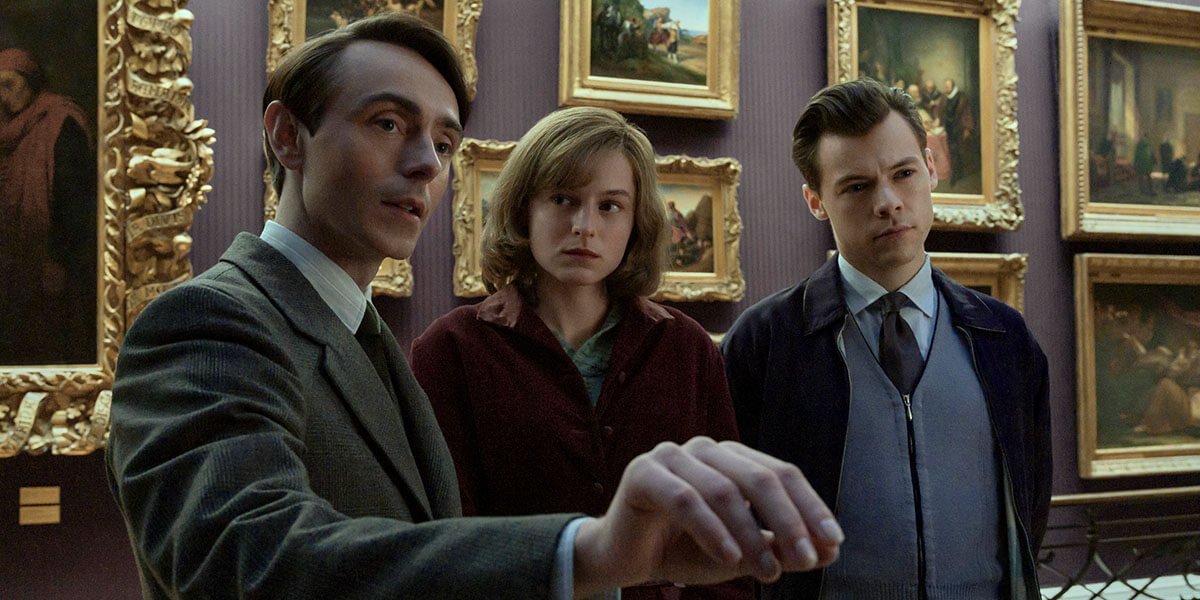
Switching between the 1990s in Peacehaven and 1950s Brighton, My Policeman follows Marion (Emma Corrin), a schoolteacher, infatuated with her friend’s brother, Tom (Harry Styles), a policeman who is eager to learn about the world, mainly literature and art. In the mix comes Patrick (David Dawson), the director of art at the Brighton museum who shows Marion the wonders of the world through art, opera, music recitals, and more. Though the three become tight friends, there’s more than meets the eye about the trio’s relationship resulting in devastating consequences for all three.
I can’t not address the elephant in the title. My Policeman? Good grief! Considering the reckoning that police have had over the past few years, it’s nothing short of weird to release a film with that title. The film has a diegetic reason for being called this but the optics of that title in this world aren’t great.
Having said that, this film is definitely an example of ACAB. Though Tom is innocent and quite sweet at times, he’s not above reproach. The film makes it clear that he has the same bad tendencies of his fellow policemen. Even though he tries to better himself, he’s still a man in uniform who has a mandate, and it doesn’t matter who gets trampled in the process.
In fact, none of the characters in My Policeman are shining examples of humanity. They’re deeply flawed and they hurt each other tremendously, sometimes deliberately so. But they’re also young and lost and lacking in direction. They’re products of their time, as the cast mentioned a few times during the press conference following the film. But their greatest folly is failing to rise above the judgements placed upon them during that era. I can’t say I quite blame the 50s versions of the characters but the 90s versions are the kind of stubborn older people that frustrate younger generations.
My Policeman is very much a film of two halves—the ’50s trio who are happy go-lucky with the world as their oyster, every experience new and wonderful. And the ’90s, a jaded, despondent group with nothing to hope for. As actor Linus Roache, who plays the older Tom, put it in the press conference, the two eras are, “completely different worlds that are united in the same universe.”
I think if we’d spent an equal amount of time in both universes, this film would have been stronger, because the 50s scenes in the first half of the film felt too familiar. We’ve got this type of context and setup in queer films so many times before. The meet-cute between the straight couple. The happenstance that brings the queer pair together. The innocent queer person making his first steps into the world with the experienced lover who is enchanted by his closeted beau. It’s Brokeback Mountain in Brighton. Had the film sped up this section, we could have focused on the more interesting aspects of the relationships, particularly the falling out that broke the friendship apart. Because that was some heartbreaking stuff.
It’s not about what My Policeman shows the audience that’s devastating, it’s the fact that nothing can make up for the lost time we don’t see. I wish the film had delved into that aspect more. That would have been possible if the story hadn’t spent so much time on context!
I will say, despite the super-slow start, the ending is more hopeful than a lot of queer films. My Policeman waits till the very of the film to include that glimmer of hope for the older versions of the characters. There’s a lesson about wanting to grow and learn even as one gets older that we can all take away from this story. Also, don’t be so quick to hurt someone just because you’re angry. And go to therapy (if you can)!
I’m not 100% sure why Harry Styles has top billing, aside from being the titular policeman. He’s the biggest draw, certainly, but Corrin and Dawson are the stars here. They’re both excellent in their roles—understated and understandable. Styles does a passable job. He fared better when tasked with playing Tom as an innocent, and less so in the more emotionally demanding scenes. His accent was also a bit all over the place but quite close to how he really sounds, as was obvious at the press conference. Having a muddled accent myself, I empathize, but the character of Tom would have benefited from Styles having a dialect coach.
In the 90s storyline, Roache hit it out off the park despite a curtailed role. The few scenes he had were so affecting that one could genuinely believe Styles’ Tom had grown into this man. Gina McKee as the older Marion was perhaps a bit too pared back in her performance. The emotions didn’t come through as much as it could have. As for Everett, I’m not sure why he took this role. At the start of My Policeman, Patrick has just suffered a stroke and finds it difficult to communicate and be mobile. As such, Everett gets to do very little. But the little he does is powerful and evocative—a man trapped by circumstance around people he hasn’t trusted in decades. I do wish we’d got a bit more of this section, especially when the film had such amazing actors to draw on.
While the time periods are extremely important in My Policeman, the geographical settings were a personal highlight for me. Most of this film is set in Brighton, where I went to university! I spent so much time pointing out Brighton landmarks, I’m glad nobody was sitting next to me. Also, there’s a montage in Venice, which I loved seeing on screen again. With settings like these, obviously the film is beautiful to look at.
I went into My Policeman feeling generally apathetic. The title, the hype around the sex scenes, the adoration/dislike of Styles (I’m so confused about which side people are on!) had me worried about what to expect. Plus, one can’t help but feel trepidation around a queer film, considering what’s come before. But aside from the overlong first half, this film was incredibly moving and felt very authentic to queer people’s experiences. It helps that writer Ron Nyswaner and director Michael Grandage are both gay men, so they were able to create a film that was deeply affecting, especially the final scenes, which had most of the audience in tears (some were outright weeping but not me!). I’d say come for Harry Styles but stay for the powerful queer story.
