


Humanity has lost a war with the majoda, an interplanetary association united by an artificial intelligence called the Wisdom. Earth has been destroyed, and a space station called Gaea now houses a remnant of humanity in a rigid militaristic society. Valkyr, teenage niece of the station’s commander in chief Aulus Jole, is waiting for her future to be decided: will she be allowed to join the military, or will she be forced to birth child after child as a member of the station’s euphemistically-named nursery?
To her dismay, Kyr (as Valkyr’s friends call her) is assigned to the nursery. Her brother Magnus, meanwhile, is given combat duties and subsequently disappears. The resulting intrigue drives Kyr to fight her way out of Gaea and head to Chrysothemis, a planet where a minority group of two million humans live alongside aliens. She has been conditioned to see the humans of this world as traitors – even Ursa, her long-lost sister. However, circumstances force Kyr to confront the dogma that has been drilled into her by Gaea: not only is she reunited with Ursa, she ends up in an alliance with Yiso, an alien with connections to the Wisdom.
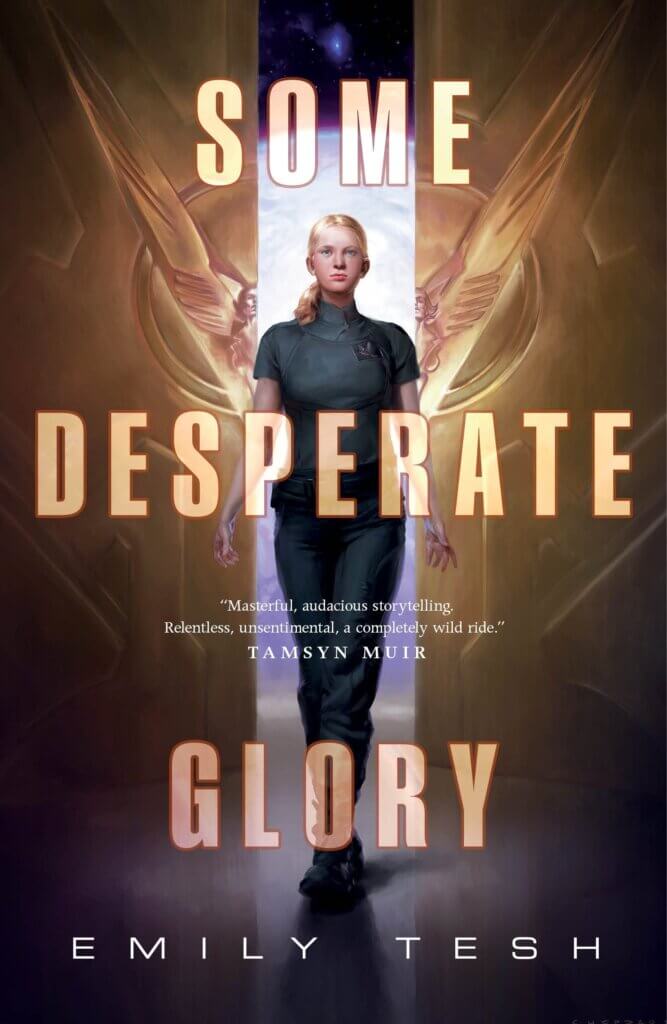
Some Desperate Glory won this year’s Hugo Award for Best Novel. In her acceptance speech, author Emily Tesh framed this victory as showing that her novel spoke to the present moment, for better or worse:
Here is my hope for this book – I hope this book disappears. I hope it joins the honourable, very honourable ranks of past Hugo winners which spoke to a particular community at a particular time and not all of history. And I hope for that disappearance, because no-one sets out to write a science fiction dystopia wanting to be proved right. And Some Desperate Glory is a book which was inspired by some of the worst of what is happening in the world today.
As well as being themed around the topical subjects of hard-right governments and the radicalisation (along with deradicalisation) of youth, Tesh’s novel speaks to the present zeitgeist in science fiction. For one, it belongs to what has become a prominent stock narrative in twenty-first century space opera: that of a space-military protagonist who defects to join the aliens they have been fighting (see also the films Avatar and Captain Marvel). It comes as little surprise that Kyr has a change of heart, as the early portions of the novel set the stage by making a point of how hard her heart is.
In the second chapter alone, Kyr is shown disciplining a younger cadet by forcing her to drink soapy water as punishment for a minor transgression; shortly afterwards, she torments the captured alien Yiso, an exchange which leaves her feeling let down at the prisoner’s seeming indifference to her brutality: “Kyr couldn’t read its expressions very well but she thought it was resigned. That made her angry. She’d wanted it to be hurt.” To drive the point home, the chapter ends with her destroying an object with sentimental value to Yiso. When the fourth chapter has fellow cadet Cleo remark: “You’re a horrible bitch, Valkyr, and everyone hates you,” this is likely to reflect something of the reader’s own feelings.
This heavy-handedness becomes easy to forgive once the novel moves on from setting up its characters and develops one of its high concepts: the agoge. Taking its name from the brutal training regimen undertaken by the male youth of Sparta (one of many examples of Gaea fetishising Greek, Roman, and Norse history), the agoge is introduced as a sort of advanced virtual reality system, and the novel’s characters become defined by their distinct attitudes towards it. Avicenna, who is something of a geek, uses the agoge as a game, even replacing the majoda aliens with monsters from fantasy fiction. Kyr, so straight-laced that she disapproves even of music being played on the station, is disgusted by Avi’s frivolity: to her, the agoge should be used only as serious military training.
To those familiar with the last few decades of popular SF literature, any story involving spaceborne youth taking part in military simulations will likely bring to mind a past Hugo Award for Best Novel winner: Ender’s Game by Orson Scott Card, published in 1985. Pared down to its essentials, Ender’s Game is the narrative of a boy, Ender, who is placed into a series of simulated conflicts against a race of aliens with which humanity is at war. Eventually, Ender opts to conclude one such scenario with an attack that completely wipes out the aliens’ homeworld. He then finds, to his horror, that this last conflict was not a simulation: he really has committed genocide.
While the similarities may be unintentional (in her afterword, Emily Tesh cites J.R.R. Tolkien and Ursula Le Guin, rather than Card, as her key influences), Some Desperate Glory is haunted by the exploits of Ender. Like Card’s protagonist, Kyr eventually learns that what she took to be mere simulations are, in fact, something rather different.
As Avicenna explains to her halfway through the novel, the agoge works by creating a branch in the timeline that exists for as long as the scenario is in use. Every time a user launches the “doomsday” scenario, which recreates the destruction of Earth, fourteen billion people are recreated in a pocket universe – and every time the user loses that scenario, those fourteen billion people are killed again. This technology was reverse-engineered from the Wisdom, which according to alien legend, was originally invented as a sort of oracle that could create potential futures, thereby allowing the user to make the best decision. The destruction of Earth was one such hard decision, being made after the Wisdom had shown every other option to come at a still greater cost.
This is a quintessentially 2020s twist on Card’s premise. In addition to framing the agoge as a the ultimate evolution of Midjourney (it creates wonders at the touch of a button, but at what cost?), the idea fits into the present vogue for fiction dealing with parallel timelines, the 2022 film Everything Everywhere All at Once being the pre-eminent example of this trend. Writers relish the opportunity to take the “what-if?” scenarios that are SF’s lifeblood and multiply them, while audiences, it seems, can never have too many Spider-Man variants onscreen together.
Some Desperate Glory puts its split-timeline concepts to good use. The narrative eventually reaches an alternate reality in which Valkyr is not the coldly brutal Kyr but rather Val, a young woman in an openly sapphic relationship who sees right through media propaganda that tells her to fear aliens, and who coexists with alternate versions of other members of the book’s cast. Kyr eventually snaps back to her own timeline but retains memories of her Val persona, giving her a new awareness of what she could have been and might yet become. Among other things, she now knows that she has feelings for a certain girl who exists in both timelines.
This last detail takes us back to the legacies of Ender’s Game and Orson Scott Card. As well-regarded as his fiction may be, Card is also notorious for his homophobia. As befits its status as a possibly unintentional reworking of Ender’s Game, Some Desperate Glory tackles LGBT themes in a thoughtful manner.
As is to be expected, the macho and militarised Gaea is unwelcoming to alternative sexualities and gender-nonconformity. The novel’s LGBT characters are initially depicted via the hostile perspective of Kyr who sees Avicenna as a “bitter sharp-tongued friendless little queer” and makes a disparaging comment about an onscreen news anchor who is implied to be non-binary. Later comes an awkward moment in which Kyr’s brother Magnus comes out to her as queer; and, later still, we witness Kyr’s inner struggles after experiencing her alternate-timeline existence as the decidedly non-straight Val.
Emily Tesh wisely avoids the trite melodrama that could easily ensue from depicting LGBT existence in a futuristic dystopia. By the time its queer aspects come to the foreground, Some Desperate Glory has outgrown the unsubtlety that had Kyr forcing someone to drink cleaning-water. Instead, the attitudes towards LGBT people between Gaea and Chrysothemis come across as a sharp reflection of such attitudes in real-world societies (like Tesh’s native Britain) where bubbles of acceptance exist in otherwise repressive communities and vice versa. The novel’s setting may be a far-flung future, but the painful coming-out moments carry a distinct ring of emotional truth.
In examining cultural homophobia, the novel does a skilful job of disentangling knotted threads of taught-bigotry and self-loathing. In doing so, it ends up in a good position to tackle a broader theme: that of Kyr’s deradicalisation. The plot thread in which she overcomes her hatred of aliens after becoming partnered with Yiso may sound simplistic when summarised but it is handled with nuance. Kyr’s moments of growth alternate with incidents which show how her prejudices still lingers.
The supporting players are also given due development; their attitudes contrasting with those of Kyr and, in the process, helping to build up her character. The calm and collected Yiso is at times an alarming figure – they are, after all, a representative of the AI that destroyed Earth – which adds wrinkles to Kyr’s shifting perspective on alien life. Meanwhile, easy-going Magnus and snarky Avicenna start out as more likable characters than the icy, bigoted Kyr; yet as Kyr matures, we get a closer look at the flaws of her male counterparts: the garden-variety selfishness of Mags and the terrifying genocidal ambitions of Avi.
All of this occurs over the course of what is, beneath the thematic enquiries, a ripping story. Some Desperate Glory gives us plenty of timeline-hopping antics and nuts-and-bolts techno-thriller hijinks, simultaneously finding time to plunge Kyr into a sizzling family saga. Not only is she reunited with her siblings Mags and Ursa, she also learns that she has a nephew of sorts in eight-year-old Ally – a boy who is ostensibly Ursa’s son, but has a more complicated history connected to Gaea’s rejection of children deemed “weak.” As the climax grows near, she is faced with the fates of her parents and marched towards an inevitable confrontation with her uncle Aulus Jole, the novel’s main antagonist. The plot is well-stuffed and the pace seldom lets up.
Emily Tesh is quite right when she says that her novel is rooted in a specific point in time. Well beyond fitting into the current vogue for fiction dealing with alternate timelines, Some Desperate Glory is unmistakably a vision of the future with a very specific set of present-day concerns: AI and its costs; authoritarian regimes; LGBT politics; the radicalisation of youth; and reactionary politics spouted by people with Greek statues as avatars. Only time shall tell how well it fares when, like Ender’s Game, it retreats into genre history. For now, though, Some Desperate Glory stands as a worthy exercise in taking the anxieties of today, filtering them through a space opera prism, and articulating them into a story that engrosses and surprises in equal measure.
