

This month’s WWACommendations is a riot of emotions. Kathryn’s reading about the discomfort of grief, Emily’s got a memoir that involves funneling emotion into activism, Christa’s got a familiar recommendation that processes feelings of isolation, Kayleigh brings us a horror anthology which of course serves up a great deal of fear, and I’ve got a slice-of-life manga for you that navigates delight, curiosity, frustration and much more. I write to you from the US Midwest, where we’ve entered winter, the season of endurance, so I hope these recommendations can brighten the dark, searingly cold days ahead.
Alenka Figa: First, I have to say “thank you!” to Kathryn for recommending Your Letter in a previous WWACommendations! I read it recently and it was beautiful and made me cry.
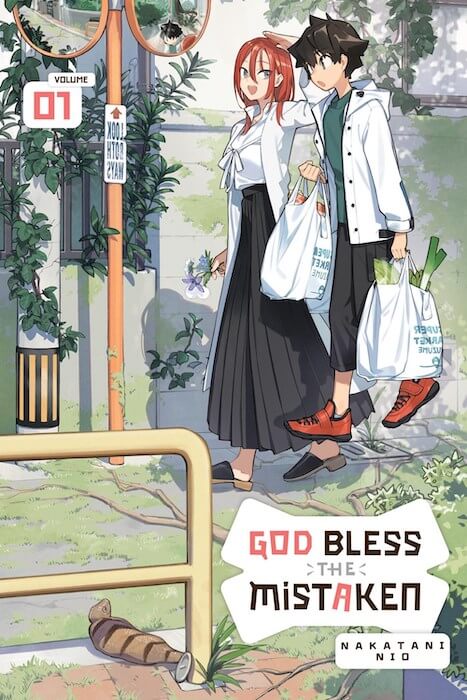
God Bless the Mistaken by Nio Nakatani did not make me cry, but it did make me feel awe and delight! This new manga by the creator of Bloom Into You is an adorable and intriguing exploration into a world that experiences a phenomenon called Bugs. Bugs are like glitches in reality that happen for unknown reasons, and that can disrupt day-to-day life but often are just strange and fun. The most prominent character, at least in the first volume, is Kon, a middle schooler who lives by himself in a sharehouse with a bunch of goofy adults. Kon’s landlady, Kasane, is a somewhat eccentric woman who studies Bugs but has the rare inability to experience them. She frequently ropes Kon into her observations, using him — or trolling him — to test theories and see the world through another’s eyes.
This manga is sort of like Glitch — also recommended by Kathryn, which I am also enjoying because Kathryn really has my number — meets Maison Ikkoku — recommended by Kayleigh! The unique personalities of the characters living in the sharehouse are the clear hook of the story, and I’m excited to learn more about them in future volumes. That interest is balanced well with Nakatani’s focus on Bugs and how they affect this setting in a myriad of ways: bringing people together, opening them to new experiences and pushing them to see how their perspectives color their particular view of the world. It’s a really fun story that lets Nakatani craft some cool illustrations of people climbing stairs and napping in the sky or of plants popping up in unusual places. This one is perfect for readers who need something low-stakes that incorporates slice-of-life and sci-fi genre conventions.

Kathryn Hemmann: Like Nio Nakatani’s God Bless the Mistaken, John Moore and Neetol’s Ditching Saskia is set in a world like our own, but with a key difference. If someone manages to acquire a Spirit Flower, they can summon a ghost of their choosing. Damien is having a rough freshman year, and there’s no one he wants to talk with more than the ghost of his mother. Using a Spirit Flower, he accidentally summons a young girl named Saskia who’s more than willing to help him get his life in order. What begins as a light comedy about high school friendships gradually shifts into a more serious tone as Damien confronts uncomfortable truths about his mother’s depression, Saskia’s murder, and his new friends’ unhealthy relationship with social media. Despite the story’s twists and turns, Neetols’s art is consistently gentle, and Moore’s writing carries the characters safely through their emotional challenges. While presenting an intriguing set of intertwined mysteries, Ditching Saskia also provides readers with a safe space to explore the theme of grief. This sensitive YA graphic novel keeps welcome company with Hyeon A. Cho’s Your Letter and God Bless the Mistaken.
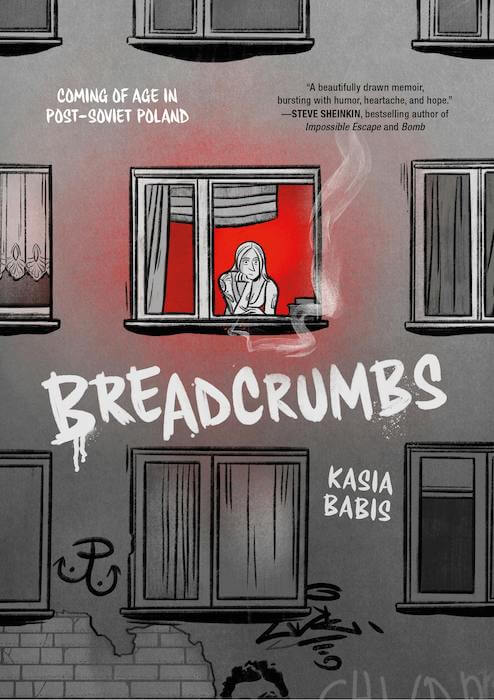
Emily Lauer: I recommend Breadcrumbs by Kasia Babis, a memoir of her activist girlhood and early adulthood in the politically tumultuous and repressive Poland of that time. Babis, whose work I knew from The Nib, traces her friends’ and her own interlocking experiences with family, sexuality, terrible boyfriends, and leftist political activism. Honestly, there were a few things I didn’t get on my first read, including changing character depictions from one panel to the next, and why the book is called Breadcrumbs. I don’t mind that, as I think it will reward rereading. Also, as I wrote about Occulted, the truth about memoir is that sometimes it isn’t as tidy and thematically coherent as fiction, and that’s understandable. Overall, Breadcrumbs offered me some insights into a part of European history I didn’t know much about, showing me how regular people are shaped by, and resist, the forces that threaten to beat them down. Breadcrumbs will be coming out in June of 2025 from First Second’s new explicitly grownup sub-imprint, “23rd St.”
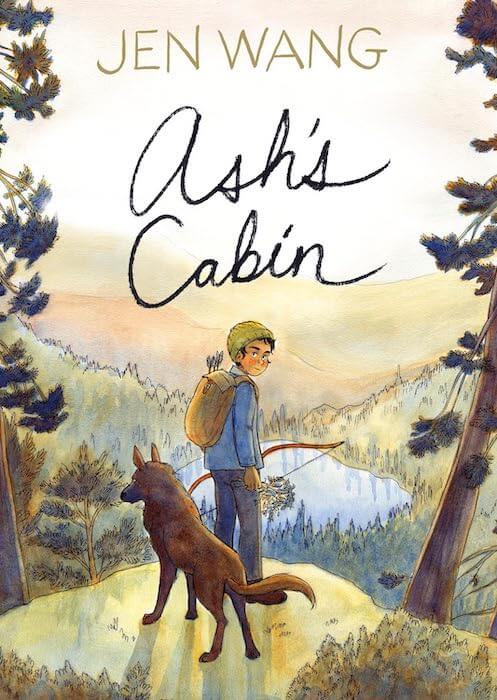
Christa Seeley: I’m one of the graphic novel panelists for the Cybils Awards this year which is allowing me to catch up on a lot of Middle Grade and Young Adult graphic novels. One of which was Ash’s Cabin by Jen Wang, published by First Second [E/N: and also previously recommended by Emily.] This Young Adult gem is a must-read and is easily one of the most beautiful comics I’ve seen all year, with lush, vibrant colours and artwork that pull you right into Ash’s world. Ash, the protagonist, is a young teen who feels isolated, not just because they’ve recently embraced their trans identity but also due to the apathy around them about the climate crisis. Inspired by memories of their Grandpa Edwin, who once dreamed of building a secluded cabin hidden in California’s wilderness, Ash sets out alone on a journey to find it believing it will be a possible refuge from the world around them. Ash experiences some really difficult situations throughout their journey but you’re cheering for them the whole time and the story is very moving throughout. If you’re someone who grew up loving books like Gary Paulson’s Hatchet, this is exactly the comic for you.
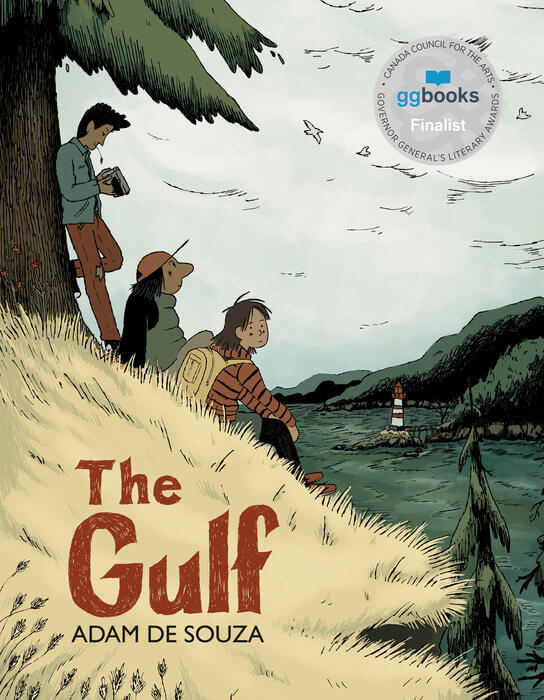
Kathryn Hemmann: If you’re interested in the themes of Ash’s Cabin, an interesting companion is Adam de Souza’s 2024 graphic novel The Gulf, which is about three disaffected queer teenagers who abscond from high school to join an isolated commune on a heavily forested island. What I appreciate about The Gulf is its honesty about how difficult this actually is. Despite having prepared for the adventure as best they could, none of the three teens really understands how to survive in the wilderness, and they’re continually rescued by people with more experience. When they eventually manage to find the commune, they learn that it disbanded long ago. But the partnered couple who remain on the property offers solid life advice for both queer people and environmentalists who want to push back against capitalism. Namely, self-sufficiency is a myth, and you have to work with your community to survive. I read The Gulf immediately after Ash’s Cabin, and I’m grateful for the difference in perspective.
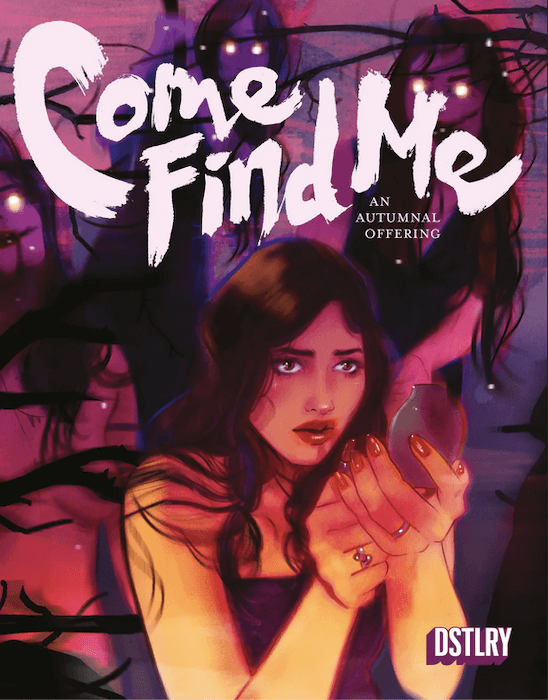
Kayleigh Hearn: For those who like a drop of arsenic in their mulled wine this fall, I recommend Come Find Me: An Autumnal Offering from DSTLRY. An erotically-tinged horror anthology conceptualized by Becky Cloonan, I impulsively grabbed Come Find Me at the comic shop after falling under the spell of Tula Lotay’s enticing variant cover.
As with any anthology, there are highs and lows, or rather, shrieks and muted gasps. “Devil’s Trill” (HamletMachine, Joe Pavelka, Lucas Gattoni), is a sensual fall into damnation that reminds me of vintage Anne Rice at her best, while “Coal & Clover” (Vanesa R. Del Rey, Andrew Betsch, John Starr, Lee Loughridge, Lucas Gattoni) features moody, atmospheric art but a predictably pedestrian ending.
For my coin to Charon, the best stories in Come Find Me are Cloonan’s own “Portorium” (also with Lee Loughridge and Pat Brousseau), a medieval tale of graverobbing gone wrong, and E.M. Carroll’s “The Warmth of the Hunt,” a stunning heart-stopper featuring skeletal lovers and their last fateful meeting. There is more I can say, but as fall chills into winter, some surprises should be left for you to unearth.

