

It’s truly, officially summer which brings us back to an evergreen question: what qualifies as a true summer read? Should summer books be lighthearted and easy? Should they be hardcovers that you take to the beach and return to the library full of sand? (Hi, it’s me, your librarian – please be careful taking your books to the beach so I don’t have to discard them because they come back coated in sand.) Here at WWAC we definitely do not think summer reads must be lighthearted; we’re going hard! I read about the Woman Life Freedom movement in Iran and Jim Terry’s struggle with alcoholism, Emily read about a teen who isolated themself in response to feeling outcast, Kathryn recommended a story about coping with rejection, and Kayleigh has got one with a bit of everything — romance, horror, and political strife. If you’re ready to use your summer vacation to dive deep into some heavy emotions, we’ve got you.
I hope this summer we will see a real ceasefire, but now is not the time to forget Palestine. If you missed last month’s WWACommendations, the intro includes recommendations on how to get involved.
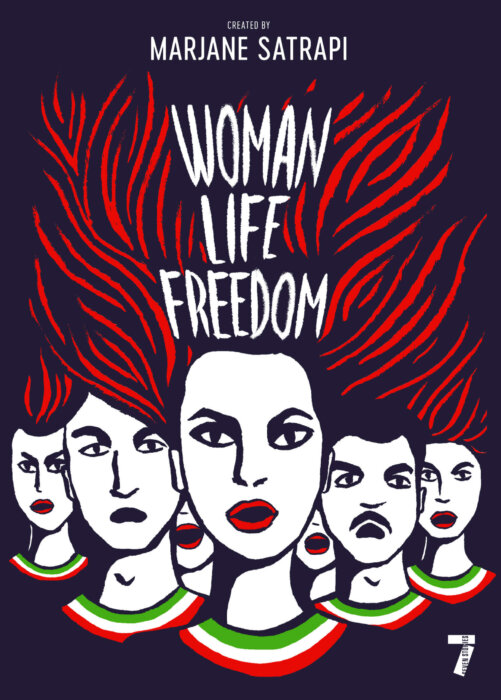
Alenka Figa: Woman Life Freedom is a collection of short history lessons, illustrated conversations, and profiles of revolutionaries that paints an expansive picture of the current feminist revolution in Iran, which started in 2022 when the morality police killed Mahsa Amini for not properly wearing a headscarf. Created by Marjane Satrapi, this volume contains comics and writing from many artists that reflect on the revolution and declare that the regime will fail, and Iranian women — as well as all of Iran — will be free.
Despite capturing such a traumatizing moment, Woman Life Freedom contains a lot of humor. Kinetic energy runs through the comics, ending with an invigorating conversation among creatives Jean-Pierre Perrin, Farid Vahid, Joann Sfar, Abbas Milani, and Marjane Satrapi about Iran’s future. It feels right to say this is a volume containing the spirit of revolution; in the section titled “Names that Will Go Down in History,” Bahareh Akrami and Farid Vahid show figures who have been imprisoned, made to suffer, and killed in smiling portraits or simple poses that could have been taken from selfies they themselves had posted. There is great respect in each profile, and a clear desire to show each person as they would have wanted to be seen. These illustrated profiles reflect what revolutionaries are fighting for – the right to live fully in public society as oneself. It’s a great collection, and very much succeeds at its goal of being accessible to a non-Iranian audience.
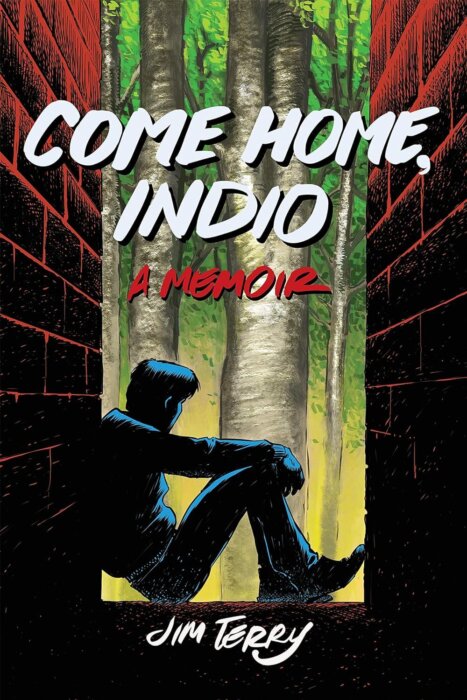
I also read Come Home Indio, a memoir by Jim Terry that chronicles his upbringing as half-white half-Ho-Chunk, his feelings of disconnection and loneliness as a multiracial person, and, most prominently, his long struggle with alcoholism. I was totally unfamiliar with Terry’s art, and after reading just the first couple of pages I was struck by how vibrant and all-consuming it feels. Come Home, Indio is all black and white with some heavy, often intense inks, and lots of tensely cross-hatched or patterned backgrounds. Jim’s isolation is easily felt as Terry boxes in his younger self with these visual techniques, bringing us along to rock bottom and beyond. Rarely, there are no comic panels and just Jim and some lettering against a blank background, and these moments are deeply jarring.
I haven’t felt so absorbed in the experience of reading a comic in a long time, and despite the dark nature of Terry’s story, it’s a wonderful reading experience. His struggle with alcoholism is long and heart-breaking, and his feeling that he belongs nowhere only resolves — or comes close to resolution, as this is the kind of trauma that never quite leaves you — when he feels drawn to join the water protectors at Standing Rock. However, it is relieving to hold this book in your hands and know that Jim Terry is alive, he is drawing, he is surviving, and he is moving away from all that loneliness to share his life. To read this memoir is to feel grateful for the beauty Jim Terry has created, and hopeful that more of his work is on the horizon.
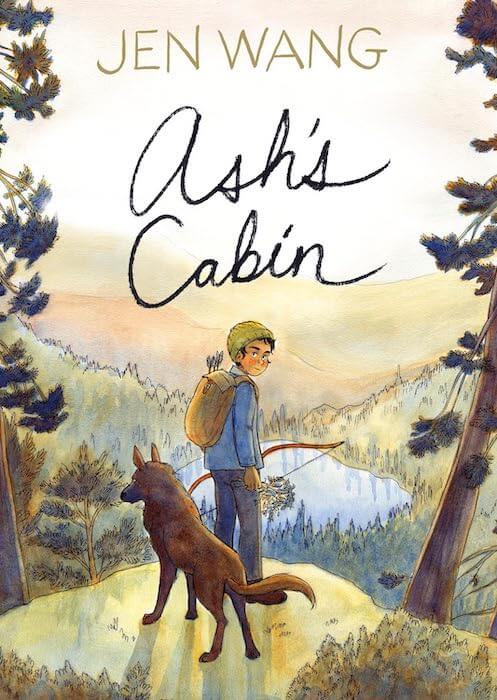
Emily Lauer: Ash’s Cabin by powerhouse Jen Wang comes out August 13 from First Second, and I absolutely love it.
Ash’s Cabin is not my usual preferred genre of YA graphic novel, as it is realistic fiction about wilderness survival rather than fast-paced speculative fiction with a lot of banter. However, it is a beautifully crafted, expertly paced character study with a lot of depth and gorgeous art, and I was riveted the whole time.
Ash is a teenager who feels out of place in their family, school, and community, so they read up on wilderness survival and try to go it alone, heading out to an old cabin they’ve heard about. They try to get their environment livable, as loneliness and ill-preparedness loom on one horizon, and climate crisis and interpersonal issues loom on the other.
I felt for Ash, and I felt immersed in the soft-looking, meticulous art. Ash’s Cabin is different from Jen Wang’s other work, like The Prince and the Dressmaker, a WWAC fave, but it’s equally excellent, and it’s exciting to see Wang’s breadth of style here.

Kathryn Hemmann: Fried Rice is a semi-autobiographical graphic novel about a Malaysian high school student named Min who dreams of studying animation at “NY Arts” in America. In the first half, the reader follows Min as she polishes her illustration skills and nurtures her ambitions. Unfortunately, Min’s application is rejected, and the second half of the story is about her preparations to study animation at a university in Malaysia. Min’s family is supportive and nurturing, as is her community, and what might first seem like a story about rejection turns out to be a story about happiness, belonging, and hope for the future.
In many ways, Fried Rice feels like an animated film. The characters are beautifully expressive, the environments are detailed and immersive, and the flow of the story is subtle yet strong. You can read the comic on its website, but what I love about the print version (available through import) are the 31 pages of sketches and notes included at the end. In these endnotes, Eng writes that her application to CalArts was rejected, and I can only hope she felt vindicated when Fried Rice won the 2020 Eisner Award for Best Webcomic. As I watch in horror and dismay as small art colleges close in the United States, Eng’s realistic yet still gentle story about finding alternate paths to achieving creative career goals feels especially relevant and important.
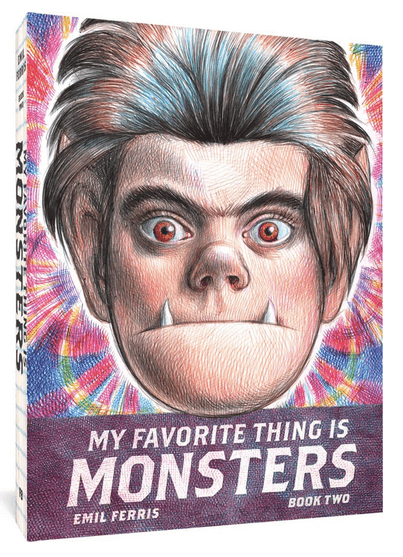
Kayleigh Hearn: My Favorite Thing is Monsters is one of the greatest graphic novels of the twenty-first century; writing anything about Emil Ferris’s long-awaited concluding volume makes me feel as inadequate as one of those unfortunate Universal Studios extras crushed under Frankenstein’s magnificent monochrome boots. The book is just that big, a towering achievement of the form that demands your attention lest it swallow you whole. There is no other book like it.
The seven years between volumes evaporate when you turn the first page. Karen Reyes is right where we left her, reeling from a shocking discovery about her beloved brother Deeze. A young girl in 1960s Chicago feasting on horror movies and monster mags, Karen’s hand-drawn notebooks comprise the entirety of My Favorite Thing is Monsters, with Karen imagining herself as an adorable (but ferocious) werewolf. Ferris’s elaborate, cross-hatched artwork is by turns funny, beautiful, and horrific – a BIC-pen recreation of Caravaggio’s Judith Beheading Holofernes and a mob wife’s garishly decorated, clown-themed apartment both get lovingly-illustrated two-page spreads.
The Cryptid-sized narrative is harder to pin down, as Karen’s fears about Deeze collide with her investigation of her neighbor’s death, her first romance (with a girl named, appropriately enough, Shelley), and the simmering political tensions in the city. I’ve been thinking about this book for the last two weeks, and I still haven’t gotten to the bottom of it – this is one to chew on, and savor. I’m excited for everyone who can now read the complete story.

