

In The Assessment, a couple living in a post-apocalyptic future try to pass a series of tests to determine whether they can qualify to have a child. But as the tests become increasingly dangerous and abstract, the couple begins to question their relationship and what they want from their world.
The Assessment
Fleur Fortuné (director), Mrs. & Mr. Thomas (writers), John Donnelly (writer), Magnus Jønck (cinematography), Yorgos Lamprinos (editor)
Elizabeth Olsen, Alicia Vikander, Himesh Patel (cast)
September 8, 2024 (TIFF)
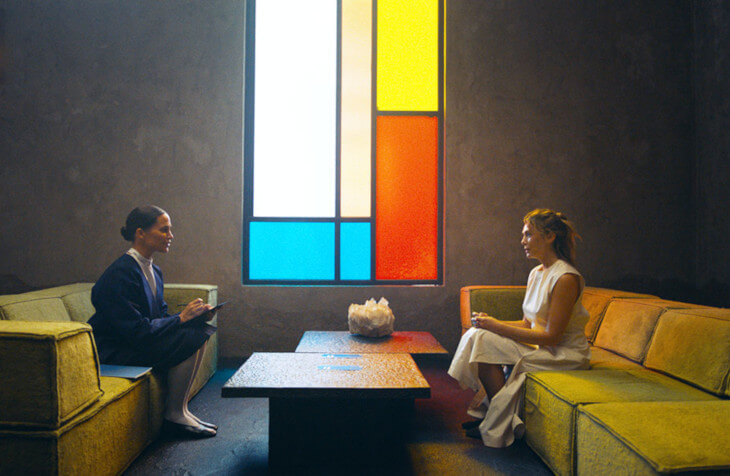
I watched The Assessment on the last weekend of the 2024 Toronto International Film Festival (TIFF). The hall was packed to watch the feature film directorial debut of Fleur Fortuné, who has already built a career directing music videos for the likes of M83 with Manu Cossu as the duo Fleur&Manu. The cast was a clear draw for the audience. The couple, Mia and Aaryan, are played by Elizabeth Olsen and Himesh Patel. Their assessor Virginia is played by Alicia Vikander. I was attracted to the film due to one still depicting Virginia and Mia sitting in front of a Mondrian-inspired window. That image coupled with the post-apocalyptic angle meant I knew I had to add this film to my list. I will mention that my twin Monita is the Mondrian fan at home and was also interested in the film because of that. But TIFF scheduling issues meant I could catch the film and not her. Well, if it makes you feel better, sis, Mondrian had nothing to do with the film.
Despite the lack of references to Mondrian, there’s plenty of artistry in The Assessment, particularly in the set design. The majority of the film takes place in Mia and Aaryan’s massive home. I can’t call the house beautiful because the walls and floors are drab, but I enjoyed the random pops of colour, like the vibrant green kitchen table, the multi-coloured glass dining table, and the maroon and orange tones of the room for Virginia. The design evokes the aesthetics of the 70s with hints of pop art which effectively screams to the audience how Aaryan and Mia are different. They’re accomplished, professionally and personally. They’ve made it in a world that needs to activate domes to keep people alive. If anyone deserves to qualify for a child in a resource-lite world, it’s them.
And then the tests start. I have a low cringe tolerance, and The Assessment pushed one of my strongest cringe buttons—adults acting like children. That’s what the assessor has to do to show the couple what life with a child is going to entail. So she flings food about, bangs on tables, insists on calling Aaryan “daddy,” while denying Mia any parental title. I cringed so hard, particularly during scenes where they had to feed Virginia. I could barely look at the screen.
Having said that, I could still bear it for one reason: the cast is committed to their roles, cringey or otherwise. As uncomfortable as I was watching the grown Vikander act like a toddler, the characters were similarly uncomfortable. Mia and Aaryan share their distaste for what’s happening, shrug, and accept that this discomfort is part of the assessment. They treat Virginia like she is their child in the hopes that doing so will help them pass the tests. The entire cast, even supporting actors, were along for the ride. They shared gentle asides about the weirdness of the situation and then just plugged on with the scene pretending Virginia was a toddler. And that made a huge difference in my ability to sit through the film as opposed to walking right out.
Virginia’s pretense at being their child is surprisingly effective. Mia reveals herself to be the firm, authoritarian who will go the extra yard for her child. Aaryan establishes himself as the fun, permissive Dad who isn’t as cautious about his child’s whereabouts as he should be. Mia becomes committed to the bond, often overlooking Virginia’s actual age, but Aaryan expects Virginia to switch back to her adult self. Their individual relationships with Virginia seem indicative of what kind of parents they will be.
Partway through The Assessment, I started thinking that this film was an unfair take on parenting. As Mia and Aaryan soon realise, it’s parenthood squeezed into one week. Children being annoying when you want quiet, messing about with the work you’ve brought home, or worse, nearly drowning when you take your eyes off them—Mia and Aaryan are thrust into all this at a moment’s notice. They assume that it’s all part of the assessment and are constantly on edge because any lapse could mean instant failure. Yet, Virginia doesn’t call time on their tests. She gives them more and more to do, and as the week progresses, the right answers become less clear. At times, it seems like Virginia is intentionally trying to sabotage their chances. But she’s a state-sanctioned assessor, how could that be possible?
It irked me that The Assessment was condensing parenthood into a short span of time. Parents have many hours of parenting which turn into years of parenting to figure things out. It’s simply not possible to get everything right with no preparation, and that too in just a week. But that turned out to be the point of the film. The assessment isn’t fair, nor is it designed solely to qualify potential parents. As the film progresses, the characters and viewers realise there are many more layers to this testing system than has been let on.
It all comes back to the world-building in The Assessment. Through dropped hints in conversations, it becomes obvious that much of what’s happening in this world, good and bad, is man-made. The people like Mia and Aaryan, the 0.1% who could qualify to be assessed, are living in a fantasy land built on state propaganda. I wish the film had delved into those aspects. I loved the world-building and every tantalising detail had me sitting up, hopeful for more. Who built the domes? What happened to the animals? How come there are almost exclusively mixed-race couples? I wouldn’t mind a series set in this world. Maybe even a sequel? The ending sets up some interesting changes in the characters’ lives.
I largely enjoyed The Assessment. The acting was solid across the board, which helped fight my cringe, an achievement all on its own. The world-building won me over, and I would have loved more details. The set design was functional and intriguing. As a film viewing experience and a thought experiment, this film has it all.
