

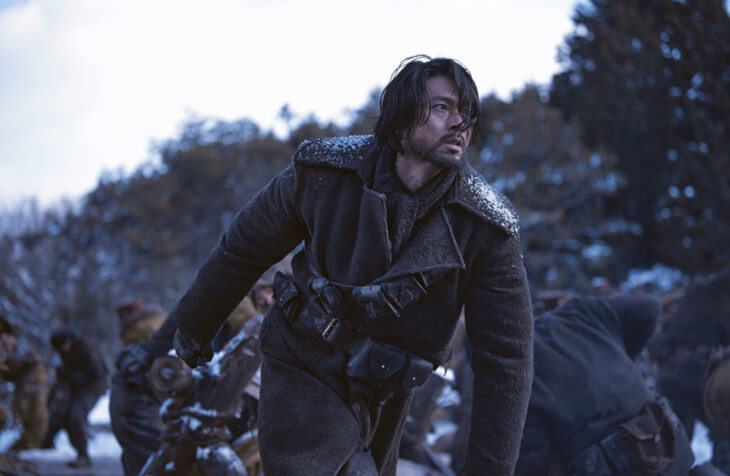
Harbin, set in 1909 Korea, then a protectorate of Japan, follows a group of resistance fighters trying to gain independence from Japan by assassinating the Prime Minister. For the freedom fighters, the fight for Korean independence has been long and arduous with countless lives lost, and this one last mission could end the Japanese occupation once and for all.
Harbin
Woo Min-ho (director and writer), Kim Kyoung-chan (writer), Hong Kyeong-pyo (cinematography), Kim Man-geun (editor)
Hyun Bin, Park Jeong-min, Jeon Yeo-been, Jo Woo-jin, Lee Dong-wook (cast)
September 8, 2024 (TIFF)
I watched Harbin at its last screening at the 2024 Toronto International Film Festival (TIFF). The film was covering an era in history that audiences outside of Korea and Japan may not know much about and have likely not seen depicted on the big screen. I love history and am well aware of how much of my historical knowledge is missing. I couldn’t wait to fill one of those gaps by watching Harbin.
Ahn Jung-geun (Hyun Bin), leader of the Korean resistance, has been a loyal and effective warrior. He’s ensured many victories for the resistance, and the promise of Korean independence from Japan seems possible under his leadership. But when Harbin begins, Ahn cuts a lonely figure crossing the frozen Tumen River, half-frozen to death, half-welcoming death due to the lives he’s lost. Ahn made the terrible mistake of being human in a time of inhumanity—he let Japanese prisoners of war free, including Major Tatsuo Mori (Park Hoon), a man longing for an honourable death who can’t forgive Ahn for denying him that end. Mori takes his revenge out on Ahn’s troops. The devastation is appalling. Ahn immediately becomes persona non grata to the majority of the resistance, especially for Lee Chang-seop (Lee Dong-wook), who not only blames Ahn for the loss of their troops, but accuses him of being a Japanese spy.
This seed of doubt from Lee sets the tone for Harbin. This film is as much a spy thriller as it is a war film. Nobody can be trusted among Ahn’s inner circle. There’s even a point late in the film where I was sure writer-director Woo Min-ho had set an elaborate plot about an unreliable narrator. The thread of loyalty, or rather disloyalty, was the most gripping aspect of the film. But the first thing that caught my eye was the cinematography.
Cinematographer Hong Kyeong-pyo creates a stunning canvas for Harbin to tell its story. From the opening scene of the lone Ahn shuffling across the frozen blue ice of the Tumen River, I knew we were in for a visual treat. Hong is equally adept at capturing the tight spaces of the resistance hideouts as he is the battlefields. I was struck by the beauty and composition of each scene, especially on the silver screen.
The cinematography is a perfect accompaniment to the genre-defying story. Part spy thriller, part heist movie, Ahn and his comrades, Woo Deok-sun (Park Jeong-min), Kim Sang-hyun (Jo Woo-jin), and Ms Gong (Jeon Yeo-been), travel across occupied Korea, China, and Russia in their hunt for the best spot to assassinate Prime Minister Itō Hirobumi. They finally decide on Harbin, where the train Hirobumi is travelling in will need to stop for a change. But the discovery of a mole sends the group into chaos with everyone mistrusting each other, like one would expect from a good spy thriller. Despite having watched a fair few thrillers in my life, the revelation caught me by surprise. It’s good to be surprised while watching a film in 2024.
Harbin was a gripping watch, and I enjoyed being educated about a period of history I didn’t know much about. But there were some misses for me. One inconsequential thing that bothered me: inconsistent blood spatter. Aside from a battle early in the film, there isn’t much bloodshed in the remainder of the film. But the blood spatter, or lack thereof, didn’t make any sense. Initially, I thought it was only the Japanese soldiers whose blood wasn’t spurting, as opposed to their red-blooded Korean counterparts. I wondered if this was a cinematic way of showing what monsters the soldiers carrying out Japanese occupation were. However, some of the Japanese did bleed eventually, some even gushed blood. So why didn’t the first few soldiers bleed out despite being stabbed repeatedly?
The rousing score was on point and punctuated moments of defeat and victory. I’m unsure whether it was the hall or the sound mixing, but the score was sometimes ear-piercingly loud, as were the gunshots. It would have been nice to enjoy the score without holding my ears.
Hyun Bin’s performance as Ahn is strong, but I wish there had been more close-ups of his face during the emotional scenes. Hyun is affecting even when in a corner or hidden in shadows, but he should have been able to demonstrate his range of emotions as close to the audience as possible. There’s a scene late in the film when Ahn is filled with self-doubt that’s severely undercut by the fact that Hyun’s face is hidden for almost the entire duration of the scene. Stylistically, it’s a good choice. The camera angle makes the audience feel like they’re in the room with him, watching him break down. But the man is acting his heart out, and we see nothing of it.
Lee Dong-wook’s Lee is practically an antagonist within the Korean resistance in Harbin considering how distrusting he is of Ahn. He does a solid job of being thoroughly annoying to watch. But his sudden reversal near the end of the film still came out of nowhere. He was, up until moments before, vying for leadership of the resistance. And then he changed his mind on a dime. There should have been more breadcrumbs up to that moment.
The biggest issue I had with Harbin was the villain of the film. I’m still unclear on why Major Mori is so vengeful against Ahn, and only Ahn. I could understand if he hated the entire resistance equally. But his goal, to the detriment of all others, is to stop Ahn. Initially, I thought Major Mori was having an extreme reaction to Ahn not killing him or letting him perform seppuku. But Mori is told off by a resistance fighter at one point in the film that suggests that may not be all, so the full reason for Mori’s vengeance remains a mystery to me.
These are small points of contention in a film that transcends genres and keeps audiences guessing. A visual feast for the eyes, Harbin highlights how necessary compassion is for humanity, but especially during times of war. If you’re looking for a gripping watch that will have you at the edge of your seat, Harbin should be your first pick.
