

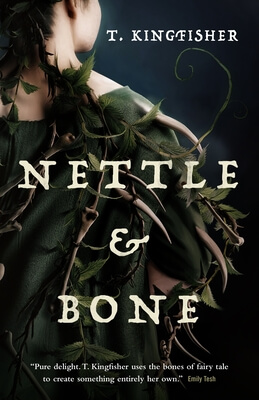
There were once three sisters in Nettle & Bone, all princesses of a small city-state called the Harbour Kingdom. The eldest, Damia, married Prince Vorling of the Northern Kingdom. Five months later Damia was dead. The middle sister, Kania, married the now-widowed Prince Vorling, while the youngest of the three, Marra, was sent to a convent by their mother, freeing her from the world of marriage and political alliances.
Years have passed since then, and Marra is concerned for her surviving sister. Having seen bruises on Kania’s body during a visit, she realises that Prince Vorling is violently abusive and that the death of Damia may have been more than a mere accident. And so, Marra departs her convent and travels through a land of strange magic, picking up whatever allies can help her in her goal: to kill Vorling and rescue Kania.
In her afterword, author Ursula Vernon (alias T. Kingfisher) reveals that her Hugo Award-winning novel Nettle & Bone grew out of an earlier short story of hers, “Godmother.” Published in 2014, this was a very brief piece with a half-familiar fairy tale setting but an unorthodox narrative voice, and a cluster of striking images: a frail princess, a rope made of nettle, a dog made of bone. These images, explains the writer, stuck with her long enough for them to become a pitch for a novel, which was duly accepted by her publisher.
If we compare “Godmother” to Nettle & Bone, then it becomes easy to see the first hurdle faced by their author: the original story left no readily obvious way for its narrative to be extended. Kingfisher has shown an inventive flair for expanding upon the short fiction of past authors, having crafted a present-day sequel to Arthur Machen’s “The White People” in The Twisted Ones and retold Poe’s “The Fall of the House of Usher” from a radically different perspective in What Moves the Dead, which was also up for a Hugo this year. In revisiting “Godmother,” she ends up using the same trick employed by L. Frank Baum when he codified the novel-length fairy tale in The Wonderful Wizard of Oz: that is, she puts together a quest narrative in which the main character picks up an ensemble of magical oddballs.
The cast of characters who come to follow Marra offers twists on familiar archetypes. Agnes is a fairy godmother; being something of a rogue among her kind, she is willing to help Marra combat Prince Vorling’s own protective godmother. Then we have the dust-wife, a gravedigger who has the additional task of speaking the language of the dead; this comes in handy when Marra needs information from victims of the kingdom’s bloody history. Fenris, the token man in a novel generally keen to spotlight women, is a former knight who feels shame at his past involvement in clan warfare on the borders of the fairy realm. His role in the story is to add muscle and love interest.
The ensemble also includes a couple of animals. The dust-wife has a demonically-possessed hen, while Marra has her very own Toto in the form of Bonedog – which, as its name suggests, is an animated dog-skeleton. Marra creates Bonedog in the very first chapter, and the character has something of the conventional Disney sidekick about him. He tends to furnish the novel’s cuter moments, as when Marra is taken aback to hear her pet described as a “monster”:
Monster?
And then she looked down and realized that her assailant had been talking about the skeleton of the dog.
Oh. Right. I suppose … yes.
She scowled. He was a good dog. He had excellent bones and even if she had used too much wire and gotten it a bit muddled around the toes and one of the bones of the tail, she’d think that a decent person would stop and admire the craftsmanship before they screamed and ran away.
“No accounting for taste,” she muttered.
The book makes some effort to sketch out a broader fantasy world. Some straightforward relations between a few kingdoms underpin the royal marriages, and Marra’s convent is tied to a religion with a number of (apparently all-female) saints and a central figure, Our Lady of Grackles, who “did not care for complex theology.” As is often the case with fairy tales, however, the story’s world is a tight bubble that surrounds the main characters.
For example, while the plot concerns a scheme to kill a monarch, the point is not how this will affect the wider kingdom, but rather how it will benefit the protagonist’s sister. Consequently, exploring the wider world is a matter of meeting one colourful character after the other. Some join Marra’s ensemble while others are one-off encounters, often resulting from the dust-wife’s necromancy. That the narrative started as a cluster of creepy images before being stretched from short story to novel is never entirely hidden: much of the plot is structured around the characters traipsing between ghost-children and animated sarcophagi.
Along the way, the novel makes a few gestures at subverting the norms of fairy tales. At one point, the dust-wife expresses hope that she is not in a fairy tale, as such stories “are very hard on bystanders. Particularly old women. I’d rather not dance myself to death in iron shoes, if it’s all the same to you.” These moments are not entirely convincing, however, as the novel is not derived from any specific fairy tale text and so has no clear target to subvert. Kingfisher notes in her afterword that the character of the abusive prince was inspired by Hans Christian Andersen’s story of the princess and the pea, but the two tales have little in common beyond this indirect connection. (Compare this to another of the year’s Hugo contenders, Alix E. Harrow’s A Mirror Mended, which is very specifically a riff on the Snow White story: the evil-but-redeemable queen’s fear of dying in iron shoes therefore carries more weight).
Instead, the story’s most successful moments of subversion come simply by embracing the raw emotion that is often skimmed over or abstracted by fairy tales. An early chapter has a starkly convincing portrayal of Marra, as a child, trying to deny the reality that her sister Damia is dead:
Marra crept into the chapel that night. If she could prove that the body lying there was not Damia, then all the foolishness of funerals could be set aside.
The shrouded figure smelled strongly of camphor. There was a death mask atop the shroud. It was Damia, her face composed.
Marra stared at the figure for a little while and thought that it had been several days since they had heard of Damia’s death. They had been cool days, but not cold. The camphor could not quite chase out the scent of decay.
If she tried to push aside the death mask and tear off the shroud, she would see a rotting corpse. Who knew what it would look like?
I was thinking like a little child, she thought angrily. Thinking that I would be able to tell if it was Damia. It could be anyone under there at all.
Nettle & Bone has many other such moments where the fantasy sparkle fades and we are shown either raw emotion or plain, unromanticised practicality. These often touch upon such traditionally feminine topics as pregnancy and childbirth, sex work (“I suppose I could sell my body,” thinks Marra to herself, “but I’m not sure how one does that, either”) and, in a less-than-obvious plot element, weaving. The nettle referred to in the novel’s title is the material that Marra is forced to use as wool, a process that leaves her with the physical pain of pricked, bleeding fingers and general despair at the sheer amount of toil that she has been given.
For the most part, the novel’s moments of emotional truth are separate from its cartoon-Gothic imagery, although there are a few moments where the two succeed in mixing. One of the minor characters is a woman accompanied by an animated puppet; although it behaves violently towards her, at one point trying to wring her neck, she insists on keeping it by her side and becomes distressed if it is taken away from her. This is a potent analogy for a toxic relationship, and it takes us back where we started: to that abusive fairy tale prince, Vorling, whose misogyny and violence kicked off the whole narrative in the first place.
While Nettle & Bone might have found more to work with had it chosen a specific fairy tale to subvert, it nonetheless manages to create a memorable set of images and characters that evoke without directly mirroring the fairy tale canon. Indeed, given the novel’s emphasis on the creepier aspects of folk-fantasy, perhaps its avoidance of the familiar is a positive aspect.
There are no Gothed-up Snow Whites, Big Bad Werewolves or other such obvious images in this twisted fairy tale. Instead, T. Kingfisher takes her reader on a tour of her own haunted world. The phantasmagoria is sometimes unnerving, often whimsical and frivolous, yet always backlit with a glow of human empathy.
