
On June 10, after news hit Twitter (well, the website now formerly known as Twitter) that artist and animator Ian McGinty had passed away at 38, cartoonist Shivana Sookdeo started the hashtag #ComicsBrokeMe. Stories poured onto social media via the hashtag, revealing how overworked, underpaid, and exploited artists are in both comics and animation. As often happens when discussions on the destructive nature of the comics industry reignite, professionals also offered up threads of advice. Amidst all this I caught a tweet by Black Josei Press founder Jamila Rowser, noting that she’d been meaning to write a thread of advice about writing comics that support artists’ health and advocating for artists in general.
#ComicsBrokeMe cropped up during a tumultuous time on social media. Twitter, as noted, has a new, stupid name and has been slowly crumbling post Elon Musk’s purchase of the platform. Competitors have popped up but not necessarily popped off, with Bluesky and Threads emerging most recently as main contenders for Twitter’s throne. Threads of advice have, historically, been reshared and relied upon by creators, but continued access to those threads is now in jeopardy. With this tumult in mind, I reached out to Rowser and proposed that she offer her advice in the form of an interview with WWAC instead. Why not give it an easily shared link and format that will survive the death of Twitter?
I’m very grateful Rowser was interested in this interview, and agreed to offer her advice through this somewhat unconventional format. Rowser kindly offered me talking points ahead of time to make sure we covered all the important aspects of writing comics scripts that provide useful insight to artists as well as considering the taxing physical labor of illustration. She also offered her thoughts on laying the groundwork for collaborations, contracts, dealing with one’s ego and much more.
What follows is a three-part interview covering all of Rowser’s advice. This first part covers the nitty gritty of comics scripting, the second focuses on the pre-writing/research phase, and the third zooms out to address working with a larger creative team and ensuring your team is credited and supported after the comic is finished. Please absorb it all, share it, and release your ego before reaching out to a cartoonist about illustrating your comic. Also, cut all those scenes involving horses.
This interview has been edited for clarity.
I want to start very, very basic. Can you tell me why is it important to provide a thorough script to an artist? Why does this matter?
Because you want to help the artists as much as you can to make their job easier, and you want the comic that you both create to be as good as possible. That starts with a really clear, good script.
Let’s start the nitty-gritty of scriptwriting. People have different styles, but for comic scripts, it seems like some people do a mostly text approach with occasional doodles or even thumbnails, and some scriptwriters will provide a lot of basic visuals. I’m curious just to break this down, what do you feel is helpful to have specifically, and how much visual information should already be there?
Something that I’ve heard a lot from the artists that I’ve worked with on my scripts is how they’re really thankful for the reference images I provide. I would definitely say include reference images. If it’s something that the artist would have to look up to see how to draw because they don’t know it off the top of their head, look it up and download the image and provide a link. Have an easy way that you organize the reference images for the artists to access, so you can link them directly from the script to where they are, whether it’s a Google Drive or a Dropbox.
For example, facial expressions — words plus a reference image is gonna be way more helpful than just words. As a writer sometimes you’re like, how do I describe this facial expression that this character is making? And you know, you can use the best words you can, but also share images that show that.
When you’re writing the script, depending on how long your comic is, thumbnail the whole thing out. Obviously, it is gonna be real rough. Like, mine are stick figures and just kind of blobs of sections, but you can see: Does what I wrote on this page actually fit? Is it too much? Am I asking for the artist to squeeze too much on this page? You can make out your own layout that you think would work, but it’s not necessarily what the artist is gonna do. At least you know, okay, this will fit. Then you can also see how page turns go, how the flow will go. I think thumbnails are very important to know if your script needs any editing on that part.

And then: layouts of rooms and areas. If you have characters that are in an apartment for a majority of the time, what is that apartment layout? You can’t say like, “they turned the corner here and the kitchen’s there and the bedroom’s there,” but technically it doesn’t make any sense. Figure out the layout, write it, draw it, Google apartment and house layouts and pick one and share that with the artist because if you don’t they’re gonna have to figure out the layout based off of all your descriptions and different panels. That’s a lot of work and it’s confusing. I did not do that at first and I know Robyn did for Wash Day, and I was like, oh, I need to do this next time.
If there’s something that you’re trying to describe that you can’t find a reference image for, or you’re trying to describe a panel or idea that you have, just draw it out. Don’t sweat about how good it looks. Draw it out, take a picture, add it to the script or add it to the folder. As many visuals as you could provide that you think will be helpful, share it.
Is it possible to give too much detail, or is more detail always better?
Oh, for sure. If you’re worried you may add too many reference images, ask the artist what would be helpful for them. There could definitely be too much detail in the panel writing. When it comes to writing panels and just writing pages, remember, you’re not writing a book! There’s a lot of stuff that isn’t necessary. It is good to explain some of the emotions, some of what’s going on in the character’s mind, but a lot of that should be clear based off the dialogue or how even the panel is described. Think of the text as more functional than flowery and pretty prose.
What does the artist need to know in each panel? What time of day is it? Where are the characters located? What kind of POV are you thinking of? Do you have things to be included in the panel that are necessary or optional? That’s definitely something I include a lot; what needs to be in there or that this person could be there but they don’t need to be. Or this: we see the background but the people don’t need to be very detailed. Those kinds of things are really helpful because then the artist doesn’t have to go out of their way to try to figure out who needs to be in the panel. One thing I always hear from artists is the time of day isn’t always included in scripts, but it’s necessary for them to know because it affects the lighting.
Also: can this be shown and not told? As a writer for comics, you don’t have to have dialogue, thought balloons, or any kind of narration. You can have a whole comic that has no text and you still wrote a comic, so don’t always think that having words on a comic page is the only way to convey aspects of the story. The beautiful thing about comics is we can see what the characters look like, their expressions and their mood can be shown through coloring and things like that.
I’m having a funny memory. I saw a play when I was in undergrad that had originally been a radio play and then they adapted it to the stage, but the original adaptation was not good. I have a distinct memory of this point where the main character was like, “I walked down the corridor,” and like, buddy, we know. We’re watching you!
I watch a lot of anime and they’re like, “His power level increased!” And we’re like, we literally just saw that happen!
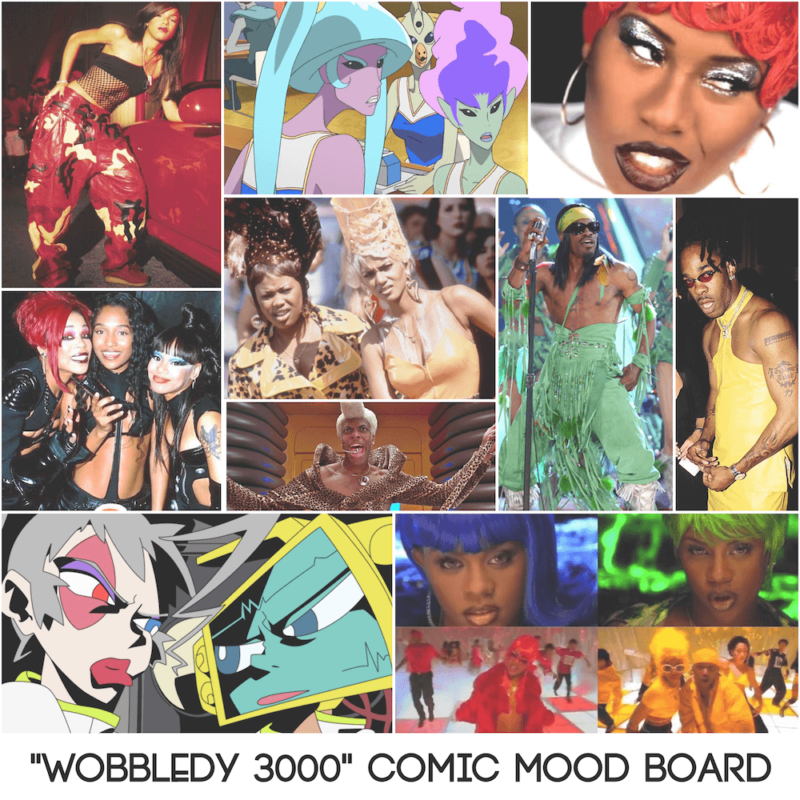
Two other things I wanted to say: first, mood boards are really helpful, especially helping the artist get a sense of the style of the setting and of certain character styles or how you want them to look — especially if they’re an alien or something non-human. Don’t go overboard with the mood board images. Save as much as you can but then edit it down and make sure that you don’t have a lot of images that are very similar, because that’s just too much information.
Second, be mindful of what you’re asking the artist to do in your script. How many crowd scenes do you have, do you need all these crowd scenes? Do you understand how much work is involved? Because it’s a lot!
A field of horses.
Horses? No horses at all!
Do you have a very detailed spaceship? Think about how much work is gonna be involved for each page, each panel. It doesn’t mean you can’t have a crowd scene or you can’t see the full ship in all detail, but you don’t need to see it all the time. There can be angles and closeups where you only see parts of it and you still get the sense of what the whole thing is because you have at least seen it once or twice.
I can see this being a place where it’s really helpful to have laid that groundwork with the artist. If it turns out they hate crowd scenes, but they love fields of horses… I’m sure someone loves fields of horses?
Ha, there has to be somebody! Yeah, that exactly. Like, if they don’t like drawing cars or mechanical things, but you know that you need some of that in the comic, think of how the POV can be framed so they don’t have to do that much or it’s not in the comic as often. Just be a good collaborator. A good person!
Let’s talk about what happens before the artist starts really drawing and getting into inks and details. Once all of this is handed over to the artist, you’ve gone over the script together and you’ve got thumbnails, how much communication is still happening? Are you doing regular check-ins or are you on-call for the artist? What’s the collaboration look like at that point?
It’s helpful to discuss all of this with the artist. Make sure you have a timeline with the artist, at least for the next one or two phases of the art. This can change, but just have a date that they’re working towards so you know what to expect. Having deadlines even for self-published comics is helpful because then you’ll know how often to communicate, like: Hey, just reminding you there’s a week left before thumbnails are due, do you think you’ll still be able to deliver it then? Do you need more time? That’s very important, and can relieve a lot of pressure and stress from the artist.
What I do is if an artist will say, I can give this to you in two weeks, I’ll be like, how about three? If there’s no rush — especially if it’s an indie comic there probably isn’t a rush. It’s your time, and life happens. All these things happen. Add buffer days. Say like, “let’s aim for two weeks, but you know, if you need an extra week, that’s fine.” Just having that extra time is really helpful.
When you’re talking to the artist, before the art has started, emphasize how their health is the utmost important thing. If they ever need more time or they’re sick, ask them to let you know and that an extension’s totally fine. Nothing is more important than somebody’s health. I don’t care how good you think your comic script is, especially with how physical it is to create art.
I can see this being a point where it’s good to get to know each other better ahead of time. This is a really exploitative industry. People have these developed habits of like, no, I gotta hit that deadline even if it kills me. If I don’t get paid enough for this I still have to do it because I don’t know when the next job is coming. If it’s your project and you’re in control of it, you can factor that in and be like, hey, I know that this is your instinct, but I wanna not do that because it’s been developed in a toxic environment.
Yes. That’s what I do for Black Josei Press. I’m like, I make the rules and I don’t care if I said it’s coming out next month. I’ll just be like, sorry, it’s not, because I want them to have more time. Making sure the artist has a healthy timeline to create the comic is not only necessary for their mental and physical health, but also it’ll make it a more fun experience. It’ll make the comic better. It’s just overall the best thing to do. It’s considerate.
Before the artist starts working on the art, ask them how they want to go over it. Do you wanna have a meeting every time? Do you prefer me writing notes? Do you prefer both? Or, you know, maybe I write notes, but if you want to talk about something more, we can meet. I prefer to always include written notes. I think that’s always most helpful even if you have a meeting because things may get lost in the meeting or forgotten, so write down your feedback.

Don’t just share what you think needs to be changed or edited. Share what you like. What do you think is really awesome? What do you think is really cool that they did? You don’t want them to have anxiety when they get the feedback.
I get a bit fangirly when I write the stuff that I like. I’ll get into all caps and use a lot of exclamation marks and stuff because that’s how I feel. Like, oh my God, the shadowing you did there! Oh, I love that little detail you added in the background. Write all that down because not only is it just nice for the artist to hear, it is helpful for them to know what you think they did well, because that can influence what they continue to create.
For Wash Day Diaries I recorded a video of me going through Robyn’s art page-by-page and just gushing about how good it was, zooming into really dope things they added. We are friends, so that might be too personal to do with an artist you’re working with. But the point is feedback does not equal “change this because it’s not working.”
We’ve already gotten into it, but my next question is about editing. I think editing is thought of as a thing that happens at the end, but really editing is a continuous part of the process. Is there a final edit that happens typically? How do you decide your comic is done?
I tend to work in very specific phases: thumbnails, rough pencils, tight pencils, inks, coloring and lettering. Sometimes things are more separate. Sometimes an artist may do something that another artist doesn’t. Knowing how they create and the steps that they will use to create a comic is important, because the writer should be reviewing the work at each of those phases. You can split it between a certain amount of pages at a time or it can be the whole thing; that’s something you work out with the artist. At every phase, you should be giving feedback, especially in the beginning because that reduces the amount of changes when there’s way more detail done.
For me, once the pages and cover are complete, that’s when the editing is done.
I can see it being difficult to be like, okay, we’re done. Especially if you have things that you wanted to hint at or build up to, or if you wanna go back and be like, oh, I actually needed this to be in a panel.
Yeah. That you should make sure you think about that before you get to the end. Even in the thumbnails part, like, “I don’t know if there’ll be enough space to convey this,” or, “how I wrote this layout I don’t think will work with what I’m trying to convey. Let me rewrite it and give it back to you.” A lot of the times I’ll see stuff that I wrote and they did it how I asked, and I’m like, this doesn’t work at all. So I’ll say, pause, don’t work on these pages, I’m gonna rework them and give that to you.
There’s always gonna be that feeling when you’re done with a comic: I wish I added this, or I wish I did that. You just have to let it go. Let it live and exist. If not, you’ll just continue to find things and nitpick. That’s not fun work for the artist.
Stay tuned for Part 2 of the interview.
