

The winners of the 2023 Hugo Awards were announced this Saturday. A whole year’s worth of science fiction and fantasy talent as voted for by members of the World Science Fiction Convention (Worldcon) were duly honoured with gleaming trophies in the shape of a panda with a rocket.
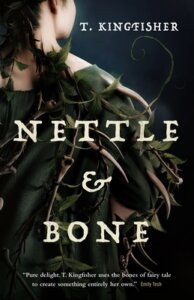
The winner of the Hugo Award for Best Novel was Nettle & Bone by T. Kingfisher (the adult fiction pen name of author Ursula Vernon). A macabre twist on fairy tales, this story sees a princess setting off to rescue her sister from a malevolent prince, a task that puts her in contact with all manner of witchcraft and necromancy.
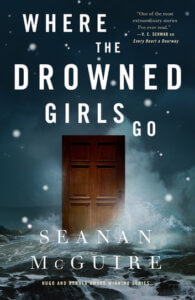
The Hugo for Best Novella went to Where the Drowned Girls Go, the seventh instalment in Seanan McGuire’s Wayward Children series. The main setting of this saga is a school for emotionally-troubled youngsters who have returned from adventures in fantasy worlds; Where the Drowned Girls Go shows us what happens when one of the pupils decides to switch schools. While every previous book in the series has been a Best Novella finalist, 2023 marks the first year since 2017 in which a Wayward Children book won the prize.
The Best Short Story winner was Samantha Mills’ “Rabbit Test.” This piece responds to the recent overturning of Roe v. Wade by exploring the history of birth control, and imagining a future in which the US government monitors pregnancies using bodily implants. Mills’ story previously won a Nebula, Locus and Sturgeon Award.
Hai Ya’s “The Space-Time Painter,” which ran in the Chinese magazine Galaxy’s Edge, and is not presently available in an English translation, was named Best Novelette. Adrian Tchaikovsky’s Children of Time space opera novels were voted Best Series. The winner in Best Related Work was Rob Wilkins’ Terry Pratchett: A Life with Footnotes, a biography of the much-missed Discworld author.
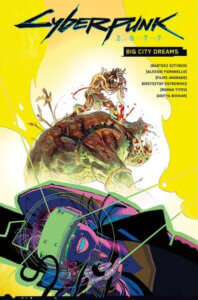
Best Graphic Story was won by Dark Horse’s Cyberpunk 2077: Big City Dreams. A tie-in for the video game Cyberpunk 2077, this comic comprises a fifty-page story from writer Bartosz Sztybor, artists Alessio Fioriniello and Filipe Andrade, colourists Krzysztof Ostrowski and Roman Titov and letterer Aditya Bidikar. The central character is a street punk who yearns to escape his life of crime for a peaceful rural environment — something he can most easily obtain through a virtual reality simulation built from appropriated memories.
The Best Dramatic Presentation awards were taken by two well-loved productions. Everything Everywhere All at Once took the prize in the long-form section, marking yet another accolade for a film whose awards have their own Wikipedia article. The Expanse won its third award in the short-form category, this time for the episode “Babylon’s Ashes.”
Illustrator Enzhe Zhao was named Best Professional Artist, while photographer Richard Man won the prize for Best Fan Artist. The two Best Editor awards went to Clarkesworld founder Neil Clarke for short form and Lindsey Hall for long form.
Uncanny Magazine took its seventh Hugo for Best Semiprozine, while Best Fanzine went to a newcomer: the Chinese publication Zero Gravity Newspaper. Chris M. Barkley, a longstanding member of the SF fan scene, won his first Hugo for Best Fan Writer. Hugo, Girl!, a feminist-oriented podcast that launched in 2019, won Best Fancast.
Also presented were two awards which, while not officially Hugos, used the same voting process. The Lodestar Award for Best Young Adult Book went to Nnedi Okorafor’s Akata Woman, while the Astounding Award for Best New Writer was won by Travis Baldree, whose cosy fantasy Legends & Lattes was a runner-up for the Best Novel Hugo.
China’s first Worldcon
Although the World Science Fiction Convention, which administers the Hugo Awards, is held in a different location each year, the majority of host cities have been in the United States. The only other countries to have hosted a Worldcon more than once are the United Kingdom, Australia and Canada. The 2023 Chengdu Worldcon is the first to be held in China and only the second to have taken place in Asia (after the 2007 Worldcon in Yokohama, Japan).
The site selection vote for 2023 was held in 2021, with Chengdu being a clear winner: attracting 2006 votes, it was far ahead of runner-up Winnipeg, which had only 807 votes. This was an unusually large turnout for a Worldcon site selection. For context, the 2022 Chicago Worldcon was chosen on 517 votes, the 2021 Washington Worldcon on 798, and the 2020 Wellington, New Zealand Worldcon on 643.
Fans familiar with China’s science fiction scene evidently left their mark on the Hugo ballot. The short fiction categories have a total of four works that were originally published in Chinese: “Resurrection,” by Ren Qing; “On the Razor’s Edge,” by Jiang Bo; “The White Cliff,” by Lu Ban and “The Space-Time Painter,” by Hai Ya. Of these, only “Resurrection” is presently available to the public in English, with a translation by Blake Stone-Banks being available in the book Galaxy Awards 1: Chinese Science Fiction Anthology.
A Hugo Award recommendation list on the Chinese social network Weixin, brought to the attention of English-language fandom by X (formerly Twitter) poster ErsatzCulture, shows a partial but still significant overlap with the final award line-up.
While only one of the Chinese prose stories included on the list made the ballot (Ren Qing’s “Resurrection”) both of the recommended Best Graphic Story contenders made the cut. The titles in question — Dune: The Official Movie Graphic Novel and eventual winner Cyberpunk 2077: Big City Dreams — were originally published in English, emphasising that the Chinese recommendation list does not restrict itself to Chinese works. A few other categories show an overlap with the contents of the list (most notably, the winning contenders for both Related Work and Professional Artist were included) but it is impossible to say for certain just how much influence this particular recommendation list may have had.
International controversy
The location of the 2023 Worldcon provoked a strong backlash.
An open letter, signed by 70 publicly-named writers and thirteen organisations, called for the Chengdu Worldcon bid to be revoked “in protest of serious and ongoing human rights violations taking place in the Uyghur region of China.” Citing a 2021 Human Rights Watch report entitled “Break Their Lineage, Break Their Roots,” the letter made the following plea:
So often, our characters make unthinkable sacrifices, and undertake impossible quests to bring down tyrants and oppressive regimes. They do so for a chance at a just and more inclusive future, where their people no longer suffer violence and discrimination.
The human rights atrocities committed by the government of China against the Uyghur and other Turkic Muslim populations are in total opposition to everything we as a community stand for. We cannot, in good conscience, celebrate the achievements of the best and brightest in our field, against a backdrop of catastrophic human suffering. To participate in WorldCon in Chengdu, China, would be equivalent to giving WorldCon’s imprimatur to genocide and to crimes against humanity.
“This is not a protest against the citizens of China, with whom we stand in solidarity,” concludes the letter, “but rather against a government that is committing crimes against humanity.” The letter’s signatories include N. K. Jemisin, Martha Wells, G. Willow Wilson, Jeannette Ng, Uighur Abdulla and Tochi Onyebuchi, among others.
The convention’s guests of honour were also controversial. One was Cixin Liu, whose novel The Three-Body Problem won a Hugo Award in 2015. As Sarah Mughal Rana pointed out in her Bookseller article “Science fiction’s moral reckoning: why we must block Worldcon Chengdu,” Liu works for SenseTime, a company involved in human rights abuses:
SenseTime—along with four other firms—is responsible for creating mass surveillance AI systems used to identify and police Uyghurs, Tibetans and other Turkic populations in China. The US has even banned investments into SenseTime for its prominent role in the genocide. The advanced systems include facial and voice recognition, DNA sampling, and racial profiling; these factors are directly responsible for widening the scope of the genocide.
There are shades here of an earlier Worldcon controversy: namely, the incident in which the 2021 Hugo Awards were sponsored by the Intelligence and Space segment of arms manufacturer RTX (formerly Raytheon). Both controversies offer a sobering reminder of technology’s human cost, something often overlooked by fictional visions of sparkling futures.
Another guest of honour at the Chengdu Worldcon, Russian science fiction writer Sergei Lukyanenko, has spoken in support of Russia’s aggressive policy toward Ukraine. The announcement of his presence prompted a petition for his guest of honour status to be rescinded; this attracted more than 2000 signatures. “Sergei Lukyanenko appears on Russian TV and fantasizes about beating Ukrainian children until they learn to love mother Russia,” reads the petition. “He smiles when his conversation partner speaks fondly of genocide.” This description refers to a notorious interview between Lukyanenko and Russian television presenter Anton Krasovsky.
S.B. Divya, whose story “Two Hands, Wrapped in Gold” received enough votes to become a finalist for Best Novelette, opted to withdraw from the awards in protest of both the Chinese government’s treatment of Uyghur people and the presence of Lukyanenko. “I hold no ill will toward Chinese fandom, writers, or artists, and I know that many of them are working under repressive conditions,” wrote Divya; “however I cannot in good conscience participate in this year’s WorldCon.”
John Wiswell, whose short story “D.I.Y.” was a Hugo runner-up this year, did not withdraw from the awards but opted to boycott the other aspects of the convention. In a subscriber-only Substack newsletter, he announced his decision neither to travel to Chengdu in person nor to participate in virtual events:
It is repulsive that anyone would platform and celebrate Lukyanenko while he gloats about war crimes. It is the same repulsion I feel when reading reports of the genocide against the Uyghurs, and that I feel when so-called Guests of Honor vocally support that genocide. So, as a Hugo finalist, I will not be participating in this year’s Worldcon. I will not travel to Chengdu in person. I will not do any virtual programming remotely, either.
“If y’all want to celebrate my nomination,” concluded Wiswell, “I recommend donating to Ukrainian refugee charities. A lot of people need help in this world right now.”
When the convention was held, Lukyanenko turned out to be missing in action. Mike Glyer of File 770 reported on his absence:
There’s no sign of the Chengdu Worldcon’s Russian GoH Sergey Lukyanenko in social media coverage of the con. And the latest posts to his blog on his official website (devoted to anti-Israel remarks, and a report that his wife rescued a migrating woodcock in the backyard) suggest he’s at home. Although he made two other professional visits to the Far East earlier in 2023 he hasn’t mentioned Chengdu on his blog this year.
Meanwhile, voters have already chosen the site of next year’s Worldcon: Glasgow, Scotland. As is traditionally the case, many participants cast joke votes, which can be seen on the site selection PDF report.
There, alongside nominations for imaginary places like Wonderland, Moomin Valley and Stargate Command, is a single, poignant vote that reads “Any country with an acceptable human rights record.”

