

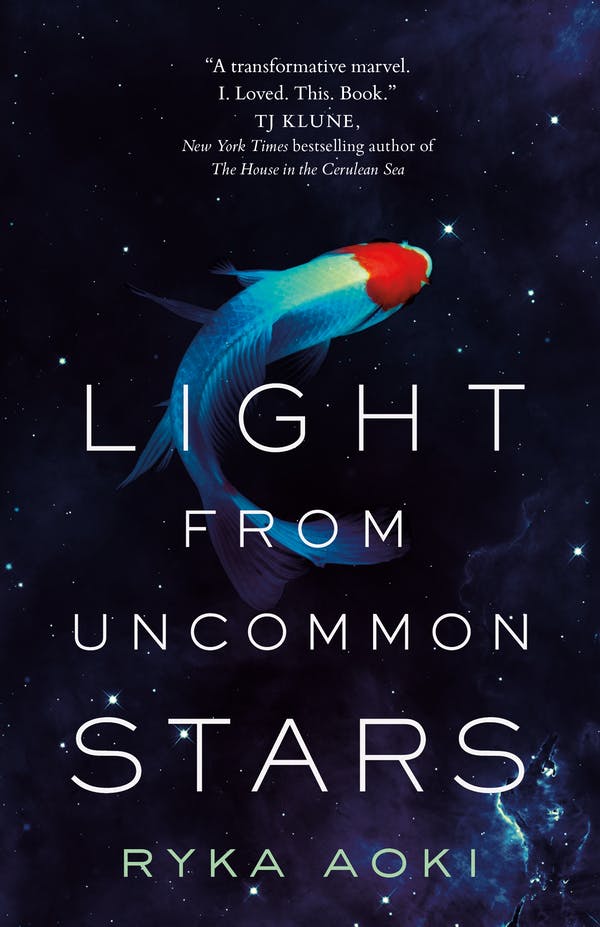
In Light From Uncommon Stars by Ryka Aoki, Katrina Nguyen is a young transgender woman who fled her abusive parents and hopes to pursue her passion as a violinist. She meets a woman named Shizuka Satomi, who previously coached six would-be musicians to stardom – only for each one to due young, thereby earning Shizuka the nickname of the Queen of Hell.
This monicker is more appropriate than might be expected, as Shizuka is in league with infernal powers: she has made a deal to procure seven souls for a demon named Tremon. Six of those souls have been dealt with, and with Katrina, a seventh is lined up. But first, Shizuka must tutor this raw talent – all the while keeping her own conscience at bay.
Demons, it transpires, are not the only otherworldly beings abroad in the world. The Tran family, who run a local donut restaurant, are secretly aliens on the run from an apocalyptic threat called the Endplague. And when Shizuka visits their restaurant, they begin to fear that she has picked up on their secret…
It is hard to summarise the plot of Light From Uncommon Stars without making it sound like a thoroughly silly novel – and, yes, any book that contains dialogue like “Have you aligned the donut with the local continuum?” is a book unafraid to come across as a bit far-fetched. But for all of the froth and frivolity, Ryka Aoki’s story is also unflinching when it needs to be.
With its racially and sexually diverse cast, the novel paints not just a portrait of communal isolation and prejudice but an entire gallery wing. Here, we witness the feeling of having one’s cultural background discussed by one’s current social circle as an exoticised curiosity; there, we find the harrowing experience of coming out as transgender to a family that views LGBT people as hellbound sinners.
The novel does not shy away from the hardships that Katrina has suffered after running away from home – which, after all, reflect the experiences of so many real-life trans people. The fact that Katrina has fallen back on sex work simply to get by is treated in a forthright manner: “Katrina told herself she should be thankful. Thanks to the part-time work, the cam shows, the blowjobs, she had escaped home and made it here. She had her violin. She had her laptop and a fresh supply of hormones. She was alive.”
Articulating such topics in a novel with demonic music teachers, alien doughnut vendors, and the sort of loose narrative where a person hunting a stolen violin can form a major plot point may seem a strange choice, but it is a choice that Light From Uncommon Stars works hard to justify. It is significant that – although the novel is knee-deep in classical music history, with the likes of Paganini, Tartini, and Bartok woven into the tale of Faustian pacts – Katrina’s passion lies with playing music from anime and video games, no matter what her peers make of such low-culture material. The novel’s sympathies clearly lie with her tastes.
Granted, this faith only goes so far. There is, after all, a sequence in which one of the alien characters expresses dismay that humanity is using its communications technology not to discuss such topics as the exploration of the wider cosmos but for celebrity gossip and porn. But when Shizuka realises that she does not have to be the Queen of Hell by playing through an Undertale-esque game that allows the player to choose between good and evil paths, it is clear what the story is saying about the value of seemingly fluffy entertainment.
Like another of the year’s Hugo finalists, Catherynne M. Valente’s The Past is Red, Light From Uncommon Stars calls to mind Charlie Jane Anders’ Sweetweird Manifesto – although unlike Valente’s novella, it has the distinction of being mentioned by name in that essay (indeed, it is the first book that she lists). In her manifesto, Anders praises the values of being “nurturing, frivolous and kind” in a harsh and often nonsensical world; this equation of frivolity with kindness, and sweetness with weirdness, runs through Aoki’s novel.
If we were to slot Light From Uncommon Stars into an established area of SF/F literature, then it could be termed a variety of magical realism; but the novel would be more accurately framed as a prose outgrowth of the webcomic tradition. The freeform blurring of fantasy, sci-fi and mundanity; the sometimes hyperspecific riffs on pop culture; the abrupt shifts between goofball humour and genuine emotional weight – all of these are traits found in many narrative-driven webcomics.
Of course, serialised webcomics tend to be products of public-facing trial and error, leading to an inevitable element of the ramshackle. This, too, can be found in Ryka Aoki’s book, given the soft focus of its narrative. The looseness of the storyline will likely test the patience of some readers – but the truth is that, as webcomics have been around long enough to influence a generation of writers, Light From Uncommon Stars is what we can expect a significant area of modern SF/F to look like.
