
Some readers may feel that, so far, the stories covered in this series on nineteenth-century American vampire literature have shown an insufficient quantity of fangs. The first part covered stories by Edgar Allan Poe, Washington Irving, and Ambrose Bierce that dealt with the theme of the seductive revenant – but, strictly speaking, none were about vampires. The second part examined a story by James Kirk Paulding on the theme of the Vroucolacas, a close-cousin of the vampire – but the Vroucolacas in Paulding’s story turned out to be a fraud. The third part, meanwhile, covered a novel by Cora Linn Daniels in which the vampirism was metaphorical.
So, by way of compensation, the fourth and final post in the series shall present a round-up of tales which should fit most readers’ definitions of “vampire literature” – even if the vampires sometimes take unusual forms…
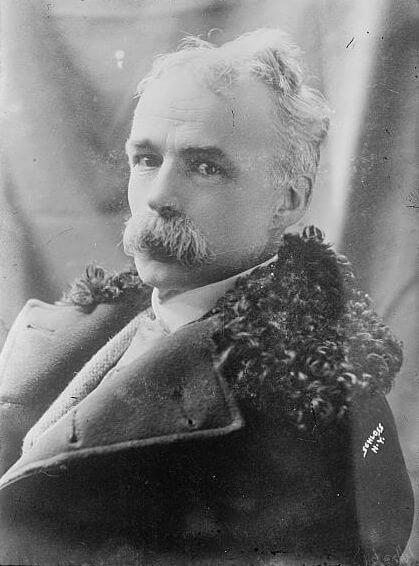
“Ken’s Mystery”/“The Grave of Ethelind Fionguala” by Julian Hawthorne (1883)
Julian Hawthorne’s contribution to vampire literature was originally published in Harper’s New Monthly Magazine in 1883 under the title “Ken’s Mystery.” In 1887, it was republished in Lippincott’s as “The Grave of Ethelind Fionguala.” It has since appeared in modern anthologies under both titles, leading to some confusion: a number of online sources incorrectly identify “Ken’s Mystery” and “The Grave of Ethelind Fionguala” as two distinct works. They are, however, one and the same.
The story begins on October 31 as the narrator goes to visit their artist friend Keningale, who has returned to New York following a trip to Europe – which, according to rumour, was connected to a love affair. The protagonist is concerned, as Keningale shows signs of having been changed by his trip: his cheerful nature has vanished, and he has become moody and withdrawn. What, muses the narrator, brought about this alteration in personality: “Had he committed a murder? or joined the nihilists? or was his unsuccessful love affair at the bottom of it?”
Keningale turns out to be most grateful at having a visitor that night. His European journey included a visit to Ireland, during which he learnt something of the country’s superstitions: “This is November-eve, when, as tradition asserts, the dead arise and walk about, and fairies, goblins, and spiritual beings of all kinds have more freedom and power than on any other day of the year. One can see you’ve never been in Ireland.”
The protagonist’s attention turns to certain objects in the studio: a set of paintings all depicting the same woman and a banjo that he had previously given to Keningale as a present. Bizarrely, the banjo appears to have aged to the extent of resembling a centuries-old antique – even though it had been brand-new when Keningale received it only a year beforehand.
Keningale reveals that the banjo is indeed 200 years old, and by way of explanation, relates his exploits in Ireland. After a long description of the countryside and locals (“They are as superstitious, as credulous of marvels, fairies, magicians, and omens, as the men whom St Patrick preached to, and at the same time they are shrewd, sceptical, sensible, and bottomless liars”), he comes to his arrival at a place near Ballymacheen on the south shore. Here, he entertained the locals with his banjo and made a number of friends. Near the end of his stay, Keningale’s companions threw him a farewell dinner on Halloween. Here, he learnt the local legend of a woman named Ethelind Fionguala being accosted by vampires:
Among the stories that Dr. Dudeen regaled us with was one about the Kern of Querin and his wife, Ethelind Fionguala – which being interpreted signified ‘the white-shouldered.’ The lady, it appears, was originally betrothed to one O’Connor (here the lieutenant smacked his lips), but was stolen away on the wedding night by a party of vampires, who, it would seem, where at that period a prominent feature among the troubles of Ireland. But as they were bearing her along – she being unconscious – to that supper where she was not to eat but to be eaten, the young Kern of Querin, who happened to be out duck-shooting, met the party, and emptied his gun at it. The vampires fled, and the Kern carried the fair lady, still in a state of insensibility, to his house. ‘
The story gives no indication that vampires would be in any way out-of-place in nineteenth-century Ireland. We have here further evidence of how vampires were spreading beyond their original homes of Eastern Europe and the Levant: witness how Robert Southey placed vampires in an Arabian Nights-inspired setting (because the Arabian Nights stories were popular at the time) or how Charles Nodier located them in Scotland (because Sir Walter Scott’s Highland romances were in vogue). Julian Hawthorne appears to have decided that Ireland, whose rich folklore of banshees and dullahans had been documented by the likes of Thomas Crofton Croker and Thomas Keightley, was another natural home for vampires. Given that vampires are now indelibly associated with Halloween, as trick-or-treaters carry out Gaelic folk customs in Dracula costumes, he was perhaps ahead of his time.
As Keningale’s narrative continues, we follow him on his traipse back to the inn, his eerie surroundings making him aware of “the tradition that Halloween is the carnival-time of disembodied spirits.” It is during this journey that he meets Ethelind Fionguala, the character in the legend – twice, in fact.
Ethelind first appears when Keningale passes through the cemetery and happens upon her grave. Here, she manifests as a black-robed woman who gives her name as Elsie. As the two walk together, Keningale gives Elsie a gold ring that he previously purchased in an Irish curiosity shop; in return, she agrees to model for his paintings. However, when they reach a bridge, Elsie vanishes – as per the widespread belief that spirits cannot cross running water.
Keningale’s next encounter with Ethelind comes when he stumbles across the house where, according to the legend, she was taken after being rescued from the vampires. After he plays her a tune on his banjo, Ethelind emerges no longer clad in a black robe, but in rich finery. Where Ethelind’s first manifestation was more akin to a ghost or fairy than to a conventional vampire, the second meeting is heavy with vampiric motifs of red blood and cold kisses:
“’I thought you had forgotten me,’ she said, nodding as if in answer to my thought. ‘The night was so late – our one night of the year! How my heart rejoiced when I heard your dear voice singing the song I know so well! Kiss me – my lips are cold!’
“Cold indeed they were – cold as the lips of death. But the warmth of my own seemed to revive them. They were now tinged with a faint color, and in her cheeks also appeared a delicate shade of pink. She drew fuller breath, as one who recovers from a long lethargy. Was it my life that was feeding her? I was ready to give her all. She drew me to the table and pointed to the viands and the wine.
“‘Eat and drink,’ she said. ‘You have traveled far, and you need food.’
“‘Will you eat and drink with me?’ said I, pouring out the wine.
“‘You are the only nourishment I want,’ was her answer. ‘This wine is thin and cold. Give me wine as red as your blood and as warm, and I will drain a goblet to the dregs.’”
The scene is dominated by a curious mix of coldness and colour: while the room is adorned with lavish tapestries and candles, and the table spread with a luxurious feast, there is no fire to keep away the chill. Ethelind, likewise, is cold, even as she gushes with love for Keningale. Dracula and its various adaptations would establish that a vampire’s dwelling place should be as gloomy and unnerving as its occupant; this story, however, appears to be drawing more upon the realm of fairies. Ethelind resides in a place that is beautiful and tempting, yet with something off about it.
Even in its choice of terminology, the story can be seen dancing back and forth as to whether Ethelind is a vampire or a fairy. Keningale, wondering exactly what happened to her after the ambiguous conclusion to the story he was told, remembers “that the victims of vampires generally became vampires themselves.” Elsewhere, though, the second-hand ring that he gave to Ethelind is specifically described as “the ring of the Kern – the fairy ring.”
The story’s ending owes more to fairy lore than to the vampire genre. Rather than being drained of blood, Keningale falls unconscious in Ethelind’s house; when he recovers, he finds the sumptuous decorations replaced with cobwebs, rotten drapes, and boarded-up windows – and, as established in the framing device, even his new banjo has withered into an age-old relic.
Here, we see the common notion that time runs at a different pace in the land of fairies: see also the Irish legend of Niamh, the English tale of Herla, or (as an example of just how widespread the motif is) the Japanese story of Urashima Tarō. Notably, many such stories concern male characters being tempted by fairy-maidens, just as Keningale is tempted by Ethelind.
A frequent complaint made by devotees of blood-and-thunder Gothic horror is that the vampires of post-Anne Rice urban fantasy are insufficiently monstrous and seem more like elves than vampires. However, as Julian Hawthorne’s story makes clear, the boundary between those two concepts has been porous for some time.
“A Kiss of Judas” by Julian Osgood Field (1893)
“A Kiss of Judas” debuted in the July 1893 edition of the Pall Mall Magazine, a British publication. Its author was Julian Osgood Field (also known under his pen-name “X. L.”), a New Yorker by birth despite also spending time in Europe. Whether we count it as an example of New World or Old World vampire literature, “A Kiss of Judas” is both an intriguing and aggravating addition to the genre.
The story begins with a lengthy description of world-traveller Lieutenant-Colonel Richard Ulick Verner “Hippy” Rowan who receives an invitation to visit a friend of his, the Turkish millionaire Djavil Pacha. While journeying to his destination by ship, Rowan meets a fellow-passenger: a young and wealthy Moldavian named Isaac Lebedenko who keeps his face hidden beneath a muffler and stares strangely at those around him. “I’m glad I’m not condemned to remain long in his society;” says Rowan, “for he certainly has the most unpleasant look in his eyes that I’ve seen since we left the lepers.”
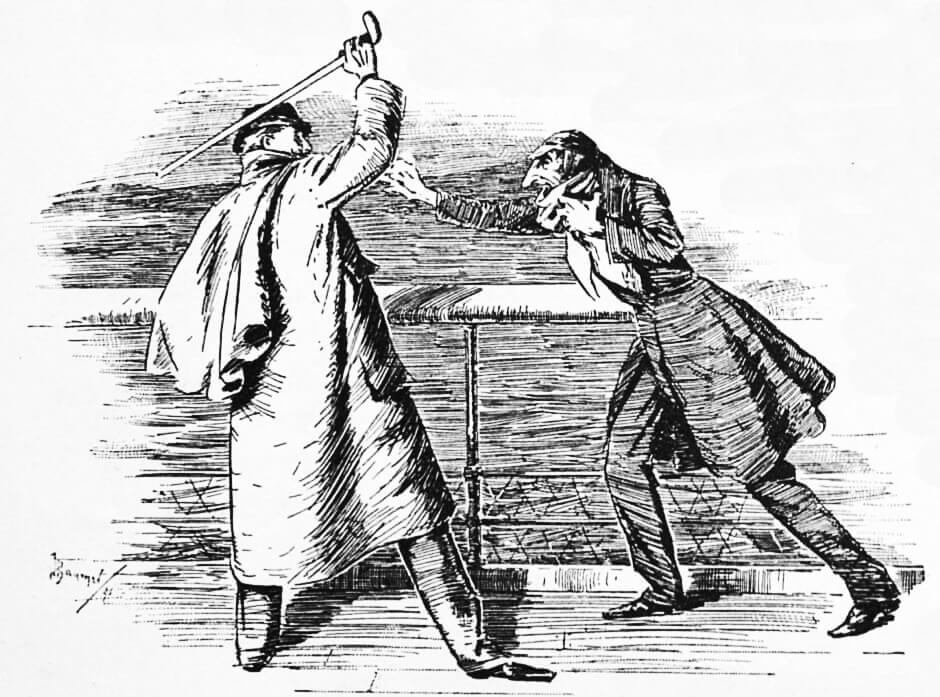
Isaac overhears this remark and picks a fight with Rowan, that “Dog of an Englishman.” During the altercation, his muffler slips to reveal his features – which turn out to include “the pointed nose as of a large ferret” and “the humid, viscous horror of a small mouth almost round, but lipless, from which came in hurried, husky sibilance the lisping words of hate and menace.” The argument ends with Rowan knocking the man to the deck and handing him to the ship’s crew.
Rowan then arrives in Constantinople where he meets not only Djavil Pacha, but also various other specimens of high society presently staying with the millionaire. The band later goes travelling out into a remote area of countryside; during this trip, their conversation turns to the supernatural and then to folklore regarding a secret sect called the Children of Judas:
“It’s a Moldavian legend,” replied the great specialist. “They say that Children of Judas, lineal descendants of the arch traitor, are prowling about the world seeking to do harm, and that they kill you with a kiss.”
“Oh! how delightful!” murmured the Dowager Duchess, glancing at Alec Torquati as if inviting, and indeed expecting, just such homicidal osculatory tribute from the lips of the young Derby winner.
But how, exactly, do they gain access to the victims chosen for the kiss of death? The answer involves a form of shapeshifting via reincarnation:
“The legend is,” said Maryx, “that in the first instance they are here in every kind of shape – men and women, young and old, but generally of extraordinary and surpassing ugliness, but are here merely to fill their hearts with envy, venom, and hatred, and to mark their prey. In order to really do harm, they have to sacrifice themselves to their hatred, go back to the infernal regions whence they came – but go back by the gate of suicide – report to the Chief of the Three Princes of Evil, get their diabolical commission from him, and then return to this world and do the deed.”
We learn that, once reincarnated, the Children of Judas come in a variety of forms, from rabid dogs to affectionate lovers:
“They can come back in any form they think the best adapted to attain their object, or rather satisfy their hate: sometimes they come as a mad dog who bites you and gives you hydrophobia – that’s one form of the kiss of Judas; sometimes as the breath of pestilence, cholera, or what not-that’s another form of the kiss of Judas; sometimes in an attractive shape, and then the kiss is really as one of affection, though as fatal in its effect as the mad dog’s bite or the pestilence.”
The narrative then shifts from folklore to personal anecdote, confirming that the Children of Judas are still leaving their mark in the present day:
“Last summer, when I was at Sinaia in attendance on the Queen, I saw the body of a peasant girl whose lover had given her the kiss of Judas, and there certainly was on her neck a mark like this:” and Maryx took up his fork and scratched on the tablecloth three X’s, – thus, XXX. “Can you guess what that’s supposed to signify?” inquired the great physician.
“It looks like a hurdle,” remarked Torquati.
“Thirty,” exclaimed Lady Brentford.
“Of course,” replied Maryx, “thirty – the thirty pieces of silver, of course – the mark of the price of blood.”
Listening to these tales, Rowan is inevitably reminded of Isaac Lebedenko – and that very man suddenly lunges out from behind a tree and attacks him with a knife, having evidently followed him over the entire course of the journey. Rowan succeeds in overpowering Isaac again, and this time metes out a gruesome punishment: he nails Isaac’s hands to a fallen tree, using the attacker’s own knife, and leaves him to whatever fate awaits. (“He might starve to death there, or escape by a terrible mutilation.”)
Back at Djavil Pacha’s home, while the others are in bed, Rowan heads out alone onto the terrace. There, he is confronted again by Isaac, who has somehow escaped. After removing his muffler and “disclosing with hideous distinctness in the moonlight the indescribable horror of the countenance of a monster not born of woman,” Isaac stabs himself in the heart and tumbles into the waters of the Bosphorous. He has committed suicide; which means that, if he is truly a Child of Judas, he shall return in a new shape.
Rowan subsequently tells his companions about the ordeal and states that he was never afraid of Isaac – indeed, as he claims, he has never felt fear in his life. This boast introduces a subplot concerning a Moldavian prince who bets a sizable sum of money that he is capable of frightening Rowan before the latter leaves.
As his stay lasts for several more days, Rowan finds himself in a state of tension as he awaits whatever prank the prince and his friends have planned. Then, one night, he hears weeping outside his bedroom door. He goes to investigate and finds a beautiful woman, pale-skinned, black-clad, violet-eyed, and silent as she embraces him.
The remainder of the story is told from the perspective of the other characters who hear Rowan yelling out in terror. The Moldavian pranksters, “creeping up the staircase, dressed in absurd costumes and armed with monster squirts and all kinds of grotesque implements,” are interrupted before they ever play their trick on him. Adams, his valet, sees him fire his gun at the woman who departs with no sign of harm. Rowan then drops dead, and on his neck are found three small wounds, each shaped like an X.
“A Kiss of Judas” brings to mind the uncomfortable manner in which vampire folklore overlaps with the folklore of antisemitism. If we look at anti-Jewish texts of the Middle Ages, we find such motifs as blood-drinking, the spreading of disease, hatred of Christian symbols, and even immortality, forcing us to consider a chicken-and-egg question: did these antisemitic legends draw upon vampire folklore, or did vampire folklore draw upon antisemitism?
Given the widespread nature of the vampire motif, which has counterparts even in societies that lack Europe’s history of antisemitism, the former seems more likely. In “A Kiss of Judas,” however, we see clear antisemitism bleeding straight back into vampire literature.
Julian Osgood Field ties his secret society of quasi-vampires to Judas Iscariot, a figure who, well into the present century, has been the basis of antisemitic caricature; and in case the implications of Isaac’s ferret-like nose are not clear enough in the text, then we are given an accompanying illustration of a hook-nosed character who would not look out of place in a Nazi propaganda publication. Note that, even when Isaac is reincarnated as a beautiful woman, she is repeatedly compared to the Madonna: another Jewish figure. This subtext is particularly regrettable given that, in many respects, “A Kiss of Judas” marks a genuinely novel spin on the vampire theme. Julian Osgood Field offers an unusual concept for how vampires work, sketches out a subculture for his supernatural evildoers and even gives us what may well be literature’s first transgender vampire.
“Will” by Vincent O’Sullivan (1898)
Here we have another story with an international background. Its author, Vincent O’Sullivan, was a New Yorker by birth, but would migrate to England in time for the height of the decadent 1890s. As documented by Kostas Boyiopoulos’s essay on O’Sullivan’s connections with the decadent movement, his story “Will” was first published in France, appearing in a 1898 edition of the Mercure de France under the title “Le Scarabée Funèbre” (“The Funeral Beetle”). Its English debut came the following year in O’Sullivan’s collection The Green Window, published by Leonard Smithers – a publisher who specialised in the disreputable, also working with the likes of Aleister Crowley and the post-conviction Oscar Wilde.
“Will” is a brief story and lays out its central themes right in the first paragraph:
Have the dead still power after they are laid in the earth? Do they rule us, by the power of the dead, from their awful thrones? Do their closed eyes become menacing beacons, and their paralyzed hands reach out to scourge our feet into the paths which they have marked out? Ah, surely when the dead are given to the dust, their power crumbles into the dust!
The tale concerns an unnamed couple who spend their time together in the park. The husband has developed a silent hatred of his wife, a woman described as being “tall, and pale, and fragile, with her raven hair sweeping about her neck,” her beauty captivating to those around her. He hates her so much, indeed, that he decides to poison her – not with a poison of chemicals, but of the spirit:
He was drawing out her life as he gazed at her; draining her veins, grudging the beats of her heart. He felt no need of the slow poisons which wither the flesh, of the dread poisons which set fire to the brain; for his hate was a poison which he poured over her white body, till it would no longer have the strength to hold back the escaping soul.
Sure enough, the woman begins to wither away. Before she passes, she condemns her husband for his crime and announces that her soul shall linger to haunt him as per a contract she has made with the Cardinals of Death. And, sure enough, she returns.
“Will” is a richly poetic story, almost every line oozing with dark atmosphere, following the examples of Charles Baudelaire and Thomas Browne (both of whom are namechecked in the narrative). The park in which the couple dwell is not just any park, but the Park of the Somber Fountains. The location of the wife’s grave is near a ruined abbey – because where else could she be interred in a Gothic story of this sort? The early scene of the couple in the park segues from descriptions of lavender aromas and silver dreams to more horrific imagery: “At sunset the river became for him turbulent and boding – a pool of blood; and the trees, clad in scarlet, brandished flaming swords.” After killing his wife, the husband travels the world to witness warfare and strife; this part of his life is covered in a short summary that soon blurs into his nightmares:
And here he spent dreaming days and sleepless nights — nights painted with monstrous and tumultuous pictures, and moved by waking dreams. Phantoms haggard and ghastly swept before him; ruined cities covered with a cold light edified themselves in his room; while in his ears resounded the trample of retreating and advancing armies, the clangor of squadrons, and noise of breaking war. He was haunted by women who prayed him to have mercy, stretching out beseeching hands — always women — and sometimes they were dead.
When the wife returns from the grave it is in the form of a red-eyed beetle, “enormous and unreal,” O’Sullivan ignoring the association between vampires and bats that had been established by Bram Stoker two years beforehand. The man develops an obsession, his mind fixating on the beetle – particularly its fangs – and goes to his wife’s tomb with offerings of treasure, in the hopes of quelling her restless spirit. Here, O’Sullivan is writing in the mode of Edgar Allan Poe, blurring the line between supernatural vengeance and the destructive psychological effects of guilt.
However, “Will” ends up leaning further into the unambiguous supernatural than Poe’s stories of murder and guilt. The man dies, and the story concludes with him being reunited with his wife, who gloats at having at last taken him to the underworld:
“Long have I awaited you,” said the woman’s voice. “For years I have lain here while the rain soaked through the stones, and snow was heavy on my breast. For years while the sun danced over the earth, and the moon smiled her mellow smile upon gardens and pleasant things. I have lain here in the company of the worm, and I have leagued with the worm. You did nothing but what I willed; you were the toy of my dead hands. Ah, you stole my body from me, but I have stolen your soul from you!”
“And is there peace for me — now — at the last?”
The woman’s voice became louder, and rang through the vault like a proclaiming trumpet. “Peace is not mine! You and I are at last together in the city of one who queens it over a mighty empire. Now shall we tremble before the queen of Death.”
Here, the notion of an underworld ruled by a “queen of Death” is a poetic one; even so, it is hard to miss the prefiguration of Anne Rice’s novels featuring the Queen of the Damned, which took readers on a rather more literal-minded tour of a vampire-riddled underworld.
“Luella Miller” by Mary E. Wilkins Freeman (1902)
Our journey through the vampire literature of nineteenth-century America is nearly at a close. It seems appropriate to finish by stepping into the dawn of the twentieth century for a glimpse of the forms that vampire fiction would take in the new era.
“Laura Miller,” by Mary E. Wilkins Freeman, was published in the December 1902 edition of Everybody’s Magazine. The story begins with a framing scene in which the omniscient narrator describes a village that was once home to Luella Miller, a woman whose reputation was so grim that, even long after her death, her abandoned house is shunned by the locals. The cause of her death, which occurred despite her being “hale and hearty” for her advanced years, is the subject of dark rumours of supernatural forces. Having set the scene, the story switches to a narrative told by one Lydia Anderson, the only villager to have known Luella Miller in person.
This begins with Luella as a young woman of elfin beauty who marries a man named Erastus Miller and finds work as a teacher. All around her, people begin to waste away and die: first her assistant teacher Lottie Henderson, then her husband Erastus, and then her sister-in-law Lily Miller who moves in following the bereavement. Throughout all of this, Luella lives a life of luxury, allowing the others to do her work for her even as they wither and perish:
Luella used to just sit and cry and do nothin’. She did act real fond of Lily, and she pined away considerable, too. There was those that thought she’d go into a decline herself. But after Lily died, her Aunt Abby Mixter came, and then Luella picked up and grew as fat and rosy as ever. But poor Aunt Abby begun to droop just the way Lily had […] She just tended out on Luella as if she had been a baby, and when her married daughter sent for her she wouldn’t stir one inch.
Through its folksy, down-to-earth narration, the story builds a convincing portrayal of a close-knit rural community, the members of which are dropping one by one. In the middle of this is the character portrait of Luella Miller herself, who comes across less as a conscious predator in the Dracula mould, and more as a witless bearer of unearned and unchecked privilege:
‘I never made the coffee in all my life,’ says she, dreadful astonished. ‘Erastus always made the coffee as long as he lived, and then Lily she made it, and then Aunt Abby made it. I don’t believe I CAN make the coffee, Miss Anderson.’
As for Lydia Anderson, she comes to feel an intense hatred for “that little pink-and-white thing standin’ there and talkin’ about coffee, when she had killed so many better folks than she was.” When the time comes for the locals to gather around the ailing Aunt Abby, the scene is similar to the sequence in Dracula where the characters gather around the ailing Lucy Westenra; yet, rather than Stoker’s melodrama, the mood is characterised by an indignant sourness, as when we read of Luella’s absence: “She’s too nervous to see folks die. She’s afraid it will make her sick.”
Lydia appears to be the only person in the village to understand Luella’s true nature. Others feel pity for the lonely widow and try to help her out, only to fall under her depleting influence. As her supply of servants dries up, however, Luella herself begins to waste away and eventually perishes.
Although the word “vampire” is never used in the story, it is clear that Luella Miller belongs to the ranks of psychic vampires, who feed on something less tangible than blood.
This motif was well-established in literature by the time E. Wilkins Freeman’s story was published, much of its appeal stemming from the concept allowing a more flexible metaphor than the literal blood-drinking practiced by Dracula and the rest. For example, Charles Wilkins Webber’s 1853 novel Yieger’s Cabinet: Spiritual Vampirism put the theme to deeply reactionary use by characterising various progressive causes, up to and including opposition to slavery, as forms of spiritual vampirism.
“Luella Miller,” despite dealing with a similar central theme, has a very different social subtext. Sarah Jackson of Bad Reputation has described it as a “Marxist Feminist vampire story,” citing Chiho Nakagawa and Lynda L. Hinkle’s interpretations of the text in terms of gender (Luella’s enforced helplessness, despite her physical strength, being a patriarchal ideal of womanhood) and class (Luella, an unproductive member of the elite, literally draining away the workforce that upholds her).
Meanwhile, the precise mechanics of Luella’s vampirism are left to the reader’s imagination. Luella herself is portrayed as being unaware of her lethal effect on those around her (Lydia compares her to “a baby with scissors in its hand cuttin’ everybody without knowing what it was doin’”) and at no point does a Van Helsing character turn up to explain it all.
There is even room to debate whether the vampirism is supernatural or psychological, although the story does climax with a memorable scene of ghostliness when Lydia describes seeing the deceased Luella enter the afterlife:
“I saw what I saw, and I know I saw it, and I will swear on my death bed that I saw it. I saw Luella Miller and Erastus Miller, and Lily, and Aunt Abby, and Maria, and the Doctor, and Sarah, all goin’ out of her door, and all but Luella shone white in the moonlight, and they were all helpin’ her along till she seemed to fairly fly in the midst of them. Then it all disappeared. I stood a minute with my heart poundin’, then I went over there. I thought of goin’ for Mrs. Babbit, but I thought she’d be afraid. So I went alone, though I knew what had happened. Luella was layin’ real peaceful, dead on her bed.”
The Great American Vampire?
Across the above stories, we meet a vampire of Irish fairy lore; a transgender vampire; a vampire of Gothic poetry; and even a vampire born of capitalist patriarchy. This is a diverse line-up indeed, and although none of these stories are as well-remembered today as Dracula or Carmilla, they show just what fertile soil was offered by nineteenth-century American vampire literature. These are the ancestors to Lestat, Louis, and all of the other, better-known characters of present-day vampire literature; and anybody tuning in to watch the latest season of Interview with the Vampire may do well to dig into the genre’s history.
