

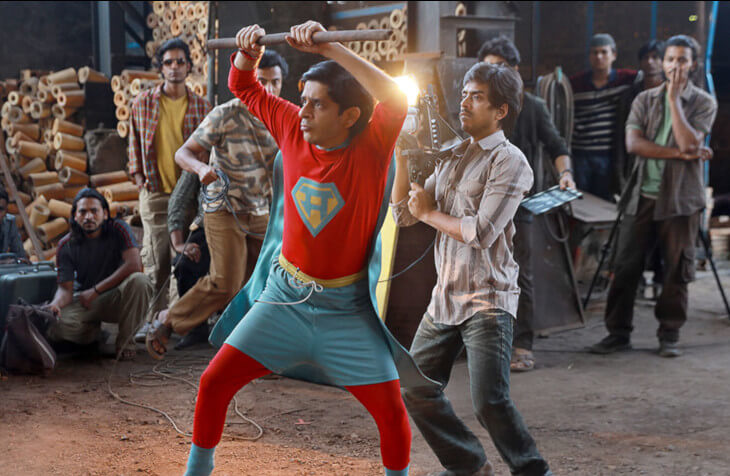
In the small town of Malegaon, dreams never come true. Superboys of Malegaon shares the true story of a group of friends in 1997 determined to bring the magic of films to their fellow townsfolk. But can they check their egos long enough to realise their cinematic dreams?
Superboys of Malegaon
Reema Kagti (director and writer), Varun Grover (writer), Swapnil S. Sonawane (cinematography), Anand Subaya (editor)
Adarsh Gourav, Anuj Singh Duhan, Vineet Kumar Singh (cast)
September 13, 2024 (TIFF)
Shaikh Nasir (Adarsh Gourav) loves films. He’s got a fondness for the classics: Buster Keaton, Charlie Chaplin, Bruce Lee. But the video parlour he runs with his brother in the small town of Malegaon in Maharashtra, India, isn’t exactly the place to show Buster Keaton films. The people want action, comedy, excitement. Nasir tries using his editing skills to splice action movies together which draws in the crowds. But when the parlour is raided for video piracy, the brothers find themselves in even more dire straits. It’s time to get creative. With a script by failed writer Faroqh (Vineet Kumar Singh), Nasir assembles a dream team of friends to make their very own Malegaon film, a parody of Ramesh Sippy’s 1975 blockbuster Sholay. Making the film will change the bonds of friendship between them forever and send them on unexpected trajectories in life.
I had been hearing a lot of buzz around Superboys of Malegaon before the film’s world premiere at the 2024 Toronto International Film Festival (TIFF). I attended a press screening of the film, fully expecting to fight my way to a seat. Shockingly, there were barely any press at the screening. I can only hope that the public screenings will be packed because I thoroughly enjoyed this film.
Superboys of Malegaon has all the elements of a feel-good film but with undertones of how the capitalist boot crushes the little guy. It’s a multi-layered film that is equally about maintaining friendships and the trials and joys of creation, as well as the importance of representation in cinema.
The friendships between the characters are the backbone of this film. The friends have a shared dream that Nasir makes reality. But they also irk each other when they don’t meet each others’ expectations. The chemistry between the actors makes these friendships believable—there’s an organic quality to the dialogue and the way the actors riff off each other that makes the audience feel like they’re in the room with them.
That chemistry also helps underscore the inequities in their relationships once the Sholay parody finds success. Ego can be a hell of a drug, and it isn’t long before it destroys even the oldest of friendships. To say I’m impressed that Superboys of Malegaon didn’t devolve into melodrama when the friends were fighting is putting it mildly. I continue to be astounded at how far Indian cinema has come in the years since I left the country.
But there’s another level where Superboys of Malegaon excelled—portraying the creative writing process and how the film industry chews up writers and spits them out. I’m currently doing a scriptwriting course, and one of the more disappointing things I’ve learned is that by the time a script has gone through the production process, often very little of the writer’s original vision remains. At one point, Faroqh says that the final film they’ve made is Nasir’s story much more than it is his because part of his story disappeared due to financial difficulties, and a large part remained solely in his heart. I tell you, I felt that in my soul.
Money is the one thing keeping creatives from achieving their dreams, and that’s more true for certain communities than others.
On the flip side, Nasir makes an impassioned plea about the difficult choices he had to make because of financing issues. Superboys of Malegaon spends a little time, but not much, on how and when to compromise on ethics to get a creative project off the ground. Money is the one thing keeping creatives from achieving their dreams, and that’s more true for certain communities than others. While the film understands Faroqh’s despair at losing his story, it’s not without reason that Nasir compromises ethics for funding.
Yet another layer of Superboys of Malegaon that I was surprised to see was regarding representation. So many communities simply never get to see themselves in entertainment. There’s a really powerful scene where Faroqh is explaining to a director how people from Malegaon want to see their stories on screen. But the director keeps insisting what they actually want to see is entertainment–then follows it up by saying nobody even cares about a place like Malegaon. All the while that I lived in India, we kept hearing about how stories had to be grandiose and escapist because that’s what the ‘people’ wanted. Nobody ever stopped to ask the people what they actually wanted to see. Now that I’ve come to the other side of the world, I see now that this is a relevant conversation on an international scale.
For a film directed by a woman (Reema Kagti) and produced by arguably one of the most popular filmmakers in India (Zoya Akhtar), women don’t have a huge role in the film. But they aren’t entirely absent. Nasir has a long romance with Mallika (Riddhi Kumar), but their relationship comes to an unceremonious end when her parents refuse Nasir’s offer of marriage. In a chilling moment, Mallika’s father asks Nasir to turn to page three of the newspaper which lists the 700 students who have graduated–Mallika is 28th. While Mallika’s father uses her achievement as a reason for rejecting the budding filmmaker as a suitable match, Mallika’s only option in life continues to be marriage, just not to the person she wants to marry. Her academic success is seen as a boon for her chances in the marriage market, not for her future professional successes. This kind of scene used to be a mainstay in many Indian households and might still be. I shuddered watching it in Superboys of Malegaon.
On the other hand, Nasir’s eventual wife Shabeena (Muskkaan Jaferi) builds a life for herself while waiting patiently to marry Nasir, her first love. But she doesn’t accept marriage as the goal of her life; she insists on pursuing a law degree. This warmed my heart–love watching women strive for success.
While most of this film is undoubtedly hopeful and feel-good, the end brings the audience crashing down to reality. Among Nasir’s friends, Shafique (Shashank Arora) is the most loyal. Despite being treated like the general dog’s body and never getting the limelight, Shafique believes so thoroughly in Nasir’s vision, that he’s willing to do anything to make these films. Shafique also begins an illicit romance with their leading lady Trupti (Manjiri Pupala), a married woman, who sneaks out of her abusive husband’s home to realise her acting dreams. Just as Nasir is reconciling himself to a life without film, Shafique is given a terminal diagnosis. It’s up to Nasir to bring the dream team back together again for one last film celebrating Shafique.
The third act of Superboys of Malegaon is slightly more dramatic than the first two acts. But the film still manages to bring a ton of humour to give Shafique the proper send-off he deserves. Arora’s performance is probably my favourite in the film–he’s the beating heart of this story and had me absolutely bawling at the end. Admittedly, I’m partial to Singh’s performance since he was playing the writer. Faroqh was the character I related to most and Singh gave such an impassioned portrayal of a despondent writer failing to make a mark in the world that I couldn’t help but be captivated by him. However, Gourav truly is a star, not just in Superboys of Malegaon, but beyond. He was layered and believable in The White Tiger, and his performance here is on par. Gourav brings a lived-in feel to his characters that makes his performances feel natural, not like he’s acting at all. He effortlessly captures the hopefulness and joy of movie-making while simultaneously demonstrating just how easy it is to let success go to one’s head. He’s riveting to watch.
Before I wrap up, I should note that I’m not 100% sold on the English subtitles. My Hindi has been getting poorer, and the Maharashtran dialect was hard for me to follow, but I still understood some parts. Metaphors were wholesale ignored in the subtitles and some words were translated incorrectly. I’ve been hearing about streaming services using AI to do subtitles, but I really hope that’s not the case here.
I had high expectations of Superboys of Malegaon and yet this film far exceeded them. The film was beautiful to look at, full of hope and a love for cinema, but was equally emotional and heart-rending. But what I loved the most about this film was just how strong a case it made for the power of human connection. Because that’s where the real magic lies.
