


In my quest to read all of Diana Wynne Jones’s books in one year, for the first month I read Witch’s Business, The Ogre Downstairs, and Eight Days of Luke!
These are three fun standalone books aimed at ages 8-12. Of them, my favorite is probably Witch’s Business for the way it shows children working together.
Note: Some minor spoilers ahead, of the “children’s books have happy endings” variety!

Witch’s Business (1973)
While Diana Wynne Jones’s official first novel was actually Changeover (1970), an extremely out-of-print political farce for grownups, Witch’s Business is her first that started establishing what she’d become known for: well-written fantasy novels with compassionate portrayals of kids and some really dysfunctional adults.
In Witch’s Business, Frank and Jess’s pocket money has been stopped because they accidentally broke something, so they go into business advertising that they’ll get people their “own back;” basically offering a revenge-for-hire service. This does not go well for them, as they are soon embroiled in a complicated interplay of grudges among the children of their town. They navigate the landscape like a British kids’ version of hardboiled detectives, ranging from their own area of town, where people have allotments, to row houses, to both “the big house” and the children of the people who work there.
I really love Frank and Jess, and their practical, well-meaning interactions with the other kids in this book. I also like that there’s a lot of socioeconomic range, and it is explicit that not all these children are white.
Prominent in the interplay of grudges is Biddy Iremonger, the witch of the book’s title. She straddles the child world and the adult world, maliciously affecting both. Frank and Jess ultimately succeed in getting the kids’ “own back” from Biddy, after a creepy magical showdown. The ending is satisfying and tidy.
This read came with delightful surprises, as I discussed it with various book groups. I learned that my book reviewing pal Doreen Sheridan is writing about some of Diana Wynne Jones’s books we are reading together, and I also learned that Marnanel Thurman will be making these weekly custom images for each book of the readthrough! They are full of references to the content of each book.
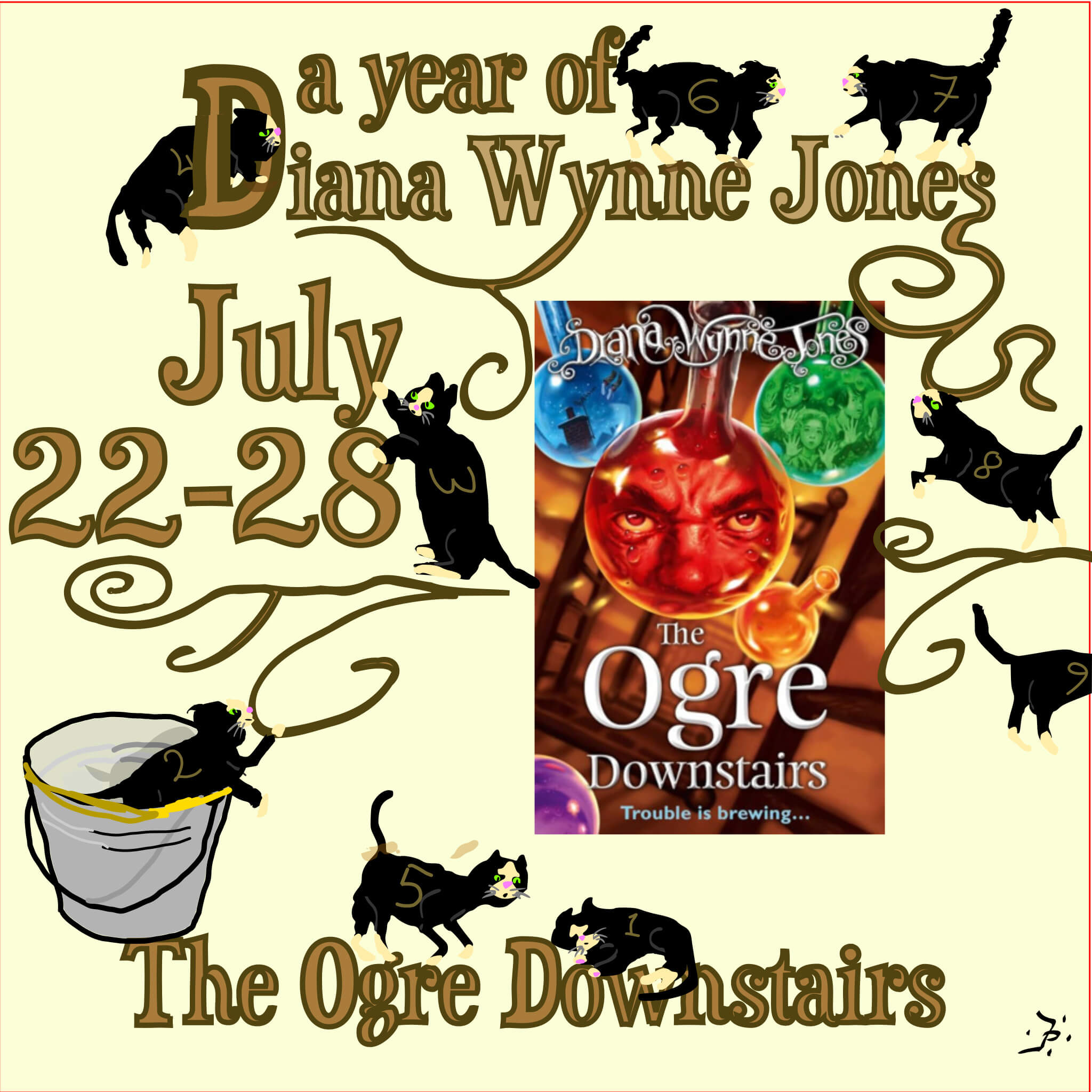
The Ogre Downstairs (1974)
Even though it was published a year later, The Ogre Downstairs feels more dated than Witch’s Business does. The three main character siblings are chafing at the confines of a new blended family, since their widowed mother Sally has just married a man (the Ogre of the title) with two sons of his own. The new stepfather is often verbally mean to his own kids, as well as the new stepkids, and physically violent more than once. One of the things that feels dated to me about this book (in addition to the gendered quality of all the housework) is that (spoiler) by the end of the book the Ogre is shown to be misunderstood and a good guy after all. Not because he was enchanted, or has some kind of revelatory experience when he “turns nice,” but simply because they all needed to work harder to understand each other.
I don’t write fanfic, but the ending of this book calls out for a fix-it fic in which Sally takes all five kids and goes. Maybe she can teach any of the four boys how to do some cooking and laundry, too.
That said, the magical premise of this book is a fun one. Early in the book the Ogre buys chemistry sets for the kids, which turn out to have a lower tray full of vials of chemicals with magical properties. In a structure that reminds me of Edward Eager books, the kids explore (and are generally thwarted by) each new magical substance one at a time. One makes them fly, one brings inanimate things to life, etc. In the process, they all learn Valuable Lessons about Being a Family.
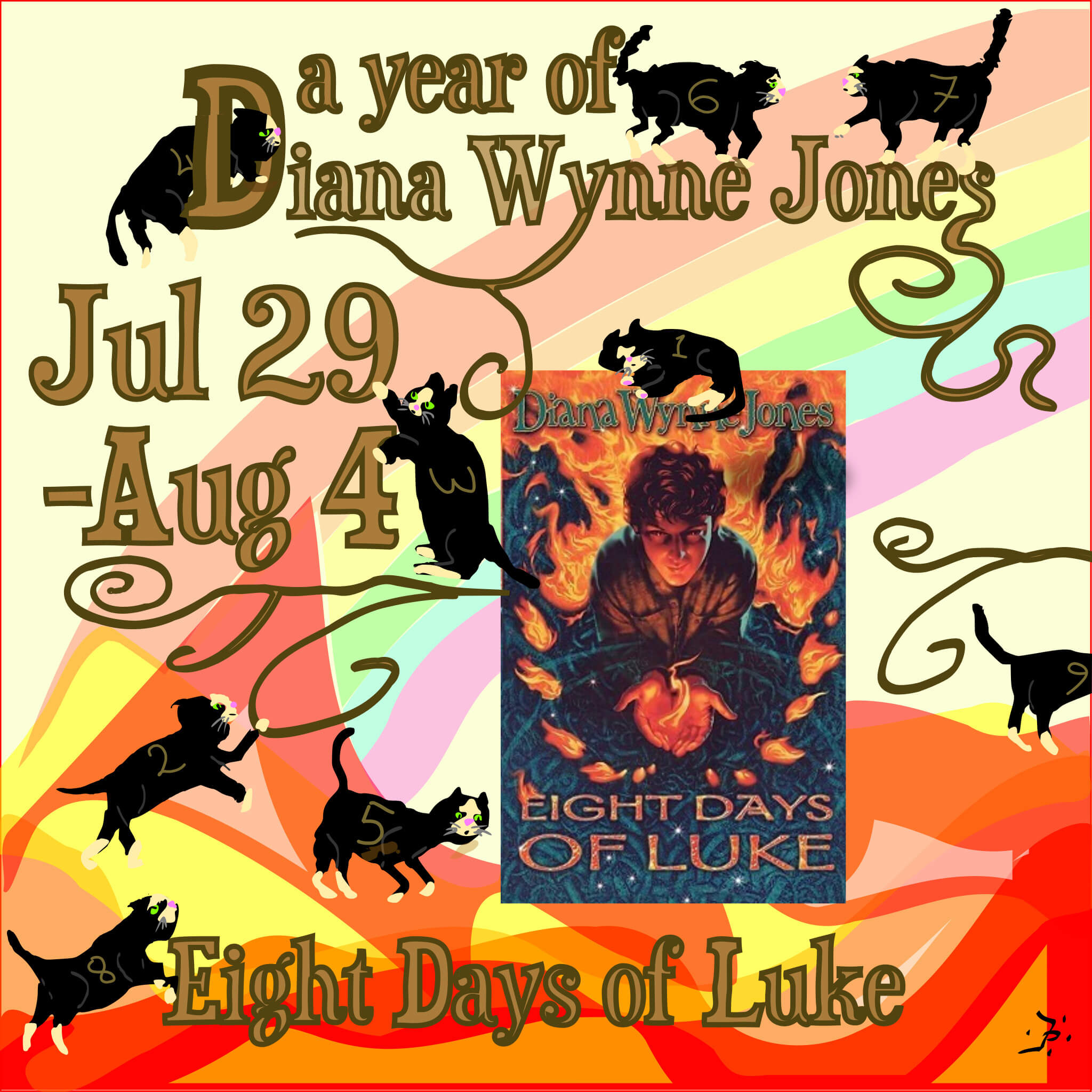
Eight Days of Luke (1975)
And then with Eight Days of Luke, I think Diana Wynne Jones is really in her stride: a kid with a terrible family of origin is plunged into a scenario where knowledge of folklore is rewarded and while that kid may find allies, they will certainly have their own agendas as well. This describes many of her most successful books.
In Eight Days of Luke, David arrives home from boarding school to his mean family, only to discover that they had forgotten when his term ended and are even more put out to see him than usual. Feeling dejected, he accidentally summons a buddy: Luke, who has been magically imprisoned for something he didn’t do. David’s terrible relatives overlap with Luke’s own problematic family as they try to recapture him, and Luke’s mythological status becomes more clear.
The terrible relatives remind me of the wicked adults in a Roald Dahl novel, but David, with his imperfections and deep interest in cricket, is a more believable kid than Charlie or Matilda.
One thing I particularly like about Eight Days of Luke is that while a knowledge of mythology is rewarded, there is no big “gotcha” reveal, nor is there an utter lack of explanation leaving a crux for the uniformed reader to flounder in. Rather, the book is enjoyable whether or not a reader immediately “gets” who Luke is. This is a good first Diana Wynne Jones book for people interested in what her writing is like!
If you’d like to read along with me, my schedule is here! Dogsbody, Cart and Cwidder, and The Power of Three are up next.
Custom images for this series are by Marnanel Thurman.
