

By Solène Mallet Gauthier and Stephanie Halmhofer
This text contains spoilers
This is Part Two of a series! Read Part One here.
Spriggan made a comeback in 2022 with the release of a deluxe edition of the complete original 1989-1996 manga series (Seven Seas Entertainment) and a 6-episode Netflix animated series. In both the original manga and recent Netflix adaptation, Spriggan follows the adventures of the special secret agent Yu Ominae, a teenager charged with protecting — or destroying — powerful artifacts associated with a mysterious ancient civilization from political and military forces looking to use these objects for their own interests. In Part Two of this three-part series, we explore how Spriggan presents politics and conspiracy theories through pseudoarchaeology!
Ancient Nuclear Wars
The concept of ancient nuclear wars is explored in Spriggan’s “Berserker” chapters and episodes. Here, a strange object found by a team of archaeologists, who firmly believe it will revolutionize their field, is seized by the British military. After conducting experiments, they inadvertently “awaken” the ancient machine, which immediately starts destroying everything around it using immense amounts of energy. We then learn that ARCAM had previously faced a similar machine and named it “Berserker” due to the high number of ARCAM operatives it had killed.
In Spriggan, the “Berserker” is said to be a war machine used during the Hindu mythological wars described in the Mahābhārata and the Rāmāyana. From India, at over 2000 years old, the Mahābhārata and the Rāmāyana are two of the oldest surviving poems ever written and are two of the most important epics of Hinduism. The Mahābhārata and the Rāmāyana include narratives about historical events that are intertwined with important philosophical teachings, mythology, magic, and cosmogony. And according to pseudoarchaeology enthusiasts, the descriptions of the after-effects of the weapons found in these Hindu texts are evidence for ancient nuclear wars, which are also interpreted as having left traces on archaeological sites.
According to pseudoarchaeology enthusiasts, the descriptions of the after-effects of the weapons found in these Hindu texts are evidence for ancient nuclear wars, which are also interpreted as having left traces on archaeological sites.
Descriptions of wars and weapons imbued with divine powers are featured in the narratives of the Mahābhārata and the Rāmāyana, however, their appropriation by ancient alien theorists as evidence of ancient nuclear or atomic weapons didn’t begin until the mid-1950s, several years after the invention of the atomic bomb and the first American reports of UFO sightings and alien abductions. Famously, J. Robert Oppenheimer, director of the creation of the atomic bomb, referred to the Mahābhārata in his recollection of the moment the first bomb was tested. And descriptions in the Mahābhārata of flying chariots called vimānas were reinterpreted as UFOs, and descriptions of the weapons, which were large projectiles, deployed from the vimānas and the resulting large pillars of smoke and fire, scorching heat were reinterpreted as referencing atomic explosions.
Authors Desmond Leslie and George Adamski made the first connection between vimānas and UFOs in 1953, while popular books in the 1960s by Louis Pauwels and Jacques Bergier (1960), Robert Charroux (1963), and Erich von Daniken (1968) popularized both the vimānas/UFO connection and claims that the Mahābhārata and in the Rāmāyana included descriptions of ancient extraterrestrial atomic bombs that had destroyed cities in India. The biblical story of Sodom and Gomorrah became the first popular target for reinterpretation through an ancient alien atomic bomb lens, which was also briefly explored in the first chapter and episode of Spriggan.
Moving out of biblical stories and into identified archaeological sites, the second popular target for claims of ancient nuclear wars are two sites in Pakistan. Inspired largely by a book written by David W. Davenport and Ettore Vincenti in 1979, the sites of Harappa and Mohenjo Daro are said by believers in ancient nuclear wars to have been destroyed by ancient atomic bombs. The book proclaimed to be sharing the results of the authors’ scientific studies and claimed that radioactive skeletons had been uncovered and that there were shards of melted glass that could only have resulted from the heat of a nuclear impact. Archaeologists have pointed out that the actual archaeological evidence from the sites (e.g., the fact that there are no radioactive skeletons) does not support Davenport and Vincenti’s claims, however, the stories of ancient atomic bombs have continued to spread through pseudoarchaeological books, shows, and websites.
Crystals and Pyramid Power
In the 1930s, American clairvoyant Edgar Cayce claimed that Atlanteans used crystals as a source of power for their technology and weaponry, including constructing crystal power plants. The concept of pyramid power is similar, although powerful energies come from pyramid shapes rather than pyramid materials. The concept was first suggested in the 1930s by Antoine Bovis but became more popularly referred to as “pyramid power” in the 1960s and 70s.
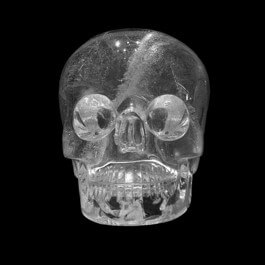
Cayce’s ideas about crystal energy have been linked to the crystal skulls, which are hoax artifacts that appeared in the 1920s by way of New Age spiritualists who claim that crystal skulls hold powerful energy that can help heal a variety of ailments and offer emotional clarity. Another popular theory, which was featured in a 2008 Sci-Fi channel documentary called The Mystery of the Crystal Skulls, was that there were 13 crystal skulls created in Atlantis that had since become spread around the world, and that bringing the 13 skulls back together would prevent the alleged 2012 apocalypse, similar to the storyline in the fourth Indiana Jones movie. When the skulls were not reunited and the world did not end in 2012, the theory was changed to claim that drawing the skulls together would ascend humanity to a new spiritual level of being.
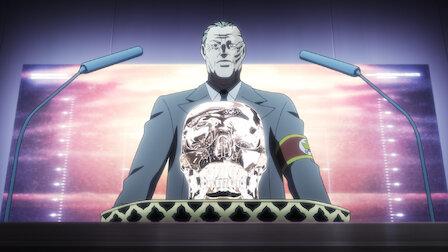
Similar ideas have been explored in Spriggan. In “The Crystal Skull” chapters and episodes, a Japanese archaeologist working in Egypt for ARCAM is murdered by German neo-Nazis looking to steal a crystal skull that holds tremendous power. Indeed, the crystal skull is said to be highly sought after for its ability to create nuclear fusion. The notion of pyramids holding huge amounts of power is also explored in “The Forgotten Kingdom” episode, where a ghostly island that appears and disappears at random is said to be powered by immense pyramids.
Politics and Conspiracies
Secrecy, as well as the idea of political and military involvement in hiding the “truth,” are both important concepts that Spriggan shares with general conspiracy theories and pseudoarchaeology. Spriggan’s main character Yu Ominae is a covert operative for ARCAM, an organization founded with the objective of sealing away relics. ARCAM’s good intentions as the “protector” of these dangerous ancient technologies can, however, be questioned. It is implied that ARCAM, while presenting itself as a normal archaeological research organization, covertly investigates relics (such as Noah’s Ark) and that high levels of secrecy and confidentiality surround its activities. Similarly, Ominae’s missions often involve saving the world without anyone knowing that it was once in danger.
Political and military forces are depicted in Spriggan as antagonistic groups, battling to acquire powerful artifacts with various goals in mind. Ominae regularly encounters and fights members of elite military groups and intelligence agencies from various countries (e.g., the SAS in “Berserker” or the CIA, KGB, and Spetsnaz in “Serpent of Flames,”) as well as private militia. A recurrent enemy is the fictional “Machiner’s Platoon,” an American military group whose bio-engineered cyborg members notably represent the main antagonists in the Noah’s Ark story arc. Like ARCAM, the Machiner’s Platoon and other military groups also work in the shadows, following orders to obtain powerful artifacts for their organizations. The UK military is notably depicted as intending to hide the truth behind the disastrous events of “Berserker” from the public.
Neo-Nazis are also present in the “The Crystal Skull” chapters and episode, seeking ancient powerful OOPArts to restore the Third Reich. Nazis were actually engaged in archaeological research during WWII. While they were not searching for artifacts specifically for their use as powerful supernatural weapons like in Spriggan’s crystal skulls storyline, one of the things Nazi archaeology teams were looking for was archaeological evidence of Atlantis, which they believed was part of their heritage. Many of the Nazi’s archaeological and pseudoarchaeological ideas, such as their beliefs around Atlantis, are still present in contemporary neo-Nazi ideologies today.
Conspiracism is one of the defining features of pseudoarchaeology.
The idea of a conspiracy in which governments or researchers work to hide the “truth,” especially when it comes to the past, or archaeology more specifically, is not limited to Spriggan. Conspiracism is one of the defining features of pseudoarchaeology, which separates pseudoarchaeology from general misunderstandings or misinterpretations of archaeology. For example, in 1970, the New York Times published an article about the SEARCH Foundation’s search for the archaeological wreckage of Noah’s Ark on Mount Ararat in Turkey, with support from the Seventh Day Adventist Church. This prompted members of US Congress to claim that the CIA was hiding satellite photos of the Ark and make official requests for those images to be declassified and shared with the public. Even though the CIA never had photos of Noah’s Ark, there are still many who claim that the government has been hiding the truth about the existence of the Ark. The lack of finding any conclusive archaeological evidence of the Ark by any of these expeditions is not viewed as the non-existence of the Ark but rather becomes adopted into continued arguments that the Ark’s existence is being hidden as part of a government conspiracy.
In Part Three of this three-part series, we’ll explore how Spriggan presents contemporary issues in pseudoarchaeology!
References cited (but not linked)
Brasseur de Bourbourg, Charles-Étienne. 1868 Quatre lettres sur le Mexique: Exposition absolue du système hiéroglyphique mexicain, La fin de l’âge de pierre, Époque glaciaire temporaire, Commencement de l’âge de bronze, Origines de la civilisation et des religions de l’Antiquité. Auguste Durant et Pedone, Paris (France).
Charroux, Robert. 1963 Histoire inconnue des hommes depuis cent mille ans. Robert Laffont, Paris (France).
Donnelly, Ignatius L. 1882 Atlantis: The Antediluvian World. Harpers & Brothers, New York (New York).
Fort, Charles. 1919 The Book of the Damned. Boni and Liveright, New York (New York).
Leslie, Desmond and George Adamski. 1953 Flying Saucers Have Landed. Werner Laurie, London (UK)
Lewis, James R. 2012 Excavating Tradition: Alternative Archaeologies as Legitimation Strategies. Numen 59(2012): 202-221.
Pauwels, Louis and Jacques Bergier. 1960 Le Matin des magiciens, introduction au réalisme fantastique. Gallimard, Paris (France)
Tsuitsui, William M. 2010 Japanese Popular Culture and Globalization. Key Issues in Asian Studies No.6, Lucien Ellington (series editor). Association for Asian Studies, Ann Arbor (Michigan).
von Daniken, Erich. 1968 Erinnerungen an die Zukunft: Ungelöste Rätsel der Vergangenheit. Econ-Verlag, Berlin (Germany).

