

A new novel by Ann Leckie is an event to anticipate and Translation State is just as gripping and beautifully written as we’ve come to expect from her. Go ahead and take the day off from work to read this one all at once. Then you can go back and reread it at your leisure.
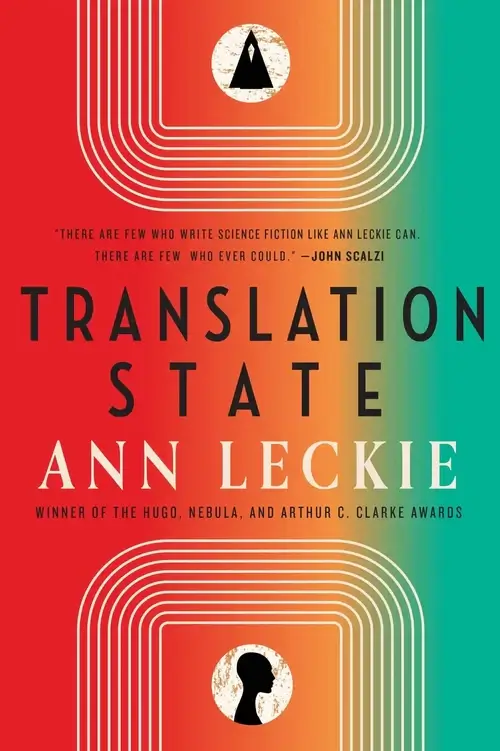
Translation State
Ann Leckie
Orbit
June 6, 2023
 Translation State takes place in the same universe as Leckie’s celebrated Imperial Radch Trilogy and the standalone novel Provenance, after the events in Provenance.
This new novel is the closest to horror writing that I’ve seen from Leckie, with detailed descriptions of squishy and viscous terrors happening to and in front of our protagonists. It’s a level of body horror that I certainly didn’t expect from Leckie and frankly, am only comfortable with now due to reading a lot of The Locked Tomb series since Leckie’s most recent book came out.
In Translation State, we are introduced to three point-of-view characters who get embroiled in interstellar and interspecies politics none of them ever chose. Enae is newly at a loose end after the matriarch of hir family dies, so sie agrees to be sent on a fool’s errand to track down a centuries-lost missing person. The understanding is that it’s a paid travel gig, with some light public relations work thrown in, but Enae is committed to actually making an effort.
Reet is someone in a very different part of space, working at a menial job and trying to find his roots. He’s always felt out of place and a cultural association believes he might be a descendant of their ruling class. He spends a lot of time watching the serial Pirate Exiles of the Death Moons and thinking about how he doesn’t fit in, which pleasantly (and I’m sure intentionally) reminds me of Murderbot.
Qven is the character whose point of view feels the most alien to us initially. They are a juvenile Presger translator being raised to fulfill their function as a liaison between the Presger, a terrifying and powerful alien race, and humans. We know the Presger translators aren’t human, exactly, but rather the Presger took some parts from humans long ago, and designed and built their translators in their own way, back when the Presger first decided they wanted to be able to communicate with humans. The juvenile translators are terrifying, and Qven’s desire to get the hell out of this situation is compelling.
I went into this book knowing a little about the Presger from how they are discussed in the Imperial Radch trilogy and Provenance, as a large and somewhat mysterious looming threat to humanity.
I was excited but nervous about the prospect of understanding more about the Presger in Translation State, since sometimes explanations can make something feel mundane, but that definitely doesn’t happen here. Partly it’s because it turns out the Presger translators are at a remove from the Presger themselves, so the Presger stay a somewhat shadowy threat, whose motivations and abilities are never explicated, but it’s also because the explanations about how the Presger translators work are horrific.
Leckie’s previous books in this universe have incorporated various terrifying sci-fi premises, such as the method by which human bodies in stasis are taken over by AIs to become ancillaries in the Imperial Radch trilogy. That process is shown to be analogous in many ways to the experiences of the Presger translators, but it wasn’t described in such visceral detail on the page before.
While the body horror is notable, it is not the only focus in Translation State. The combination of the three point-of-view characters serves to showcase Leckie’s brilliance in matters of scale, and themes she returns to in multiple books and stories. In text after text, she explores the question of how much of our identity is ours to shape, and how much of it is determined by how others see us.
For Leckie’s characters, individual concerns and personal motivations intersect with larger issues at stake. And in Translation State, there sure are giant universe-wide political tangles that hold implications for the future of sentient species overall.
These dovetail not only with interpersonal relationships in the lives of the main characters but also political entanglements on different local, national, and planetary levels. That is, there are multiple registers of importance and they all feel like high stakes to the reader because interpersonal concerns, local political concerns, nations, planetwide and species-wide concerns are all in play at once.
That’s great. It makes Leckie’s worlds feel deep and rich.
On each of these scales, the characters grapple with issues of home and heritage as moving signifiers, and the overarching question: can you choose where you belong? While this is a spoiler-free review, I do feel comfortable pointing out that Leckie’s endings tend to be hopeful ones.
I know all Leckie’s previous books well, having read them multiple times and discussed them with a range of people in a range of situations. Therefore, all Translation State’s little references to events from previous books in this world and cameos from characters I knew already were delightful and satisfying. That made me feel like I was the intended audience for Translation State as an existing fan.
However, recently someone who’d never read the Imperial Radch Trilogy told me they were excited about this book because they loved Provenance. It honestly hadn’t occurred to me that Leckie’s books might be successfully encountered out of publication order, but of course it makes sense and it will work that way for Translation State as well.
While readers who haven’t read all of Leckie’s other work in this world might miss a few references to characters who have already been introduced, Leckie’s world building is so sound, and Enae, Reet and Qven are all such immediately engaging characters, that Translation State could indeed be a remarkably successful introduction to this universe.
And then, you’ll have a lot to look forward to with the earlier books, too. Because if you love this one, you’ll love them all.
