
Where was Rana Fawaaz when the zodiac constellations disappeared from the sky? The mystery of the missing stars unfolds in Saladin Ahmed, Megan Levens, and Kelly Fitzpatrick’s Starsigns #1, from Image Comics.
Starsigns #1
Saladin Ahmed (writer), Heather Antos (editor), Kelly Fitzpatrick (colorist), Shawn Lee (letterer), and Megan Levens (artist)
Image Comics
May 3, 2023

But Fawaaz, a Lebanese-American Brooklynite, was in her kitchen, where thanks to light pollution she wouldn’t have seen the stars disappear anyway. But Starsigns doesn’t start with its protagonist at home, where she recounts her memory of the astronomical and astrological anomaly, instead opening on its apparent antagonists somewhere in the Northwest Territories of Canada. There, they watch the stars die, which readers see as a rainbow zodiac wheel fragmenting across space.
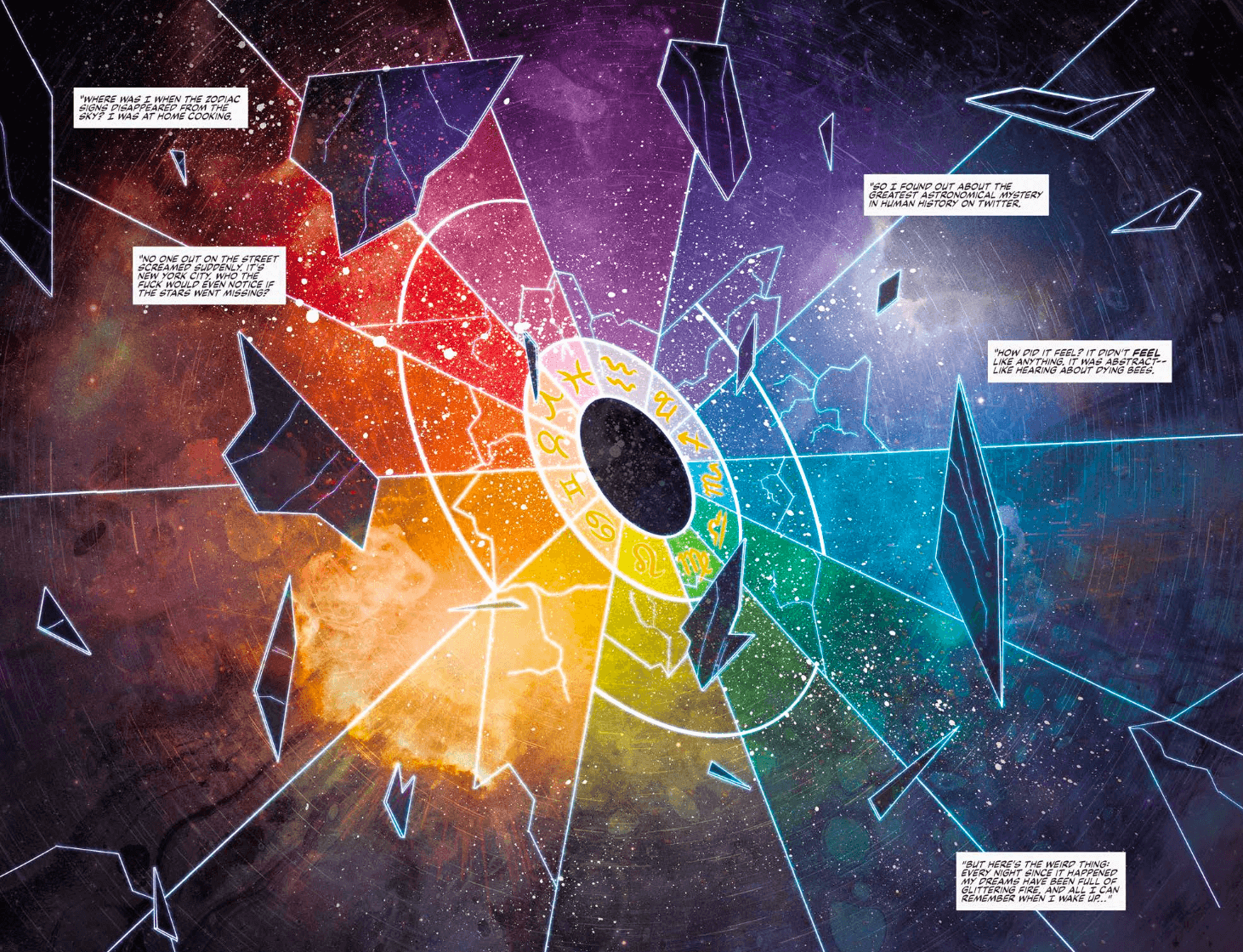
This two-page spread is the most striking visual in the issue. The jagged lines and broken pieces show movement. Unfortunately, the bulk of Starsigns #1 feels static. It doesn’t help that when – although not yet entirely clear how or why – the stars die, Rana develops the ability to stop time.
That superpower is obviously but not necessarily effectively conveyed as an orange aura emanating off of her in linework and enveloping her in a glow (Fitzpatrick matching the color to that of Rana’s sign, Taurus). At the art gallery where Rana’s power manifests for the first time during a catering gig, artist Levens overly relies on splashing liquid to indicate that single-appearance background characters (neither standing in place looking at paintings nor standing in place conversing in small groups being particularly athletic activities) are frozen. It’s difficult to see that time has stopped when everyone already looks so still.
There may have been a potential solution to that problem in page layouts, but paneling was underwhelming if not outright confusing despite its simplicity. When Rana speaks with her father on the phone, a ragged gutter runs between them. It does not appear to convey technological difficulty, which would be understandable for an international call, or interpersonal drama. She affectionately calls him Baba, and he calls her Baba back at the beginning and end of the call. And while I’m glad to see letterer Shawn Lee style Ahmed’s Arabic dialogue exactly the same as that in English, without italicized font or asterisks leading to editorial explanations, there’s no visualization in the text backing up the choice of the border design. Most other panels are square or rectangular, making these and those framed by smoke stand out more, for worse and for better, though mostly for worse.
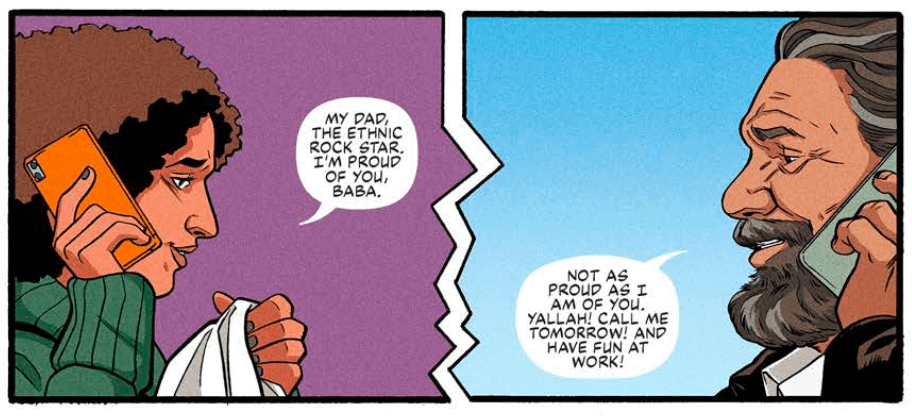
Although Starsigns #1’s panel design is a weakness, its character design is a strength. Rana’s curly hair says as much about her as her roommate’s ponytail or antagonist Tatiana’s undercut. Having Rana and her father repeatedly mirror one another makes their physical similarities especially hard to miss. Rana’s shredded, orange jeans feel authentic to her even when they don’t look appropriate when paired with her work jacket, and the yellow on Tatiana’s snow gear anticipates the yellow of her superpower and the Leo sign, which puts her not far from Rana on the wheel. Seems like a safe bet that the red Tatiana’s co-antagonist (and father figure) Mister Duke wears, which places him even closer to Taurus than her, will reappear when he does.
The comic’s closing question – not about where Rana Fawaaz is but, instead, about where she is going – is one that, despite its issues, makes me want to keep reading.
