

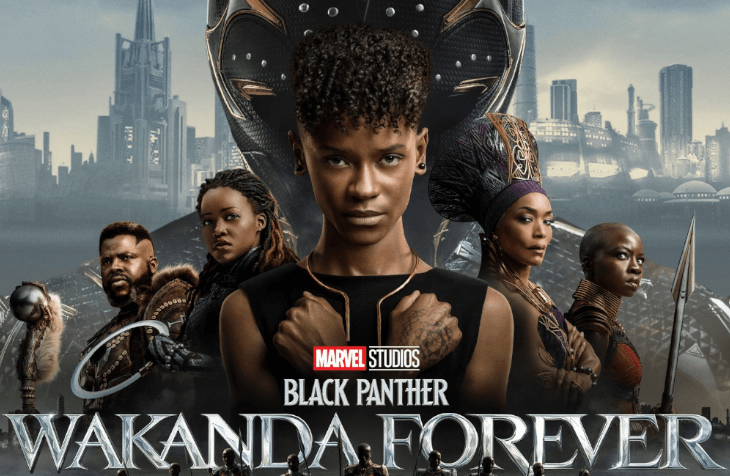
In Black Panther: Wakanda Forever, Wakanda is faced with a new threat from a heretofore unseen foe. Queen Ramonda (Angela Bassett) and Princess Shuri (Letitia Wright) must make tough decisions to protect their people, their nation, and the world.
[Ed’s note: Light spoilers; if you don’t want to know any plot details steer clear]
Black Panther: Wakanda Forever
Ryan Coogler (director and writer), Joe Robert Cole (writer)
Letitia Wright, Lupita Nyong’o, Danai Gurira, Winston Duke, Angela Bassett, Tenoch Huerta Mejía (cast)
November 11, 2022
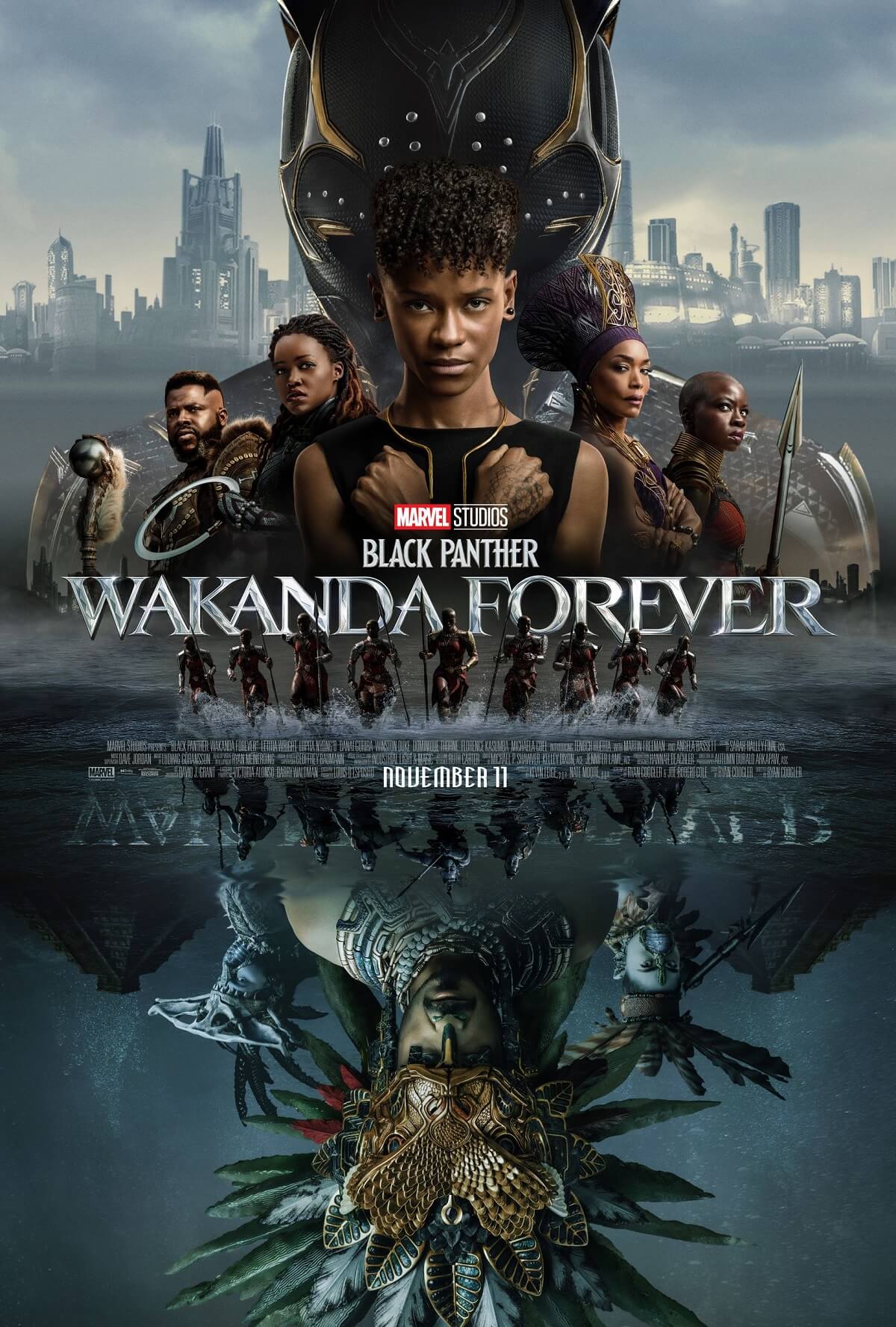
As the Marvel Studios logo played out in Black Panther: Wakanda Forever, I realised what the term ‘pin-drop silence’ really meant. The packed audience in my Toronto theatre had been a raucous bunch but when the montage of the late Chadwick Boseman as King T’Challa began, it stunned everyone into respectful quiet. The Black Panther sequel was always going to be an emotional affair—every Marvel Cinematic Universe property that has featured T’Challa since the sudden passing of Boseman has been emotional. And Black Panther: Wakanda Forever is the actor’s farewell and the completion of T’Challa’s arc. But nothing quite prepared me for the absolute gut-punch that was T’Challa’s funeral. What the film does right is that it lets the characters, and by extension, the audience, sit with their grief. We need this tribute.
But Black Panther: Wakanda Forever is about more than just the loss of Boseman and T’Challa. It’s also a complex film with several interweaving plots, commentary on racism and American military interference, while being an absolute visual feast. Every scene in Wakanda is a beautiful sight, from the architecture and the rituals to the costumes. Cinematographer Autumn Durald Arkapaw (Loki) joins the team of production designer Hannah Beachler (Lemonade), and costume designer Ruth Carter (Do the Right Thing) who helped create the lush world of Wakanda in the first Black Panther. Their work (plus the work of the many artisans and concept artists they collaborated with) shows how we need more Afrofuturism in Hollywood!
The contrast of the colourful sights of Wakanda against the stark blue of the underwater nation of Talokan is startling but I liked it. I was concerned about how Talokan (Atlantis in the Marvel Comics) would be rendered in the film, considering Aquaman and his Atlantis already exist in the DC Extended Universe. Fortunately, Talokan is completely different, aesthetically and functionally. There’s a lot of lore introduced in Black Panther: Wakanda Forever about Talokan that makes the nation even more interesting. (But you’ll just have to watch to find out.)
The story, again by Coogler and screenwriter Joe Robert Cole, is driven by the underlying theme of grief and how people react to it differently. T’Challa’s loved ones are mourning him, as is the nation of Wakanda. But the world doesn’t stop for people’s sorrow and it isn’t long before an attack on an American ship puts Wakanda in the crosshairs of hostile governments. Since the events of the first film and the blip, Wakanda’s vibranium, and their refusal to share it with the world, has been a constant source of resentment with trigger-happy nations. As we’ve seen earlier in the MCU, the Wakandans may be prepared to fight, but they’re not predisposed towards taking to arms. In Black Panther: Wakanda Forever, Wakanda’s strong principles puts the country in a desperate situation when it’s faced with an enemy just as powerful as them: Namor, played by Tenoch Huerta (Tigers are Not Afraid, Narcos: Mexico).
The sequence introducing Namor’s people, the Talokanil, is suspenseful, chilling, and just the kind of fanfare a fan-favourite character like Namor deserves. The audience feels as lost as the hapless people under attack, and that’s the point. Namor’s an enigma—is he friend or foe? He’s a charmer with an edge and you can’t quite take him at his word even though you really want to. After years of people fan-casting everyone and anyone as Namor, Huerta, a relative newcomer to Hollywood, is an excellent choice. He’s got screen presence down pat and manages to own even the campier parts of his character — the wings on his ankles, sometimes comical in the comics, give Huerta’s Namor a positively sinister edge. Even his costume, comics-accurate green shorts and a heavy Mesoamerican-inspired neckpiece, give Namor an air of elegance and power. I was excited that a person of colour, especially an Indigenous Mexican, had been cast as Namor and I love how Black Panther: Wakanda Forever based much of Namor’s history on Mayan culture and Huerta’s Aztec heritage. From the Talokan aesthetic to the history of Namor’s people, to the very name of their underwater nation, Talokan, it’s all based on Aztec and Mayan myths. I love that real world connection, similar to the way real African culture was woven into Wakanda’s world-building.
I could honestly talk about Namor forever but Black Panther: Wakanda Forever is chockful of incredible characters, old and new. Following T’Challa’s passing, Queen Ramonda becomes the ruler of Wakanda and gets to be a leader, much as we saw her in What If… Killmonger Rescued Tony Stark? Shuri, a genius teen in earlier films, is now given the responsibility of being her mother’s sole-surviving family along with heir to the Wakandan throne. However, it’s a burden she doesn’t take to at all, burying herself in her science and eschewing her royal duties.
Mother and daughter spend much of Black Panther: Wakanda Forever at loggerheads, Ramonda asking Shuri to grieve with her, and Shuri refusing to acknowledge her feelings and Wakanda’s traditions. But as Queen and Princess, Ramonda and Shuri are on the same page—protect Wakanda, continue diplomacy, and keep the fighting at bay as long as they can. This dichotomy between the pair makes for an interesting dynamic and the ridiculously easy chemistry between veteran Bassett and Wright brings it to life.
Wright comes into Black Panther: Wakanda Forever under a ton of pressure and with massive shoes to fill. She takes to the responsibility with aplomb, completely owning the screen and imbuing Shuri with a lot of personality and characterization. Wright hits the perfect balance between Shuri’s inability to cope with loss, her unquenchable sense of humour, and her growing need for vengeance. Wright is a powerful young actor and if there was any doubt that she can carry the sequel to a billion-dollar film, this film will dispel them.
The introduction of Riri Williams (Dominique Thorne) acts as a catalyst for bringing Ramonda and Shuri together while also adding another plot to Black Panther: Wakanda Forever. A genius on Shuri’s level, Riri is also immediately willing to protect Wakanda, a country she’s only ever heard of, earning her Ramonda’s trust. As a young newbie to the franchise, Thorne manages to stay toe to toe with the stalwarts. Her humour, her natural performance, and especially, her enthusiasm, are a delight and she’s a great addition to the MCU. I’m relieved that Riri was introduced in Black Panther: Wakanda Forever and not in another film (looking at you, Doctor Strange 2 and the mess you made of America Chavez). She fits perfectly as a scientist and an action hero. I know in the comics Riri/ Ironheart is Iron Man’s protégé, but she feels more naturally like Shuri’s hero-partner. And I’m fine with that. Tony Stark is gone and it’s past time that his influence fades in the MCU.
The Dora Milaje have been in fighting form since their first few moments in the MCU and they are absolutely stunning in Black Panther: Wakanda Forever. The fight scenes allow the all-women fighting team to show off their skills and if you thought the first film couldn’t be topped, the Dora Milaje are a sight to behold in the sequel.
Danai Gurira returns as leader of the Dora Milaje, Okoye, and she gets to stretch her acting skills this time. There’s one particular scene partway through the film between Okoye and Ramonda that shocked me and the audience in the theatre. It’s an unexpected moment between protagonists that demonstrates how layered these characters are. Yes, we want the Wakandans to be heroes, but they also get to be people. As we saw in Black Panther when T’Challa learned the truth about his father and his uncle, people make mistakes when they don’t give themselves time to think. Black Panther: Wakanda Forever lets its characters be emotional and act out even against their best interests. They make the wrong decisions for the right reasons and suffer the consequences. The characters get to be human and I’d say this film has the most believable people we’ve seen in the MCU, spears and vibranium suits aside.
Okoye’s fellow returning Dora Milaje Ayo (Florence Kasumba) has a curtailed role and there’s precious little of Michaela Coel’s Aneka. Since they’re the only queer pairing in Black Panther, I would have loved to see more of them together. But alas, in typical MCU fashion, they get a single moment.
Lupita Nyong’o’s Nakia hasn’t been seen in the MCU since the first film and I for one, was thrilled to see her again. Nakia is a consummate spy and a warrior and Nyong’o gets to show off both skills in Black Panther: Wakanda Forever, while being an emotional support for Ramonda and Shuri. As you can see there are a ton of amazing Black female characters in this film and as a result, we get to see tons of female friendships. More of this please!
Within Wakanda, Winston Duke’s M’Baku is really the only man with a major role. He’s once again an absolute delight to watch. M’Baku is funny but also shares some hard truths that the Wakandan council and even Queen Ramonda don’t want to hear. But unlike in Black Panther where M’Baku was fairly selfish, here, he has the best interests of the country at heart.
One of the things I’ve noticed about MCU films is that the film score can be hit or miss. The first film had a score and soundtrack that I still listen to and I can safely say the music of Black Panther: Wakanda Forever follows suit. I’m impressed that, aside from a few returning musical themes, there are a lot of new compositions by Ludwig Göransson. I can’t wait to fire up this album.
Black Panther: Wakanda Forever offers fans of Chadwick Boseman catharsis in a way that is completely unique to the MCU. But Coogler and his cast also honour Boseman’s legacy by making a film that can stand without T’Challa, giving audiences an incredibly rich world and multi-layered characters. Sequels are hard and not many live up to expectations. Black Panther: Wakanda Forever exceeded mine in terms of storytelling, characterizations and sheer moments of awe. Wakanda Forever, indeed!
