

Women Write About Comics celebrates the 150th anniversary of J. Sheridan Le Fanu’s Carmilla with a series of posts on female vampires in nineteenth-century literature.
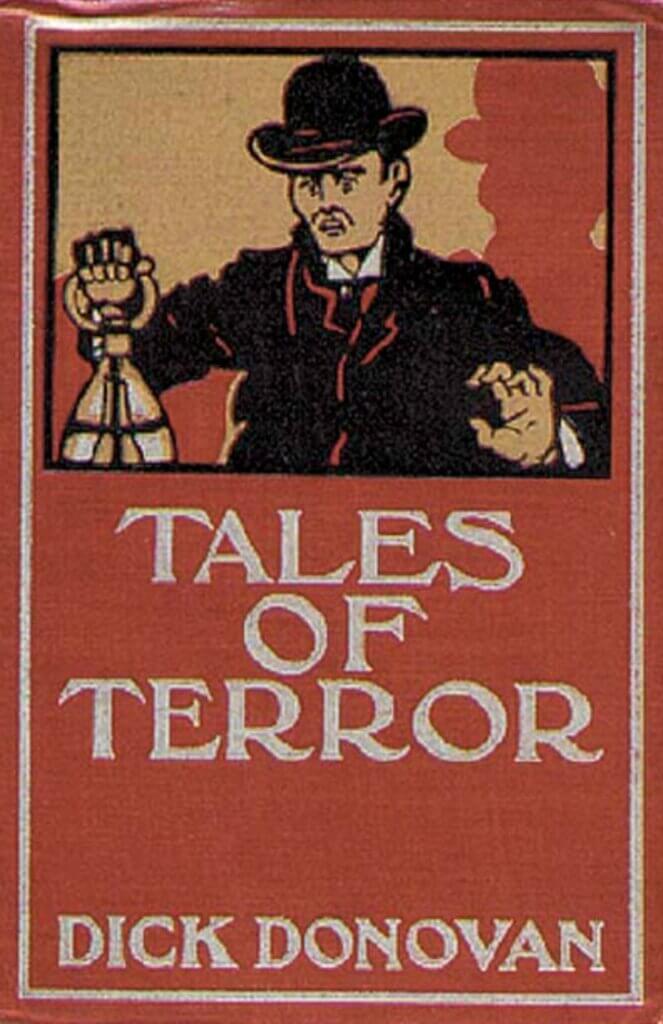
“The Woman with the ‘Oily Eyes’” is not, perhaps, the most alluring title for a vampire tale. This might go some way as to explain why the story in question has, since its first appearance in Dick Donovan’s 1899 collection Terror Tales, been seldom reprinted in vampire anthologies. It saw a brief revival in 2011, when it was included in three such books (Vintage Vampire Stories, Vampires: Classic Tales and In the Shadow of Dracula) and then sank swiftly back into obscurity.
This is unfortunate, as author Dick Donovan – a pen name of J. E. Preston Muddock, who was best known in life for his detective fiction – made an unusual and memorable contribution to the ranks of Victorian vampires.
“The Woman with the ‘Oily Eyes’” is set in the 1850s and, after some long scene-setting, begins in earnest with newlyweds Jack and Maude Redcar meeting a mysterious woman while honeymooning in Germany. Both are struck by the woman’s face: Maude describes it as “a strong, hard-featured, almost masculine face, every line of which indicated a nature that was base, cruel, and treacherous.” Most unsettling of all are her eyes. “Why, they make one think of the fairy-books and the mythical beings who flit through their pages.” Maude concurs:
‘[I]t was the eyes that were the wonderful feature—they absolutely seemed to exercise some magic influence; they were oily eyes that gleamed and glistened, and they seemed to have in them that sinister light which is peculiar to the cobra, and other poisonous snakes.’
The two head to another city, where they catch sight of the same woman; Jack brushes this off as a coincidence, but Maude suspects that she has followed them. Later, Maude goes looking for her husband and finds him sitting with the mysterious woman, whose name turns out to be Annette. Does the stranger have designs on Jack?
The two return home to England and Mary has a baby. To her horror, the family home receives an unexpected visit from Annette, who briefly plays with the infant. After Annette leaves, the child falls ill and dies:
‘As soon as she had departed I rushed upstairs, for baby was screaming violently. I found him in the nurse’s arms, and she was doing her utmost to comfort him. But he refused to be comforted, and I took him and put him to my breast, but he still fought, and struggled, and screamed, and his baby eyes seemed to me to be bulging with horror. From that moment the darling little creature began to sicken. He gradually pined and wasted, and in a few weeks was lying like a beautiful waxen doll in a bed of flowers. He was stiff, and cold, and dead.
‘When Jack came home in the evening of the day of Annette’s call, and I told him she had been, he did not seem in the least surprised, but merely remarked:
‘”I hope you were hospitable to her.”’
Next, Jack’s temperament changes; he becomes sullen and morose, and when Maude objects to him inviting Annette over to stay for a period, he becomes violent. Annette soon comes to control the entire household, dominating Jack and – through him – Maude, and forcing the servants to leave. Maude’s only recourse is Dr. Peter Haslar, a close friend of her husband.
All of this is framed as a narrative told by Maude Redcar to Haslar, who takes over as the main character. He is initially unconvinced with the supernatural abilities attributed to Annette by Maude, who speaks of her as a diabolical creature with basilisk eyes and “some devilish power which enables her to destroy men body and soul” – a person who is no less than “a human ghoul, a vampire, who lives not only by sucking the blood of men, but by destroying their souls.” Instead, Haslar interprets the matter as simply a case of Jack Redcar being wood away by an “adventuress.”
Nonetheless, he takes it upon himself to rectify matters and traces Jack and Annette to a hotel in Spain. There, he finds that Jack corroborates Maude’s story. “Hush!” says the tormented husband. “Annette mustn’t know this – mustn’t hear. I tell you, Peter, she is a ghoul. She sucks my blood. She has woven a mighty spell about me, and I am powerless.” Then, Haslar comes face to face with Annette herself:
Annette was slightly above the medium height, with a well-developed figure, but a face that to me was absolutely repellent. There was not a single line of beauty nor a trace of womanliness in it. It was hard, coarse, cruel, with thin lips drawn tightly over even white teeth. And the eyes were the most wonderful eyes I have ever seen in a human being. Maude was right when she spoke of them as ‘oily eyes.’ They literally shone with a strange, greasy lustre, and were capable of such a marvellous expression that I felt myself falling under their peculiar fascination.
What follows is a battle of wills between Haslar and Annette against a backdrop leading from a Spanish village to a climactic chase in the mountains. Here, the good doctor discovers that Jack Redcar’s description of Annette as a bloodsucker was more than metaphorical:
Beneath a huge boulder which had fallen from the mountain above, and lodged on the slope, were Annette and Redcar. He was lying on his back, she was stretched out beside him, and her face was buried in his neck. Even from where I stood I could see that he was ghastly pale, his features drawn and pinched, his eyes closed. Incredible as it may seem, horrible as it sounds, it is nevertheless true that that hellish woman was sucking away his life blood. She was a human vampire, and my worst fears were confirmed.
Haslar fires a gun to startle Annette, who shows her face – blood oozing from her mouth, eyes violet-hued. She tries to escape with her victim, only to fall from a precipice. A later search party finds Jack’s crushed corpse, but of Annette there is no sign; the authorities conclude that her body has been left to rot in some obscure crevice.
Throughout the story, Annette is surrounded by an aura of the supernatural. There is, however, no indication that Annette is a risen corpse. Haslar’s description of her as a “human vampire” draws an implied distinction between her and the inhuman, undead vampire of folklore. Much of her nefarious activity is framed in quasi-scientific terms: her attacks on Haslar consist not of black magic but of poisonous drugs and “a sort of mesmeric influence”.
So, Annette belongs less to the realm of true vampires (as embodied by Count Dracula, who debuted two years before her) and instead prefigures the sorts of archvillains that would come into vogue in the following century: those fiendish criminal master-minds dreamt up by the likes of Sax Rohmer and Ian Fleming; characters who seem something more than human even if they are ultimately as much flesh and blood as the heroes who pursue them. Haslar identifies this simultaneously superhuman and subhuman aspect:
In the ordinary way she might be described as a woman of perverted moral character, or as a physiological freak, but that would have been rather a misleading way of putting it. She was, in short, a human monstrosity. By that I do not mean to say her body was contorted, twisted, or deformed. But into her human composition had entered a strain of the fiend; and I might go even further than this and say she was more animal than human. Though in whatever way she may be described, it is certain she was an anomaly—a human riddle.
And like all supervillains worth their salt, Annette has a strong line in gloating:
‘His wife,’ she said with a sneer of supreme contempt. ‘A poor fool, a fleshly doll. At the precise instant I set my eyes upon her for the first time I felt that I should like to destroy her, because she is a type of woman who make the world common-place and reduce all men to a common level. She hated me from the first and I hated her. She would have crushed me if she could, but she was too insignificant a worm to do that, and I crushed her.’
But why, if Annette is not a true vampire, does she drink blood? This is never explained, although we can perhaps infer that she is a necrophile. Haslar identifies her as “one of those human problems which, happily for the world, are very rare, but of which there are several well-authenticated cases” – a description that reads like a coyly euphemistic reference to such individuals as Sergeant François Bertrand, a man convicted of violating corpses in 1841. Bertrand’s crimes had been discussed in various texts, from Krafft-Ebing’s Psychopathia Sexualis (1886) to Baring-Gould’s Book of Were-Wolves (1865), and would have provided ample fodder for a Victorian detective writer hoping to create a ghoulish new villain.
“The Woman With the ‘Oily Eyes’” appears in Terror Tales alongside a sequel, “The Story of Annette” – although, despite being presented as a distinct story, this comparatively short piece is really more of an extended epilogue. Framed as the findings of an inquest into the circumstances surrounding Jack Redcar’s death, the story delves into Annette’s personal history, revealing that she was born in the Sierra Nevada under the name Isabella Ribera. Her eyelids, we learn, were sealed for the first year of her life – until they finally opened, startling the superstitious locals:
When the girl was in her thirteenth month she one day suddenly opened her eyes, and those who saw them were frightened. Some people said that they were seal’s eyes, others that they were the eyes of a snake, and others, again, that ‘the devil looked through them.’ The superstitious people in the village urged the parents to consult the priest, and this was done, with the result that the infant was subjected to a religious ceremony, with a view to exorcising the demon which was supposed to have taken possession of her.
After a certain incident involving a slaughtered pig at the age of four (“she thre herself on mthe dying animal and began to drink the blood that flowed from the cut throat”) and continuing hostility from the surrounding villagers (“They were seriously advised to have the girl strangled, and her body burnt to ashes with wood that had been blessed and consecrated”) Isabella/Annatte’s family was forced to relocate and place their daughter into the care of a convent.
We then learn of the anti-heroine’s adult life: her time travelling through Europe, America, Jamaica and India and briefly becoming “queen of the gipsies” (in a touch of racial prejudice, the story hints that this is where she picked up her aptitude for poisons). The account follows her as she adopts a string of pseudonyms – Madame Docoudert, Marie Tailleux, Anna Clarkson, Mademoiselle Sassetti, Isabella Rodino – and leaves a trail of dead husbands behind her, gaining considerable inheritance in the process. Her supernatural aura builds throughout, as we read of her finding work as a fortune-teller, being compared to the sirens of legend by a Times reporter, and likened to Circe by the story’s narrator. The tale concludes with a note of mystery:
‘Annette,’ as we will now call her, was a human riddle, and she illustrates for the millionth time the trite adage that ‘Truth is stranger than Fiction,’ besides which she presents the world with an object lesson in the study of the occult.
As a final note, Duck Donovan – like many other authors of vampire fiction going back to Robert Southey – accompanies his fiction with a spot of information about the vampires of folklore. Between “The Woman with the ‘Oily Eyes’” and “The Story of Annette” we find this paragraph:
The foregoing story was suggested by a tradition current in the Pyrenees, where a belief in ghouls and vampires is still common. The same belief is no less common throughout Styria, in some parts of Turkey, in Russia, and in India. Sir Richard Burton deals with the subject in his ‘Vikram and the Vampire.’ Years ago, when the author was in India, a poor woman was beaten to death one night in the village by a number of young men armed with cudgels. Their excuse for the crime was that the woman was a vampire, and had sucked the blood of many of their companions, whom she had first lured to her by depriving them of their will power by mesmeric influence.
The volume cited here, Vikram and the Vampire, is Richard Burton’s abridged rendition of a Sanskrit text entitled Baital Pachisi. This narrative details an extended encounter between the folk-hero King Vikramāditya and a Baital, a supernatural creature that inhabits dead bodies, with the latter telling a series of stories in the manner of Scheherazade (or, for a more modern comparison, the Cryptkeeper). Burton opted to refer to the Baital as a “vampire” throughout his version of the text, although there is no indication that the revenant drinks blood. Here is Burton’s account of the creature after it came to inhabit, and transform, the body of an unfortunate oilman:
Its eyes, which were wide open, were of a greenish-brown, and never twinkled; its hair also was brown, and brown was its face–three several shades which, notwithstanding, approached one another in an unpleasant way, as in an over-dried cocoa-nut. Its body was thin and ribbed like a skeleton or a bamboo framework, and as it held on to a bough, like a flying fox, by the toe-tips, its drawn muscles stood out as if they were ropes of coin. Blood it appeared to have none, or there would have been a decided determination of that curious juice to the head; and as the Raja handled its skin it felt icy cold and clammy as might a snake. The only sign of life was the whisking of a ragged little tail much resembling a goat’s.
Judging from these signs the brave king at once determined the creature to be a Baital–a Vampire. For a short time he was puzzled to reconcile the appearance with the words of the giant, who informed him that the anchorite had hung the oilman’s son to a tree. But soon he explained to himself the difficulty, remembering the exceeding cunning of jogis and other reverend men, and determining that his enemy, the better to deceive him, had doubtless altered the shape and form of the young oilman’s body.
But although Donovan chose this as a reference point rather than any of the more familiar European vampire narratives, “The Woman with the ‘Oily Eyes’” gives no indication that it is in any way influenced by vampire-like beings of Indian folklore. It could be said that as vampires go, Annette and the Baital are direct opposites: the former drinks blood but is not a risen corpse, and the latter is the reverse. Nonetheless, the story is proof that the vampire genre was starting to take influence from a wider body of legend – even if that influence was not always evident.
Next week: a virgin vampire from Hungary.
